Celebrating Drawing by Jeannine Cook

I always love it when out of the blue, one learns of the celebration of the art of drawing.

Just a small entry in today's Spanish papers, but a good piece of news for all of us who think that drawing is just as important as painting. Miquel Barcelo, the highly successful artist from Mallorca, has just been awarded the Penages Award for Drawing from the Mapfre Foundation in Spain. In his acceptance speech, he talked of the fact that he finds that, " Es gracioso pensar que la pintura ha muerto y el dibujo no" -explicó en referencia a aquellos que dan por muerto este arte-. Como si muere Dios pero la Virgen María siguiese viva" ( a quote from the Diario de Mallorca, that it is somewhat ironic to think that painting has died whilst drawing survives, as if God had died but the Virgin Mary remains alive). He received the award in Madrid, with Princess Elena present at the ceremony.

Barcelo's drawings and etchings are indeed a delight with their fluid ease and grace.

Marche de Shange, la Jupe Verte (the Green Skirt),  mixed media, 2000, Miguel Barceló (image courtesy of the website of Paola Curti/Annamaria Gambuzzi & Co)

Marche de Shange, la Jupe Verte (the Green Skirt),  mixed media, 2000, Miguel Barceló (image courtesy of the website of Paola Curti/Annamaria Gambuzzi & Co)

Barceló has spent a lot of tiime in Africa, especially in Mali, and his images capture the essence of Africa.

This 1999 etching is from his series of works from the Balearic island of Lanzarote, entitled Lanzarote XXV, courtesy of ArtNet.

This 1999 etching is from his series of works from the Balearic island of Lanzarote, entitled Lanzarote XXV, courtesy of ArtNet.

This is another of the Lanzarote series, a wonderful depiction of dogs.

This is another of the Lanzarote series, a wonderful depiction of dogs.

I delight when an artist celebrates drawing as does Miquel Barceló. He inspires us all to keep drawing.

Art in the Supermarkets by Jeannine Cook

I read of a wonderful, imaginative initiative for handicapped people to create art for supermarkets in Valencia and Palma de Mallorca, Spain. I think it is an example that bears copying, no matter where.

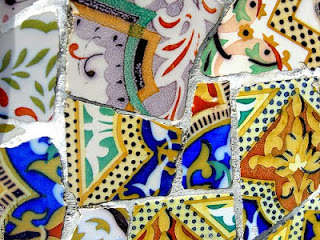
This was a report written by L.R. in the Diario de Mallorca on 19th February about about 200 people with learning disabilities who are creating a special Catalan form of mosaics (trencadis) for murals for the different branches of the supermarket chain, Mercadona. The idea was first put forward in Valencia by someone involved with polishing ceramic tiles: there are inevitably broken tiles and these have traditionally formed the basis of trencadis. The most famous exponent of the use of the irregular tile bits, set in mortar, was Antoni Gaudi. He began to use the brightly coloured, broken pieces of tile in his adornment of architectural elements in Barcelona's hillside garden, Parc Guell at the beginning of the 20th century.

Part of entrance to Parc Guell, Barcelona

Part of entrance to Parc Guell, Barcelona

This is part of a dragon at the entrance to the Parc, done in these broken ceramic pieces. Beyond, all over the Parc, there are wonderful combinations of brilliantly coloured tiles juxta-posed in joyous - often sinuous - configurations. One of the advantages of this trencadis form of ceramics is that the surfaces can indeed curve, something much more difficult with regular whole ceramic tiles.

Below, these are two other images of Gaudi's use of trencadis in Parc Guell, Barcelona.

2041363948_3b67321328.jpg
trencadis parc guell 2.JPG
GuellTrenca2.jpg

Various non-profit organisations involved with caring for people with Down's Syndrome or other learning disabilities got involved in the Mercadona supermarket murals venture. The first mural was done for the fish section in one of Mercadona's supermarkets in Valencia. It was so well received that the meat sections were soon chosen as the next destinations for murals. From there, the idea has snowballed and many more people are involved in the creation of these murals.

Understandably, when they first learn they will be creating a mural some 5 meters long, the participants are somewhat daunted. But they are first taught to sort the ceramic shards by colour. Then comes the assembly of parts according to a design, and as the pieces are placed together on a flat surface, a mesh is then placed over them to secure them. Eventually everything is united in the overall design and mortared into place. In the execution of these murals, there have been many benefits for the participants. They are gainfully employed and taught a new skill, which involves concentration, coordination and application. At the end of the venture, the participants are able to see tangible results which give people pleasure and interest, and they have achieved something they thought initially that they could not do.

To me, it seems the most wonderful alliance of art and skills to enhance the buying experience for everyone in a supermarket, while uplifting and reaffirming the spirit of those who don't always have such opportunities. Good for Mercadona and all those involved in the trencadis murals!

Beauty and Nature by Jeannine Cook

I constantly measure my personal luck to have grown up surrounded by dramatically wild and beautiful scenes in East Africa, far away from any city. Later life has led me back to wonderful coastal spaces in Georgia and many beautiful natural areas remaining on Mallorca. So I tend to respond very quickly and with delight to beauty in nature wherever I find it.

I found a wonderful passage in Roger Scruton's book, Beauty, about beauty and nature. With his permission, I am going to quote it, as it bears reading virtually in toto. (I also heartily recommend this book, as it is full of thoughtful observations on beauty and the world around us.)

I quote: "From earliest drawings in the Lascaux caves to the landscapes of Cezanne, the poems of Guido Gezelle and the music of Messiaen, art has searched for meaning in the natural world. The experience of natural beauty is not a sense of 'how nice' or 'how pleasant'. It contains a reassurance that this world is a right and fitting place to be - a home in which our human powers and prospects find confirmation in many ways, such as on some wild moor, sky-filled with scudding clouds, shadows racing across the heather and you hear the curlew's liquid cry from hill top to hill top, the thrill that you feel is an endorsement of the things you observe and of you, the observer. When you pause to study the perfect form of a wild flower or the blended feathers of a bird, you experience an enhanced sense of belonging. A world that makes room for such things makes room for you."

These thoughts resonate with me and confirm my sense of beauty that helps inform my art-making. What happens when an artist only lives in a world of urban concrete?

Art as diary by Jeannine Cook

Picasso - amongst all the other interesting things he said - remarked that, "Painting is just another way of keeping a diary." He was so right.

I have kept many drawing books, usually small so that they can be slipped into a bag as I travel, and I was going through some of them recently. As I leafed through the pages, memories came flooding back. No matter how quickly I did a drawing or painting, it still has the power to evoke. The place, of course, but the sounds, the scents, the other events surrounding my doing the art - all are connected to the art-making. I am not sure that had I only kept a written diary, I would have such vivid memories of all those trips I have made. Yes, I do keep a written journal, but I tend to record other types of things, such as names, people, events.

I think that art-making is always a record of where the artist is in terms of life and experience. Viewers may not always understand the art from the "diary" point of view, but the artist can always remember. Historically, there have been some wonderful diaries left by artists.

Two very famous ones are from Renaissance times. Albrecht Durer's 1521 diary of his trip to the Netherlands was a series of astonishing silverpoint drawings of places, people, sights that he experienced. He had kept other diaries before this one, but executing the drawings in unforgiving silverpoint is stellar work. Paper was still a precious commodity so Dürer used the pages on both sides and crammed things into them.

Albrecht Dürer ,animals drawn in the Coudenberg Place zoological gardens, 1521

Albrecht Dürer ,animals drawn in the Coudenberg Place zoological gardens, 1521

The image reproduced was apparently done when Dürer visited Brussels and went to the Coudenberg Place zoological gardens. He also drew lions there and was generally fascinated by the animals. He went to this zoo in 1520 on his way to the Netherlands, and then did these drawings when he returned in 1521, on his way home.

Leonardo da Vinci, diary, Image courtesy of the Victoria and Albert Museum, London

Leonardo da Vinci, diary, Image courtesy of the Victoria and Albert Museum, London

Another very famous diary-keeper was Leonardo da Vinci. He kept notebooks in which he drew out ideas, made notes and calculations, basically evolving as an artist. This image is courtesy of the Victoria and Albert Museum, one of Leonardo's small, intense diaries, full of genius calculations, thoughts and observations.

Codice Atlantico, 1478-1518,Leonardo da Vinci, Image courtesy of the Ambrosiano Library, Milan

Codice Atlantico, 1478-1518,Leonardo da Vinci, Image courtesy of the Ambrosiano Library, Milan

This is a page from the Codice Atlantico, a wonderful collection of pages of Leonardo's thoughts and observations, with 1750 drawings on 1119 pages, dating from 1478 to 1518. The Codice belongs to the Ambrosiana Library in Milan and constitutes one of the most amazing diaries an artist has ever kept.

Another artist, much nearer our times, who famously kept a diary was Frida Kahlo. In effect, most of the art she produced was about herself, a form of journaling. Nonetheless she formally kept a dairy too about her Mexican world.

FridaKahlo-Diary-Pages-04.jpg
frida 003 (2).jpg

These are pages from her journals. They are eloquent testimony to her spirit and creativity.

Today's artists don't just confiine themselves to diary-keeping on paper - video and photography are other means to record life. Nonetheless, a small spiral or moleskin journal slips easily into a pocket and goes everywhere with you as you navigate life as an artist. Try following Picasso's advice!

Connections to the Earth through Art by Jeannine Cook

Sometimes life brings those wonderful connections and coincidences together to make a point in the art world, at least for me.

Last Tuesday, 7th February, the papers were full of news of the death of the great Spanish painter, Antoni Tapies, at the age of 88. I had always associated his work with the highly imaginative and almost mystical use of all kinds of materials, from clay, marble, sand and earth to cloth, always with an evocation of man's passage through life, with its pain and experiences that were grounded in his Spanish world. I remember being riveted by his use of ochers and other clays in a passionate series of canvases that were exhibited in Mallorca a long time ago.

As was reported in an article in The Nation, in 2004, Tapies spoke about his interest in "deeper, more serious colours" partly because he wanted to "feel close to the earth." "I have always wanted to get closer to the formations of the universe. Deep down, we are made of earth – and we go back to her."

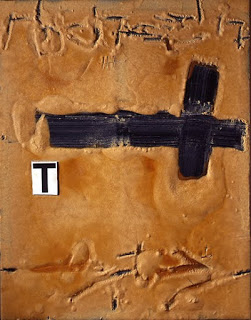
Black I,  mixed media, 2007, Image courtesy of Waddington Galleries, London

Black I, mixed media, 2007, Image courtesy of Waddington Galleries, London

Tapies at his most tactile and Zen-like.

Then comes the coincidence that I loved: in a February 8th, Wednesday, Diario de Mallorca newspaper, there is a small item of news that forms a wonderful linking circle for me.

The famous Nerja Caves, in Andalucia, Spain, has a wealth of Paleolithic rock paintings dating for the most part between 16,000 and 20,000 years ago.

Rupestrian Art, Nerja Caves, Andalucia

Rupestrian Art, Nerja Caves, Andalucia

However, it has just been ascertained that six of the rock paintings possibly date from 42,000 years ago, thus placing them amongst the first works of art created by man. Even more interesting is the hypothesis that Neanderthals created these rock paintings, not Homo sapiens. Quite a thought!

So a 20th century Spanish artist working for the most part in Cataluna, just up the east coast of Spain from the Nerja Caves, is hailed for his use of clay and other earths, and his deeply-held beliefs about humankind's mystical bonds with the earth. A few hundred miles and possibly about 42,000 years after early versions of mankind were virtually creating the same kind of mystical marking with the same clay materials. It certainly gives one a sense of perspective about what it is to be an artist.

The Mona Lisa Echo by Jeannine Cook

Leading the news on this morning's Radio Nacional de España bulletin was an item much more uplifting than the usual recitals of violence, disaster and unemployment. Madrid's Prado Museum has announced that it has on its walls a Mona Lisa - La Gioconda in Spanish - painted at the same time, between 1503-06, as Leonardo da Vinci was painting the original Mona Lisa, the iconic portrait of Lisa Gherardini, wife of a Florentine cloth merchant.

This announcement is, understandably, of huge interest to the Spanish, at a time when everything seems to be going wrong for them. The story has fascination for everyone who has fallen under the spell of Mona Lisa's enigmatic smile as she gazes from the walls of the Louvre, now sadly rather hidden behind layers of bullet-proof protection. There have been a number of copies of this famous painting which are distributed around the world. However, the discovery of the Prado "twin" is full of interesting insights, although the experts are trying to play down the public excitement.

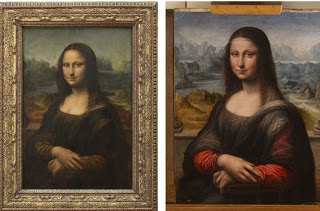
La Gioconda at the Prado, (courtesy of the Prado Museum)

La Gioconda at the Prado, (courtesy of the Prado Museum)

This twin portrait, of very similar dimensions to the Louvre version, has actually belonged to the Prado Museum for a long time; it was first recorded in 1666 as part of the Royal Collection. However, as has now been discovered, it was then considered an interesting but unexciting portrait, mainly because the figure was set in a black background as can be seen in the image above prior to restoration.. It was also thought to have been painted on an oak panel, which implied that an artist working in the Low Country (today's Holland and Belgium) painted it. Florentine artists used poplar or walnut panels for their paintings.

However, the spur for further investigation was an upcoming exhibition about Sainte Anne, Leonardo's last great painting,opening in March at the Louvre. The Prado experts first found that the wooden panel was indeed walnut, which meant that it was painted in Florence. Then infrared reflectography revealed that there was a landscape painted behind the lady, which echoed the landscape behind the Louvre's Mona Lisa. The removal of the black background confirmed a luminous Tuscan landscape, with the river Adda, a favourite of Leonardo. Crisper and with no sfumato, the scene helps confirm details on Leonardo's version. Apparently, the black ground was added about two centuries after the painting was executed, probably following current fashion.

a6703a3940c7958508bf07de1547.jpg
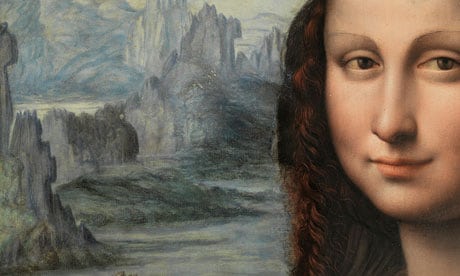
A detail of the nearly conserved Leonardo da Vinci pupil's take of the Mona Lisa. The Prado has yet to finish conservation work on the whole painting. Photograph: Museo Nacional del Pradio

A detail of the nearly conserved Leonardo da Vinci pupil's take of the Mona Lisa. The Prado has yet to finish conservation work on the whole painting. Photograph: Museo Nacional del Pradio

Not only is the background a luminous echo of the original, but the lady herself has a few interesting details which supplement those of the Louvre's Mona Lisa. Eyebrows, a frilly dress neckline, a sheer veil draped across her left shoulder and elbow, and even clearer details of the spindles of the chair in which the lady is seated - these are seen as clarifying details. All this information has led to the conclusion that this version of the Mona Lisa was painted at the same time that Leonardo da Vinci was working on his portrait of Lisa Gherardini, but that he himself did not work on this copy. Possibly the two paintings were done side by side, using the same model, maybe as a teaching exercise or maybe to duplicate a good painting for money. Indeed, Leonardo still possessed his portrait of Lisa Gherardini at his death, so he did not give the work to her husband, despite it being commissioned to celebrate the birth of her second child.

There are three names being mentioned in the press - the Spanish are talking of Francesco Melzi, a star apprentice from 1506 in Leonardo's studio, or else Andrea Salai, who joined Leonardo in 1490 and became a favoured pupil and possibly his lover. The Italians are talking of contemporaneous documents talking of a Fernando Spagnolo who was working with Leonardo in 1505 on the huge mural, the Batalla de Anghiari.

Whoever created this portrait of a young, vibrant woman in her twenties, it is intimately linked to Leonardo da Vinci and his iconic Mona Lisa.

It would, I am sure, amuse and interest Leonardo to know that over 500 years later, these two paintings are to be reunited temporarily at the Louvre later this year.

What is Invisible to others by Jeannine Cook

"Vision is the art of seeing what is invisible to others". This was an interesting remark, made by Roberto Polo, artist and founder of Citibank's Fine Art Investment Services, and quoted in the 19th November, 2011, edition of The Spectator by Bevis Hillier.

I found the idea thought-provoking, and was reminded of it in an unusual context. Tomorrow morning, at about 7.30 a.m. in Palma de Mallorca's magnificant Gothic cathedral, La Seu, there is a moment of pure magic.

Main Nave, Cathedral, Palma de Mallorca

Main Nave, Cathedral, Palma de Mallorca

At that time (and again in November) every year, the giant rose window lines up with the rising sun, and a perfect glowing circle is projected across the vast cathedral to the opposite wall, where another rose window joins in the celebration.

This huge rose window, one of the largest in the world, was created in the 14th century, in the Royal Chapel, using a Levantine design for its more than two thousand pieces of stained glass.

Rose Window, Cathedral, Palma de Mallorca

Rose Window, Cathedral, Palma de Mallorca

Its fleeting echo, twice a year, on the golden Mallorcan stone wall opposite, is an event that is anticipated eagerly for its amazing beauty.

The rose window's light cast on the opposite wall of the Cathedral, Palma de Mallorca

The rose window's light cast on the opposite wall of the Cathedral, Palma de Mallorca

These two images are courtesy of the website, Mallorcaquality.com, with my thanks.

The design and alignment, let alone actual construction, of this huge rose window is, to me, a perfect example of seeing, in one's mind's eye, what is as yet invisible to others. Its concept implied knowledge of the movement of the sun, the necessary geometrical siting in relation to the rising sun on the requisite days of the year, and an ability to calculate all these parameters and ally them with the actual building dimensions and orientation as it was being built. No computers, no cameras, no lasers. Just vision and skill.

Perhaps that ability to envision something that no one else sees and then to create something that renders the invisible visible is the ultimate hallmark of an artist, whatever the discipline. It is certainly an ability to cultivate.

Seeing the Marvellous by Jeannine Cook

Flying high above Georgia's hinterland in the dusk, I was watching all details of the land below disappear into soft evening haze. Suddenly, a marvellous swirled flash of silver and golden glints leapt from the darkness below. I gazed enthralled, for it was truly beautiful in its sinuous elegance. Then it was gone - the light and our position in the sky had changed. I later deduced that it must have been the Oconee River in its middle reaches.

The magical image stayed in my mind's eye, and I have finally tried to translate it into a silverpoint drawing – as yet unscanned. But I keep feeling that glimpse of the silvered world far below me was a wonderful, fleeting gift.

The episode made me think of a quote made by the extraordinary French poet, Charles Baudelaire. He said, "We are enveloped and drenched in the marvellous, but we do not see." He is so often correct - we live in a world of haste and stress, rushing from one thing to the next, a life style that often precludes our stopping to savour of something simple, beautiful, uplifting. Yet those moments, when we can perceive the marvellous around us, enrich and anchor our lives.

The Financial Rewards of Art and Culture by Jeannine Cook

It is not an easy time to be a member of the arts community, no matter what role each of us plays in it. On a personal level, one's colleagues all talk of funding difficulties, slow art sales, diminished public support. In the press, there are frequent reports of slashed funding for the arts and culture; today, I was reading that the Prado Museum in Madrid, flagship of Spain's museums, has had its Government support cut by six million euros and counting. Hard times... but at least the Prado is fighting back. They are now going to open seven days a week, something to celebrate.

Yet at the same time, I stumbled on a report on today's HuffPost Detroit of a report released about the impact of the arts and culture on Michigan's economy which makes one think. Some 221 arts organisations in Michigan shared their economic data to help formulate the Michigan Cultural Data Project, which analyses, on an on-going and ever-wider basis, what effect the arts have on this American state's economy. The figures are eloquent - for every dollar spent by the Michigan State on arts and culture, five-one ($51) dollars are returned to the state economy. That is quite a return.

That is the sort of message that all governments need to hear. Europeans seem more receptive to such information because they have always been keenly aware of tourist returns on investment in their cultural riches. Americans, on the whole, seem a little less aware of the huge impact that a vibrant arts scene can have - hence the importance of such information as that generated in Michigan. Even in today's less than cheery financial news coming out of Davos, Switzerland, there are ways to enhance the quality of our lives in terms of arts and culture.

Artists' Egos by Jeannine Cook

An aspect of the art world that the general public often talks about is an artist's ego - it is part of the domain of artistic myths and legends. Everyone, at one point or another, has heard about an artist seemingly behaving like a prima donna. It makes good copy for a reporter or writer and interests many readers.

Nonetheless, artists themselves seldom think specifically about ego or how they might be perceived as having a large ego. Usually we are all too involved with our artwork and artistic endeavours, and anxious to ensure its visibility, success and survival. There is usually such a clamour in the public space that it is hard to get viewed, heard, understood.

Marina Abramovic

Marina Abramovic

Marina Abramovic, a very successful artist whose reputation is coupled with a sense of serious dedication to her work, talked in an interesting way about artists' egos. She was interviewed in May 2009 by David Ebony in Art in America, and described how she had gained humility during a month-long yoga retreat in which she had participated. To achieve complete emptiness in her thinking, she talked of retraining herself to work from the top downwards, thus achieving an absence of ego. She remarked, "Our culture is so much about building up the ego of the artist. But it's not you who is important, it's the work. The ego is actually an obstacle to the work." (The image above is courtesy of the Guardian, UK, from an article by James Westcott about Abramovic's 2010 exhibition at MOMA, The Artist is Present.)

Thinking about her statement made me measure its truth. If you have envisaged a work of art and launch into making it, there is frequently an insistent little voice in your head talking about those preconceived ideas, how the work might be perceived, what effect the work might have on a viewer, etc. Emptying your mind of all expectations and simply flowing, almost instinctively, with the development of the work is a totally different affair. Things happen that you do not know consciously about, perceptions that only become obvious after coming out of the creative phase, conversations that develop in spite of or despite the ego. Making art becomes a voyage into the unknown, a voyage unaccompanied by preconceptions and that looming sense of self.

After all, at the end of any creation process, the work has to stand on its own feet, away from any reference to the artist, in many senses. This situation was driven home to me a couple of days ago when I walked into the beautiful home of a new friend. On her walls hung a number of interesting pieces of art, some of which I recognised instantly, but many of which were created by artists I did not know. Their work was just that - artwork - and each piece transmitted its messages to me. The ensuing dialogue was, of course, coloured by my life experience and perceptions, but nevertheless, the paint on canvas or drawing marks on paper had to "make their own sale" to me. The artist's ego, in each case, was a moot point. No longer were there a gallery owner or the artist at my elbow to explain and validate the work.

It seems to me that Ms. Abramovic spoke wisely about ensuring that the ego should not get in the way of creating art. Letting art guide one in its making and then in its dialogue with the world is, in truth, very complicated and yet, very simple.