Abstract Organisation by Jeannine Cook

Thinking further about composition and the fact that the path to achieving a successful painting or drawing often takes one into abstraction reminded me of a quote that I had found by British painter, Royal Academician and art professor at St. Martins, Frederick Gore. He was writing about abstract art back in the mid-fifties, rather against the tide of art in England at the time. He remarked, "The meaning of a figurative work of art lies in its abstract organisation."

Late Evening Looking towards the Crau, Frederick Gore (image courtesy of John Adams Fine Art Ltd.)

Late Evening Looking towards the Crau, Frederick Gore (image courtesy of John Adams Fine Art Ltd.)

During his long and productive life, Gore produced a huge body of work, often working en plein air, and frequently travelling to different parts of the Mediterranean region. It is interesting to look at examples of his work to see how he used abstract organisation to compose his paintings, and thus allow their meaning and impact to be strengthened.

Above, Late Evening Looking towards the Crau shows this abstract underpinning: wedge shapes are counterbalanced by thrusting mounds that echo each other through the painting, each shape linking in subtle fashion with the next.

Paysage du Luberon, Frederick Gore, (image courtesy of Charlotte Bowskill Fine Art)

Paysage du Luberon, Frederick Gore, (image courtesy of Charlotte Bowskill Fine Art)

Paysage du Luberon, another painting done in France (image courtesy of Charlotte Bowskill Fine Art), shows the same strong abstract organisation. Gore used not only the different shapes to form an abstract pattern but he used colour to lead the eye through the picture. This painting is a wonderful example of what American watercolour artist and teacher, Edgar Whitney, always talked about, namely, that a strong shape in a painting is "irregular, unpredictable and oblique".

Puig Mayor from Fornalutx, near Soller, 1958, Frdereick Gore, (image courtesy of the British Government Art Collection)

Puig Mayor from Fornalutx, near Soller, 1958, Frdereick Gore, (image courtesy of the British Government Art Collection)

Another painting, done in Mallorca of Puig Mayor from Fornalutx, near Soller, uses the shapes of the olive trees to organise the painting, with the distant mountains echoing the clumps of trees. As a counterbalance, Gore used the wonderful orange-yellow-russet fields to pull one through the whole composition.

Landscape near Deya 1958, Frederick Gore,(image courtesy of the British Government Art Collection)

Landscape near Deya 1958, Frederick Gore,(image courtesy of the British Government Art Collection)

In an even more brilliant depiction of Mallorca, also done in 1958, Frederick Gore painted this Landscape near Deya. He organised the canvas into four main abstract forms and one smaller one, always a powerful way of dealing with a composition. The olive trees again lead one into and around the painting. The abstraction allows total coherency in what Gore was meaning to say about this hot, sunlit Mediterranean mountainside.

On a more personal note, I always love seeing how other artists respond to the landscapes of Mallorca, an island I know and love deeply. Despite the more than fifty years since these two paintings were done, this part of Mallorca is not that dramatically changed, something to be celebrated.

Frederick Gore certainly put into personal practice what he advocated. It is good to remind oneself of how to organise an eloquent, powerful work of art through abstraction.

Today's Realities in the Art World - as per Mat Gleason by Jeannine Cook

Once in a while, thanks to all those links that artists post on Facebook, one stumbles on an interesting article that is a tonic to read. Today's art article by Mat Gleason of the Coagula Art Journal - " Twelve Art World Habits to Ditch in 2012" - is worth a read in the Huffington Post.

Lots of what Gleason said is pretty obvious, but it is worth having a robust reality check.

The Whole Composition by Jeannine Cook

A visual artist always has a set of decisions to make at the beginning of a work - how to compose the picture, what to emphasise, what to convey by the way the picture is composed. That is in part why so many people advocate doing thumbnail sketches before embarking on a painting or drawing; one needs to work out a sensible road map, a composition that works.

Henri Matisse once remarked, "I don't paint things. I only paint between things." He paid close attention to the relationships between objects and how they relate to the whole composition. In a way, he was, in essence, creating an abstract web and underpinning to the composition by looking at the negative spaces, versus focusing on the "things".

Still Life with Geraniums, Matisse, 1910 (image courtesy of the Pinakothek der Moderne, Munich)

Still Life with Geraniums, Matisse, 1910 (image courtesy of the Pinakothek der Moderne, Munich)

Look, for instance, at this Still Life with Geraniums which Matisse painted in 1910. There is a wonderful, energetic structure going on thanks to the contrasts between the horizontals and verticals and the organically curvaceous objects and flowers. Half-closing your eyes and looking at the negative spaces in the painting leads to a really strong, dynamic underpinning to the work. Yet there is also a sense of space and airiness that was one of Matisse's great skills. His paintings looked out, not inwards in a hermetic fashion.

In the same way, the 1912 painting, The Window at Tanger, relies heavily on the relationships between the sense of space and spaciousness and the "things". (The image is courtesy of the Pushkin Museum of Fine Arts, Moscow.)

The Winndow atTanger, Henri Matisse, 1912, (Image courtesy of the Pushkin Museum of Fine Arts, Moscow.)

The Winndow atTanger, Henri Matisse, 1912, (Image courtesy of the Pushkin Museum of Fine Arts, Moscow.)

The deep blue knits everything together, but flattens the space into a near-abstract image. Matisse visited Morocco in 1912 and again in 1913, and the bright colours and flat perspective show the influence that Islamic art was having on Matisse. He had already brightened his palette considerably with his Fauve period, so it was a logical development to embrace the brilliance of the Moroccan world. He used the "differences" in this scene from his hotel window to knit together an enormously evocative and energetic composition.

Another very different approach to the concept of composing a picture by concentrating on the spaces between objects can be seen in Rembrandt's prints. When he was working on his etchings, he was so technically skilled that he could fade out the contours of objects he was depicting and allow the "differences between things" to evoke the desired effect. Seventeenth century Italian art historian and connoisseur, Filippo Baldinucci, remarked, "that which is truly noteworthy of this artist (Rembrandt) was his remarkable style that he invented to etch in copper - that is, loose hatching and irregular lines and without contours he succeed in making profound contrasts."

Rembrandt's 1654 etching, The Descent from the Cross

Rembrandt's 1654 etching, The Descent from the Cross

Rembrandt's 1654 etching, The Descent from the Cross, is one example. Few contours, wonderful spaces between "things" and an arresting composition all are rendered more powerful by this technique that Baldinucci described.

The Woman before a Dutch Stove, Rembrandt, 1658 etching

The Woman before a Dutch Stove, Rembrandt, 1658 etching

In the same way, the spaces between, so expertly depicted and so vital to the composition, are masterfully achieved in this 1658 etching, The Woman before a Dutch Stove.

For every artist working now, it is always rewarding to go back and study attentively what has been done by the great artists of the past. The Internet helps greatly in allowing us to see these images, but there is, even now, a huge difference between these digital images and the actual artwork. That is when seeing how Matisse actually applied paint to the canvas as he evoked those relationships between things, or peering at Rembrandt's etchings, with their amazing hatching, through a magnifying glass, allow us to see the artist's hand and deft, skilled touch. Those details allow the ultimate consolidation and achievement of the composition, the relationships of things one to the other and thus to the whole work.

Getting down to work in art by Jeannine Cook

I wonder if everyone else has a hard time getting down to work again after the holiday period? As an artist, I find it is so easy just to let the days slip by, to think about what I am going to do, do office work, drift and dream.

Then I reread a quote I had noted some time ago from Julia Cameron's The Artist's Way. She remarked crisply, "Art is not about thinking something up. It is the opposite - getting something down." Ho - ho! Time to get doing – to stop devising the way to do something new and different, and just get down to trying to do it.

It is, in essence, putting into practise what I was drawing - namely getting the fire going again – like this silverpoint drawing I did, which I entitled

Flames of Oak, silverpoint, Jeannine Cook artist

Flames of Oak, silverpoint, Jeannine Cook artist

What to do and how to do it are perpetual questions that each artist asks of him or herself. Even beyond those questions, there are other considerations, such as one that was evoked by a thoughtful friend recently. She was describing walking along a beach and collecting sharks' teeth with delight. She remarked that she tended to disdain shells for most of them had some imperfection. She then questioned her own judgement - who was she to judge of the merit of a shell, its state and level of beauty? And how did one know when something was beautiful? What are the criteria that the definition of beauty should meet?

These are all questions every creative person grapples with at one point or another. I replied that I thought the definition of beauty was, to a great degree, dependent upon the life experience one brought to the consideration, and was a very personal affair. Nonetheless, personally, there is a still, small voice in my head - or my heart, who knows - which says insistently - that is beautiful, that is worthy of intense scrutiny and appreciation. Stop and look - hard.

That is when, for me, the process of "getting something down" in art begins. Something magical has gone "clic" and then it is simply the nitty gritty of getting myself organised, out of my holiday optic – and getting down to work. Mañana!

Drawing by Jeannine Cook

One of the nice aspects of the contemporary art world is how drawing is thriving.

Twenty-five or thirty years ago, when I started seriously learning of the American art world, draughtsmen and women seemed to have a rather thin time. It was a very rare connoisseur, especially in the United States, who either knew much about drawing media or appreciated drawings for the sake of drawings. The Drawing Center in New York, for example, was founded in 1977. Interestingly, it claims in its mission statement still to be the only not-for-profit fine arts institution in the country to focus solely on the exhibition of drawings, both historical and contemporary.

Few young artists were taught to draw - it was not really considered necessary, it seemed. Life drawing was the domain of the few, and eye-hand coordination skills were seldom talked about. The Natural Way to Draw, Nicolaides' now-famous book, completed after his death by a friend and student,Mamie Harnon, was little known, I learned. Silverpoint drawing was virtually unknown - there were very few artists using this medium.

Slowly, slowly, there has been a groundswell in the drawing world. A few exhibitions here and there, more and more institutions, like the Arkansas Arts Center, seriously collecting contemporary works on paper which were mostly drawings in different media... more courses taught. For silverpoint, there was the seminal exhibition in 1985, curated by Dr. Bruce Weber, at the Norton Museum of Art in Palm Beach, Fl, called The Fine Line: Drawing with Silver in America.

Now, there is a wonderful change. Not only are there regularly Master Drawing exhibits around the country, but there is a great deal of interest generated by the institutions famed for their drawing collections, ranging from the National Gallery or the Metropolitan Museum of Art to the Morgan Library in New York. Courses are widely offered, magazines devoted to draughtsmanship. Galleries are more willing to show contemporary drawings. You know there is wide acceptance of an art form when art fairs begin to focus on it. For instance, this is the sixth year that the fair, "Master Drawings New York", is being held across twenty blocks of New York's' Upper East Side, for nine days , as of 20th January. Its co-founder, Crispian Riley-Smith, is quoted in this month's Art+Auction magazine, as saying, "Drawings are quite intimate, and people need to take their time to look at them."

Another indication of how widespread is the acceptance and practice of the many drawing media are now is to glance through one the the art catalogues that land in one's mail box (surprisingly in today's on-line commercial world!). Jerry's Artarama, for example, has 51 pages in its "Drawing" section, and that does not include any of the pages devoted to Paper (which constitutes another 48-odd pages....). The total catalogue has some 560 pages for everything, from paint to frames... so you can judge how important drawing has become to the purveyors of art materials.

As with every skill that becomes more widespread and more accepted, there is a flowering of ideas, of innovations and approaches. New materials used, fresh combinations of media, different ways to express oneself - the state of drawing is vibrant and healthy. What fun and how wonderful to see this happen. A good omen for 2012.

Art as a Mirror by Jeannine Cook

As we enter a year of elections, not only in the United States, but elsewhere in Europe and beyond, minds turn inevitably to all the contentious issues of left, right, roles of government, the place of religion in society, jobs and the economy and how to improve life for people. There is, nevertheless, an interesting aspect to national discourse as Jawaharlal Nehru once sagely remarked, "The art of a people is the true mirror to their minds".

I don't believe I have heard a politician, in recent years, ever talk about how the mood and ethos of his or her nation can be read by looking at the art produced. Yet, if you think about it, it is a very good indicator of a lot of things. Even the size of art that is being produced is often tied, to some extent, to the state of the economy! The content and styles of art produced reflect or herald issues and attitudes prevalent in the country. Artists are often barometers of society but also, having to earn their living, they try, to some extent, to produce art that is saleable because it provokes a favourable response amongst the viewing public. In recent times of bubble-affluence, quite different art was being heralded as marvellous to what is now "in fashion".

If one thinks back to pre-Renaissance times, for instance, when the Roman Catholic Church was pre-eminent in society, artists were far more likely to achieve success by securing commissions to paint altar pieces or works that celebrated religion and their patrons' religious devotion. As religious diversity spread through Europe, artists adapted and many more genres of art - from floral ebullience to landscapes to portraits and beyond - became the norm. People became more worldly, and their tastes were mirrored in their support and choice of art.

Whether it is Western art, Japanese art, that of Iran, India or elsewhere, down the ages, art helps us understand the evolution of that country's society. Art is the mirror by which today's historians, architects, fashion designers, interior designers and others can learn of what previous generations deemed important, how they lived, dressed and behaved, even what political and religious attitudes they espoused.

Margate Imperialists, 1930s Roy Eastland metalpoint drawing  (Courtesy of the artist)

Margate Imperialists, 1930s Roy Eastland metalpoint drawing  (Courtesy of the artist)

I am left wondering what future generations will deduce from today's art about the state of our societies, country by country. I have a nasty feeling that it will not be a pretty picture shown in many of the mirrors left by artists as the creative representatives of their nation. But, in the spirit of a New Year promising better days, I hope I am wrong!

Play by Jeannine Cook

As the old year wanes and there are these few final days during which to think about the incoming New Year, I suddenly remembered a little statement that I had caught during the fascinating PBS film, A Murder of Crows. It seems something important to remember - for me, at least - as 2012 dawns.

"Play allows the mind to develop and thus the crows become more creative." I think that pertains to us all, corvids, humans, and everyone in between.

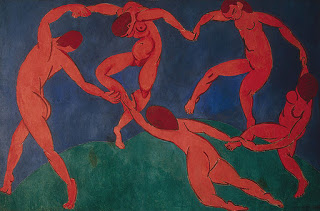
Dance, Matisse, 1909-1910, (Image courtesy of the State Hermitage Museum)

Dance, Matisse, 1909-1910, (Image courtesy of the State Hermitage Museum)

As artists, it is so important to play, to revert in a way to a childlike mental state, to relax. Every time I remember to do this, I find that the art I am trying to create seems to flow better.

Think of some of Henri Matisse's dancers; here, he seems to have distilled his art to a marvellous sense of joyous play. Above is a second version of Dance that Matisse did in 1909-1910, the version now in the State Hermitage Museum . But then fast forward to 1947, when Matisse had to resort to paper cut-outs, papiers coupes, because his infirmities precluded him from painting. He still retained a sense of play, and his creativity was undimmed.

Icarus (Jazz), papiers coupes, 1947, (image courtesy of the Metropolitan Museum of Art, New York).

Icarus (Jazz), papiers coupes, 1947, (image courtesy of the Metropolitan Museum of Art, New York).

How more eloquent an example of play allowing creativity to flow can one get! The crows can certainly teach us a lot. So can Matisse!

Happy New Year to all, and joyful play.

The Sistine Chapel by Jeannine Cook

By way of sending good wishes for a wonderful day today to all my friends, I thought I would add a link sent to me that is amazing in its beauty and technological wonder as well.

It is views of the Sistine Chapel that none of us would really have, in today's crowded world, if we were physically craning our necks to see Michelangelo's masterpieces above.

Go to the Sistine Chapel. To view every part of the Chapel, simply click and drag your mouse arrow slowly in any direction you want. You can see every nook and cranny of the place. To zoom in very close, use the plus sign at the bottom left of the screen, and of course, the minus sign to zoom out. The music is a lovely bonus.

Happy viewing and happy holidays to all!

Black in Art by Jeannine Cook

I remember being firmly told, when I was being taught how to paint in watercolours at school, that black was not something to use straight out of a tube. You achieved a huge spectrum of blacks by mixing other colours, such as reds and greens. Along the way, when learning of oil painters, there seemed to be some who historically used black in generous amounts, while others avoided its use in their work.

Viejos comiendo sopa, Francisco Goya, (Image courtesy of the Prado Museum)

Viejos comiendo sopa, Francisco Goya, (Image courtesy of the Prado Museum)

One of the most famous artists to be associated with black is perhaps Francisco Goya. His "Black Paintings" are somber indeed in their generous use of black, but, in this case, the subject matter is also associated with very dark themes. Goya painted this series of 14 paintings on the walls of his house, the Quinta del Sordo, outside Madrid when he lived there from 1819-1823. He was deaf by this time, he was afraid of going mad, and he had a very bleak view of humanity, having lived through the savage Napoleonic Wars and having watched the disasters of Spanish government. He painted these works without title, and by painting them directly on the walls, he clearly did not intend others to see them. This image, transferred to canvas from the wall of the house, was later titled Two Old Men eating Soup.

Edouard Manet comes to mind immediately when I think of later 19th century artists who began to use black very effectively. He turned away from subtle modelling and simplified, even flattened, the images he portrayed. Not only did he outline in black, but in such paintings as the "scandalous" Olympia - a painting which seemed to shock everyone when it was first exhibited in 1863, his use of black was extensive.  Like other contemporaries in France, Manet also was influenced by Japanese woodcuts, where the use of black was widespread and powerful.

Olympia, Edouard Manet, 1863, (Image below courtesy of the Musee d'Orsay)

Olympia, Edouard Manet, 1863, (Image below courtesy of the Musee d'Orsay)

He continued his use of black even after he became close to many of the Impressionist painters.

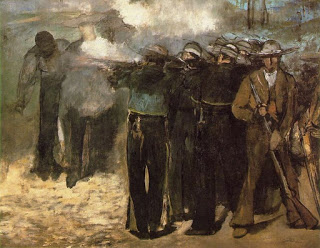
The Execution of Emperor Maximilian, 1867.. (Image  courtesy of the Fine Arts Museum, Boston)

The Execution of Emperor Maximilian, 1867.. (Image  courtesy of the Fine Arts Museum, Boston)

This is one of his three paintings of The Execution of Emperor Maximilian, painted in 1867. Again, his use of black is striking.

Pierre Soulages, black painting

Pierre Soulages, black painting

When one thinks of artists in the 20th century who are noted for their use of black, Pierre Soulages is one artist who stands out. He began to concentrate on the use of black after 1979, and pushed the possibilities of black by manipulating the surface of the paint to enhance texture, reflectivity, character. In fact, Soulages remarked that, "There are people who refuse to accept that you can create light on a black canvas." He calls his use of black outrenoir, ultra-black. He talks of black as being like another country, and has commented, "I like the authority of black. It is an uncompromising colour. A violent colour, but one that encourages internalisation. Both a colour and a non-colour. When light reflects on black, it transforms and transmutes it. It opens up a mental field of its own." At 92, Soulages is one of France's most noted artists, now linked inextricably to his huge opus of black paintings, none of which have titles. These are two illustrations courtesy of his website.

Pierre Soulages, black painting

Pierre Soulages, black painting

Perhaps I have become more interested recently in the use of black in art because of my increasing use of black as a ground for silverpoint drawings. It is certainly a colour that arrests the gaze and transforms - I feel as though I too am straying into a totally different country with my silverpoints on black.

Simplicity in Art by Jeannine Cook

It is thought-provoking for every artist to see Albrecht Dürer's statement that "Simplicity is the greatest adornment of art". In some ways, it is a bit ironic for Dürer was perfectly capable of making complex, crowded works of art, especially his woodcuts.

Hands of an Apostle, Albrecht Dürer,  (image courtesy of GraphischeSammlung Albertina).

Hands of an Apostle, Albrecht Dürer,  (image courtesy of GraphischeSammlung Albertina).

Nonetheless, the image that of course comes first to mind when I read his remark is his super-famous Hands of an Apostle, a grey and white drawing on his favourite blue paper. This drawing was done in preparation for the Frankfurt church altarpiece that Jakob Heller commissioned him to paint in 1508. This is indeed a devastatingly simple drawing in one sense, but look at the rendering of the skin texture, the way Dürer conveys the gentle meeting and touching of the finger tips, as well as the effort of keeping the hands together, despite their weight. The blue paper used, "cartaazzurra", was a new enthusiasm for Dürer; he learned about it when he went in 1507-08 to Venice. Artists in Northern Italy had been using it since 1389, and Venetian artists favoured it because it allowed them to use wonderful chiaroscuro effects.

Twelve-year Old Christ, drawing, Albrecht  Dürer (image at right courtesy of the GraphischeSammlung Albertina).

Twelve-year Old Christ, drawing, Albrecht  Dürer (image at right courtesy of the GraphischeSammlung Albertina).

He was using this paper again for this study of the Twelve-year Old Christ, an extraordinary, sensitive and yet very straightforward drawing.

Dürer continued to use this paper and took a goodly supply of it back home to Northern Europe. I remember reading somewhere that when he ran out of it, he went to great lengths to find alternative blue papers. This drawing of the Arm of Eve was again, a very simple, powerful drawing Dürer did on blue paper in 1507.

Arm of Eve, drawing on blue paper, 1507l Albrecht Dürer  (image courtesy of the Cleveland Museum of Art)

Arm of Eve, drawing on blue paper, 1507l Albrecht Dürer  (image courtesy of the Cleveland Museum of Art)

I think that it is a real discipline for each of us, as an artist, to try to simplify our work, to distil it to its essence, not to dilute and maybe obscure the message. There is always the temptation to add in more detail, more complexity. When you think of it, however, that a simple study, drawn 503 years ago on a small piece of blue paper, can remain so memorable, so vivid, so powerful is a total confirmation of Dürer's statement about simplicity being the greatest "adornment of art".