Artists' Antennae by Jeannine Cook

While listening to the BBC World Service on the radio today, I heard an interesting interview on The Strand programme with South African composer Kevin Volans. He was discussing the multiple influences on him and sources of inspiration for his compositions.

He made the remark that a musician needs to have his ears open at all times to all the sounds around him, because he is thus "fed" and inspired - I am paraphrasing. I thought it was the perfect reminder to me, as a visual artist, that artists' antennae should be up at all times, our eyes open and registering actively and our senses receptive to the world around. No one ever really knows what will stimulate some new creative idea – that is perhaps what makes being an artist so endlessly interesting and exciting.

Volans was talking of living in South Africa and listening to Zulu being spoken on the street all around him. When he went to Germany and heard German being spoken, it made him very aware of the differences in sound and in fact, drove home to him his links to Africa.

I relate to that statement, because I grew up with melodic Kiswahili being spoken all around me, and somehow those sounds still mingle with brilliant African light and tropical colour in my mind. Antennae, for artists, don't just register visually; rather, we all should be aware of sounds, light, colour, motion or stillness – the world around us in multi-dimensional form. Sharpening one's powers of observation always brings rewards, because whatever the artist is seeking to create comes across more powerfully and authentically when there is knowledge behind the creation.

The Large Piece of Turf, Albrecht  Dürer, watercolour and gouache on paper, 1503 (Image courtesy of the GraphischeSammlung Albertina, Vienna)

The Large Piece of Turf, Albrecht  Dürer, watercolour and gouache on paper, 1503 (Image courtesy of the GraphischeSammlung Albertina, Vienna)

Thinking about artists' antennae being up and registering actively makes me think of those wonderful examples of Albrecht Durer's work, the watercolour studies of humble aspects of nature that became great art because of Durer's keen attentiveness. Perhaps my favourite example of this is his Great Piece of Turf, done in watercolour and gouache on paper. How many artists, then - in 1503 - or now - would think of painting a small sample of the grasses in a field, let alone be so aware of the exquisite details in the turf? In the same way,  Dürer's awareness of the beauty and intricacy of this Muzzle of a Bull is amazing. (Image courtesy of The British Museum.)

Muzzle of a Bull , 1523, Albrecht Dürer  (Image courtesy of The British Museum.)

Muzzle of a Bull , 1523, Albrecht Dürer  (Image courtesy of The British Museum.)

Dürer painted this study in watercolour in 1523, many years after he painted the turf, but he was still looking very carefully at nature. In fact, Albrecht Dürer was so noted for his studies of plants and animals that in the years after his death in 1528, those were the aspects of his art that were most admired and emulated by fellow artists and subsequent generations of artists.

Perhaps part of being an artist, in any discipline, is to have one's eyes and ears really working. Certainly all the great artists confirm the need for these well-honed antennae.

Leonora Carrington by Jeannine Cook

A really wonderful book on Leonora Carrington has just helped me fill in all sorts of blanks in my knowledge about this high-voltage Surrealist painter, who died earlier this year at the age of 94. The book, in Spanish, is simply entitled "Leonora", in the form of a novel, but clearly hewing very close to reality, because the authoress, Elena Poniatowska, knew Leonora well in Mexico City.

A rebel from the very start, Leonora Carrington spent her privileged youth in Britain in a series of acts of defiance against her father, Harold Carrington, the then powerful and very wealthy head of Imperial Chemical Industries. She soon developed a very lively imagination and fascination with Celtic folklore, as well as a deep love of horses, a motif that appeared frequently in her paintings.

Leonora Carrington and Max Ernst

Leonora Carrington and Max Ernst

Her love of art helped sweep her into a world where she met Max Ernst, the Dada and Surrealist German painter. Ernst influenced her way of painting, hardly surprising for they had a passionate love affair in Paris and the South of France until Ernst was arrested and interned after the Germans invaded France. Their circle of friends included most of the artists and celebrities of pre-World War II who spent time in Paris, from Picasso to Andre Breton, Dali, Paul Eluard and Miró .

After Ernst was arrested, Leonora suffered a horrific nervous breakdown. She escaped to New York after so-called treatment for the breakdown at an expensive clinic in Spain, an escape from war-ravaged Europe that was only possible because she married Renato Leduc, working at that time in the Mexican Embassy. Peggy Guggenheim was also awaiting passage to New York and the whole group of Surrealist authors, artists and their entourage continued to see each other in New York, where Peggy Guggenheim helped secure exhibits for the Surrealists.

Leonora painted but she also wrote a large number of books that garnered her a loyal following, especially after she moved with Leduc to Mexico City. There, she and Leduc separated and she married the Hungarian refugee Surrealist photographer, "Chiki" Weisz who had been the darkroom manager for his friend, the photographer Robert Capa.

Chiki Ton Pays., Leonora Carrington

Chiki Ton Pays., Leonora Carrington

Leonora's life in Mexico City was enriched by friendships with other artists, such as Remedios Varo, as they explored Mexican folklore, pre-Columbian art, alchemy, Jungian and Freudian thinking, Gudjieff's writings – in wonderfully diverse intellectual questings. All these strands showed up in some form or another in Carrington's paintings, and she became one of the most celebrated artists in Mexico. The mythical worlds she created on canvas (and in sculptures) wove magical beings and animals together, literally (for she would turn cobras into goats or transform blind crows into trees) and metaphorically.

Lepidoptera,.1968, Leonora Carrington

Lepidoptera,.1968, Leonora Carrington

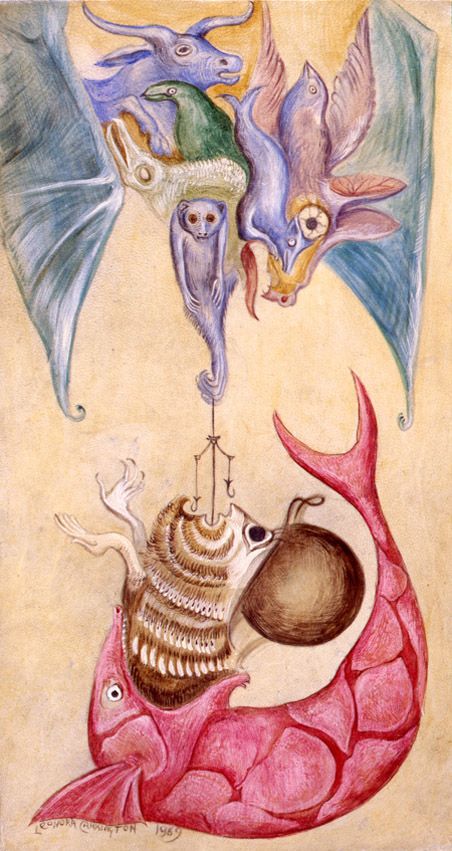
Untitled,1969,  gouache on  vellum, Leonora Carrington (Image courtesy of Guggenheim Museum)

Untitled,1969,  gouache on  vellum, Leonora Carrington (Image courtesy of Guggenheim Museum)

Leonora Carrington's life is an inspiration to us all as artists. She dared defy traditions and pre-conceptions. She drew on such diverse sources for inspiration, from childhood, from fairy stories and folk art, from religions. She was endlessly creative and inventive, in her writing, in her art and in her relationships with friends and acquaintances.

When Elena Poniatowska's book, "Leonora", is translated into English, as it surely will be, I highly recommend it. It is a fascinating way to learn more about this remarkable Surrealist artist.

Trees by Jeannine Cook

It's funny - when you are scrolling though masses of art images, there is sometimes one that stops you, grabs you and makes you investigate carefully. This happened to me the other day when I was trying to find out more about the Iranian poet and artist,  Sohrab Sepehri, who lived from 1928 to 1980. His poems are beautiful, but it was his paintings that interested me.

Trees, 1970, S. Sepheri, (image courtesy of the Grey Art Gallery, New York University Art Collection.)

Trees, 1970, S. Sepheri, (image courtesy of the Grey Art Gallery, New York University Art Collection.)

He apparently had a love affair with trees all his life and did the most wonderful renditions of their trunks.  He spent time in the early 1960s in Japan and was very much influenced by Japanese art, especially woodcuts, and Japanese haikus. He later had a very successful international career in art, and spent time working on a series that he called The Tree Trunk Series.

 House of Kashan,  S. Sepheri, 1978-79. oil on  canvas

 House of Kashan,  S. Sepheri, 1978-79. oil on  canvas

Apparently shy and retiring, Sepehri found a means of expression, as a painter, in his renditions of trees and landscapes, using soft brush strokes and a restrained palette to create these semi-abstracted portraits of trees that are very arresting, yet somehow very specific to place and implying great space beyond the canvas. His huge canvas, painted in 1978-79, is called House of Kashan and below, an earlier work in the Tree Series. As was commented in an auction catalogue on Arcadja, "To him the tree was a symbol of benevolence and stability in a world corrupted by ignorance and malice, his majestic portrayals capture absolutely the quiet grandeur of ancient forests and harbour an undeniable mystical quality." Painting trees kept him anchored in a world in which he felt very comfortable, particularly when he had to deal with places like Manhattan, in which he felt very alien.

In the Tree Series, S. Sepehri

In the Tree Series, S. Sepehri

I suppose these paintings and the commentaries I have been able to read about Sepehri's optic on trees, both in his writings and in his art, all resonate with me, because I too love depicting trees. I find each one to be utterly individual, powerful and very much worth of a portrait. I realised that I keep returning to trees as subject matter, especially for my drawings in graphite and especially silverpoint, because I was selecting work to put up on another website to which I was invited this week. Since one travels in hope in life, this site is apparently aimed at designers and decorators - who knows! Nonetheless, my making a selection of art led me to posting a series of tree images.

What is always so interesting is to see how each artist approaches interpretation of trees. Since we all bring our life experience to the art-making, that is logical. The main point is to celebrate trees!

Silverpoint Drawing by Jeannine Cook

At times, there is a wonderful bonus to being an artist and specialising in a medium - it brings together a community of like-minded artists. It becomes, in essence, a celebration.

This happened to me this weekend in the silverpoint drawing world. A friend of mine, whom I had met first by Internet and then in person at The Luster of Silversurvey of contemporary silverpoint drawing at the Evansville Museum of Art, Evansville, IN, came to visit me with her charming husband. Marjorie Williams-Smith, an exquisite silverpoint draughtswoman, drove from Little Rock, Arkansas, with her equally talented, master printer husband, AJ. The main purpose of the visit was to see the work I am doing, more and more, in silverpoint on a black ground versus a white or tinted ground. Marjorie obtained a grant to explore this dimension of the medium of silverpoint/metalpoint, and chose me as one of her "subjects" A huge compliment.

For me, as an artist very much working on my own in a rural part of the world, sharing ideas and "talking shop" with other artists, particularly in this rarified medium of silverpoint, is a real event. This weekend visit was indeed fascinating, as each of us has a different approach to drawing in silver on a black ground. We agree that one needs to have one's head go into reverse, as it were, since lights become darks, and the silver marks on the black ground are scintillating but very subtle. Choice of subject matter is different from the usual luminous versions of things in traditional silverpoint on a white ground. The few other artists we know who are working on black tend to work abstractly because it is such a challenge to make the delicate silver line visible. In real life, you can see the shimmer; in digital form, that is lost.

Posidonia, Palma, silverpoint, Jeannine Cook artist

Posidonia, Palma, silverpoint, Jeannine Cook artist

For instance, this drawing of "Posidonia", a wonderful Mediterranean sea grass, has much more of the feel of undulating fronds in real life as you look at the drawing.

Life Forces, silver/copperpoint, Jeannine Cook artist

Life Forces, silver/copperpoint, Jeannine Cook artist

However, there are also other aspects of this silverpoint on a black ground that are really interesting to learn about. I have found that because, apparently, the silver and copper (as in this drawing, "Life Forces") react chemically in a different fashion from when you are working with a white ground, there are other effects that appear. It depends, evidently, upon the chemical formulation of the actual ground. Presumably each manufacturer's formulation for black gesso might be different, to some degree, and this would also change the reaction of the silver and copper. Lots to learn!

It was fun, too, with Marjorie and AJ, to ponder the other conundrum to do with these black silverpoint drawings: how to frame them! I have been struggling with this aspect of these drawings for some time now and have not really found a true solution, because there is such subtlety and mystery to the drawings that they need a different framing approach.

It was really such a celebratory day together with these two wonderful artists. I was so appreciative of the fact that silverpoint drawing brought us all together. It was a wonderful bonus.

What Trees tell me by Jeannine Cook

I realise that I am extremely lucky often to be surrounded by very beautiful trees, of very different types according to where I am in the world. I can quite understand why people worshipped trees and why today, there are so-called tree-huggers.

Givhans Ferry Beech, graphite, Jeannine Cook artist

Givhans Ferry Beech, graphite, Jeannine Cook artist

There is a majesty and serenity inherent in a large tree, something that dwarfs human presumptions and quiets one's fears. Their trunks tell of their capacity for endurance, adaptation and survival; their shapes tell of past influences of weather, treatment by man or animal, drought or abundance of rain and nutrients. This huge beech, growing in Givhans Ferry State Park in South Carolina, spoke to me insistently, in the cold spring light. Before long, as I was drawing this in graphite, I was totally at peace, unaware of anything save the tree.

A-Top the Terrace, Palma, silverpoint, Jeannine Cook, Private collection

A-Top the Terrace, Palma, silverpoint, Jeannine Cook, Private collection

Every time I find myself drawing or painting a tree, I remember a remark that Paul Cezanne apparently made: "Art is a harmony parallel with nature". In the case of trees, as wonderful representatives of nature, they help me achieve a degree of harmony and serenity that is a huge gift. When I perched uncomfortably on a very hard rock to draw this Aleppo Pine on Palma de Mallorca's outskirts, I was oblivious of the curious looks given me by people walking their dogs. I was somehow in harmony with this luminous tree that spoke of times when Palma was not such a sea of concrete.Drawing in silverpoint seemed appropriate for it had the same wonderful luster.

Overlooking Ibiza, silverpoint, Jeannine Cook artist

Overlooking Ibiza, silverpoint, Jeannine Cook artist

This is another silverpoint drawing of an Aleppo pine, growing far up on the mountains above the city of Palma, where the view takes one far over the sea to the neighbouring island of Ibiza. The driving winds are shaping this pine, as it clings to the rocky mountainside. But it somehow seemed timeless.

At the Top of the Hill, Le Vicomte-sur-Rance,  silverpoint, Jeannine Cook artist

At the Top of the Hill, Le Vicomte-sur-Rance,  silverpoint, Jeannine Cook artist

These rugged pine trees, growing on a windswept ridge in Brittany, were equally "eternal" in feel, as I sat in a ploughed, muddy field to draw them. Farmers were passing with huge trailers full of manure to fertilise their fields, and they gave me some very curious looks. The crows were calling far overhead in the soft luminously grey sky. It was a time when my art did indeed provide me a passport to a "harmony parallel with Nature".

This quiet that comes to one as one works outside en plein air is especially magical. Nothing else seems temporarily to matter - just the dialogue between what one is trying to depict and one's hand working on the surface of the paper. Yet one hears bird song, the sound of the wind, different calls of humans or animals - but as a backdrop only. It is somehow a different experience to when one is deep in work in the studio, perhaps because of the vagaries of the weather and surroundings. Another aspect also comes into play when trees are the subject matter: they are intensely, logically complicated in their form and growth, and somehow one has to sort that all out, without depicting every single branch or leaf. Each type of tree is totally individualistic, and I liken drawing each one to doing a portrait of a person.

Perhaps, however, one is more likely to be in harmony with trees than with a fellow human being that one is drawing or painting? Who knows!

Gratitude by Jeannine Cook

I love it when life decides to underline things. I was busy digesting a thought-provoking and timely article on "Gratitude" in that excellent publication, The Christian Science Monitor (November 21 issue), when I got news that delighted me and made me feel distinctly grateful.

I had found a listing for Art Residencies in Neopoli, South Italy, in one of the bulletins sent out by the Fulton Council Arts Council; it sounded totally alluring. So I applied, outlining ideas for the work I might do during a two-week residency. To my delight, I have been accepted for this Residency at Palazzo Rinaldi.

So when I read in the CSM article on "Gratitude" this quote from Albert Einstein: "There are only two ways to live your life. One is as though nothing is a miracle. The other is as though everything is a miracle", I can only echo - Amen.

Painters' Heritage by Jeannine Cook

Just in time for Thanksgiving, I learn from Science News of a reason to thank our ancestors again for artistic ventures.

Apparently, in that amazing archaeological treasure trove of very early man's life, Blombos Cave, along South Africa's coast, yet another indication of man's early artistic interests has been excavated. The engraved pieces of ochre, dating from some 80,000 years ago, have already been celebrated, and in fact, I blogged about them in August, 2010. Now, Dr. Christopher Henshilwood of Norway's University of Bergen has found a pair of tool kits which show that man, some 100,000 years ago, was already deliberately mixing chemicals to produce a pigment. Dr. Henshilwood and his colleagues have shown that these early inhabitants of South Africa were taking ochre chips, treated animal bones charcoal, quartz in granular form and some unidentifiable liquid and producing a form of paint. They were planning ahead, preparing pigment for a specific purppose, just as artists do today.

Abalone shell for mixing Pigments, Blombos Cave, South Africa

Abalone shell for mixing Pigments, Blombos Cave, South Africa

Among their finds, the archaeologists found this abalone shell which held this "paint", and an animal bone that had traces of red on it and which was spatula-shaped, perhaps to stir the paint and apply it. (Image courtesy of Science News.)

100,000 years is a long stretch back in time. To know that artistic activities - i.e. mark-making by deliberate pigment preparation - were already underway makes my mind really stretch. But it is a good stretch! And a reason to give thanks.

Making Others See by Jeannine Cook

Every artist knows the excitement of seeing something, discovering something or thinking of something that can then be translated into a work of art. The greater the excitement, the more impassioned the work and frequently, the better the results. Yet those results are then out in the wide world for each viewer to interpret and understand. And the path to achieving memorable art for viewers can be long and arduous.

Edgar Degas remarked, "Art is not what you see, but what you make others see." This wise and oh so experienced artist knew that that transformative alchemy needs somehow to come into play amidst the excitement of creation. His skill and innovative methods in choice of composition - often daring indeed for the time with their nod to Japanese woodcuts - allowed him to direct the viewer's gaze in almost unconscious fashion. He also commented, "No art was ever less spontaneous than mine. What I do is the result of reflection and of the study of the great masters; of inspiration, spontaneity, temperament I know nothing." As he grew older, he would work and rework compositions, trying out parts and juxtaposing them in different fashion, seeking to express movement, psychological impact, social distinctions, but always mindful of what he wished the viewer to appreciate. Chance was not in his methodology of art making.

Woman Bathing, 1886 pastel, E. Degas (image courtesy of the Hill-Stead Museum, Farmington, CT).

Woman Bathing, 1886 pastel, E. Degas (image courtesy of the Hill-Stead Museum, Farmington, CT).

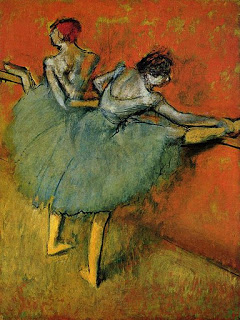
Dancers at the Barre, c. 1888 oil painting, E. Degas, (Image courtesy of the Phillips Collection, Washington, DC.)

Dancers at the Barre, c. 1888 oil painting, E. Degas, (Image courtesy of the Phillips Collection, Washington, DC.)

Look at these two works with their bold, unusual compositions. In each case, Degas is playing with the viewer, directing the eye like an orchestra director conducts the musicians. If you pull the works apart and analyse each one, there are all sorts of odd shapes of limbs, strange angles of bodies, tipped lines. He is using almost hieroglyphic forms to convey what he wants us to see.

Some of the influence in later works is also photography, a medium that Degas embraced from the 1870s onwards. The camera's eye allows even more radical cropping and organisation of space than did the Japanese woodcut tradition, and Degas used these possibilities to full advantage, often in multi-layered compositions.

Part of his way of creating art, especially as he grew older, was to rely on his memory or on the small working sculptures he created of ballerinas, refining and refining the marks and gestures, in the same way that ballet dancers practise and practise movements. I read that he once said that were he to set up an art school, he would house it all under one roof, a building with six floors. On the top floor, he would put the novices to start drawing from the model. As the students progressed, he would move them downstairs, floor by floor. When they were at their most proficient, they would be on the ground floor, and that meant that in order to see the original model, they would actually have to clamber back up the stairs to the sixth floor. By this, he implied that memory is critical to an artist. Until you have practised, practised and re-practised until your art-making has become indelibly part of your inner being, you cannot then devote your attention to organising your artwork in seeming spontaneity but in very purposeful fashion for the maximum effect on viewers.

There are, coincidentally, a number of interesting exhibitions currently on display about Edgar Degas and different aspects of his artistic endeavours. Perhaps the most unusual sounds to be that of Degas and the Nude, at the Boston Museum of Fine Arts. At the Phillips Collection, there is Dancers at the Barre: Point and Counterpoint, while at the Royal Academy, London, Degas and the Ballet: Picturing Movement. Lucky viewers can savour of being skilfully "made to see" what Degas wanted them to see.

Parables of Creation by Jeannine Cook

The celebrated art dealer and collector, Ernst Beyeler, who died in Basel, Switzerland, last year, remarked, "I have always perceived works of art as parables of creation - analogous to nature, as Cezanne once said - an expression of joie de vivre". That perception and keenness of eye made him famous for his choices in art.

Art as a parable of creation is an interesting concept. In a literal sense, there has long been art which illustrates and teaches aspects of religion, particularly when the Catholic Church was, de facto, the sponsor of some of the world's greatest artists during the Renaissance time and beyond. One of the most celebrated examples is, of course, Michelangelo's Sistine Chapel ceiling.

Hands of God and Adam, Michelangelo, Sistine Chapel ceiling

Hands of God and Adam, Michelangelo, Sistine Chapel ceiling

This is one of the most iconic parts of that vast series of paintings, when God gives Adam the gift of life.

Artists explored every way they could conceive of conveying interpretations of creation, as written in the Bible. Some of this art also spoke of joie de vivre, of sensuous love, of beauty and of life. Nature came once more into prominence, as it had been in earlier Medieval art, when depictions of flowers, birds, and landscapes had symbolised holy matters. As the 16th century moved on in Italy, for instance, more and more artists were combining the richness of the new technique of oil painting with their draughting skills. Their subjects expanded to landscapes, cityscapes, everyday scenes – art where creation could have a much wider meaning. The same movement was happening in Northern Europe.

Rembrandt, for instance, was magisterial in his ability to create art that evoked deep meaning about creation, about man's condition, and - sometimes - joie de vivre. Interestingly, as highlighted by an exhibition this year at the Louvre and at the Philadelphia Museum of Art, Rembrandt broke with artistic tradition by using Jewish models to depict Christ and made his Christ a living person, not an icon due great reverence. Indeed, by the 17th century, the artistic vocabulary had become much more elastic; it could allude to many more emotions that were not so dictated by religious concept.

As art - and Western society - moved on through the centuries to our own, both the definitions of creation and joie de vivre have evolved hugely. Art became less and less "coded" and straightforward, so that knowledge of symbols, especially religious, became unnecessary. There can of course be many layers of meaning, but most paintings can be read to some degree, with consequent enjoyment. (Think of people's reactions to Impressionist paintings, or those of 20th century artists.) Nature has always contributed greatly to the joie de vivre of viewers, from flower paintings onwards. Now the parables of creation are more about general celebrations of life, our world in general.

Meanwhile, other civilisations' art (China, Japan, Korea, India, Islamic art, etc.) have been equally eloquent spokesmen for parables of creation - just in totally different fashion. In truth, personally, I have always found Japanese art totally intoxicating in its beauty and thus,joie de vivre.

Pine Trees,  Hasagawa Tohaku six folded screens on paper, (Image courtesy of the Tokoyo National Museum.) 

Pine Trees,  Hasagawa Tohaku six folded screens on paper, (Image courtesy of the Tokoyo National Museum.) 

In the same way, exquisite Koranic calligraphy is sacred art and in a way, a very real parable of creation. Look at this:

Maghribi script version of a Koran Sura, done in North Africa in the 13th century (image courtesy of the Smithsonian Museum.)

Maghribi script version of a Koran Sura, done in North Africa in the 13th century (image courtesy of the Smithsonian Museum.)

I have strayed far from Ernst Beyeler's opinion, but I think his criteria of how to delight in beautiful art, of all descriptions, are very accurate. When a work of art rings true, is "analogous to Nature", then a viewer can indeed fall in love with that art at first glance - in other words, have a coup de foudre. What fun!

A Gift of Colour and Light by Jeannine Cook

The Mayo Clinic in Jacksonville, Florida, is a place of such contrasts. Dread and hope, anxiety and tranquility, fears and laughter. Yet it is often a vessel of transformations and healing alchemy.

There are sculptures gracing the lawns, fountains play in the different lakes, live oak trees shade camellias in bloom - all help calm and center the visitors to the Clinic.

There is, however, an even more beautiful gift of colour and light at the moment, in the Mayo building, en route to the hospital. It is a small exhibition of work by the Scottish Colourists, owned and lent by the major Mayo benefactors, Isabelle and Robert Davis.

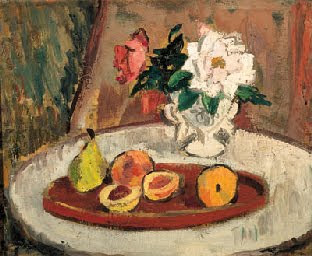
I have always loved the bold, elegant work of the Scottish Colourists, a small group of artists who included Samuel John Peploe(1871-1935), John Duncan Fergusson(1874-1961), Francis Campbell BoileauCadell (1883-1937) and George Leslie Hunter (1877-1931). They achieved a wonderful fusion of French artistic influences that ranged from Manet to Cezanne and Gauguin, in composition, brushwork, colour and their choice of humble everyday objects that became monumental. Post Impressionist in their approach, they all worked together, often travelling to different locations to work as companions. Fergusson and Hunter were essentially self-taught, while the Academie Julian in Paris played an important role in their collective development, along with the artistic ferment of early 20th century France, where Matisse, Picasso or the Fauves were supplanting the Impressionists.

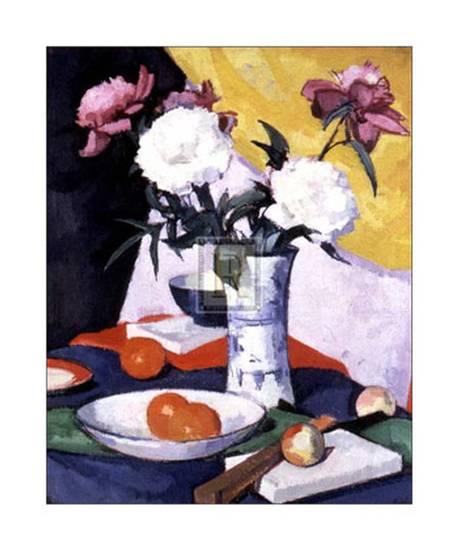
Still life - Peonies and Fruit, Samuel John Peploe

Still life - Peonies and Fruit, Samuel John Peploe

Whilst he painted many landscapes, Peploe loved to paint still lifes, such as this Peonies and Fruit, one of his many carefully arranged compositions. "There is so much in mere objects, flowers, leaves, jugs, what not - colours, forms, relations" he said. "I can never see mystery coming to an end."

Fergusson was also very much influenced by Manet and even Velazquez. He was a pivotal figure amongst the Scottish quartet of artists, and he in turn influenced other artists such as the young American artist, Anne Estelle Rice, (1877-1959), who had been trained at the Pennsylvania Academy of Fine Arts, before coming to Paris.

Anne Estelle Rice, drawing, John Duncan Fergusson

Anne Estelle Rice, drawing, John Duncan Fergusson

Fergusson painted some fine portraits of Rice; this is a drawing he did of her in preparation for a painting. She too produced some wonderfully strong and simple still life paintings, such as the one displayed at the Mayo, Still Life with Dahlias.

Anne Estelle Rice in Paris - Closerie des Lilas, 1907, oil on canvas, John Duncan Fergusson

Anne Estelle Rice in Paris - Closerie des Lilas, 1907, oil on canvas, John Duncan Fergusson

Still Life, oil on canvas, Anne Estelle Rice

Still Life, oil on canvas, Anne Estelle Rice

Her friend, Fergusson, produced a huge body of work: at a 1961 memorial exhibition, his artist friend, André Dunoyer de Segonzac, wrote, ""His art is a deep and pure expression of his immense love of life. Endowed with a rare plastic feeling, almost sculptural in its quality. he joined with it an exceptional sense of colour, outspoken, ringing colours, rich and splendid in their very substance." This late painting is a perfect example of his love of life.

The Red Sail, oil on canvas, John Duncan Fergusson

The Red Sail, oil on canvas, John Duncan Fergusson

Frank "Bunty" Cadell studied in Paris and became noted for his portraits of glamorous women. He returned to Scotland, where he discovered the island of Iona, an important turning point in his development as an artist. He served in world War I, as did his fellow Scottish Colourists, and he reacted to the horrors of war with optimism and heightened joie de vivre, both of which were reflected in his subjects and the joy with which he painted them. He returned often, after the War, to his utopia, Iona, where he summered, alone or with Peploe in 1920. A fellow artist noted, "It seems to me more than ever clear that your forte lies in a gift of colour and light." The joyous mid-1920s painting above of Iona would bear out that statement.

Iona, oil on canvas, Frank "Bunty" Cadell

Iona, oil on canvas, Frank "Bunty" Cadell

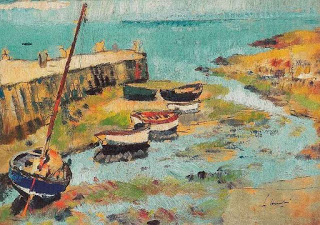
George Leslie Hunter moved from Scotland to California with his family as a young boy, but as an adult, he spent time in Scotland, France, Italy and America. He was recognised early on as a skilled draughtsman and drawing remained one of his great strengths. Like Cadell with Iona, Hunter found Largo, in Scotland, to be a place of great inspiration, as is shown in this painting. He was also noted for his treatment of light and sense of colour.

Lower Largo, George Leslie Hunter

Lower Largo, George Leslie Hunter

The Davis collection of Scottish Colourists being shown at the Mayo is also rounded out beautifully by exquisite canvases by three artists who had links to the Scottish Colourists - Anne Estelle Rice, the American artist whom Fergusson both encouraged and celebrated in portraits.

Still life with fruit and flowers, Anne Estelle Rice  (recently sold at Sotherbys)

Still life with fruit and flowers, Anne Estelle Rice  (recently sold at Sotherbys)

Another Scottish artist, Anne Redpath (1895-1965), was a student of the Scottish Colourists while she was studying in Edinburgh. She later moved to the South of France with her husband where they became part of the Scottish Colourists circle. In her work, she was, to an extent, one of their heirs, being especially influenced by Peploe and Cadell.

Flowers on a White Table, Anne Redpath (Image courtesy of Portland Gallery)

Flowers on a White Table, Anne Redpath (Image courtesy of Portland Gallery)

Her celebration of familiar household objects in her still lifes and her use of colour harmonies of cool contrasting with warmer hues were hallmarks of her work. This wonderful flower study, Flowers on a white tablecloth, was in her collection at her death.

The last artist represented in the Mayo exhibition was a British artist, Robert Bevan (1865-1925). The link with the other Scottish artists was that he too studied at the Academie Julian in Paris. He also spent time in Brittany and was linked to the Pont-Aven school of artists who were experimenting with the use of colour and form. During his life, his work was considered controversial and too avant-garde, with one critic labelling his use of colour "garish". However, by the time he died in 1925, he was celebrated in art circles and hailed for his "modernist powers".

Near Applehayes, Robert Bevan

Near Applehayes, Robert Bevan

By the time I had finished savouring of the beautiful and interesting exhibition in the Mayo building, I had become sadly aware of how many preoccupied people had hastened past this gift of colour and light. All I can hope is that they will find a moment of peace and delight the next time they pass that way. They would be rewarded.