The Process of Discovery by Jeannine Cook

When artists embark on a creative venture, particularly one that uses Nature as its springboard, a process of discovery is often necessary.

Take, for example, a tree that may be inspiring a sculptor, a photographer, a draughtsman or a painter. Unless the artist already knows that tree very well, he or she will need to study the tree to learn of its characteristics. Height, form of growth, girth, type of leaf and bark, its flowers and seeds, its general look that identifies it as an oak, a cherry tree, or a poinciana. Only after learning about that particular tree can the artist move on to creating art that evokes it, in some form. By finding out about the tree, you can then decide what to depict, what to emphasise, what to eliminate, how to weave the fruit of your discoveries into a composition, a work of art. In essence, the process of discovery allows one to distill some order out of the seeming chaos in front of one's eyes.

For a painter or draughtsman/woman, small thumbnail sketches are one passport to imposing some order on one's discoveries. Frequently, when one is working en plein air, there is such an abundance of information pouring into one's brain that it is overwhelming. Translating all those discoveries of form, light, pattern, whatever... into a coherent composition is daunting. So small, quick studies, trying out compositions, seeking to simplify shapes and strengthen light patterns and passages. introducing repetitions and contrasts, are a way to further the process of discovery.

These studies don't take very long, one can try out lots of versions, in any medium, and each one helps further to refine what one is trying to say. They are also a form of shorthand note-taking, helping to catch fleeting light or shapes, or sorting out complex aspects. I find that they are especially valuable before I launch into a silverpoint drawing, because they can save me lots of troubles, given that silverpoint precludes any alterations or erasures.

Thumbnail drawings of landscape (Image courtesy of Marion Boddy-Evans. (Licensed to About.com, Inc.)

Thumbnail drawings of landscape (Image courtesy of Marion Boddy-Evans. (Licensed to About.com, Inc.)

Since I have never scanned any of the thumbnail sketches from my drawing books, I am indebted to other artists for allowing me to illustrate ways of using thumbnail sketches. Above is an example of small exploratory drawing/paintings which use knowledge already absorbed from the landscape to determine which is the best way to proceed.

Park Sketches, George Bumann

Park Sketches, George Bumann

These thumbnail drawings are done by George Bumann, a noted wildlife sculptor living in wild and beautiful Montana. The studies were apparently done on a visit in 2009 to Yellowstone National Park. Eloquent shorthand, they show how his knowledge of those landscapes, born of multiple discoveries and observations, helps define his art. I am grateful to him for such illustrations.

Because an artist has taken the time and made the effort to discover what it is that makes a subject notable, beautiful, interesting, relevant... the resultant distilled knowledge becomes a passport to making good art, art that rings true without having to be a faithful reproduction of what is being viewed. As the French poet, Charles Baudelaire, once remarked, "All good and genuine draughtsmen draw according to the picture inscribed in their minds, and not according to nature."

For that picture to be inscribed in the mind, there needs first to be a process of discovery.

"Deliberate Practice" by Jeannine Cook

I am still reading the fascinating book, Moonwalking with Einstein, by Joshua Foer - it rewards with lots of ideas. One that I found thought-provoking today is one about hitting a wall when you are trying to achieve proficiency in some activity, from golf to music or memory-training.

According to Foer, this limiting plateau is know to psychologists are the "OK plateau". When we learn a skill, we go through phases - the beginning "cognitive stage" when you are learning the ropes and finding out the best ways to accomplish the task. Then comes the "associative stage", when things are becoming more automatic and fewer errors happen. Finally, the "autonomous stage" is reached, when you are no longer really conscious of exactly what you are doing when performing the task. Being on autopilot allows us then to concentrate on other, less familiar things whilst still getting the job done, but there is a drawback. You no longer improve your particular skill.

I think that happens easily to all of us as artists. We work and work, practise and practise, and believe that the more we spend time doing art, the better we will become. But apparently, there is a remedy to the walls we all hit in our art. Thank goodness!

Professor K. Anders Ericsson of Florida State University's Human Performance Laboratory, Department of Psychology, in Tallahassee has apparently studied the top experts in many different fields and analysed their methods of working and improving skills. They all adopt similar strategies: they find ways consciously to keep their "autopilot" state from turning on when they practise. They pay close attention to their technique, they remain very clear about their goals, and they rely on lots of feedback that is frequent and immediate.

Applying this wisdom to making art seems to be very relevant. It makes the case for being flexible and inventive in the techniques we use for art-making, using new media, trying a different approach to media we already use... I think any successful artist knows that realistically-defined but very clear goals are vital ... and need updating and "nourishing" frequently. The feedback aspects are terribly important too, but harder for those of us who tend to work alone. It is a wonderful gift of the gods when one has a group of trusted and respected fellow artists, or even a friend, to whom one can show one's efforts and get reactions and feedback. Every time I am lucky enough to have a critique session with artist friends, I know that I learn and grow a great deal.

I find it so interesting to have these foundations for artist growth confirmed so elegantly in a book on enhancing memory. It is logical, but unexpected!

Learning to See Things Accurately by Jeannine Cook

Saturday was one of those days when it was so misty at one point that one could hardly see anything across the marshes at Dunham Farms, Midway, Georgia. Within a couple of hours, however, it was brilliant sunshine and the world was transformed. It all made one stretch as an artist working outdoors!

I thought of a remark that Michael Gormley had written about the artist, Bo Barlett, in an American Artist article in the March-April 2011 issue. He reported about Barlett that, "Like many other artists, he notes that looking and learning to see things for what they really are (my emphasis), rather than seeing a projection of a preconceived mental concept, is key to the development of a visual language."

Barlett's observation is so true for all of us as artists. I found that as I peered through the mist to try and see accurately, it became a series of surprises. What I saw first, in the scene below, (Edge of the Creek, Dunham Farms,graphite), were indistinguishable silhouetted lines of distant horizons. I looked harder, and finally began to see individual small islands and different trees edging the marshes.

Edge of the Creek, Dunham Farms, graphite, Jeannine Cook artist

Edge of the Creek, Dunham Farms, graphite, Jeannine Cook artist

The same thing later occurred when I wanted to draw the wood storks perched on a dead tree on a distant island. The birds moved constantly, the wind riffled the palmettos and their fronds were a maze of lines and ever-moving shapes. It was a real challenge even to make any sense of the scene, let alone create a drawing.

 Dunham Farms, Midway - wood storks, graphite, Jeannine Cook artist

 Dunham Farms, Midway - wood storks, graphite, Jeannine Cook artist

Another effort of intent observation, later in the day when the sun allowed one to see better in the forest, was trying to follow the myriad lines and patterns in a magnificent old dead live oak tree trunk. Time had distilled the upright trunk to rhythmic sinews, an endless maze of movement. Its patterns and rhythms fascinated me, but I found it really challenging to sit and concentrate on following its ways whilst trying to create a sensible drawing.

 Live Oak Rhythms, Prismacolor, Jeannine Cook artist.

 Live Oak Rhythms, Prismacolor, Jeannine Cook artist.

Every time that I go out to work plein air, I am reminded of how difficult it actually is to look really hard and see things accurately. It is a siren call to assume one knows what is going on in the scene in front of one. It is so much easier to think one knows. Only when I remind myself to look again and again, with my eyes really open, do I discover that Nature is once again liable to fool one. In other words, a facile, preconceived "visual language" would not necessarily be an accurate one that reflects one's artistic voice.

Landscape Painting by Jeannine Cook

Back in March of this year, in The Spectator, Angela Summerfield discussed Peter Frie:Last Summer, an exhibition of landscapes by a Berlin-based Swedish artist, Peter Frie. In view of the fact that tomorrow, I am planning to work plein air on landscape drawings, this statement in Summerfield's article came back to me.

I quote, "Landscape painting has not fared well within the dictates of modernist and post-modernist art definitions. It is as if an urban-centric, text-driven and often anti-aesthetic dogma has stifled both alternative discourse and individual human expression. Yet our experience of landscape, and by association Nature, is fundamental to the development of our senses, perceptual vocabulary and cognitive awareness.

Eliopainting No. 3   Peter Frie, oil on canvas, (image courtesy of Eskilstuna Konstmuseum.)

Eliopainting No. 3   Peter Frie, oil on canvas, (image courtesy of Eskilstuna Konstmuseum.)

This statement resonates for me in a number of ways. Since I live in non-urban environments, I find most of my daily delights and inspiration in Nature, in one way or another. I am also very aware that my tastes are therefore different from those of countless millions of people who live in big cities, where the dragooned green trees along streets and in artificially-constructed parks are the major remnants and reminders of the natural world, apart from weather conditions.

The world in which we all live is indeed mostly text-driven, a fact which again contributes, according to this thought-provoking book that I am reading, Moonwalking with Einstein, by Joshua Foer, to our collective loss of the capacity for memory. Because we can all rely on books, Google, digital files or whatever to recuperate facts, our memories have virtually abdicated, as compared to the memory of Greeks, Romans and medieval notables.

In those early times, people could remember vast amounts of knowledge, from all the names of soldiers in an army to long, involved speeches or treatises. After Gutenberg invented the printing press in 1436, our memories took a hit. In the same way, only well-trained artists retained the capacity to remember innumerable details of landscape or human form. Familiarity with landscapes and Nature's ways became the domain of the few in the art world.

Today, that is indeed true. Yet unless we artists somehow learn how Nature "works", an enormous chunk of our personal vocabulary is stunted. It is as if we try to learn French, but never hear how the words are correctly pronounced. We thus never understand the nuances, the cadences and accentuations, let alone the words themselves, that convey a world of meaning.

Ultimately, I fear that Angela Summerfield's rather pessimistic outlook about landscape painting will continue to pertain. I don't see art collectors returning en masse to support landscape painting (and drawing). Nonetheless, for those of us who believe landscapes and Nature in general have much to offer, there is the comfort that personally, we are enriched, and that there are indeed some people with whom landscape painting resonates. Hurray for "alternative discourse and individual human expression"!

Peter Frie's version of a "Blue Morning" (image courtesy of artfinders.co.uk.)

Peter Frie's version of a "Blue Morning" (image courtesy of artfinders.co.uk.)

Just look at  Frie's Blue Morning.  He should give us all encouragement and hope to follow our own paths vis-a-vis Nature.

Artists' Ways of Seeing Things by Jeannine Cook

I am reading a book entitled "Moonwalking with Einstein. The Art and Science of Remembering Everything" by Joshua Foer. The title is self-explanatory, the style is highly readable as Foer is a seasoned writer for such publications as the New York Times, National Geographic, Slate, etc. The content is totally fascinating - about how science is slowly understanding better how the human brain works, especially in terms of memory.

I still have many pages to go, but one page started me thinking about the parallels between artists and the master chess players that Foer was discussing. In the 1940s, Adriaan de Groot, a Dutch psychologist and chess player, decided to investigate what separated a good chess player from a master chess player - what was going on in their heads? Were the top players able to think further ahead in their moves, did they have better mental tools or a more honed intuition for the game? From past high level games,De Groot selected a series of board positions where there was one correct move to make which was not all that obvious. He then asked a group of top flight chess players to ponder these boards and to think aloud as they selected the proper move.

To De Groot's astonishment, the players mostly did not think many moves ahead, nor did they consider more possible moves. What they did was to see the right move, and almost immediately. After analysing the players' commentaries, De Groot realised that the chess experts were reacting, rather than thinking, and they could do this because their long experience of playing had taught them to think about "configurations of pieces like 'pawn structures' and immediately noticed things that were out of sorts, like exposed rooks". They had learned to see the whole chess board and thirty-two chess pieces as systems and groups. Later studies of top players' eye movements confirm that they literally see a different chess board, for they see more edges of the squares, which means they are encompassing whole areas at once. They also move their eyes across greater distances, without lingering for long at any one spot. Those places on which they do focus tend to be the key areas linked to making the right move.

This description of how master chess players function made me think of artists who have honed their skills day after day, year after year. Their eye-hand coordination has been perfected, their senses of composition/design, colour and content are developed. When they draw a nude, for instance, or work on a landscape painting plein air, for instance, they are not looking at just one spot. Rather, they are encompassing the whole so that almost intuitively, they can adjust their composition, their values and colour in the work for the best results. Their powers of observation and concentration are almost unthinking, because they are trained and disciplined.

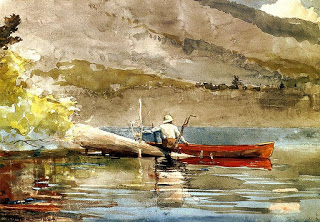
The Red Canoe, 1889, watercolour, Winslow Home (Image courtesy of the Peabody Art Collection, Baltimore, Maryland)

The Red Canoe, 1889, watercolour, Winslow Home (Image courtesy of the Peabody Art Collection, Baltimore, Maryland)

To me, Winslow Homer is an example of a highly skilled painter, producing amazingly fresh landscapes, frequently plein air, and often in watercolour. One such example is "The Red Canoe" (image courtesy of the Peabody Collection, the Athenaeum).

Foer goes on to comment on the master chess players' amazing memories. I suspect that the great artists, past and present, also intrinsically rely on their memories quickly to understand a subject after a brief moment of studying it, Like the chess players, they can also call upon past experiences to bolster and inform their present work. The saying, "Been there, done that" applies, in a very positive sense, to an artist as well as chess players. Perhaps one should just add, "umpteen times"!

Assessing the Year as an Artist by Jeannine Cook

Summer has slipped into autumn all too quickly this year. Only now have I been able to send my art-collector friends a brief newsletter about the year as an artist. I find this yearly exercice an interesting assessment of what I have been trying to do and where my art has been available for viewing.

This has been, in truth, an unusual year, with bereavement and family health problems precluding a lot of artwork being done (and fewer blog posts as well!). Nonetheless, sadness and anxiety have been mixed with great joy and delights.

McIntosh Art Association, Darien, GA, hosted my spotlight solo exhibition, At the Edge of the Marsh, in April and May. I showed watercolours, silverpoints and graphite drawings. In May-June, I exhibited silverpoint drawings alongside Daniel Smith's monoprints in Point and Counterpoint at the Hospice Savannah Gallery. Meanwhile, in April and May, I was part of an invitational exhibition, again with silverpoint drawings, at the Art and Soul Gallery at the Women's Center of Jacksonville, entitled Lasting Impressions. Another national invitational show in which I participated was Luminous Metal: Contemporary Drawings in Metalpoint, at the Clement Art Gallery in Troy, NY. I have also just exhibited my art at a Coastal Wildscapes conference held in early October at Richmond Hill, GA.

Other shows in which my work was selected for exhibit during the year were:

- Brainstorm: Opening Minds, Embracing Change, with Women's Caucus for Art of Georgia.
The first venue was at Atlanta's Central Library and the show then travelled to
Upstairs/Artspace in Tyron, NC.
- I'm in Love with this Idea, also a in Women's Caucus for Art Georgia exhibition, was held at the Georgia Perimeter College, Atlanta.
- Katonah Museum Artists' Association, a large group show at Northern Westchester Hospital, NY.
- Little Things mean a Lot, a holiday show at the Swan Coach House Gallery, Atlanta.
- Portraits to Pixels: Celebrating 125 Years of Collecting at the Telfair, a selection of work from the permanent collection, at the Telfair Museums, Savannah. One of my silverpoint drawings was included.
- Transformations, an on-line international show sponsored by the Women's Caucus for Art in San Diego, CA, in which I was awarded second place honours for one of my silverpoint drawings.
- New Hall Art Auction 2011, an on-line auction for the New Hall Art Collection, Cambridge, with art produced by those of us with work in their permanent art collection.

Early in the year, I held a silverpoint workshop at the Telfair Museum of Art at their invitation, and was scheduled to hold a watercolour workshop. Alas, I had to cancel that due to my mother's death. Later, I held a plein air workshop for McIntosh Art Association members on Butler's Island, near Darien.

My art was featured in a variety of newspaper articles: the Darien News covered my Darien solo exhibition, as did the Brunswick News. Later, the Savannah Morning News's art critic, Alison Hersh, wrote about the "Dynamic Duo at Hospice Gallery". The Art Connection in Boston featured my art, as did the WCAGA website. My work was also included in websites as varied as Women Environmental Artists, Artist Sites, Wooloo or the Irving Sandler Artist Slide Registry/Artists Space. Of course, my art and updated activities are also featured on my own website at http://www.jeanninecoook.com.

I am already working towards exhibitions which are planned for next year and beyond. I am co-curator with Professor Jeff Lewis of Auburn University of a silverpoint exhibition to be held in 2013 at the Jule Collins Smith Museum of Fine Art, Auburn, AL. I shall be participating with a group of artist friends in Celebrating the Coast at Glynn Art Association Gallery in 2012, and joining my friend, Marjett Schille, in an exhibition, Sapelo Island, at Brenau University, Gainesville, GA, in 2013.

My 16th Annual Art Tasting was held last December 4th and once more, for Rundle and me, it was a celebration at our home at Cedar Point. I felt honoured to display my art for my friends. This memory is now a little bittersweet as I realise that this year, I will not be able to invite people to another Art-Tasting. Rundle is facing surgery for an incipient aneurysm in his other leg, and between those uncertainties and our late return from Spain, I sadly concluded that it would unrealistic to organise things in time. Nonetheless, I hope that, deo volente, I can plan a spring art celebration.

Efforts and hopes - but now to getting down to creating art again. That is where the discipline comes in!

Euros - Symbolism on the Bank Notes by Jeannine Cook

Last week, when the Eurozone was hanging on the final "yes" vote in the Slovak Parliament to agree to the proposed EU bailout fund, I could not help thinking about the actual euro currency and its design.

For those who have not seen the bank notes, they are elegant. In clear and distinct colours that are easy to distinguish, they are a welcome change from semi-monochromatic currencies. Their design was thoughtful and symbolic, for this currency is an ambassador for the countries of the European Union. History, ethics, moral values –are all implied by a country's currency, and more so with this new currency that the EU launched in 2002.

euro_notes.jpg

On the side illustrated at right, it was decided to use architecture down the ages in Europe, designing it so that it was not specifically that of any one place. Using the symbolic motif of arches and entrances, examples were sought from across Europe and then stylised. The 5€ bill evokes classical architecture, the 10€ Roman architecture and the 20€ alludes to Gothic buildings. The 50€ brings us to Renaissance times, the 100€ refers to Baroque and Rococo architecture, the 200€ evokes the advent of metal in 19th century buildings, while the 500€ brings us to modern architecture. (For many years, in Spain, the 500€ bills were referred to as "Bin Ladens" as they were so seldom seen!)

The reverse side of the bank notes is about bridges, another important symbol for this ever-increasing union of countries that have often been enemies in the past.

money_architecture.jpg

Again, the style of architecture follows the same time frame, from classical to modern.

One of my favourite notes is the 20€ bill, for its limpid, subtle blue and serene design reminds me of the wonderful stained glass windows in Gothic cathedrals and the old bridges across the rivers of Northern Europe.

598864-20_note_Bridges_side_Europe.jpg

Sometimes, it is at the physical level - that of handling the bank notes and looking at their artistic design and symbolism - that helps bring home the importance of parliamentary decisions. I am glad that the Slovaks decided to help the euro stagger on again. It would be a great shame to abandon such elegant currency!

The Shock of Recognition by Jeannine Cook

You enter an exhibition, perhaps almost by chance. You see the title of the show, and you are trying to orient yourself as to what it is about.

Then you round the first corner in the exhibit room, and boom, you get a jolt. Straight in front of you, out of the blue, you see a piece of art that you know well, something that has resonated with you before. And there it is again, quietly hanging on the wall. This shock of recognition, a thrill of interest and delight, are what makes me realise how much art means to me in daily life.

This reunion with pieces of art that I admire happened a little while ago when I strayed into the lovely CaixaForum exhibition hall in Palma, in the elegantly restored modernist Gran Hotel. I saw that there was an exhibition of etchings entitled, "From Dürer to Morandi. Engravings from the William Cuendet Foundation and the Atelier Saint-Pret". It was a large Swiss collection of very fine editions of work by innumerable artists from Dürer to Rembrandt, Canneletto, Piranesi, Goya, Degas and many others.

One of my first delights was a Rembrandt work - The Holy Family with a Cat, from 1654 - a work that always enchanted me with the inclusion of the cat. I had not seen it for a while, and so lingered to savour of the composition, the feeling conveyed by the whole harmonious order of the etching.

The Holy Family with a Cat, etching, 1654 .Rembrandt Harmensz van Rijn (image courtesy of the Jenisch Museum, Vevey, Switzerland).

The Holy Family with a Cat, etching, 1654 .Rembrandt Harmensz van Rijn (image courtesy of the Jenisch Museum, Vevey, Switzerland).

Another happy reunion amongst the other one hundred and thirty works was this deliciously memorable work by Edgar Degas, At the Louvre, Painting, Mary Cassatt, 1879-1880. I have always loved its daring composition and essentially late 19th century French atmosphere. Both these images are courtesy of the Jenisch Museum, Vevey, Switzerland.

At the Louvre, Painting, Mary Cassatt, etching, 1879-1880., Edgar Degas (image  courtesy of the Jenisch Museum, Vevey, Switzerland).

At the Louvre, Painting, Mary Cassatt, etching, 1879-1880., Edgar Degas (image  courtesy of the Jenisch Museum, Vevey, Switzerland).

My impulsive choice to walk into this exhibition, as I hastened through a list of errands, was such a bonus. The shock of recognition jolted me again and again. I came out exhilarated and grateful for the serendipitious gifts of art.

"Suite dans les idees" - is it important in art? by Jeannine Cook

I have always been fascinated by a consistency of thought in people as they develop an idea or a work. It seems often to be important to have a logical progression, an evolution of ideas that allow others to follow what is being done. Nonetheless, it seems often to be a challenge for artists to produce a consistent body of work, and I wonder more and more if it is that important.

In the art market, for instance, it is often considered desirable that an artist work in a coherent and understandably sequential fashion - think of Andy Warhol's series of silkscreen prints that have been so wildly successful from their creation. Art galleries are often reported to be less than enthusiastic if an artist suddenly changes and goes off in a very different direction in the work.

Personally, I realise that there are two warring tendencies in my art-making. I find it often to be rewarding to work in series, trying to explore aspects of a subject in a sequence of pieces. Yet I also love to go off in a totally different direction, trying another medium, another approach that has nothing to do with anything else I have done. So I was interested to find a quote about Joan Miro, who told an interviwer in 1928, that "when I've finished something, I've got to take off from there in the opposite direction" (from "A Conversation with Joan Miro", Francesc Tribal, La Publicite, 14 July 1928).

This observation is an insight into how an artist works - where the inspiration comes from, the wellspring of ideas and general artistic discipline. I think that many artists relate to Miro's way of working - variety is stimulating. They may later circle back to a previous theme, but with the subtle changes that time can impose.

This "suite dans les idees" - a coherency and consistency of ideas - can lead to the definition of an artist's style and hallmark. But it can also lead to repetition and even staleness. Perhaps Miro was wise to find reasons to renew his energies by challenge and change. The diversity of his oeuvre certainly makes a good case for going off in "the opposite direction".

Artists' Dedication by Jeannine Cook

The other day, a friend remarked to me that in these lean economic times, we will see important works of art and literature being produced. In other words, artists, almost in spite of themselves, will be working away, and the challenges they face will be a stimulus to go further, do things differently and make progress.

This dedication to art-making was, for instance, an early characteristic of Joan Miro . As early in his career as 1915, he quoted Goethe's statement that, "He who always looks ahead may sometimes falter, but he then returns with new strength to his task". At that time, Miro was principally dedicated to landscape painting, and was soon to produce some of his early masterpieces about life at Mont-roig, his family home in the Tarragona countryside, near Barcelona.

House with Palm Tree, 1918, Joan Miró. (image courtesy of the Reina Sofia Museum, Madrid)

House with Palm Tree, 1918, Joan Miró. (image courtesy of the Reina Sofia Museum, Madrid)

L’ornière, The Rut, 1918, Joan Miró, Private Collection

L’ornière, The Rut, 1918, Joan Miró, Private Collection

Vegetable Garden and Donkey, 1918, Joan Miró, (Image courtesy of Moderna Museet, Stockholm, Sweden

Vegetable Garden and Donkey, 1918, Joan Miró, (Image courtesy of Moderna Museet, Stockholm, Sweden

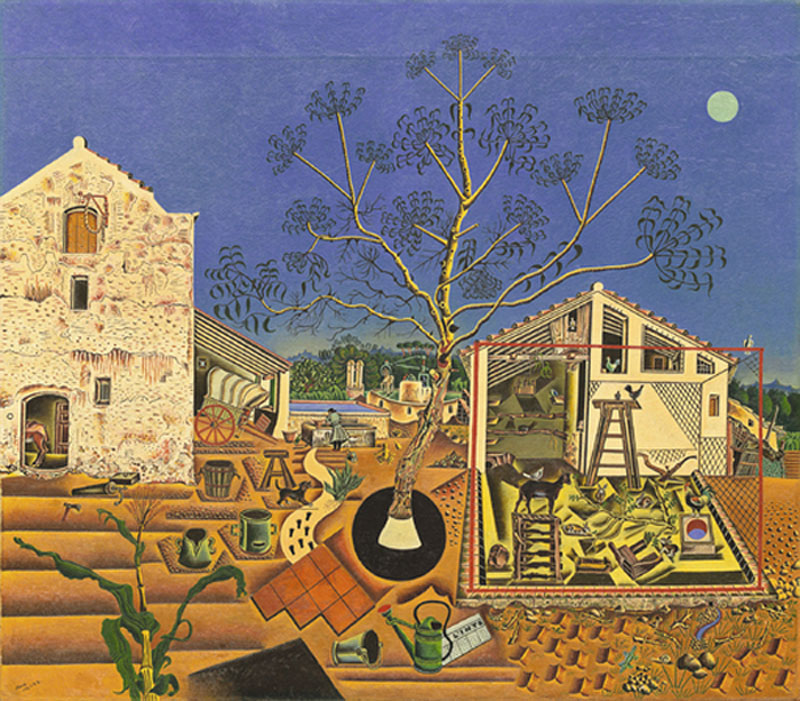
The Farm,  oil on canvas, 1921, Joan Miró (image courtesy of the National Gallery of Art, Washington, DC),

The Farm,  oil on canvas, 1921, Joan Miró (image courtesy of the National Gallery of Art, Washington, DC),

These four paintings are all results of what Miró regarded as trial and error work. He admitted to stumbling as he tried to deal with his depiction of the countryside, but he always got "to his feet again". This determination to "return with new strength to his task" remained with him during his long and artistically very inventive life, despite the difficulties he experienced personally or because of his opposition to Franco and his regime in Spain. (A marvellous celebration of Miró's dedication to art, "The Ladder of Escape", can be seen in Barcelona at the Fundacio Joan Miro from 13th October, 2011 to 25th March next year. It has just closed at the Tate Modern, London.)

Every single artist hesitates, stumbles, doubts and abandons one path for another. Only those who have enough inner fortitude, a strong enough conviction that they must continue with their endeavours, are people whose creativity leaves a mark in our world. When there are really difficult times, economically, politically or personally, it becomes a real test of an artist's dedication that he or she continues to work and produce. We are living in such times. It will be interesting to see - in a few years' time - whether my friend's prediction about stellar work being produced in today's world is accurate.