Drawing - a High-wire Act by Jeannine Cook

Lorne Coutts is a frequently quoted advocate of drawing.  One of his statements that resonates the most - understandably - is: "Drawing is risk.  If risk is eliminated at any stage of the act, it is no longer drawing." (Trying to find out more about Lorne Coutts leads one to mysteries - borne in 1933, he has apparently published one book, in 1995.  Entitled The Naked Drawings, it is out-of-print, with "image unavailable" on almost every listing - what a surprise!

In any case, everyone who has ever launched into drawing, especially without the psychological support of an eraser, knows that the results are a gamble.  Even the most skilled of draughtsmen will have a surprise sometimes, a huge success but also, potentially, a total disaster.  Just as the thoughts we think and the words we utter sometimes surprise, delight or dismay us, so too the lines that we place on a drawing surface can be a high-wire affair.

Even the very first lines made on the rock faces of caves such as Lascaux, France, showed that those artists, working some 40,000 years ago, were not only daring in concept and mastery of line, but they combined these aspects with the understanding of how to use the protuberances of the rocks to add extra impact to their drawings.
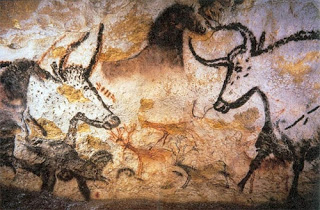
Lascaux

Lascaux

Think of the amazing kaleidoscope of drawings, often very gestural, that show how the artist is combining eye-brain-body/hand coordination and skill to produce a series of marks on a surface.  Western art is rich in such drawings, as is Eastern art.  Think of Leonardo da Vinci's work in chalks, for instance, or go to the other side of the world, to Japan, for drawing with brush and ink.

Leonardo da Vinci, Studies for the Heads of Two Soldiers in the Battle of Anghiari (1504-05). Image courtesy of  Museum of Fine Arts, Budapest

Leonardo da Vinci, Studies for the Heads of Two Soldiers in the Battle of Anghiari (1504-05). Image courtesy of  Museum of Fine Arts, Budapest

Sekkan (active 1555-1558) Monk Riding Backward on an Ox. Hanging scroll; ink on paper  Image: 13 7/8 x 16 7/8 in. The Phil Berg Collection. Image courtesy of  Museum Associates/LACMA

Sekkan (active 1555-1558) Monk Riding Backward on an Ox. Hanging scroll; ink on paper  Image: 13 7/8 x 16 7/8 in. The Phil Berg Collection. Image courtesy of  Museum Associates/LACMA

A little earlier, about 1510-15, back in Venice, Titian's searching chalks were recording this sensuous, thoughtful Young Woman, the lines probing and balancing - a deeply intense study.

Tiziano Vecellio, called Titian (Italian, ca. 1485/90-1576). Study of a Young Woman (detail), ca. 1510. Black and white chalk on faded blue paper. 41.9 x 26.5 cm (whole drawing).© Prints and Drawings Department, Galleria degli Uffizi, Florence

Tiziano Vecellio, called Titian (Italian, ca. 1485/90-1576). Study of a Young Woman (detail), ca. 1510. Black and white chalk on faded blue paper. 41.9 x 26.5 cm (whole drawing).

© Prints and Drawings Department, Galleria degli Uffizi, Florence

There were so many extraordinary master draughtsmen during that period, from the Renaissance onwards, who could create fireworks and pirouettes of drawings - Michelangelo,  Raphael, the Caracci brothers, Mantegna, Dürer, Caravaggio, Rubens, Tintoretto, and many, many others. One of the 17th century giants was of course Rembrandt. Just look at Rembrandt van Rijn's quick drawing of the two adults with the serious little child, or his flying strokes as he depicted this amazing lion.

Two women teaching a child to walk, Rembrandt, 1635-37. Red chalk.  Image courtesy of the British Museum.

Two women teaching a child to walk, Rembrandt, 1635-37. Red chalk.  Image courtesy of the British Museum.

Extinct Cape Lion, Panthera leo melanochaitus, Rembrandt, 1650-52. Ink. Image courtesy of the Musee du Louvre

Extinct Cape Lion, Panthera leo melanochaitus, Rembrandt, 1650-52. Ink. Image courtesy of the Musee du Louvre

Jumping to the late 19th/ 20th century, the high-wire act still goes on for some artists who draw, draw and draw.  Gustav Klimt and Egon Schiele are two Viennese artists famed for their drawings.

Egon Schiele, Crouching Woman, 1918

Egon Schiele, Crouching Woman, 1918

Another amazing draughtswoman working in Germany about the same time was Käthe Kollwitz. Constantly risking, constantly probing, she recorded human suffering and disasters in a way that rivets and remains in one's memory long afterwards.

K. Kollwitz, Self Portrait

K. Kollwitz, Self Portrait

Even during the later 20th century when drawing skills were less appreciated, there were artist who persisted in working on the drawing trapezes.  One of the high-flyers was Lucien Freud, who produced powerful, direct drawings, mostly of people, and sometimes his dogs.
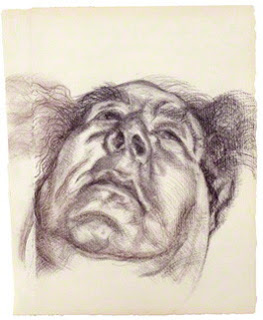
Arnold Abraham Goodman, Baron Goodman by Lucian Freud, charcoal, 1985, 13 in. x 10 1/2 in. (330 mm x 267 mm), Given by Connectus Komonia Trust, 1986, Image courtesy of the National Portrait Gallery

Arnold Abraham Goodman, Baron Goodman by Lucian Freud, charcoal, 1985, 13 in. x 10 1/2 in. (330 mm x 267 mm), Given by Connectus Komonia Trust, 1986, Image courtesy of the National Portrait Gallery

So many artists who dare to draw.  They inspire the rest of us to aim for the high wires, even if the drawing only succeeds once in a while.  But the more one draws, the more it becomes part of one's psyche.    After all, as Keith Haring observed, "drawing is basically the same as it has been since prehistoric times.  It brings together man and the world.  It lives through magic."

No Boundaries for Art by Jeannine Cook

As I spent a magical morning in the Ridola Archaeological Museum in Matera, South Italy, last summer, I was enthralled by the freshness and complexity of many of the images on the Greek ceramic vessels on display. Since the Greeks had been coming to Southern Italy since the 10th century BC, huge numbers of ceramics have been found, often totally intact, in different archaeological digs in the area. Some of the pieces were imported from Greece, but many were created in Italy. 

 Detail from a Greek vase, Apulia, Italy, 4th century BC

 Detail from a Greek vase, Apulia, Italy, 4th century BC

Red figure Greek pottery, Matera

Red figure Greek pottery, Matera

As I wandered, entranced, I remembered reading that many ancient Greeks, such as art critic and writer Philostatus, thought of art as a continuation of our world, the space within which we live and breathe. There were no boundaries between art and the world; the figures existing in contemporary art or on the pottery surfaces  might have been imaginary, but they were as real to the Greeks as film characters are real and believable to us today as we watch a film. In other words, art was viewed as an extension of reality. No wonder so many of the figures, fish, birds and other creatures in dynamic movement around those red-figure vessels I was seeing in Matera seemed so arresting.

Three sea-perch and three limpets. Apulian red-figured fish-plate, ca. 340–320 BC.

Three sea-perch and three limpets. Apulian red-figured fish-plate, ca. 340–320 BC.

That long heritage, from the Greeks and from earlier artists working on cave walls, rock faces, in Mesopotamia, China, India or Egypt, has always involved realism in some fashion. Art has blurred the boundaries between the  imagined world, the depicted world and the real world; man has always expected the viewer to have "leaps of faith".  Today, artists grapple with the same issues. What a visual artist sees and experiences gets distilled and translated into images that go beyond the range of verbal description.

Noted artist Michael Klein was quoted as saying, "Painting realistically is a means to an end." What he is interested in creating is the visual image that was the basis for the feelings he wants to express - the boundaries of reality and art flow through the artist's brain and hand in seamless fashion. Developing a visual language implies that an artist looks hard and learns to see things for what they really are.  

In the same way, according to sculptor and artist, Lee Ufan of Korea,  boundaries between art and reality can be eliminated by "allowing the relationship among the viewer, the materials and the site to stand in for the experience of art" (Alexandra Munroe, Guggenheim curator, writing in Art & Auction, May 2010). Ufan  makes the art object "disappear" so that the art becomes "a fluid and dynamic event occurring in real time and space".

Ufan talks of "the art of encounter". Mankind has been blurring the lines between reality and the art encountered since time immemorial.

Respect in the Art World by Jeannine Cook

As I listened to the PBS NewsHour  December 5th, 2012 programme this evening, Jeffrey Brown was  interviewing George Wein, founder of the Newport Jazz Festival, about Dave Brubeck who has just died.  One of the final descriptions of this wonderful Jazz musician impressed me greatly.  Mr. Wein said that Dave Brubeck was "the ultimate in elegance and excellence."  He apparently respected everyone, musicians, his family, the promoters and producers that worked with him, and he respected his public.  By communicating respect to everyone, he in turn was respected and loved.

Dave Brubeck, 1920-2012

Dave Brubeck, 1920-2012

I began to think about this mutual magic of respect that helped make Brubeck such an icon on the 20th century music world.  It seems to me that we can all learn about respect in the art world, as artists and as participants in every other way.Only this morning, I had a remark made to me at the beginning of a life drawing session about respecting other artists and the model by being on time.  Respect, consideration, courtesy - all aspects of being a professional, civilised human being, an artist.

In other words, Dave Brubeck's example served to remind me about the old adage, "do as you would be done by", part of the Golden Rule.  A good rule for us artists.

Watercolor Magic by Jeannine Cook

Mary Whyte is a watercolourist whom I have long admired, ever since I saw her work at her husband's gallery, Coleman Fine Art, in Charleston, South Carolina.  It was thus a treat to be able to see a large body of her work, Working South, currently on display at the Telfair Museums in Savannah, Georgia.

Trap, Crabber, Pinpoint, GA, watercolour on paper, 2008, 30 x 38, image courtesy of Mary Whyte

Trap, Crabber, Pinpoint, GA, watercolour on paper, 2008, 30 x 38, image courtesy of Mary Whyte

The exhibition apparently grew out of one of those lucky coincidences and flashes of inspiration: she was painting a portrait of a Greenville banker and they were commenting on the number of lay-offs announced in the local textile mills.  A chance reply to her about the fact that in ten years, all the mills would be gone sparked the idea to record and paint people who were working in the large number of disappearing occupations; from crabbers and textile mill workers to loggers and small hog farmers.  Mary Whyte set out to find and paint workers in these different worlds in the South.  Three years of work produced the exhibition now at the Telfair.

There is a felicitous mixture of large finished watercolour paintings and the small studies and preparatory drawings on display.  It is always good to see how careful preparations and study, learning about the people, the places, the look and feel of a subject, with accompanying journal notes, small drawings and paintings, help ensure a good result in the final work of art.  It is a salient point we all ought to register as artists!

New Year, watercolour painting of a milliner from Atlanta, GA; 2009, 22 1/2 x 29, image courtesy of Mary Whyte

New Year, watercolour painting of a milliner from Atlanta, GA; 2009, 22 1/2 x 29, image courtesy of Mary Whyte

What is also fascinating and impressive about these watercolours is their combination of tight realism in faces, hands and arms for each portrait, and then the fluid, abstract use of watercolour's rich capacity to meld and swirl billows of colour in other parts of the painting.  Underpinning all this skill is, in each case, a sense of dramatic, arresting composition, an arrangement of shapes that goes to the essence of the occupation or industry Whyte is depicting.

Crossing, Ferryboat captain, Valley View, KY, 2009, watercolour, 15 x 30, image courtesy of Mary Whyte

Crossing, Ferryboat captain, Valley View, KY, 2009, watercolour, 15 x 30, image courtesy of Mary Whyte

Eclipse, tobacco farmer. Gretna, VA, watercolour, 2009, 22 x 30, image courtesy of Mary Whyte

Eclipse, tobacco farmer. Gretna, VA, watercolour, 2009, 22 x 30, image courtesy of Mary Whyte

One of the most interesting of these paintings, for me, was this highly evocative depiction of elderly musicians marching to honour the dead in this Miami, FL, cemetery, a custom that is almost gone.  Whtye's ability to go from tight, detailed realism to the most diaphanous of "mists" of colour, melding bodies and ground, with the mighty banyan tree as abstract counterpoint, was impressive.

Pilgrimage. Funeral band, Miami, FL. watercolour, 2009, 39 x 48, image courtesy of Mary Whyte

Pilgrimage. Funeral band, Miami, FL. watercolour, 2009, 39 x 48, image courtesy of Mary Whyte

Perhaps the most valuable remark - for fellow artists as well as for viewers -  that Mary Whyte makes in the book accompanying the exhibition, Working South; Paintings and Sketches by Mary Whyte, is :  "true art is not about copying. Every painting is an invention.  Each painting we make is about our observation and the feeling about what we are seeing.  Not one painting represented in this book is exactly what I saw, but each is exactly what I felt." (page 8)

This exhibition is well worth visiting - several times!

Patterns of Nature by Jeannine Cook

I am finding that patterns are becoming more and more fascinating to me as I function as an artist.  I suppose I have always had a love of nature's order and patterning - in seed pods, striationson tree bark, flower petals and leaves, in the way shadows fall on surfaces, how rocks are distinctively formed, how sands get ridged and shaped by water or wind. 

Patterns in the Sand

Patterns in the Sand

Now, however, I am more and more aware of the amazing power of patterns - in life in general and in art in particular.  Take a look at a fascinating website on the Fibonacci Numbers and see how marvellous all these patterns are.

 Romanesque cross between broccoli and cauliflower

 Romanesque cross between broccoli and cauliflower

I think my newfound passion for drawing in metalpoint on a black ground has fuelled my interest in patterns, for somehow this medium seems to lend itself readily to the seeming abstraction of patterns.  Living as I do in beautiful natural surroundings also helps me suddenly see new patterns which excite and inspire. Artists of all stripes seem to respond to the diversity of nature's patterns, from draughtsmen to photographers.

M.C. Escher’s 1938 woodcut entitled “Sky and Water 1”

M.C. Escher’s 1938 woodcut entitled “Sky and Water 1”

My small drawings of nature's patterns are often of tree bark and wood grains.

Jacaranda bark - silverpoint, Jeannine Cook artist

Jacaranda bark - silverpoint, Jeannine Cook artist

Rings of Time: Wood grains - silverpoint, Jeannine Cook artist

Rings of Time: Wood grains - silverpoint, Jeannine Cook artist

Eucalyptus bark - silverpoint, Jeannine Cook artist

Eucalyptus bark - silverpoint, Jeannine Cook artist

The rewards of looking closely and attentively at nature to see these myriad complex and magical patterns are endless.  History is full of artists who have found patterns to be a wonderful source of creativity - just think of Van Gogh, for a start!

Detail of Vincent Van Gogh's Starry Night, 1889, Image courtesy of The Museum of Modern Art, New York

Detail of Vincent Van Gogh's Starry Night, 1889, Image courtesy of The Museum of Modern Art, New York

Artists' Generosity by Jeannine Cook

When I was hanging my art, alongside my friends, in our joint exhibition, Eight Reflections, today at the Hinesville Area Arts Council Gallery, part of the celebration, for me, was generosity of spirit.

Japanese Kanji symbol for Generosity

Japanese Kanji symbol for Generosity

As all of us tried to help each other in the art gallery as the work was organised and hung, I kept noting how thoughtful and generous each artist was with the others.  It made for a very nice couple of hours as we worked.

I was reminded of an interesting snippet I read about Michelangelo.  Apparently he frequently lent his artist friends detailed studies that he had drawn to help them with their own paintings.  As David Galloway commented in his ArtNews review of "Michelangelo" the Drawings of a Genius" at the Albertina, this generosity of spirit was testimony to the "generous humanism that so vividly animates his work as a whole."

Study for the Head of Leda," Michelangelo, circa 1530. Red pencil on paper.  Image courtesy of  the Casa Buonarroti, Florence, Italy

Study for the Head of Leda," Michelangelo, circa 1530. Red pencil on paper.  Image courtesy of  the Casa Buonarroti, Florence, Italy

Perhaps we all should remember that our character and optic on life in general comes through in our art, whether we like it or not.  I think we can all think of artists whose work sings of a generous spirit, and others who definitely seem to lack that warmth in their work.

Mysteries of Art-making by Jeannine Cook

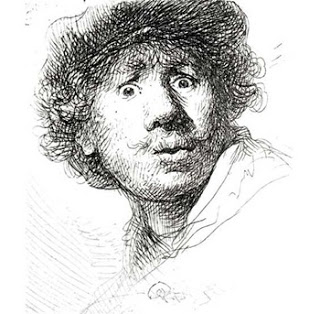
The mysterious process of creating art never ceases to interest and amaze me.  An artist's adaptability to circumstances is a vital ingredient in this mix, and one that tests the seriousness of resolve to create.  Somehow this self-portrait by Rembrandt expresses some of what I am trying to say.

Self Portrait with a Cap, open-mouthed. 1630. Rembrandt Harmensz. van Rijn. Image courtesy of the Rijksmuseum

Self Portrait with a Cap, open-mouthed. 1630. Rembrandt Harmensz. van Rijn. Image courtesy of the Rijksmuseum

Depending on the circumstances, an artist can find totally different sources of ideas and inspirations for art.  A simple example is when one is working plein air, versus working in one's studio and relying on very different sources than the outside world.

High Point, Sapelo Island, watercolour, Jeannine Cook artist

High Point, Sapelo Island, watercolour, Jeannine Cook artist

High Point Dance, metalpoint, Jeannine Cook artist

High Point Dance, metalpoint, Jeannine Cook artist

I did both of these pieces of art when I was working on Sapelo Island, one of the magical Georgia barrier islands fronting the Atlantic Ocean.  They were done almost in reaction to that small voice inside my head, saying 'this is a scene which could be the source of a painting or drawing'.  Of course, once that decision is made, then comes the endless actions, reactions and alterations that are part of my art-making.  Working in the wind and sun, with changing conditions, an artist adapts according to the moment, trying to push through on the original idea and inspiration, and yet trying, at the same time, to end up with a respectable piece of art.  Incidentally, both watercolour and metalpoint are rather unforgiving media for changes and alterations, especially when drawing in different metals (silver, gold, copper, etc.).  It makes for interesting, if not challenging moments during the process of art-making!

By contrast to the concepts and reactions to working outdoors, en situ, there is the work in the studio, when an artist can draw inspiration from a myriad sources, in the head, from ideas derived from the wide world outside, from music, from reading, from films or television, from one's family and its history, from politics... an endless reserve of triggers that suddenly spark an idea for a piece of art.  In some ways, the work created in the studio is far more controllable, even if it is complex to execute.  Normally, you don't have to battle the weather, light constraints, travel, insects, etc. that you encounter often outside. 

Perhaps the only "constraint" in the studio is cultivating what Paul Cézanne talked of: "genius is the ability to renew one's emotions in daily experience".  You have to keep fresh, alive, thinking and reacting, to find that springboard to a new venture in art creation.  How that trigger comes is often, to me, totally mysterious, but again, I find that that mysterious small voice at the back of the head speaks when one least expects it.  Ironing, day-dreaming, a walk - meditative, repetitive jobs all help. Dare yourself to try another medium, another voice, another subject that you have not embraced before. Even an idea that is not perhaps initially the most inspired can evolve and become something special, something significant.  Whilst sustained hard work can yield results, there are times when other considerations in life - family, illness or whatever - have to be factored in.  In those cases, creating art can go on, even if only in your head, for a while.  Allow yourself to follow different work rhythms at those times, for ultimately, you will get back to inspiration and art-making, perhaps with added depth and ideas.

Basilicata # 2, silverpoint, Jeannine Cook artist

Basilicata # 2, silverpoint, Jeannine Cook artist

Basilicata #5, silverpoint/goldpoint, Jeannine Cook artist

Basilicata #5, silverpoint/goldpoint, Jeannine Cook artist

These were two drawings I created in the studio, long after I had returned from an art residency in South Italy.  The seeds were sown there, the inspiration came later when I was looking back at drawing books and notes I had made there.

Inspiration comes in such magically mysterious ways, often by different routes, but every artist becomes attuned to his or her paths to art-making.  Trusting one's inner voice, believing in oneself and keeping one's antennae up high are all ingredients in these mysteries.

The Dynamics of a Blank Piece of Paper by Jeannine Cook

We artists have all faced the blank sheet of white paper or canvas, time and time again. It can be a daunting moment. Yet it can also be the start of a fascinating balancing act, whose dynamics hark back to the earliest cave drawings, the origins of calligraphy and the vast heritage of both Eastern and Western art-making.

"Tabula rasa"

"Tabula rasa"

Some while ago, I found a marvellous statement by the wonderful British artist, Rebecca Salter,about the state of a piece of paper. She talked of an old Chinese saying that "a piece of paper is not empty until you have made the first mark", a saying which underlines the dynamics between a mark that you make on that paper and the blank space around it.  She continued by saying that "the word 'blank' is, however, misleading as the space, instead of becoming a space of nothingness, is 'activated by the presence of the drawn or painted mark".

This concepts seems to go to the very heart of composition, of a sense of balance and fitness of the symbiotic relationship of the marks placed on that surface.  It also ensures that your particular style, your hallmark as an artist, will be evident from the dynamics of your choices of marks made on that blank sheet of paper.

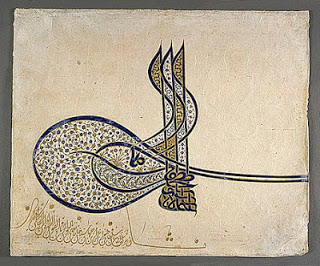
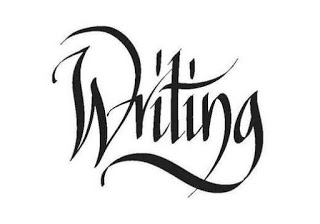
Calligraphy, from all traditions, has been based on this concept of dynamic balance on the page.

Japanese calligraphy

Japanese calligraphy

Ottoman tugra of Suleiman the Magnificent,1520, with flowers and saz leaves

Ottoman tugra of Suleiman the Magnificent,1520, with flowers and saz leaves

Present-day Western calligraphy

Present-day Western calligraphy

These examples from different types of calligraphy are wonderful examples of the dynamics that can be created on a black piece of paper. However, we can all be mindful of those potential relationships that we can work with when we face that sheet of paper.

Creating Art: Staring until your Eyes Pop by Jeannine Cook

Vincent Van Gogh,Self-Portrait, 1889, Image courtesy of the National Gallery of Art

Vincent Van Gogh,Self-Portrait, 1889, Image courtesy of the National Gallery of Art

Author Simon Schamaused this wonderful phrase about Vincent Van Gogh, in his book, "The Power of Art".Schama talked of Van Gogh seeking to create art that was imbued with the "visionary radiance" that previous generations of artists had found in Christianity.  To achieve this source of light and inspiration that could reach out to fellow men, Van Gogh's approach was painting with "blood and blisters and staring until your eyes popped" (my emphasis).

Even though Van Gogh did not necessarily follow the time-honoured rules of perspective, colour usage or subject-matter, he sought to give his art a different, more open view of life that embraced nature in all its aspects.  His pulsating interpretations of trees, fields, and flowers show powers of observation that amaze. Catching the clouds, the light, the motion of the wheat, or, in the Olive Grove below, the silvery dance and form of the olive trees - all that requires great, tenacious powers, first of observation, then of organisation and simplification.

Wheat Field with Cypresses, Van Gogh, 1889, Image courtesy of the Metropolitan Museum of Art

Wheat Field with Cypresses, Van Gogh, 1889, Image courtesy of the Metropolitan Museum of Art

Olive Grove, Van Gogh, 1889

Olive Grove, Van Gogh, 1889

Every artist, especially those working with aspects of the world around him or her, knows that observation is key to understanding and thus depicting a subject.  It does not necessarily have to  be a realistic depiction either, just as in Van Gogh's case.  Nonetheless, staring and staring at your subject always brings rewards; you keep noticing fresh aspects, you learn how things interlock, how things work, where the light falls, how shadows shape things. In this month's Artist's Magazine,for instance, in an article on still life artist Eric Wert, he is quoted as spending long hours "trying to get to the reality of a particular element.  'But once all the data are there that makes something look real,' he says, ' I step back and let it become its own creature, develop its own personality.  I'm open to what the subject can start to tell me.' "

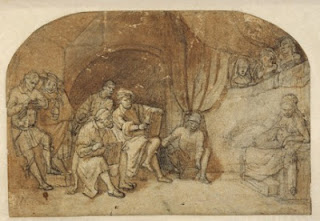
Another time one needs to stare, stare and stare some more is during life drawing.  As soon as an artist begins to draw from a live model, the conversation begins between eyes, hand and the model. The subtleties of light on skin, the delicacy of muscles in tension or at rest, the twist of limbs or torso only reinforce the need to look and understand.  Only with that understanding comes the freedom then to simplify, edit and create works that are powerful.  Take but one example - Rembrandt:

Constantijn Daniel van Renesse,, Rembrandt and his Pupils drawing from a Nude Model. c. 1650, Image courtesy of Hessisches Landesmuseum, Darmstadt

Constantijn Daniel van Renesse,, Rembrandt and his Pupils drawing from a Nude Model. c. 1650, Image courtesy of Hessisches Landesmuseum, Darmstadt

Rembrandt, Study of Female Nude seen from the Back, 1630-34, Image courtesy of the Courtauld Institute, London

Rembrandt, Study of Female Nude seen from the Back, 1630-34, Image courtesy of the Courtauld Institute, London

In other words, as the old English saying goes - "Open your peepers"! Your art will thank you.

Art and Cooking by Jeannine Cook

A story in today's NPR All Things Considered about cooking a Tuna Noodle Casserole started with a statement that immediately had me making a parallel with art.  Melissa Gray was citing food editor and author Ellen Brown discussing her recipe for this dish.  She started by quoting Ellen Brown saying that many food professionals claim that we eat with our eyes first. Brown however disputes this claim and thinks that it is not with our senses that we approach food, but with our emotions.

I think that the same order of priorities often comes to play when we approach art.  Long before we start looking at paintings or drawings, for instance, we are in a mood and frame of mind to look at art. In many cases, we make a conscious decision to go to an art museum or an art gallery. So we have already elected to go in a frame of mind that is open to viewing art, for reasons that range from experiencing beauty to learning about an artist's work, or, on occasions, to purchasing a work of art. Of course, there are other times when we round a corner, or just happen on, a work of art that stops us in our tracks.  But bound up with the visual experience always comes a rush of emotion - interest, delight, surprise, incomprehension – a full gamut of reactions or emotions is possible.

Only after that first visceral reaction do we start to use our eyes to study the work of art and understand more about it.  Perhaps then the same effect can happen as occurs when we have a plate of attractively presented food placed in front of us.  Colour, shape, texture, form – all count at that point.

But I think Ellen Brown has a point: just as we associate a certain dish that we know with pleasant past experiences (or the reverse!), so we associate certain artists' works with previously experienced emotions positive or negative.  For most people, "Claude Monet" means beautiful Impressionist landscapes that radiate luminosity and delight the viewer. 

The Manneporte (Etretat), Claude Monet, oil on canvas, image courtesy of The Metropolitan Museum of Art, New York

The Manneporte (Etretat), Claude Monet, oil on canvas, image courtesy of The Metropolitan Museum of Art, New York

Antibes vue de la Salis, Claude Monet, 1888, image courtesy of the Toledo Museum of Art, Ohio

Antibes vue de la Salis, Claude Monet, 1888, image courtesy of the Toledo Museum of Art, Ohio

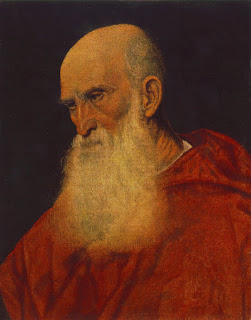
The name, "Titian", conveys to many viewers a sense of marvel and admiration at extraordinary portraits, long before one's eyes can feast on the skill and virtuosity with which he depicts his subjects. 

Portrait of an Old Man (Pietro Cardinal Bembo), Titian, 1546 ,Image courtesy of  Museum of Fine Arts (Budapest)

Portrait of an Old Man (Pietro Cardinal Bembo), Titian, 1546 ,Image courtesy of  Museum of Fine Arts (Budapest)

"Rodin" means wondrous, sensuous, powerful shapes sculpted in plaster, marble or bronze; it is only later that our eyes can tell us exactly how and why we find his work so memorable.

Eternal Springtime, Auguste Rodin, 1880-1901, image courtesy of Museum of Fine Arts, Budapest

Eternal Springtime, Auguste Rodin, 1880-1901, image courtesy of Museum of Fine Arts, Budapest

Emotions and/or senses – basically Ellen Brown is talking about the same important ingredients of life as we all are - enhancing and celebrating life through beauty, interest, taste. Both cooking and art help us get though each day with  enjoyment.