Positive Aspects of Art by Jeannine Cook

I was reading an interview done with designer Rachel Roy, about her collections and designing clothes.  She was visiting Valencia at the time, and was featured in Diario de Mallorca.

One of her remarks rang so true, for any artist.  She said, "The positive thing about art is that you need to know how to tell your own story, always respecting what you are doing and as well, what others are doing."

I thought it was so simple an observation and so accurate.  It goes back to the issue of one's own personal style as a visual artist, how to achieve it by being true unto oneself, and yet being aware of what one is doing, or trying to do, at the same time as keeping one's eyes open to the world, and art in particular, around one. She went on to say in essence that one should also be fair to oneself, and basically not worry about criticism too much.

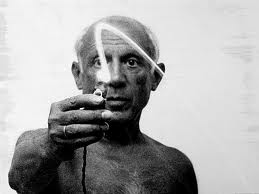
Certainly, if one is working seriously and thoughtfully, keeping one's focus on what matters personally and what one is trying to say in the art - or letting the art say things for one - then that is telling your own story. As Picasso remarked, "Painting is just another way of keeping a diary."  I think that the "diary entries" and our stories become universal many times without one realising it, and they thus resonate with others, often in ways that the artist cannot foresee.  

Pablo Picasso

Pablo Picasso

In these times of angst, it is interesting to see how many voices are raised about the importance of art - of all kinds - that helps engender curiosity and expansion of the human spirit.  Since each of us is an individual, with individual experiences, those personal stories enrich everyone's life and widen each person's optic on the world around us.

Rachel Roy gave a timely reminder of how positive art can be for us all.

"Crossed Gazes" by Jeannine Cook

Obra Social "La Caixa", the cultural foundationbelonging to the Spanish bank, La Caixa, offers wonderful, often thought-provoking art exhibitions in its different venues throughout Spain.  In CaixaForum Palma, in the Balearic Islands, there is an interesting exhibition currently on display, "Crossed Gazes".

It is a selection of works owned by La Caixa Foundation and the MACBA Foundation from Barcelona. Realistic art from the 1950s and 60s is juxtaposed with abstract work from the 1980s and 90s. Theshow uses paintings, some sculpture and photographs to examine how artists saw the world during those decades and how they chose to express what they felt about their realities. There are works by artists as varied as Sigmund Polke and Anselm Kiefer, Joan Miro, Henri Michaux, Antoni Tapies or Philip Guston, Jean Dubuffet or Edouardo Chillida.Many photographs were included, often black and white (Brassai, Robert Frank or Xavier Miserachs for the earlier decades) and in colour, usually of huge format for the later decades (Andreas Gursky, Hiroshi Sugimoto or Thomas Struth amongst others).

I personally found the title of the exhibition a little ironic, as my reactions to the art, as I walked through the rooms, were those of someone with a personal set of "crossed gazes".  It so happened that the previous day, I had spent a magical day by myself in the countryside, working plein air, drawing and marvelling at the complex, expansive beauty of the countryside and the amazing abstractions within the natural world around me.  Abstractions of form in trees and their bark, the lay of the land, types of stones and their patterns – things which I found fascinating to observe.

Consequently, when I walked into the CaixaForum exhibition the following day and began to look hard at the works of art on display, I found myself getting almost claustrophobic.  The massive paintings of the  80s and 90s, the Kiefer, the Miquel Barcelo or the one by Juan Usle, bore down on me in a way I had not expected - they seemed airless and pretentious.  This surprised me as I usually find that particularly Barcelo's and Anselm Kiefer's work interest and often move me.  My reaction made me realise afresh that large paintings are not my favourite format - I relate far more comfortably to work of "human" size, works that are more intimate and draw one in to a closer look.  I think that we have been, and still are, living in an era when public spaces have required huge works of art, and somehow the intensity of such work is diluted and lost. My personal gaze finds that art on a smaller scale is often a far greater test of quality and veracity - bombast can cover a lot of sins, verbally or in art.

My disappointment - at myself especially - continued when I went on to the rooms covering the 50s and 60s.  There, the art was indeed of a more human scale, often quite small in size.  The photographs were full of impact, and also of historic interest, of course.  Nonetheless, the abstract art seemed a little disassociated from anything that I could relate to today; gone - thankfully - is the angst that the aftermath of the Spanish Civil War and the Second World War generated in artists who were striving to distance themselves from those particular awful realities.  There was, nonetheless, a feeling of almost desperate creativity in the work that seemed almost forced, a "we have got to do something totally different from anything done before" feeling.  In a way, that is always a sub-text of each decade in the art world - we all strive to be different and innovative.  However, the overall effect of my "crossed gazes" was somewhat depressing in that all these talented artists' works were just not "talking to me" that day!  
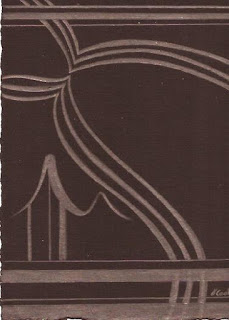
Philip Guston, Untitled (1968). and Tower (1968)

Philip Guston, Untitled (1968). and Tower (1968)

Philip Guston,

Yet there were truths in some of the work that resonate constantly.  One commentary, of three 1967 ink on paper drawings by Philip Guston - Mark, Edge and Horizon, interested me. They were very minimalist lines on paper, like the ones illustrated above, to some extent. However, the curator's commentary for them ran as follows (in Spanish and a mixture with my English translation):

La materia misma de la pintura - su pigmento y su espacio - se resiste mucho a la voluntad, se siente muy poco inclinado a reafirmar su plano y permanecer inmovil.  La pintura parece una imposibilidad, solamente con un signo de su propria luz de vez en cuando.  Lo cual seguramente se debe al estrecho pasaje entre el diagramar y ese otro estado, la corporeidad.  En este sentido, pintar es poseer, mas que imaginar.

The very essence of painting - its pigment and space - is so resistant to the will, so inclined to assert its plane and remain still.  Painting seems an impossibility, with only a sign now and then of its own light.  Which must be because of the short passage from being a diagram to that other state - taking physical shape. In this sense, to paint is to possess rather than to imagine. 

Concepts to ponder as I sort out my gaze from the "Crossed Gazes" of the exhibition.  Perhaps it means a return visit to the CaixaForum!

Individual Voices in Art by Jeannine Cook

Every time an artist has to interact with a gallery owner, a competition judge, a collector or the public, there are some implicit questions lurking at the back of the artist's mind:  is my art individual enough, does it stand out as different from the art created by others, will it retain my hallmark and stamp?

Every choice made in creating a work of art carries those implications and questions, even if we don't consciously think about them as we work.  Willy-nilly, the work of art will reflect who the artist is, even in commissioned work. Works of art are about things, people and places seen and remembered, with the resultant interpretation of what the eyes have observed, and the brain imagined, thought about and interpreted.  Thus each artist, as an individual, can develop that unique voice.  As Yeoh Guan Yong, of Shanghai's Super Nature Design, said, "Art is about finding individual voices and searching one's own heart and soul."

To do this requires an artist to be lucid about him or herself, honest and observant, in fact.  That little inner voice needs to be respected, and the ability to do this only comes with experience and active effort.  I was thinking about this development that every artist has to achieve as I was reading a wonderful new biography about Titian, Titian: His Lifeby Sheila Hale.  She brings out the fact that this quiet, elegantly behaved artist was observant and dedicated in his art, adapting examples from other artists to enrich and improve his own art, yet remaining very much in his own idiom as he developed into the great artist that he became.

Man with a Glove.  Image courtesy of Musee du Louvre, Paris

Man with a Glove.  Image courtesy of Musee du Louvre, Paris

Portrait of Gerolamo (?) Barbarigo (?), Image courtesy of  The National Gallery, London. Bought, 1904 © The National Gallery, London

Portrait of Gerolamo (?) Barbarigo (?), Image courtesy of  The National Gallery, London. Bought, 1904 © The National Gallery, London

Titian's portraits, as in the examples above,with their powerful simplicity and psychological penetration, also demonstrate the other maxim that we all need to remember, as practising artists: "Simple is not always best, but the best is always simple." Only when we refine and refine our art to be true unto ourselves can we hope to achieve a voice that others can recognise as ours and ours alone.  That is a lifetime occupation!

Cutting Funds for the Arts by Jeannine Cook

Government and other bodies turn to cutting funds for the arts again and again. It is an almost monotonous - but oh so sad - "official announcement".  I was reminded forcibly of this as I read headlines this week in the Spanish press about more cuts in the arts budgets, and at the same time, that Emory University in Atlanta, Georgia, is considering closing its Visual Arts Department.  Just two small examples of this continual drumbeat of cuts to lessen any country's chances of a cultured, civilised society within its borders and beyond.

The powers that be find it easy to forget that the arts get people involved in science, mathematics, geometry, history, language, social sciences in general, and on and on. You find this out in spite of yourself any time you engage in art-making or art viewing, whether you conscientiously realise it or not.  Everyone in power mouths platitudes about wanting their country's inhabitants to be better educated, to be able better to face a far more complicated future in the ever-expanding global marketplace.  Yet the optics on how better to ensure a suitable education to achieve well-rounded, versatile and competent human beings seem to become narrower and more impoverished in so many instances.  The image below, courtesy of the Guardian newpaper in the UK, says it well.

Artists Mark Wallinger, left, David Shrigley and Jeremy Deller, right, lobby cent cuts in arts funding, in London, September 2010. Photograph: Alastair Grant / AP

Artists Mark Wallinger, left, David Shrigley and Jeremy Deller, right, lobby cent cuts in arts funding, in London, September 2010. Photograph: Alastair Grant / AP

I could not help thinking about how I would cope in life if I had not had the good fortune to be introduced, as eary as possible, to the arts.  In East Africa, museums, concert halls, and art galleries were virtually non-existent when I was growing up, but that did not prevent my being taken to the wonderful top art and natural history museums when I first went to Europe at the age of five, as well as to ballet performances, concerts.  Soon afterwards, theatre-going was also introduced, while my reading included wonderful illustrated books, full of beauty. Had I not started out in this way, I would now find daily life far more limited, more complicated.  Just a small example: in the process of redoing a bathroom, the multiple choices one has to make of tiles, faucets, styles of hand basin, finish of towel rails, etc., would be so much harder had I not been allowed to develop an innate sense of style and design.  My own style and design, of course, for each of us is an individual: nonetheless, an ensemble which ultimately produces an effect, a statement, a type of bathroom. The interesting thing is that other people then also can relate to those choices made, because, when said and done, there is an underlying tissue of culture uniting us, a tissue that can be fostered and improved when people can have access to examples of the different arts.

Just to carry my example a little further about the bathroom:  if people have been given a decent grounding in the arts during their education, they then have far more confidence in themselves when it comes to making esthetic choices.  When decorating their home, for instance, it would not be so necessary to call on the services of interior decorators (not that I have anything against interior decorators for they perform valuable services), simply to feel comfortable about the choices they are making.

Ultimately, having access to education about and exposure to the arts in general empowers people.  At a time when individuals need all the tools and knowlege we can muster to push back against abusive power structures, it seems almost machaevellian to cut funding for the arts.

"Nothing Ugly in Art" by Jeannine Cook

Auguste Rodin asserted that "There is nothing ugly in art except that which is without character, that is to say, that which offers no outer or inner truth." (Remember that the very first sculpture he submitted to the Paris Salon was The Man with the Broken Nose, a sculpture that was the essence of what people normally considered ugliness, not only in the subject it portrayed, but also in the way the sculpture was executed, with an emphasis on the emotion of the piece and its rough, unfinished nature.)

Rodin, Man with a Broken Nose

Rodin, Man with a Broken Nose

Yet Rodin was, in effect, setting out on a course of teaching his viewers about a new vocabulary of art, a one that was more relevant to the time in which he lived, one that was truthful and more meaningful to his age. Perhaps every artist does the same thing, consciously or unconsciously. The miracle is that viewers, down the ages, seem to learn from artists how to enter into a dialogue, refocus their eyes and learn to adjust to what seemed ugly, jarring or strange before. That readjustment on the part of viewers represents the ever-renewing pact between artist and viewer.

I have just had my wonderful website wizard, Tracie of Traceable Creations, refresh the images on my website, http://www.jeanninecook.com, and I was reminded of what Rodin said about nothing in art being ugly as I looked at the Drawings page. 

Without realising it, I seem to be depicting more and more trees, tree bark, strange tree formations. All things which even I, years ago, might have hesitated to describe as beautiful. Now, however, I find them compelling, complex and highly eloquent – eloquent about the life those trees have led, the storms they have weathered, the droughts they have endured. They have become, for me, metaphors for a lot of what is happening to people all around, whose lives that have become even more complex and taxing than ever.

The inner truths about all these trees I find so fascinating are there to read if we want. They adapt, they endure, they grow in grace.  The scars of their lives add to their interest and individuality, their growth is logical yet idiosyncratic. Even in death, they are amazing.

Just like Rodin's Man with the Broken Nose, the trees all around us can be totally memorable. It makes me feel even more acutely that we need to be good stewards of all aspects of nature. Our daily lives can be so much more magical if we remember that there is nothing really ugly in nature, nor in art. It just depends on the focus of our mental and physical eyes.

"Cannibalising" the World by Jeannine Cook

Joan Miro famously once remarked that "That magical spark is the only thing that matters in art".  In other words, he noticed and absorbed everything imaginable around him in his life, cannibalised it and transformed it into art, especially in his sculptures.  The most amazing things became part of his art, from his children's toys to the famous paper bag which caused one of his foundries to exclaim, "You expect us to cast a paper bag?"  The answer was yes, in bronze!

Miro - sculpture, image courtesy of Jeff Epler

Miro - sculpture, image courtesy of Jeff Epler

To me, the lesson Miro gives us all is that as artists, we have to be open to every possible resource, every possible influence, because from it, and usually from the most unlikely of instances, comes the spark that leads to creation of something new in our art.

We all know about those moments when we pass something which is part of our daily life and which, until magic suddenly happens, has been unremarkable.  Then, unexpectedly, the light falls on the object in a certain way, or there is a new relevance to it because of something else going on in our head, whatever.  Then the "cannibalising" happens, and we can incorporate a new dimension into what we are creating.

Other times, the world becomes fresh and exciting because of a visit to somewhere new, which talks to one.  That little voice inside one's head says, "Pay attention, this is important", even though, at the time, you don't really know why.

This happened to me in Matera, South Italy, when I was looking at Neolithic shards of pottery in the Archaeological Museum.  They fascinated me, and I draw a lot of them, something I normally don't think of doing.  But as I drew them, I began to realise I was linking back to early artists who had, in their turn, looked around them in their world and cannibalised images from what they saw.  This was a link of many thousands of years, a fact which made an even greater impression on me.

Once home again, I realised that these notations that I had made were potentially the basis of a series of silverpoint drawings.  I was cannibalising on the world I had encountered in Matera, in essence.  This is one of the drawings.

Basilicata # 3 - silverpoint, Jeannine Cook artist

Basilicata # 3 - silverpoint, Jeannine Cook artist

Thanks to those artists working aeons ago, I started doing work that is totally different from my normal drawings.  Sometimes it is definitely fun to be a "cannibal of the world".

More Thoughts on "White Page Fright" by Jeannine Cook

Having blogged about the situation that all artists encounter, sooner or later, of having "white page/canvas fright" and being unable to get going on creating a piece of art, I discovered that the blog resonated with people. 

What I had not expected was to find that Eric R. Kandel, in his superb book, "The Age of Insight" (about which I have previously written), indirectly addressed this situation.  Discussing why unconscious thought, or distracted thought, helps creativity, Professor Kandel cites studies carried out by Ap Dijksterhuis, a Dutch social psychologist, and his colleague Teun Meurs, which show that we all work best in terms of creativity when we don't consciously think about the problem.

Three groups of people were asked to perform various mental tasks, lists of activities or places, for instance. The people had to generate the lists immediately, after a few minutes of deliberately thinking about the lists or after a few minutes of being distracted by doing something else entirely.  Surprise, surprise – the groups all made the lists required, but the group that had produced the lists after being distracted, and thus being made "unconscious thinkers", made lists that were far more creative, interesting and full of differences.

So all those "strategies" of tidying up one's studio, taking the dog for a walk, ironing shirts, or whatever - are totally valid means of becoming creative. Artists have found all this for themselves, but it is interesting that carefully quantified studies validate all these strategems for becoming creative.  Professor Kandel details out the many insights into unconscious processes happening in the brain, and how it all works (pp.470-71).

As he states,  "distraction, letting the mind wander, may not only encourage unconscious (bottom-up) thought, but also, as evidenced by the emergence of a new solution, recruit a new top-down process from memory storage."  In other words, relax - the inspiration will come for that next work of art - when you least expect it.  But it will come - just trust that wonderful complex brain of yours!

More Thoughts on Art Residencies by Jeannine Cook

I wrote about Art Residencies on 13th August, when I had just returned from a Residency in South Italy.  As life accelerates again, that experience is receeding a little into the past, although I am still creating art inspired by that visit.

Nonetheless, as I was reading the wonderful Eric R. Kandel book, The Age of Insight.  The Quest to Understand the Unconscious in Art, Mind and Brain, I found a passage that seems to me to be really pertinent to art residencies. My thanks go to Professor Kandel for these insights and my using the quotes from his wonderful book.

KANDEL_AgeInsight-660x983.jpg

Professor Kandel discusses the essential prerequisites for creativity - in other words, what an art residency seeks to offer.  The basic requirements are "technical competence and a willingness to work hard" (page 456), according to the famed Viennese art historian, Ernest Kris, and psychiatrist, Nancy Andreasen. Those criteria are givens, I suspect, in every selection an art residency makes of artists who will spend time at the residency. It would not make sense to have people coming if they could not perform competently as artists, unless, of course, they are coming for courses that are offered.

The other prerequisites that Professor Kandel cites are: "(1) the types of personalities that are likely to be particularly creative; (2) the period of preparation and incubation, when a person works on a problem consciously and unconsciously; (3)the initial moments of creativity themselves; and (4) subsequent working through of the creative idea."

The mixture of individuals who are knowledgeable in a discipline, the different cultures in which each individual works and the social field when the person comes all combine to form a creative mix.  That, to me, is a good summary of the interest and rewards of an art residency when the artists are all serious professionals, from different walks of life and coutnries, but all willing to share ideas and experiences.  This was the situation I experienced in South Italy, and it made the art residency there a delight, despite drawbacks on the administrative side of the residency.

Art - Binding People Together by Jeannine Cook

One of the most fascinating books I have recently read is Eric R. Kandel's newly published book, "The Age of Insight.  The Quest to Understand the Unconscious in Art, Mind and Brain. FromVienna 1900 to the Present".  It is dense, interesting and challenging, as it details the many new discoveries of how the brain works and the many dimensions of humankind's involvement with art over millennia. There are so many aspects of the book that are worth talking about, but one short passage resonated with me because of my recent visit to South Italy, a place so rich in history.

In a chapter entitled "Artistic Universals and the Austrian Expressionists", Kandel delves into the large questions as to whether art has "universal functions and features" (p. 440).  He goes on to state that, "Since the artist's creation of art and the viewer's response to art are products of brain function, one of the most fascinating challenges for the new science of mind lies in the nature of art." The questions then multiply: do we respond to art because our biology dictates our reactions, do we respond to art instead as individuals with our own personal experience and taste?  Kandel refers to one opinion formed by Dennis Dutton, a philosopher of art, that art is not simply "a by-product of evolution, but rather an evolutionary adaption - a instinctive trait - that helps us survive because it is crucial to our well-being." (my emphasis)

Kandel goes on to allude to Cro-Magnon man painting those marvellous images in the Grotte Chauvet, 33,000 years ago, and reminds us that apparently, the Neanderthals, also living in Europe during that same period, did not create representational art.  The conclusion which experts, such as social psychologist Ellen Dissanayake and art theorist Nancy Aiken, have reached is that art was a crucial means of binding people together during the Paleolithic age.  People gathered together in communities and thus enhanced their likelihood of survival; one way to create this social glue was to make objects, images, and events that were important to these people, memorable and pleasurable.  Just like the festivals celebrated all summer in Southern European towns and villages today, despite economic gloom; people enjoy themselves and reinvigorate their social ties, enhancing their daily life with religious or ceremonial events.

I immediately remembered two humble, but to me very powerful, objects I had seen and drawn quickly in the Matera Archaeological Museum in South Italy.

Upper Paleolithic stones from Matera area, South Italy, Prismacolor, Jeannine Cook artist

Upper Paleolithic stones from Matera area, South Italy, Prismacolor, Jeannine Cook artist

Hasty drawings, but what fascinated me was the literal binding-together marks that were on these stones, of a shape and size that would fit comfortably into a human hand.  Just my interpretation of the marks, but I found them compelling.  Even then, so many thousands of years ago, for the Upper Paleolithic age officially lasts from 45,000 to 10,000 years ago, our ancestors were scoring careful, thoughtful marks into stone, driven by a need to create art, art to bind those communities together most likely.  

The fact that those stones can still compel our attention today makes an even stronger case for art's universal power to bind humans together.

Always Something New to Learn in Art by Jeannine Cook

What started out for me as an e-mail exchange with that most generous and genial Museum Director, John Streetman, at the helm of the Evansville Museum of Arts, Science and History, Evansville, Indiana, has evolved into a delicious lesson in another technique for creating art.

I had read a small paragraph in a Spanish paper about the Evansville Museum finding an unrecognised Picasso work that that been mis-catalogued and kept in their holdings for some 50 years, a piece that was now going to be offered at auction.  I know that the Evansville Museum has been in the throes of building an addition and generally struggling to hold its own, as is every museum, in the current economic difficulties.  So I dropped a line to Executive Director Streetman, who has been generosity itself to me and countless other artists, to congratulate and celebrate.

As part of his gracious reply, John Streetman sent me the full text of the press release, and therein began my learning curve.   It turns out that the Picasso in the Evansville Museum holdings was not a painting, but a work done in gemmail.  I quote the definition of this medium from the website, Gemmail:

 "The word “Gemmail” is the contraction of two words « gemmme » or precious stone and  » email  » or enamel, the medium used to assemble pieces of glass. The sound of this word in French describes the essential characteristic of this art form and its unlimited potential."

Using layers of coloured stained glass which are fused by heat with clear liquid enamel, the artist can produce a radiant work which is then set in a deep shadow box and back lit to achieve a jewel-like work of art. Picasso was introduced to this technique by his friend, Jean Cocteau, in 1954.  The Atelier Malherbe, an art studio in France, had perfected the medium, and Picasso immediately seized on its possibilities.  He shared his excitement with his friend, Georges Braque, and together, and separately, they created an important body of work.  Later, Picasso gave half of his fifty-odd pieces to the Malherbe family in recognition of the debt he owed them, and sold many of the other pieces to notable collectors.  He had reproduced in gemmaux (plural of gemmail) many of his most successful paintings.

Picasso, Self-Portrait, gemmaux

Picasso, Self-Portrait, gemmaux

Picasso, Woman with Doves, gemmaux

Picasso, Woman with Doves, gemmaux

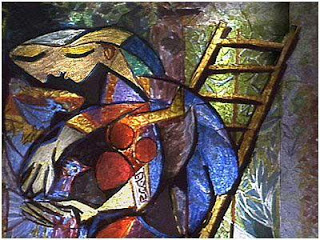
The amazing work discovered at the Evansville Museum,  "Seated Woman with a Red Hat" had been donated in 1963 by Raymond Loewry, but it had been mis-labelled.  When the auction house, Guernsey's, was researching Picasso's gemmaux works, they contacted Evansville about this donated work of art, and the research began. Slowly, slowly, the excitement has been building and will continue until there is a proud new collector enjoying this "Seated Woman", an image of Picasso's mistress and model, Marie-Therese Walter.  Not only the auction world is watching – and many more people have, like me, learnt about another fascinating aspect of art-making.

Picasso, Seated Woman with a Red Hat, gemmaux

Picasso, Seated Woman with a Red Hat, gemmaux