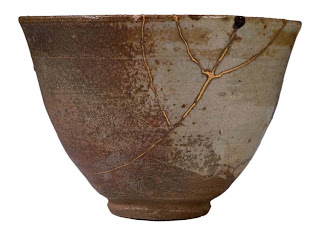
Kintsugi or the Art of "Golden Joinery" by Jeannine Cook

A little while ago, I read on a friend's Facebook page of Kintsugi, the Japanese art of repairing broken ceramics with gold.  I thought it was truly fascinating as a concept, and also as a metaphor.

According to the Wikipedia entry for Kintsugi, this skill of making a new and beautiful object out of a broken and probably worthless and useless vessel came about because the late 15th century shogun Ashikaga Yoshimaga sent a damaged Chinese tea vessel back to China to be repaired.  The resultant repairs, with ugly metal staples, were so shocking that the Japanese began to seek better ways to repair broken ceramics. Firing lacquer resin sprinkled with gold dust as infill, Japanese created this new art form of kintsugi, an art that became so popular that purportedly, people deliberately broke important ceramics simply to enhance them with Kintsugi. Apparently silver was also sometimes used in the lacquer resins.

article.jpg
article 3.JPG
article 5.jpg
artilce 8.jpg
2.jpg
índice.jpg
índice 1.jpg

There is a growing interest in this art form, which allows vessels to take on a fresh and enhanced life, complementing originally refined work or adding new and more modern dimensions to classical vessels. Ironically in our parlous economic times, when repairs and renewals have again often become the order of the day,

kintsugi seems to be very relevant as a philosophy and example of ways of repairing and recycling objects. I also feel that kintsugi is a wonderful metaphor for dealing with daily life.  If disaster or adversity strikes, how can each of us use the equivalent of gold dust to repair the cracks in life, at least to some degree, and create something new and viable, if not beautiful, out of what has happened.  In other words, how can we turn a negative into a transformed but luminous positive?

Art and Photography by Jeannine Cook

Recently, I seem to have been seeing more and more allusions to artists who make or have made considered efforts to make art that in some way fights back against the all-pervasive influence of photography.

Turner was one of the first artists to do this, at a time when photography was newly invented.  (The Frenchman, Niepce, made the first permanent photograph in 1826.) 

Joseph Nicephore Niepce

Joseph Nicephore Niepce

By 1819, Turner had already begun to move away from paintings that were faithful reproductions of the world around him after a visit to Venice. 

 Ivy Bridge, Devonshire, c.1813-1814, J.M.W. Turner (Image courtesy of the Tate.org.uk)

 Ivy Bridge, Devonshire, c.1813-1814, J.M.W. Turner (Image courtesy of the Tate.org.uk)

He continued, however, to make careful studies of clouds, of storms and waves, for instance, which were the underpinnings of many of his paintings. His interest was far more directed towards capturing his vision of things, rather than reproducing the exact likeness of the world around him.  It was thus a way of rebutting the influence of photography's slavish capturing of appearances.

Sunrise, with a Boat between Headlands, 1835, J.M.W. Turner (Image courtesy of the Tate.org.uk)

Sunrise, with a Boat between Headlands, 1835, J.M.W. Turner (Image courtesy of the Tate.org.uk)

Ever since the invention of photography, there has been this tug of war between "fine art" and photographs, a contest that de facto seems to be have won in large part by photography. One ironic measure of this in our parlous economic times is the number of photography exhibitions in museums which has greatly increased in recent years.  One suspects that costs of mounting and insuring such exhibitions might be a consideration. The prices of photographs is also climbing steadily for many historic works as well as contemporary prints.

Photographs have also become the drawing book of preference for many artists, as opposed to actually drawing scenes or objects that will be later incorporated into a work of art. Many artists go as far as simply reproducing the contents of a photograph, ideally one that they have taken themselves as opposed to using someone else's and thus infringing on copyright.  There is always a danger in using a photo for art - if the artist is not already very familiar with the object or scene, having drawn or painted it before many a time, a photograph can be a fickle friend.  The camera lens cannot "see" all that the human an eye can see, so a great deal of information is missing that might help in creating a work of art.  Added to that, a work of art based too heavily on a photograph tends to have a frozen look, airless and static.  Somehow, the image has not been processed through the artist's eyes-brain-hand in the same way as it would have been if drawn or painted from life.

Every artist today has to decide just what role photos should play in the production of his or her art. Whether the art is realistic, abstract or in between, photography can be a useful tool or a demanding taskmaster.  Each of us has a interesting choice to make.

Google and an Art Inheritance by Jeannine Cook

Some while ago, I was fortunate enough to inherit a painting I had always loved in my family home. A coastal scene with a wonderful foreground frieze of golden gorse, it had always delighted me with its luminously expansive feel.  I had been told that it was painted from the veranda of my family's home in Albany, Western Australia, but that was all I knew.

One day, I decided to start investigating to see what I could learn about the work.  I copied onto paper the almost illegible signature, and eventually started working on Google, trying out whatever I could decipher. Google came up trumps - which, in a way, is less and less of a surprise as time and the reach of Google have taught us all.  The signature was of an Australian woman artist, Ellis Rowan,who was active, and prominent, in the late 19th and early 20th century.  As I learned a little more about her intriguing, adventurous life, and her skills at self promotion as she developed her career as a "flower painter", I was filled with admiration.  I was also delighted to find that she had connections with my redoutable great grandmother, Ethel Clifton Hassell - another very strong character by all accounts. Pushing all sorts of boundaries as a woman, Marian Ellis Rowan seemed to make no concessions in her pursuit of flowers to paint and places that might be of interest.

Ellis Rowan travelled several times to Western Australia, following in the footsteps of her much admired flower painter role model, Marianne North, who travelled the world to paint flower species during the 19th century, finally endowing Kew Gardens with a gallery for her wonderful works.  It was thus natural for Ellis Rowan to meet my great grandmother, a community leader in Western Australia and a flower lover.  They possibly got on well and I can imagine the scene of Ellis Rowan settling down on the veranda at Hillside, the Hassell home in Albany, to paint the view out to King George Sound.  Her skill in painting was considerable, especially given that she often used gouache, which is quick drying and often difficult as a medium. She also used watercolours and oils.

Birds and flowers, of preference tropical, colourful and exotic, were Ellis Rowan's favourite subject matter, and many of her paintings in the National Library in Australia show her skills.  She was prolific, and consequently, there is a marvellous diversity in her work.  These are but a tiny sample of her flower paintings.

Wild Cornflowers, gouache and watercolour, c. 1900, Marian Ellis Rowan, (Image courtesy of Museum of Applied Arts & Sciences)

Wild Cornflowers, gouache and watercolour, c. 1900, Marian Ellis Rowan, (Image courtesy of Museum of Applied Arts & Sciences)

Fringed Violet, watercolour and gouache, 1900, Marian Ellis Rowan, (Image courtesy of Museum of Applied Arts & Sciences)

Fringed Violet, watercolour and gouache, 1900, Marian Ellis Rowan, (Image courtesy of Museum of Applied Arts & Sciences)

Norfolk Island Hibiscus, watercolour and gouache, c. 1900, Marian Ellis Rowan, (Image courtesy of Museum of Applied Arts & Sciences)

Norfolk Island Hibiscus, watercolour and gouache, c. 1900, Marian Ellis Rowan, (Image courtesy of Museum of Applied Arts & Sciences)

Swamp Banksia, watercolour and gouache, c. 1900, Marian Ellis Rowan, (Image courtesy of Museum of Applied Arts & Sciences)

Swamp Banksia, watercolour and gouache, c. 1900, Marian Ellis Rowan, (Image courtesy of Museum of Applied Arts & Sciences)

Black Wattle, gouache and watercolour, c. 1900, Marian Ellis Rowan, (Image courtesy of Museum of Applied Arts & Sciences)

Black Wattle, gouache and watercolour, c. 1900, Marian Ellis Rowan, (Image courtesy of Museum of Applied Arts & Sciences)

Life becoming Art by Jeannine Cook

A wonderful quote from Sir Anthony Caro, the famed British sculptor, was in the 2/9th June 2012 Spectator: "I believe art is about what it is to be alive".  The article was by Ariane Bankes, discussing Caro's current exhibition of sculpture at Chatsworth House in Derbyshire.

Ms. Bankes was writing of Caro's huge and unending curiosity about the world around him, and his use of these interests as the source of his creative work. It reminded me how important it is to be curious about everything around one: as an artist, antennae need to be up as much as possible, eyes and ears open, and a questing attitude cultivated.  Not always easy and other things in "life" obtrude, but even then, it seems that later, things not consciously registered at the time come floating back into one's mind.

A Day at Julienton, watercolour, Jeannine Cook artist

A Day at Julienton, watercolour, Jeannine Cook artist

I realised, the other day, that a day I had spent drawing on the coast was more rewarding than I had thought.  I was concentrating on what I was trying to do at the time, but indeed, I was "alive" to many more things around me.  The result was a watercolour that came flowing, quite some time after this day's drawing. The different elements of the painting - marshwrack, a contorted dead cedar, eythrinia flowers, a baby alligator, different birds - are those that I was not drawing at the time, but were burned in my memory because of the heightened senses that art was allowing me to have.  A lovely gift.  Capturing the energies and magical forces of life around one is a never-ending quest for an artist and a passport to living life to the full.

Approaching Paintings by Jeannine Cook

The Abstract Expressionist artist, Richard Poussette-Dart, once said, "Paintings are like people.  They must be approached, won friendship with, known and loved as people are, if they are to open up and reveal themselves."

When you look at his paintings, even in digital form, it is easy to understand why he said that.  His work is elegantly intellectual, each canvas well worth studying and embracing as a "friend".

Hieroglyph #2, Black  1974. (Image courtesy of The Estate of Richard Poussette-Dart.) 

Hieroglyph #2, Black  1974. (Image courtesy of The Estate of Richard Poussette-Dart.) 

This is just one image that caught my eye (since I seem to be attracted especially to work in black at present) - Hieroglyph #2, Black painted in 1974. I could imagine living very rewardingly with such a work.

The way we all approach paintings is conditioned on so many things, from our mood at the moment, to the time we have to look at a work of art, to our life experience and tastes and even the current fashions in art appreciation.  Nonetheless, I am sure that most people have rounded a corner in a gallery or museum and come face to face with a work which stops one short, calling out to come closer and look.  Just like catching sight of someone who attracts one's attention, pulling one out of the humdrum busy world, sending implicit messages that this person might be worth getting to know.  In truth, it does not even have to be an encounter with a work of art in a gallery: sometimes, on the Web or in a book, an image leaps out at one, saying that they are worthy of much closer attention and appreciation.

I was going back through the catalogue chapters prefacing an exhibition of Watercolours that I saw last year at Tate Britain, and suddenly saw a most beautiful reproduction of work by the British artist, Rebecca Salter. Again, her work demands a closer approach, to savour and learn of what each painting has to say, with its layers of allusion to Japanese art, light, texture, and our pared-down world.

Untitled AB4, 2010, mixed media on linen. Rebecca Salter (Image courtesy of teh artist)

Untitled AB4, 2010, mixed media on linen. Rebecca Salter (Image courtesy of teh artist)

In the same spirit of work on black, I chose this mixed media on linen painting from 2008, MM42, which talked to me (image courtesy of Rebecca Salter).  Its understated elegance attracts me enormously - and I am left regretful that I missed her show, Into the Light of Things 1981-2010", at the Yale Center for British Art last year.

The delight and interest of constantly acquiring "new friends" in works of art seem to one of the magical aspects of all art, of whatever period.  We are all potentially enriched when we open our eyes to art, in all forms - and in these times of angst, violence and division, I think we all need to concentrate on seeking new friends who can sustain and nourish our lives.

Creating Something from Nothing by Jeannine Cook

Listening to NPR, this morning, Rachel Martin interviewed the English songwriter-singer, Emeli Sande, about her music, now that she is launching her first album here in the United States.  She is a highly lucid and engaging young woman, a neuroscience major, who has reverted most successfully to her first love, music, since opportunity came knocking. 

At one point, when asked when she started writing songs, she replied,

"I began writing when I was about 6 or 7. And even at that age, I just thought it was so incredible that you could create something from nothing, and it was all in your mind and imagination," she tells Weekend Edition host Rachel Martin. "The combination of poetry and music I just thought was incredible."

The phrase, "you could create something from nothing, and it was all in your mind and imagination", set me reflecting on how the same thing is true about visual artists, all composers – just about any creative act.  It is all so, so simple, in truth.  From some magical recesses of one's brain, out pops an idea, an inspiration, a "what if you do such and such a thing?  It is like finding a shiny, perfect shell as you walk along the beach.  You pick it up and turn it over, marvelling at it, evaluating it, examining its possibilities.

This remark dovetailed in a way with many of the theses that Simon Schama puts forward in his marvellous book, The Power of Art, in which he had fascinating and stimulating chapters on eight artists down the ages, from Caravaggio to Rothko, who have been revolutionary each in their own way.  The 2006 book accompanied a BBC/PBS series of the same name, which alas, I have not seen, but in any case, the book is - as always with Simon Schama's books - a gem.

Each of the artists examined in this book basically dared to adhere to their own visions, the ideas that emanated from their minds and imaginations. They pursued these ideas even if they were totally at odds with what other artists were doing or even what their patrons wanted them to produce by way of art.  Of course, they evolved over time, but they kept believing in their own inner voices and ideas. 

Blue, orange, red, Mark Rothko, 1961

Blue, orange, red, Mark Rothko, 1961

Perhaps the last artist written about, Mark Rothko, was the one who had to keep seeking and clarifying his ideas the longest.  He once said that paintings had to be miraculous, Schama wrote.  And indeed, he was fifty years old before the miracle paintings began, his dazzling, amazingly subtle colour stacks. (Above,Blue, orange, red,  and below, Pink and orange.)  

Pink and orange, 1950, Mark Rothko

Pink and orange, 1950, Mark Rothko

Rothko said that painting was an exercise in continuous clarification, as Schama wrote, but once the artist had clarified the ideas, he had to ensure that this clarity was passed on to the beholder.  Back to the dialogue, the communion, between artist's work and the viewer, for instance.

So simple, so elegant, so difficult - this materialisation, seemingly from nothing or nowhere save the inside of one's head - of something that then becomes interesting, beautiful, inspiring, memorable enough to speak to other humans.  Something from "nothing".

Telemarketing for "Art Rankings" by Jeannine Cook

As the rain pelted down this morning from now sub-tropical storm Beryl, a 9 a.m. phone call really seemed out of place.  A purported phone call on behalf of Google Art, from someone with a strangely affected British accent.  Did I want to sell more art on the Web, did I know that if you Google Art-Georgia, there were some 1000 plus, plus hits per month?  Google could be the answer to the maiden's prayer in terms of pushing my ranking up to number one, and help me sell art. Olé!

I wondered if other people are being importuned like this and if it is indeed emanating from Google? I think that the last thing any artist wants at 9.a.m. is a telemarketer's call, especially if one is supposed to be on "do not call" lists.

Selling art is a complex enough world, with enough honourable people and scams around to keep everyone sifting through the mix.  I don't think that we need Google to enter the fray, particularly via the telephone.

Anyone else had this experience?

Places that Inspire by Jeannine Cook

Some while ago, I read a comment by a British watercolourist, Tony Foster, who had been painting on both the North and South Rims of the Grand Canyon.  (He managed to paint six-foot wide pieces on location, quite a feat in of itself!)  What he said was, "My thesis is that despite a world overloaded with imagery, certain places still retain the power to inspire awe and wonder.  All of my work is based on the philosophy that our planet is a gloriously beautiful but fragile place, and that as an artist, it is my role to deliver a testament to the fact that wild and pristine places still exist."

He is right. Art is one way to remind people that we are still able to visit places that transcend our normal humdrum lives, with beauty and grandeur that humble and inspire us.  But the subtext of such reminders is that we need to be vigilant, thoughtful custodians of such places.

This past weekend, when I was out along the Georgia coast, drawing, I felt myself to be in such a place of inspiration.  There is something about a natural environment that has not been much changed nor manipulated by man: it has another feel, another rhythm.  More primal, perhaps, but infinitely more powerful, subtle, complex and yet, very fragile.  As you settle down in such a place to try and create art plein air, the magic of the place begins to seep in - the lay of the land, the movement of water, the breezes, the sounds, the play of light.  It is hard to access how these influences show up on the art one is creating - perhaps only others can see them.  Nonetheless, there is an alchemy, an inspiration that keeps one going.

Even when the art one is creating is on a small scale, unlike Tony Foster's, the dialogue between place and artist is very much there.  Perhaps one is working almost instinctively, but the influences and inspiration of the place seep into what one is doing. 

Marsh wrack, silver/gold/copperpoint, Jeannine Cook artist

Marsh wrack, silver/gold/copperpoint, Jeannine Cook artist

This metalpoint drawing, Marsh wrack, is about the wonderful, but seemingly chaotic patterns left by the dead Spartina grass swept up onto the high water mark by spring tides and left there to decay and re fertilise the salt water marshes.  Having spent time drawing a tenaciously majestic dead red cedar tree in Prismacolor, it was interesting to focus in on the marsh wrack lying in rafts along the shore at high water mark.

Last Days for the Cedar, Prismacolor, Jeannine Cook artist

Last Days for the Cedar, Prismacolor, Jeannine Cook artist

Both these drawings were, in essence, about the cycle of life in such natural, wild places.  The dead cedar was decaying, slowly and inexorably, host to lichen and insects, just as the marsh wrack was home to innumerable small crabs and insects who helped break down the grass stems.

These places of inspiration owe at least some of their power, perhaps, to the implicit reminders that, untrammelled by man's intervention, nature continues its exquisitely balanced and logical cycles of birth, growth, decay. We are straying into a world that should, and can when allowed to,  continue to evolve and exist in amazing, elegant sophistication.

As artists, we are privileged to get glimpses of these wonders.

Experiments in Art by Jeannine Cook

When luck is kind and an opportunity presents itself to work in peace and beauteous quiet, experiments in art-making are a serious option.

As part of the WCAGA Drawing Marathon, a day of plein air work had been organised for yesterday, Saturday.  Luck was indeed on our side - it had poured with rain the previous days, and today, the day after, while Saturday dawned crystal clear, sunny and delicious.  With such good auguries, it was time to try different media, different subjects in art.  It seems to me that it is so important always to try to grow as an artist by experimenting, refining one's voice and one's style of art, whilst still remaining true to that little "inner voice".  As artist/art coach Bob Ragland once remarked, "Being an artist is like planting a garden - plant the seeds and see what sprouts".

The Last Days for the Red Cedar, Prismacolor, Jeannine Cook artist

The Last Days for the Red Cedar, Prismacolor, Jeannine Cook artist

Seeing what sprouted was fun as I worked yesterday.  I used sepia Prismacolor to tell the story of a wonderfully contorted dead red cedar which was slowly decaying, lichens and other forces working on its reduction.

Growing right at the edge of the marshes, the tree showed what happens when salt water levels rise and affect both the tree's root system and the solidity of the oyster shell bank into which its roots burrowed.  Using Prismacolor to depict the tree is a very different medium, as compared to graphite or silverpoint, with its wide range of tone and its waxy quality that can lead to build-up on the paper.  Like silverpoint, Prismacolor does not allow erasure.  So the experiment was about flying blind, to a certain extent.

Another venture I tried was to look around me with fresh eyes, to try and see possible subject matter that was totally new and different for me. It is always tempting to return to the same types of subject matter in art -in essence to stay in a zone of comfort and depict things/places/people with which you are familiar.  I am not sure, however, that one grows a great deal if you are always doing the same things - whether it is making the same pastries over and over again, using similar phrases only when learning a new language or doing the same things again and again in art-making. 

Charles Hawthorne, the American painter who founded the Cape Cod School of Art, declared that "in his attempt to develop the beauty he sees, the artist develops himself".  In other words, try putting on new spectacles in life.

Marsh Wrack, metalpoint, JeannineCook artist

Marsh Wrack, metalpoint, JeannineCook artist

I spent some time prowling along the wonderful interface between salt marsh and high ground, with sunlight filtering through the many live oaks, cedars and palmettos.  But what I finally "saw" was the wonderful patterning of the marshwrack, the amazing amalgam of dead stalks of the Spartina alterniflora or Cord grass, the essence of the salt marshes of the South Eastern coast.  The high tide gathers up these dead stalks and deposits them in wonderful rafts  at the high water mark along the banks and higher ground.  There, they eventually break down, aided by the activities of a myriad small crabs and insects, and contribute to the enrichment of the marshes and salt water, nourishing all life in the marshland nurseries.  This marsh wrack was the subject of my next drawing experiment, using metalpoint to follow its rhythms and weavings.  Gold, copper and silver followed the Spartina's patterns,a meditation about life, decay and new developments, both for the marshes and, I hope, for my art.

Gardens and Artists by Jeannine Cook

It is hard to decide whether a gardener-artist is better off than just a gardener.  Most of the famous garden designers, from Lancelot "Capability" Brown (1716-83),via William Robinson (1838-1935), Gertrude Jekyll and into the famed 20th century English gardeners, Vita Sackville-West, Christopher LLoyd, Penelope Hobhouse, etc., are famed not only for their horticultural knowledge, but also for their skills in design. In essence, they were or are just as much artists as gardeners.

That happy combination can be found in many countries where gardening has been of great importance - France, the Netherlands, Italy and Spain, the United States and countries where the British gardening heritage has taken root, like Canada, Australia, New Zealand or South Africa.  On a personal basis, however, I can never decide whether it is of help to be an artist or not when I am planning and working in my flower garden.

Every time I open a plant catalogue or book, or walk into a plant nursery, I feel a double pull.   I love the plants and feel very comfortable with a great number of them, since I have gardened in the tropics, northern Europe, the Mediterranean, the Northeast US and now the South East.  But, and it is a big but when it comes to the purse strings, my artist's eye gets fired up and I can see the plants already installed in my garden, blooming and harmonising with others that I already have there.  This capacity to imagine the "fait accompli" makes for hard choices, I find.  I often wonder if I were not so able to visualise the scene as an artist, I would be a little more hard-headed in my purchases!

This predicament was driven home to me this week when I received a heavy, delightful gardening book I had ordered. Heirloom Gardening in the South by William C. Welch and Greg Grant, published in 2011 by the Agrilife Research and Extension Services at Texas A & M University.  Not only do they briefly evoke the different heritages of Southern gardening, from the Native American, African, Italian and English, but they then have a huge listing of plants and trees they deem of heirloom status for the South.  Oh, oh, did my artist's eye and brain go into overdrive! 

Crinum powellii

Crinum powellii

Suffice to say, I now have long lists of plants and bulbs to think about using in the ongoing creation of what I hope is a garden worthy of an artist.  A garden that not only looks beautiful and peaceful for humans, with plants I can then paint and draw, but also a garden which attracts the really important visitors.  And who are those connoisseurs?  Why, birds, butterflies, moths, lizards, frogs, toads, snakes and even tortoises – all the delightful inhabitants who instinctively know when their environment is "right" for them.  That is always a wonderful challenge for any artist.