Landscape Painting by Jeannine Cook

Back in March of this year, in The Spectator, Angela Summerfield discussed Peter Frie:Last Summer, an exhibition of landscapes by a Berlin-based Swedish artist, Peter Frie. In view of the fact that tomorrow, I am planning to work plein air on landscape drawings, this statement in Summerfield's article came back to me.

I quote, "Landscape painting has not fared well within the dictates of modernist and post-modernist art definitions. It is as if an urban-centric, text-driven and often anti-aesthetic dogma has stifled both alternative discourse and individual human expression. Yet our experience of landscape, and by association Nature, is fundamental to the development of our senses, perceptual vocabulary and cognitive awareness.

Eliopainting No. 3   Peter Frie, oil on canvas, (image courtesy of Eskilstuna Konstmuseum.)

Eliopainting No. 3   Peter Frie, oil on canvas, (image courtesy of Eskilstuna Konstmuseum.)

This statement resonates for me in a number of ways. Since I live in non-urban environments, I find most of my daily delights and inspiration in Nature, in one way or another. I am also very aware that my tastes are therefore different from those of countless millions of people who live in big cities, where the dragooned green trees along streets and in artificially-constructed parks are the major remnants and reminders of the natural world, apart from weather conditions.

The world in which we all live is indeed mostly text-driven, a fact which again contributes, according to this thought-provoking book that I am reading, Moonwalking with Einstein, by Joshua Foer, to our collective loss of the capacity for memory. Because we can all rely on books, Google, digital files or whatever to recuperate facts, our memories have virtually abdicated, as compared to the memory of Greeks, Romans and medieval notables.

In those early times, people could remember vast amounts of knowledge, from all the names of soldiers in an army to long, involved speeches or treatises. After Gutenberg invented the printing press in 1436, our memories took a hit. In the same way, only well-trained artists retained the capacity to remember innumerable details of landscape or human form. Familiarity with landscapes and Nature's ways became the domain of the few in the art world.

Today, that is indeed true. Yet unless we artists somehow learn how Nature "works", an enormous chunk of our personal vocabulary is stunted. It is as if we try to learn French, but never hear how the words are correctly pronounced. We thus never understand the nuances, the cadences and accentuations, let alone the words themselves, that convey a world of meaning.

Ultimately, I fear that Angela Summerfield's rather pessimistic outlook about landscape painting will continue to pertain. I don't see art collectors returning en masse to support landscape painting (and drawing). Nonetheless, for those of us who believe landscapes and Nature in general have much to offer, there is the comfort that personally, we are enriched, and that there are indeed some people with whom landscape painting resonates. Hurray for "alternative discourse and individual human expression"!

Peter Frie's version of a "Blue Morning" (image courtesy of artfinders.co.uk.)

Peter Frie's version of a "Blue Morning" (image courtesy of artfinders.co.uk.)

Just look at  Frie's Blue Morning.  He should give us all encouragement and hope to follow our own paths vis-a-vis Nature.
Artists' Ways of Seeing Things by Jeannine Cook

I am reading a book entitled "Moonwalking with Einstein. The Art and Science of Remembering Everything" by Joshua Foer. The title is self-explanatory, the style is highly readable as Foer is a seasoned writer for such publications as the New York Times, National Geographic, Slate, etc. The content is totally fascinating - about how science is slowly understanding better how the human brain works, especially in terms of memory.

I still have many pages to go, but one page started me thinking about the parallels between artists and the master chess players that Foer was discussing. In the 1940s, Adriaan de Groot, a Dutch psychologist and chess player, decided to investigate what separated a good chess player from a master chess player - what was going on in their heads? Were the top players able to think further ahead in their moves, did they have better mental tools or a more honed intuition for the game? From past high level games,De Groot selected a series of board positions where there was one correct move to make which was not all that obvious. He then asked a group of top flight chess players to ponder these boards and to think aloud as they selected the proper move.

To De Groot's astonishment, the players mostly did not think many moves ahead, nor did they consider more possible moves. What they did was to see the right move, and almost immediately. After analysing the players' commentaries, De Groot realised that the chess experts were reacting, rather than thinking, and they could do this because their long experience of playing had taught them to think about "configurations of pieces like 'pawn structures' and immediately noticed things that were out of sorts, like exposed rooks". They had learned to see the whole chess board and thirty-two chess pieces as systems and groups. Later studies of top players' eye movements confirm that they literally see a different chess board, for they see more edges of the squares, which means they are encompassing whole areas at once. They also move their eyes across greater distances, without lingering for long at any one spot. Those places on which they do focus tend to be the key areas linked to making the right move.

This description of how master chess players function made me think of artists who have honed their skills day after day, year after year. Their eye-hand coordination has been perfected, their senses of composition/design, colour and content are developed. When they draw a nude, for instance, or work on a landscape painting plein air, for instance, they are not looking at just one spot. Rather, they are encompassing the whole so that almost intuitively, they can adjust their composition, their values and colour in the work for the best results. Their powers of observation and concentration are almost unthinking, because they are trained and disciplined.

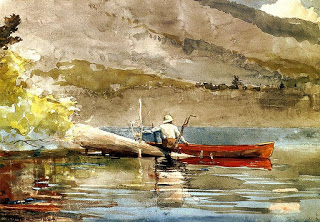
The Red Canoe, 1889, watercolour, Winslow Home (Image courtesy of the Peabody Art Collection, Baltimore, Maryland)

The Red Canoe, 1889, watercolour, Winslow Home (Image courtesy of the Peabody Art Collection, Baltimore, Maryland)

To me, Winslow Homer is an example of a highly skilled painter, producing amazingly fresh landscapes, frequently plein air, and often in watercolour. One such example is "The Red Canoe" (image courtesy of the Peabody Collection, the Athenaeum).

Foer goes on to comment on the master chess players' amazing memories. I suspect that the great artists, past and present, also intrinsically rely on their memories quickly to understand a subject after a brief moment of studying it, Like the chess players, they can also call upon past experiences to bolster and inform their present work. The saying, "Been there, done that" applies, in a very positive sense, to an artist as well as chess players. Perhaps one should just add, "umpteen times"!

Assessing the Year as an Artist by Jeannine Cook

Summer has slipped into autumn all too quickly this year. Only now have I been able to send my art-collector friends a brief newsletter about the year as an artist. I find this yearly exercice an interesting assessment of what I have been trying to do and where my art has been available for viewing.

This has been, in truth, an unusual year, with bereavement and family health problems precluding a lot of artwork being done (and fewer blog posts as well!). Nonetheless, sadness and anxiety have been mixed with great joy and delights.

McIntosh Art Association, Darien, GA, hosted my spotlight solo exhibition, At the Edge of the Marsh, in April and May. I showed watercolours, silverpoints and graphite drawings. In May-June, I exhibited silverpoint drawings alongside Daniel Smith's monoprints in Point and Counterpoint at the Hospice Savannah Gallery. Meanwhile, in April and May, I was part of an invitational exhibition, again with silverpoint drawings, at the Art and Soul Gallery at the Women's Center of Jacksonville, entitled Lasting Impressions. Another national invitational show in which I participated was Luminous Metal: Contemporary Drawings in Metalpoint, at the Clement Art Gallery in Troy, NY. I have also just exhibited my art at a Coastal Wildscapes conference held in early October at Richmond Hill, GA.

Other shows in which my work was selected for exhibit during the year were:

- Brainstorm: Opening Minds, Embracing Change, with Women's Caucus for Art of Georgia.
The first venue was at Atlanta's Central Library and the show then travelled to
Upstairs/Artspace in Tyron, NC.
- I'm in Love with this Idea, also a in Women's Caucus for Art Georgia exhibition, was held at the Georgia Perimeter College, Atlanta.
- Katonah Museum Artists' Association, a large group show at Northern Westchester Hospital, NY.
- Little Things mean a Lot, a holiday show at the Swan Coach House Gallery, Atlanta.
- Portraits to Pixels: Celebrating 125 Years of Collecting at the Telfair, a selection of work from the permanent collection, at the Telfair Museums, Savannah. One of my silverpoint drawings was included.
- Transformations, an on-line international show sponsored by the Women's Caucus for Art in San Diego, CA, in which I was awarded second place honours for one of my silverpoint drawings.
- New Hall Art Auction 2011, an on-line auction for the New Hall Art Collection, Cambridge, with art produced by those of us with work in their permanent art collection.

Early in the year, I held a silverpoint workshop at the Telfair Museum of Art at their invitation, and was scheduled to hold a watercolour workshop. Alas, I had to cancel that due to my mother's death. Later, I held a plein air workshop for McIntosh Art Association members on Butler's Island, near Darien.

My art was featured in a variety of newspaper articles: the Darien News covered my Darien solo exhibition, as did the Brunswick News. Later, the Savannah Morning News's art critic, Alison Hersh, wrote about the "Dynamic Duo at Hospice Gallery". The Art Connection in Boston featured my art, as did the WCAGA website. My work was also included in websites as varied as Women Environmental Artists, Artist Sites, Wooloo or the Irving Sandler Artist Slide Registry/Artists Space. Of course, my art and updated activities are also featured on my own website at http://www.jeanninecoook.com.

I am already working towards exhibitions which are planned for next year and beyond. I am co-curator with Professor Jeff Lewis of Auburn University of a silverpoint exhibition to be held in 2013 at the Jule Collins Smith Museum of Fine Art, Auburn, AL. I shall be participating with a group of artist friends in Celebrating the Coast at Glynn Art Association Gallery in 2012, and joining my friend, Marjett Schille, in an exhibition, Sapelo Island, at Brenau University, Gainesville, GA, in 2013.

My 16th Annual Art Tasting was held last December 4th and once more, for Rundle and me, it was a celebration at our home at Cedar Point. I felt honoured to display my art for my friends. This memory is now a little bittersweet as I realise that this year, I will not be able to invite people to another Art-Tasting. Rundle is facing surgery for an incipient aneurysm in his other leg, and between those uncertainties and our late return from Spain, I sadly concluded that it would unrealistic to organise things in time. Nonetheless, I hope that, deo volente, I can plan a spring art celebration.

Efforts and hopes - but now to getting down to creating art again. That is where the discipline comes in!

Euros - Symbolism on the Bank Notes by Jeannine Cook

Last week, when the Eurozone was hanging on the final "yes" vote in the Slovak Parliament to agree to the proposed EU bailout fund, I could not help thinking about the actual euro currency and its design.

For those who have not seen the bank notes, they are elegant. In clear and distinct colours that are easy to distinguish, they are a welcome change from semi-monochromatic currencies. Their design was thoughtful and symbolic, for this currency is an ambassador for the countries of the European Union. History, ethics, moral values –are all implied by a country's currency, and more so with this new currency that the EU launched in 2002.

euro_notes.jpg

On the side illustrated at right, it was decided to use architecture down the ages in Europe, designing it so that it was not specifically that of any one place. Using the symbolic motif of arches and entrances, examples were sought from across Europe and then stylised. The 5€ bill evokes classical architecture, the 10€ Roman architecture and the 20€ alludes to Gothic buildings. The 50€ brings us to Renaissance times, the 100€ refers to Baroque and Rococo architecture, the 200€ evokes the advent of metal in 19th century buildings, while the 500€ brings us to modern architecture. (For many years, in Spain, the 500€ bills were referred to as "Bin Ladens" as they were so seldom seen!)

The reverse side of the bank notes is about bridges, another important symbol for this ever-increasing union of countries that have often been enemies in the past.

money_architecture.jpg

Again, the style of architecture follows the same time frame, from classical to modern.

One of my favourite notes is the 20€ bill, for its limpid, subtle blue and serene design reminds me of the wonderful stained glass windows in Gothic cathedrals and the old bridges across the rivers of Northern Europe.

598864-20_note_Bridges_side_Europe.jpg

Sometimes, it is at the physical level - that of handling the bank notes and looking at their artistic design and symbolism - that helps bring home the importance of parliamentary decisions. I am glad that the Slovaks decided to help the euro stagger on again. It would be a great shame to abandon such elegant currency!

The Shock of Recognition by Jeannine Cook

You enter an exhibition, perhaps almost by chance. You see the title of the show, and you are trying to orient yourself as to what it is about.

Then you round the first corner in the exhibit room, and boom, you get a jolt. Straight in front of you, out of the blue, you see a piece of art that you know well, something that has resonated with you before. And there it is again, quietly hanging on the wall. This shock of recognition, a thrill of interest and delight, are what makes me realise how much art means to me in daily life.

This reunion with pieces of art that I admire happened a little while ago when I strayed into the lovely CaixaForum exhibition hall in Palma, in the elegantly restored modernist Gran Hotel. I saw that there was an exhibition of etchings entitled, "From Dürer to Morandi. Engravings from the William Cuendet Foundation and the Atelier Saint-Pret". It was a large Swiss collection of very fine editions of work by innumerable artists from Dürer to Rembrandt, Canneletto, Piranesi, Goya, Degas and many others.

One of my first delights was a Rembrandt work - The Holy Family with a Cat, from 1654 - a work that always enchanted me with the inclusion of the cat. I had not seen it for a while, and so lingered to savour of the composition, the feeling conveyed by the whole harmonious order of the etching.

The Holy Family with a Cat, etching, 1654 .Rembrandt Harmensz van Rijn (image courtesy of the Jenisch Museum, Vevey, Switzerland).

The Holy Family with a Cat, etching, 1654 .Rembrandt Harmensz van Rijn (image courtesy of the Jenisch Museum, Vevey, Switzerland).

Another happy reunion amongst the other one hundred and thirty works was this deliciously memorable work by Edgar Degas, At the Louvre, Painting, Mary Cassatt, 1879-1880. I have always loved its daring composition and essentially late 19th century French atmosphere. Both these images are courtesy of the Jenisch Museum, Vevey, Switzerland.

At the Louvre, Painting, Mary Cassatt, etching, 1879-1880., Edgar Degas (image  courtesy of the Jenisch Museum, Vevey, Switzerland).

At the Louvre, Painting, Mary Cassatt, etching, 1879-1880., Edgar Degas (image  courtesy of the Jenisch Museum, Vevey, Switzerland).

My impulsive choice to walk into this exhibition, as I hastened through a list of errands, was such a bonus. The shock of recognition jolted me again and again. I came out exhilarated and grateful for the serendipitious gifts of art.

"Suite dans les idees" - is it important in art? by Jeannine Cook

I have always been fascinated by a consistency of thought in people as they develop an idea or a work. It seems often to be important to have a logical progression, an evolution of ideas that allow others to follow what is being done. Nonetheless, it seems often to be a challenge for artists to produce a consistent body of work, and I wonder more and more if it is that important.

In the art market, for instance, it is often considered desirable that an artist work in a coherent and understandably sequential fashion - think of Andy Warhol's series of silkscreen prints that have been so wildly successful from their creation. Art galleries are often reported to be less than enthusiastic if an artist suddenly changes and goes off in a very different direction in the work.

Personally, I realise that there are two warring tendencies in my art-making. I find it often to be rewarding to work in series, trying to explore aspects of a subject in a sequence of pieces. Yet I also love to go off in a totally different direction, trying another medium, another approach that has nothing to do with anything else I have done. So I was interested to find a quote about Joan Miro, who told an interviwer in 1928, that "when I've finished something, I've got to take off from there in the opposite direction" (from "A Conversation with Joan Miro", Francesc Tribal, La Publicite, 14 July 1928).

This observation is an insight into how an artist works - where the inspiration comes from, the wellspring of ideas and general artistic discipline. I think that many artists relate to Miro's way of working - variety is stimulating. They may later circle back to a previous theme, but with the subtle changes that time can impose.

This "suite dans les idees" - a coherency and consistency of ideas - can lead to the definition of an artist's style and hallmark. But it can also lead to repetition and even staleness. Perhaps Miro was wise to find reasons to renew his energies by challenge and change. The diversity of his oeuvre certainly makes a good case for going off in "the opposite direction".

Artists' Dedication by Jeannine Cook

The other day, a friend remarked to me that in these lean economic times, we will see important works of art and literature being produced. In other words, artists, almost in spite of themselves, will be working away, and the challenges they face will be a stimulus to go further, do things differently and make progress.

This dedication to art-making was, for instance, an early characteristic of Joan Miro . As early in his career as 1915, he quoted Goethe's statement that, "He who always looks ahead may sometimes falter, but he then returns with new strength to his task". At that time, Miro was principally dedicated to landscape painting, and was soon to produce some of his early masterpieces about life at Mont-roig, his family home in the Tarragona countryside, near Barcelona.

House with Palm Tree, 1918, Joan Miró. (image courtesy of the Reina Sofia Museum, Madrid)

House with Palm Tree, 1918, Joan Miró. (image courtesy of the Reina Sofia Museum, Madrid)

L’ornière, The Rut, 1918, Joan Miró, Private Collection

L’ornière, The Rut, 1918, Joan Miró, Private Collection

Vegetable Garden and Donkey, 1918, Joan Miró, (Image courtesy of Moderna Museet, Stockholm, Sweden

Vegetable Garden and Donkey, 1918, Joan Miró, (Image courtesy of Moderna Museet, Stockholm, Sweden

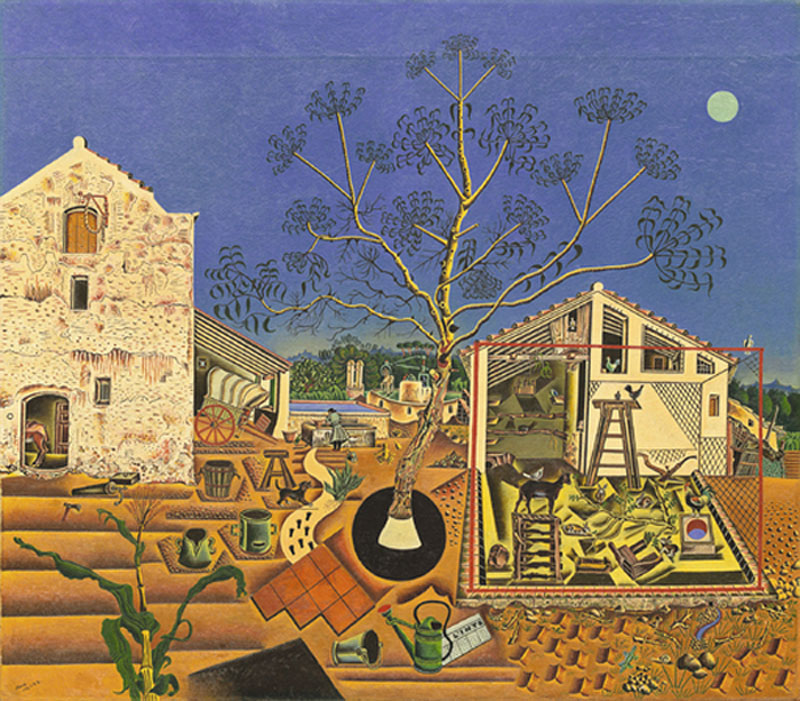
The Farm,  oil on canvas, 1921, Joan Miró (image courtesy of the National Gallery of Art, Washington, DC),

The Farm,  oil on canvas, 1921, Joan Miró (image courtesy of the National Gallery of Art, Washington, DC),

These four paintings are all results of what Miró regarded as trial and error work. He admitted to stumbling as he tried to deal with his depiction of the countryside, but he always got "to his feet again". This determination to "return with new strength to his task" remained with him during his long and artistically very inventive life, despite the difficulties he experienced personally or because of his opposition to Franco and his regime in Spain. (A marvellous celebration of Miró's dedication to art, "The Ladder of Escape", can be seen in Barcelona at the Fundacio Joan Miro from 13th October, 2011 to 25th March next year. It has just closed at the Tate Modern, London.)

Every single artist hesitates, stumbles, doubts and abandons one path for another. Only those who have enough inner fortitude, a strong enough conviction that they must continue with their endeavours, are people whose creativity leaves a mark in our world. When there are really difficult times, economically, politically or personally, it becomes a real test of an artist's dedication that he or she continues to work and produce. We are living in such times. It will be interesting to see - in a few years' time - whether my friend's prediction about stellar work being produced in today's world is accurate.

Celebrating Art in the Teeth of "the Crisis" by Jeannine Cook

In Spain, everyone knows exactly what you mean when you talk of "la crisis". Town halls, autonomous governments, the national government - they are all pretty well broke and red ink drips in all directions. One of the first areas of government expenditure in the Balearics to feel the effects of this fiscal crisis was the cultural scene. The sixteen years of autumn-winter internationally celebrated ballet company visits - gone. The opera season - decimated. The theatre season - hacked. And so it goes at present.

Nonetheless, there are wonderful bright stars in the cultural scene - private groups fighting back and ensuring that there are events that uplift and delight. Last week, there was a week of celebrating the visual arts and music in a small, jewel-like town, Santanyi, in Mallorca. The first weekend showed off the many local artists, while the second week's musical offerings ranged from popular to zarzuela to the single, wonderful performance of Mozart's Le Nozze de Figaro. Under a full moon, a huge courteous crowd of all nationalities sat in the open to be delighted by a beautifully presented and sung version of this delicious opera. It was so clever - the Teatro Principal's stage gets "reversed" for these outdoor performances so that everyone can sit in the open air; the orchestra is at the back of the stage and the singers' stage projects out against the glowing golden stone walls of the theatre. The quality of the singing was impressive and the whole performance was a reaffirmation of what can be done, in spite of "the crisis".

Yesterday showed the same spirit of joy and defiance for the reigning pessimism. In Palma de Mallorca, thirty-one galleries and museums opened their doors at seven p.m. for a wonderful Nit de l'Art. This annual event is sponsored by the Independent Association of Art Galleries in the Baleares (AIGAB) and the Art Palma Contemporani Association of Galleries, in conjunction with the museums and non-profit art spaces in town.

There was art for all tastes - from late 19th and early 20th century painters famed for their depictions of the natural beauty of the Balearics to the most allusive and fleeting performance art, with all manner of art in between. Interesting techniques, challenging concepts, humour and joie de vivre - it was all there to enjoy as you strolled through the historic narrow streets of Palma on a warm summer evening. Restored 17th, 18th or 19th century buildings, high-ceilinged and quirkily elegant, imaginatively adapted as permanent or temporary art galleries, floodlit golden monuments, strains of music floating down the streets beneath the tree canopy, smartly dressed people of all ages strolling, laughing, studying art intently.

It was a kalidescope of scenes that reaffirmed that the arts need to be part of all our lives, no matter what the economic situation.

Landscape Painting and Politics by Jeannine Cook

There has been a small but fascinating exhibition tucked into the National Gallery rooms in London. "Forest, Rocks, Torrents. Norwegian and Swiss Landscape Paintings from the Lunde Collection" had just opened when I saw it in late June but it runs until the 18th September.

Two rooms, but expansive views of Norwegian and Swiss mountains, rivers and dramatic natural scenery that take one far away from the tourist-filled Trafalgar Square outside. It was a collection of small and beautiful paintings assembled by Asbjorn Lunde, a major art collector/lawyer from New York. Not only did this exhibition of art delight and inform, but it made me think about the role of landscape painting in national politics and national identity. This was mainly because of a fascinating and informative piece, "Two Traditions", in the catalogue written by Christopher Riopelle. Curator of post-1800 Painting at the National Gallery.

Ancient Rome celebrated its landscapes in frescoes, such as those which survived from Pompeii. However, in the Western art tradition, basically relgious motifs and classical narratives provided the major impetus for painting themes and subjects until the 17th century. At that time, the Dutch begain to celebrate their flat, luminous countryside, where the northern light and ever-present sea predominated. They had regained control of their land (and church) from the Spanish and by the 17th century, Holland was linking political identity with the Dutch landscape. In fact, the very word landscape, used in relationto painting, comes from the Dutch language, where landschap first meant a cultivated patch of land and then an image.

 View of Harlem with Bleaching Fields, 1670-75, Jacob van Ruisdael, (Image courtesy of  Kunsthaus Zurich)

 View of Harlem with Bleaching Fields, 1670-75, Jacob van Ruisdael, (Image courtesy of  Kunsthaus Zurich)

Jacob van Ruisdael was a major protagonist of Holland's land and wide skies in his art in the 17th century, as one can judge in this "View of Harlem", above. Much of this landscape art was produced in studio after plein air studies had first been done.

Salomon van Ruysdael specialised more in maritime scenes, but he too represented the Dutch landscape in remarkable fashion.

The River Scene,  Salomon van Ruysdael, 1632(image is courtesy of the National Gallery.)

The River Scene,  Salomon van Ruysdael, 1632(image is courtesy of the National Gallery.)

These and many other artists were projecting the new self-confidence of a successful maritime nation whose trading stretched across the globe and brought home great wealth. These relatively small landscape paintings were bought by the affluent burghers as part of this new national celebration.

The same phenomenon occurred in Britain in the 18th century as the landed gentry and newly-affluent townspeople started to identify with their green, gentle island whose power was spreading far abroad. There were many great landscape artists working then, and even those more famous for portraiture, such as Thomas Gainsborough, were meeting this demand for landscapes. His 1748 "Landscape in Suffolk" is one such example. In subsequent decades, John Constable and J.M.W.Turner, amongst other artists, also allowed the English to be proud of their island, its landscapes, people and history, through their paintings.

Landscape in Suffolk,1748  Thomas Gainsborough (courtesy of the Kunsthistorisches Museum),

Landscape in Suffolk,1748  Thomas Gainsborough (courtesy of the Kunsthistorisches Museum),

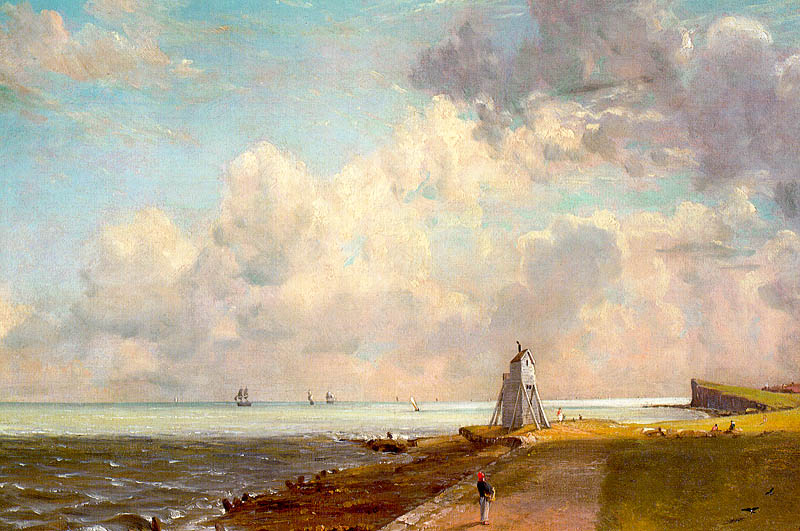
Harwich Lighthouse, c. 1820, John Constable (image courtesy of the Tate)

Harwich Lighthouse, c. 1820, John Constable (image courtesy of the Tate)

Constable painted this canvas of "Harwich Lighthouse" about 1820. His renditions of skies and clouds show the results of his many, many wonderful cloud studies and knowledge of Britain's climatic conditions.

Turner was equally attentive to light and climate as he painted, as can be judged by this astonishing canvas from 1816, "Chichester Canal". Apparently, the Indonesian volcano, Mt. Tambora, had erupted very violently in 1815, and the ash travelled around the world, causing dramatic atmospheric conditions. The 3rd Earl of Egremont commissioned the painting.

Chichester Canal, Joseph Mallord William Turner circa 1829 (Image courtesy of the Tate Collection).

Chichester Canal, Joseph Mallord William Turner circa 1829 (Image courtesy of the Tate Collection).

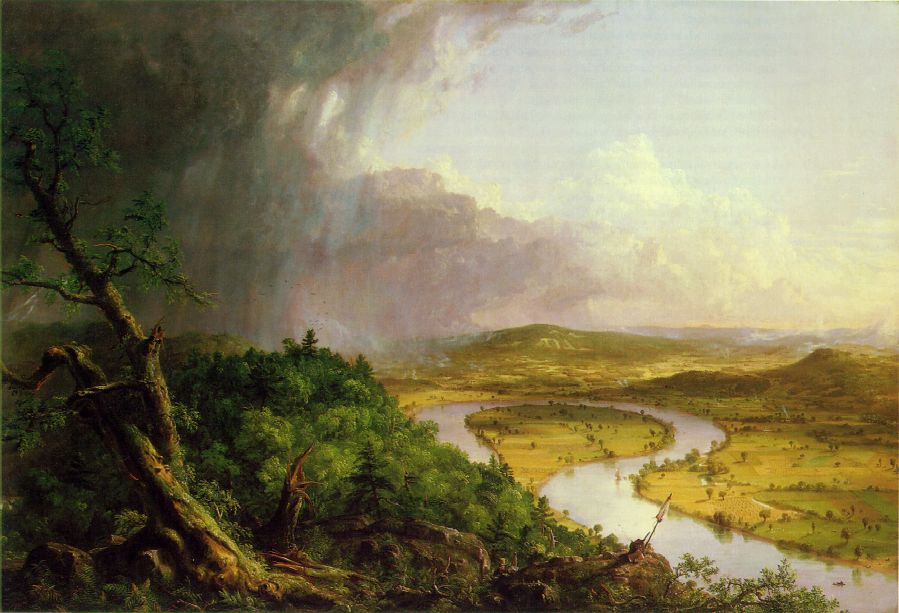
While the British, the Russians, the Swiss, the Norwegians and other Europeans were identifying increasingly with their nations, thanks in large part to artists' depictions of the natural wonders and characteristics, the Americans were doing the same. As the Hudson River School, the Romantic and Luminist schools of landscape painters developed in the United States, the paintings of the country's natural splendours helped fuel the sense of nationhood and drive towards development of the West. Even the eventual creation of National Parks was made easier by the depictions of the marvels of Yosemite and Yellowstone. Manifest destiny was implicit in much of the 19th century landscape painting in America, where discovery, exploration and settlement were all driving forces in society.

The Oxbow. View from Mount Holyoke, Northampton, Mass. after a Thunderstorm", 1836, Thomas Cole , (Image courtesy of the Metropolitan Museum of Art.)

The Oxbow. View from Mount Holyoke, Northampton, Mass. after a Thunderstorm", 1836, Thomas Cole , (Image courtesy of the Metropolitan Museum of Art.)

British-born American artist Thomas Cole was the founder of the Hudson River School; he introduced the beauties of the Hudson River Valley, the Catskill Mountains and upper New York/New England to an audience of appreciative fellow Americans. Second generation American landscape painters who continued to shape the political framework of America included such artists as Luminist John Frederick Kennsett. His work centered on the North East, but included work depicting the Mississippi and further afield.

Lake George, ca. 1860,John Frederick Kensett (1816–1872)Oil on canvas, 22 x 34 inches (approx.)Collection Museo Thyssen-Bornemisza, Madrid, Spain,

Lake George, ca. 1860,John Frederick Kensett (1816–1872)
Oil on canvas, 22 x 34 inches (approx.)
Collection Museo Thyssen-Bornemisza, Madrid, Spain,

Thomas Moran, meanwhile, was celebrating the wonders of the West. His depictions of Yellowstone were hugely instrumental in the National Park being created. His dramatic canvases were complemented by watercolours of many natural phenonmena, such as this 1873-74 watercolour of the "Shoshone Falls, Idaho" (image courtesy of the Chrysler Museum of Art).

Shoshone Falls, Idaho, 1873-74, thomas Moran,  (image courtesy of the Chrysler Museum of Art).

Shoshone Falls, Idaho, 1873-74, thomas Moran,  (image courtesy of the Chrysler Museum of Art).

All these landscape artists, European, Russian, American... were part of an ever-swelling political discourse about national identity and aspirations. The 18th and 19th centuries were era of great social upheavals and changes, with the Industrial Revolution shaping new societies. With increasing urbanisation, the role of landscape underwent a subtle change: it was no longer such an important defining factor in perception of nation. Artists themselves were often urban dwellers who had to make trips to the countryside to paint landscapes. The French Impressionists built on this tendancy that the previous generation of artists had begun - from Daubigny to Millet and Rousseau. Monet, Pissarro, Sisley, and their companions all made trips out from Paris in their early times as artists. But they also found increasing inspiration in urban scenes - railway stations, the French boulevards, the Seine river. As the artistic trends evolved, Picasso, Braque, Juan Gris, Matisse and countless others began to turn away from landscape painting. There were, of course, others - Cezanne, the Fauves, Miró  - who still used the vocabulary of landscape to explore the role of man in society.

Nonetheless, I can't help wondering how much the influence of urban landscapes - concrete and stone boxes and towers, streets vanishing in distant perspectives, the geometry of man's creations - overwhelmed the artistic eye as the trend accelerated towards abstraction and away from organic natural shapes and scenes. With such a different artistic vocabulary, has our societal identification of land and nation altered? Even though today's world is saturated with high definition images of amazing landscapes, do we identify with our lands in the same way as people did in previous centuries with their artists' depictions of land/nation? Do we find it easier to airbursh/Photoshop ourselves out of involvement with the landscapes we are filling up and polluting and exhausting today? Easier than when we were being shown the beauties of our lands by artists who were, in essence, pictoral ambassadors for those splendors? Indeed, basically, the majority of today's populations live in some form of urban setting, where concrete obliterates the natural world and where political perceptions have been altered by those surroundings.

Today's landscape artists have a very different role, I suspect, from the nation-building one of the Dutch artists onwards. Now, perhaps, it is almost a rearguard action or one of recording natural beauties before they disappear. However, I have grave doubts as to whether any of today's landscape artists, seldom ones who make the headlines in the art world, have much sway amongst our politicians. Perhaps it would make society better if they did?

From Reading about Art to a Metalpoint Show by Jeannine Cook

Threading my way between matters of health, matters of daily life and delights ranging from markets that are a visual and sensual feast of fresh produce to turquoise-sapphire seas sparkling enticingly, I keep trying to remember I am supposed to be an artist!

A reminder of this came this week with the opening of "Luminous Metal: Contemporary Drawings in Metalpoint" at the Clement Art Gallery in Troy, New York. Despite Hurricane Irene being in evidence in the area, apparently there was a goodly number of people at the reception. Photos of the show can be seen on Facebook. I was one of ten artists invited to exhibit in this show, something I was delighted about. We each had to submit three pieces for the show, and judging by the photos and sneak preview, we are all as diverse as possible, which of course makes for a fascinating exhibition when it comes to savouring of the wide range of possibilities even within this relatively narrow medium of silverpoint/metalpoint.

Meanwhile, threading though my daily life, I keep dipping into a truly interesting book which I found recently. Entitled "Artists' Techniques and Materials", it was written by Antonella Fuga, translated into English by Rosanna M. Giammanco Frongia, and published by the J. Paul Getty Museum in Los Angeles in 2006. One of the simple reasons I looked at it originally in the Royal Academy bookshop in London was that it was one of the few books dealing with artistic techniques and media which talked of silverpoint. (I found some seemingly definitive and weightly tomes on drawing there, which did not even mention the words "silverpoint" or "metalpoint" - shame on the authors, for they did not do their homework.)

I soon realised, however, that the book I did buy by Ms. Fuga is a gem. It is teaching me, in succinct and clear fashion, with wonderful, annotated illustrations, about media in a way that has me enthralled. Not only are drawing media talked of, but all manner of other media - printmaking, painting, sculpture, mosaic and intarsia, ceramics, glass, metalwork and jewellry, as well as contemporary techniques. Within each discipline, there are a myriad techniques explained, many of which are new to me – filigree glass, reticello work in glass, scagliola intarsia, for instance. There is a page of text for each, so that you learn enough about each technique to be at least sensible about it - and it is a door opened to further exploration if you want. Such fun!

It certainly keeps reminding me of the privilege of belonging to this great band of incredibly diverse artists, one that has existed since time immemorial in such intensity, imagination and skill.