The Test of Time by Jeannine Cook

How often do images of artwork remain with one long after going to the exhibition? I always find it to be a good test of how much I like a piece of art, how much it has spoken to me, and how it has become embedded in my mind.

I was thinking about this aspect of viewing art in relation, for instance, to the Summer Exhibition 2011 at the Royal Academy in London. I went to see this huge show in early June - it stays up until 15th August. Now, nearly six weeks after I saw the exhibition, I find that there are only a few of the thousand-plus works of art that remain fresh in my mind and still interest me. Naturally, as I invariably find, the art I like is seldom illustrated in any catalogue (let alone postcards in a museum)! So it is even more an acid test that I need to remember the artwork entirely without prompts, save for any notes or quick drawings I might have made at the time.

The RA Summer Exhibition, a selling exhibition, is a giant affair, with eminent Academicians in charge of hanging different rooms. Christopher Le Brun was the show's main co-ordinator; he operated under the thesis, "There are two ways of showing paintings. One is the classic orthodox hang with lots of space around every single piece. But here it's like a battle of the paintings - forty big pictures on one wall alone!" By contrast, Michael Craig-Martin, who curated another room, went in another direction. He explained, "Normally, the Royal Academicians are hidden among everyone else. I wanted to show their range and quality by focusing for the first time on RAs only, because there are lots of new ones and nobody quite realises that they have all arrived here."

Photographs, paintings, etchings and other prints, artist's books, architectural renderings and models, sculpture, drawings - the 1117 works gave everyone a taste of today's art. You need a few hours or several visits properly to absorb the diversity, quite apart from having to navigate the crowds which ebb and flow according to the hour. It makes the test of time even more demanding, in fact. But as I remember back, some works remain to delight me.

Frederick Cuming's large oils were a delight of subtle atmospherics, whose titles, "Crescent Moon and Sea" "Clouds Evening, Camber", "Clouds and Reflections" or "Dawn Garden, Frost" tell of his interest and skills in conveying almost abstractions that evoked northern climes. Later, I found his silkscreens, "Etna" and "Thaw", and promptly fell for them!

May Evening, Crescent Moon,  Fred Cumming, oil on board. (courtesy of the Artist)

May Evening, Crescent Moon,  Fred Cumming, oil on board. (courtesy of the Artist)

Winter Sea Camber 14, Fred Cumming , oil on board (courtesy of the Artist)

Winter Sea Camber 14, Fred Cumming , oil on board (courtesy of the Artist)

At the other end of the spectrum, a warm evocative abstraction in reds, "Window Screen Ajanta" took one far to the tropics - it was an oil by the late William Baillie. I have to say it was positively miserably hung, and almost impossible to view - shame on the RA for such a disservice to the artist.

In between, of course, there were the large and dramatic, the small and delightful, the ugly and strident, but more importantly, the gems. One, for me, was Edmund de Waal's "Untitled, 2011" white lacquered cabinet, hung on the wall, with clear laminated glass, containing 70 diminuitive celadon and white vessels. Discreet and elegant, interesting and evocative of so much history eastern and western in the ceramics world, I was not surprised that it was already sold. The other reason for my pleasure at seeing it was that the artist is also the author of one of the best books I have read for ages, "The Hare with Amber Eyes".

Another series of eight drawings, "Marks on the Edge of Space" were a fascinating use of conte, graphite and mylar by Ann Christopher RA. Layers, stainless steel rivets to attach them, use of shadows to evoke water, fields of grass, trees – so many plays of tone and shape to delight. Very sophisticated, lovely work.

THE LINES OF TIME -15, Pastel / graphite / crayon, Ann Christopher (courtesy of the Artist)

THE LINES OF TIME -15, Pastel / graphite / crayon, Ann Christopher (courtesy of the Artist)

THE LINES OF TIME -20, Pastel / graphite / crayon , Ann Christopher (courtesy of the Artist)

THE LINES OF TIME -20, Pastel / graphite / crayon , Ann Christopher (courtesy of the Artist)

THE LINES OF TIME -21,  Pastel / graphite / crayon, Ann Christopher (courtesy of the Artist)

THE LINES OF TIME -21,  Pastel / graphite / crayon, Ann Christopher (courtesy of the Artist)

There was another delight in the drawing section - a silverpoint. Small and quiet in its faintness, it was a lovely portrait, "Dulcie" by Dylan Waldron. Marvellous to find another silverpoint artist!
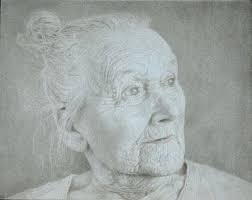
Dulcie, silverpoint, Dylan Waldron

Dulcie, silverpoint, Dylan Waldron

Of course there were many other stimulating or beautiful works of art at the RA. Nonetheless, the artworks which have stood the test of time for me and that come first to mind are, as I have mentioned above, but a handful. Of course, that is just my personal selection: vive la difference is definitely the operative phrase at a show like the RA Summer Exhibition. It is worth going to the exhibition if you are in London, for it is a good way of testing the pulse of a wide selection of British artists.

Art sustaining daily life - it works! by Jeannine Cook

Many a week has flashed past since I last blogged here, weeks that began with a wonderful kalidescope of art exhibitions in London for five days (of which more in future days) but then became a succession of shocks and anxieties as my beloved Rundle was found to have a ruptured aneurysm in his leg. Art obviously took very much a back seat as I robed and unrobed on my visits to the ICU in a local hospital, where Rundle lay fighting to beat the high odds of losing his leg.

For the next weeks, Rundle was in a hospital room overlooking the azure Mediterranean, with the view framed by beautiful umbrella pines and buildings that perfectly complemented the scene with luminous ocres and cream facades. Expansive and beautiful - I finally was able to do some quick drawings, but the wonderful variety of moods and lights was harder to capture. Nonetheless, even the act of picking up a pencil to draw helped to ground me again in this strange world in which both of us were living. Showing Rundle the drawings seemed to help him too, despite the grinding pain and discomfort.

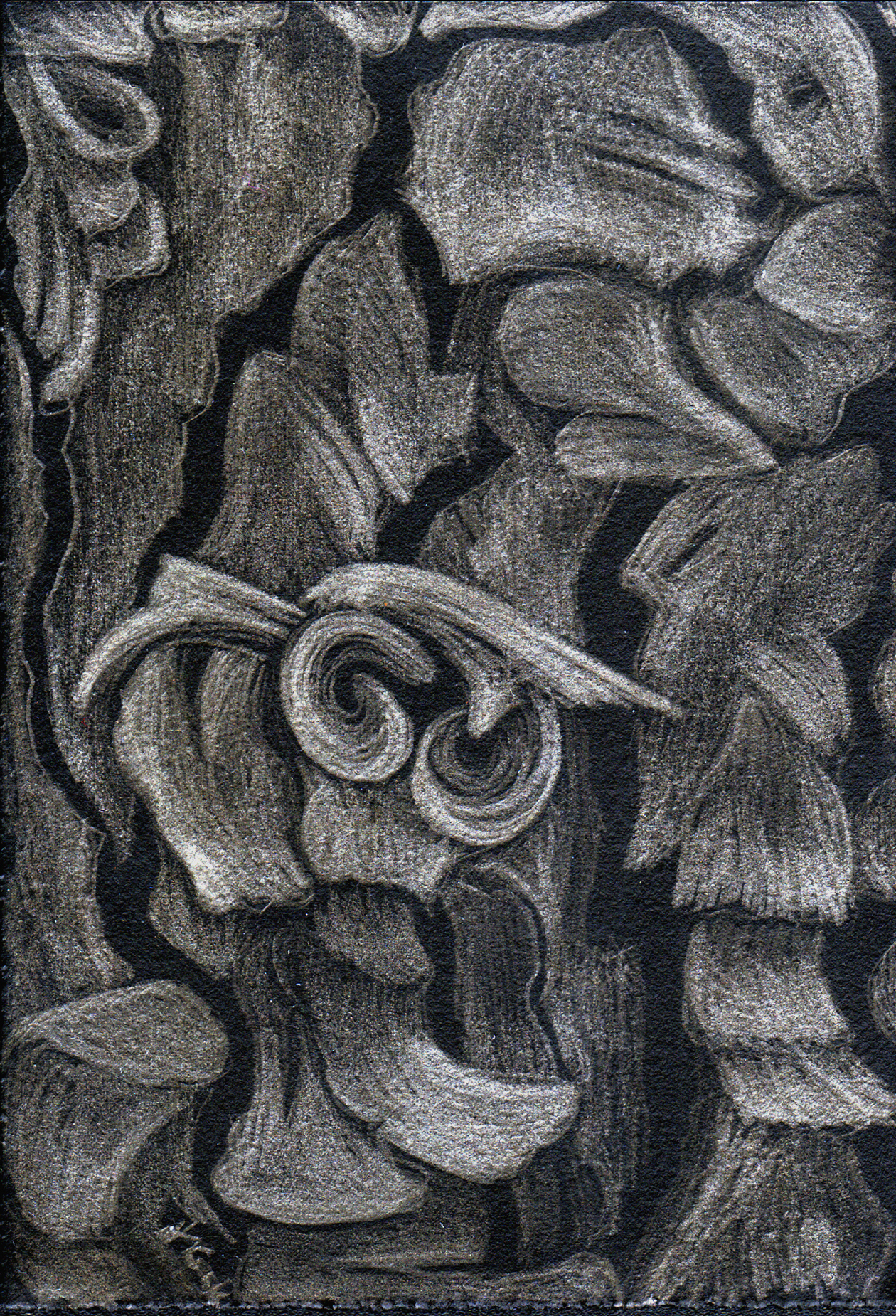
Now the days back at home are far more interlinked with art. It helps at every turn - distraction for Rundle as he recuperates, centering for me when I can slip away for a few minutes to start drawing tiny silverpoints - a series on black ground (again!) which I found myself referring to as Ariadne's Thread. She provided the thread that helped Thesus wend his way out of the Labyrinth after he had killed the Minotaur. It seems art is helping us out of our labyrinth, towards sustaining a more normal life.

Ariadne's Thread I - pine tree bark, silverpoint on black, Jeannine Cook artist

Ariadne's Thread I - pine tree bark, silverpoint on black, Jeannine Cook artist

Ariadne's Thread II - pine tree bark, silverpoint on black, Jeannine Cook artist

Ariadne's Thread II - pine tree bark, silverpoint on black, Jeannine Cook artist

Meanwhile, my earlier gambles with an artist's eye in decisions on reorganising a house are paying off. By now, furniture is moved, paintings hung in different places, lighting improved, and everything is indeed becoming serene. Beautiful things can now breath and be seen, with remarkably few major changes. It confirms the fun and huge importance of being an artist, even in daily life when one is not wielding a paint brush! Art does sustain.

Art concepts in daily life by Jeannine Cook

The past two or more weeks have been a maelstrom of activity, none of it involved with the actual creation of any art. Nonetheless, I have been very busy as an artist!

I have been working to create a serene, uncluttered home from one that was lovely but full, oh so full, of furniture, ornaments and other things that are in daily use. As I studied the rooms, trying to work out what changes could be made without major building ventures, I realised that I was calling on everything I know in art-making about balance, composition, colour harmony, variety. Even the exercise of being able to visualise how things would look if I made a specific change was valuable, and comes dirctly from all the visualisation I do when I am trying to work out how to approach a painting or drawing. Having visualised things, then a tape measure helped confirm the viability of the plan.

It became an interesting exercice, and one that required different stages. The first critical move was to get rid of one piece of furniture, only - the lynch pin of the whole venture. That allowed all sorts of other furniture to be moved around, and all of a sudden, space and serenity "happened", where everyone can circulate easily. Amazing! A spacious, coherent living room and a functional diningroom were the results.

Next came colour decisions for a huge reupholstering effort of all the chairs and sofa, a bewildering exericise, of course! The fabric samples are always so alluring, and then you have to extrapolate from that small piece of fabric to how the whole sofa will look, once recovered! Again, my role as an artist was distinctly helpful. Trying to harmonise colours of tiled floors, carpets and the seating was a full day's chopping and changing ideas about fabric selections. But it was finally done, the upholsterer carried off the first item, and now comes the waiting period whilst I wonder if the "artist's eye" has carried me through alright!

One of these days, soon, soon, I promise myself: I will be able to get back to drawing and painting and not just be dependent on my art to reorganise a house.

Going for a Walk in Manassas Bog by Jeannine Cook

Several weeks ago, I went with Coastal Wildscapes organisation to a deceptively ordinary-looking place near Bellville, Georgia, called Manassas Bog. It was a hot day in an area that is showing the effects of drought, and the group of us followed each other down dusty, sandy roads to a fenced off area beneath power lines.

Soon, however, the enthusiasm of our hosts had us all excited and fascinated. This seemingly featureless area is home to a multiplicity of plants, rare and more common, many of which were in full, glorious bloom. As we walked along the rolling hill terrain, people were photographing left, right and center. But I suddenly knew that here was a source of many potential silverpoint drawings, although I was not yet at all clear how or even, really, why. Instinctively, I began selecting dried seeds, grasses and dead flowers when one of them "spoke" to me. By the end of the long and interesting morning's walks, I had a handful of "trophies" that I carefully put in the car to bring home. I had no idea what I would do with them; I just knew they promised.

The results of this wonderful walk in Manassas Bog were two silverpoint drawings, one of which I am donating to Coastal Wildscapes to use for fund-raising. I spent time allowing the subconscious dialogue I had had with these dried materials to float up to my conscious mind. I then started trying out arrangements of the different pieces, until it seemed a possible mix and composition. A loose graphite study helped me in deciding how to position things on the page. Finally, I settled down to the often slow development of each silverpoint drawing. Each one brought out a different reaction in me, but both gave me fascination and delight.

Seen at Manassas Bog, silverpoint, Jeannine Cook artist, Private Collection

Seen at Manassas Bog, silverpoint, Jeannine Cook artist, Private Collection

A Day at Manassas Bog, silverpoint, Jeannine Cook artist, Private Collection

A Day at Manassas Bog, silverpoint, Jeannine Cook artist, Private Collection

 I did enjoy my walk in Manassas Bog!

More about Self-portraits by Jeannine Cook

When I was writing recently about art being a form of self-portrait, a record of where each artist is in time and space and outlook in life, I remembered another statement, this time by Leonardo daVinci. He said, "Every painter paints himself. Painters seem to paint their own faces and make paintings that seem directly involved with their own life. " Indeed, there has been much speculation about many of Leonardo's portraits using his own features, such as this video of Siegfried Woldhek talking about his search for Leonardo's self-portraits. This image is the most famed, done between 1512-15 in red chalk, when Leonardo was in his sixties, a drawing in the Royal Library of Turin.

Self-Portrait, Leonardo da Vinci, 1512-15 in red chalk drawing (Image courtesy of the Royal Library of Turin)

Self-Portrait, Leonardo da Vinci, 1512-15 in red chalk drawing (Image courtesy of the Royal Library of Turin)

The urge to record one's own existence, one's presence, has been with us humans since time immemorial. This form of saying "I exist, I am present", in visual fashion, is testimony to mankind's sense of community, of shared characteristics that are more important than their differences, at least at some moments in our history. One of the most amazing collections of human representations is apparently becoming better known and understood in recent years - the GwionGwion rock paintings in the Kimberly area in N.W. Australia. Not only are these rock paintings probably more than 40,000 years old, but they tell of human life and adventures in stunning, elegant fashion.

Tassel Bradshaw (Gwion Gwion) figures wearing ornate costumes

Tassel Bradshaw (Gwion Gwion) figures wearing ornate costumes

Bradshaw figure, ( courtesy of the Bradshaw Foundation).

Bradshaw figure, ( courtesy of the Bradshaw Foundation).

As examples of artwork that reveals the artist's own experience, in "self-portraiture" style, there is a red rock painting of a boat, the earliest known in history, that tells of man's migration to Australia via a four-man canoe on the Gwion Gwion rocks.

Bradshaw boat people, 40,000 years ago

Bradshaw boat people, 40,000 years ago

There is also another long panorama of four-legged, antlered animals that the artist had evidently seen during the migration from SE Asia. There are no such animals, now or in early times, in Australia.

Gwion Gwion (Bradshaw) paintings on a rock wall.

Gwion Gwion (Bradshaw) paintings on a rock wall.

Gwion Gwion cave paintings in the Kimberely

Gwion Gwion cave paintings in the Kimberely

This huge collection of rock paintings, in hostile, difficult and remote terrain is an astounding example of man recording existence, beliefs, and ceremonies from very early times that one author, Jo Lennan, describes as "a forgotten Eden". The name, Gwion Gwion, comes from a bird's name. The Aboriginal people recount that this bird pecked the rock with such force that its blood sprang forth and it used its bloodied beak and feather to delineate the elegant, dainty figures. Indeed, it is thought by today's experts that these long-ago artists actually used quills to make the fine lines on the rocks. The actual dates of these early artists' work are still being determined, because the pigments used to draw have become part of the rocks themselves, and carbon dating doesn't work, especially in the tropics where its limits of dating go back +-40,000 years. Nonetheless, apparently on top of one drawing, there is a fossilised mud wasp's nest, and optical luminescence (which dates when something last saw the light of the sun) allowed a date of about 17,500 years for the drawing. This means that these artists were telling of themselves and their world at the same time as their long-distant colleagues were painting the wonderful images of their immediate universe on the cave walls in Lascaux, France.

What marvels we all inherit when such artists create "self-portraits" of their personal worlds.

Art as Self-Portraits by Jeannine Cook

Allison Malafronte, writing in October 2010 in American Artist, quoted the late wonderful artist, Timothy R. Thies, as saying, "The interesting thing is that I can go back to an image and remember exactly how I was feeling at the moment I painted it. In fact, every painting I do is a self-portrait, because they are all about where I am in my life at that specific moment."

I think that is such an accurate statement. I was storing away art that had returned from an exhibition this evening and moved some old drawing books to make space. I leafed though them quickly, and memories came flooding back. They were of different trips to parts of Europe - quick drawings of places, things that interested me, light effects - a myriad evocative scenes. In essence, each drawing was part of the continuous record of my being, my evolution through life, my interests and excitements.

Perhaps this continuous self-portraiture - de facto - is one of the most compelling reasons to be disciplined enough to keep a drawing journal. Writers keep written journals - and in fact, so do many artists. But the act of drawing is somehow different, and for an artist, immensely powerful as an aide-mémoire in its unadorned directness. Not only is one recording images that can perhaps serve later on for more sustained paintings or drawings, but each drawing tells of that particular moment in one's existence. Taking photographs is not quite the same - perhaps the mechanical click of the button to record the image is too quick and too easy to imprint the scene on one's mind in the same way as actually executing a drawing.

In fact, in one of the drawing books I was looking at this evening, I found some photographs that - very unusually - I had taken with my husband's camera. They were of some marvellous handmade wooden big reels of fishing line, lying on a quay in the Azores. I had drawn the reels a couple of times, but evidently wanted the colour images as well. My drawings brought back a flood of sensations - I could hear the sounds of the boatmen working on their vessels, the sound of the wind lapping the waves on the concrete harbour wall, the cool shade where I was standing. But the photographs conveyed none of those remembered sensations – they seemed "dead" and impersonal.

I am glad that I inadvertently had a trip down memory lane today. It validated the effort always to carry a drawing book with me when I travel.

Small Incidental Images by Jeannine Cook

I think I have always been attracted to the small and intimate, rather than the large and often grandiose in art. When I spent many hours in the Louvre as a young, homesick girl in Paris, I found myself constantly returning to the galleries where drawings, or small sculptures and other three-dimensional objects were displayed. Things that you could, in theory, hold in your hands, things that were proportioned to the human body, that could be studied close up and very attentively.

There is a discipline and orderliness required in small artwork for the close scrutiny required means that incoherence or mistakes show up more readily. Think of the rather extreme example of miniature portraits, that marvellous subset of likenesses on ivory, vellum or other delicate surfaces.

Henry Frederick, Prince of Wales, miniature portrait done about 1606 by Isaac Oliver (1558/68-1617), Image courtesy of the  Fitzwilliam  Museum

Henry Frederick, Prince of Wales, miniature portrait done about 1606 by Isaac Oliver (1558/68-1617), Image courtesy of the  Fitzwilliam  Museum

 Isaac Oliver miniature, done in 1615, portrait of Charles, Prince of Wales (later Charles I). Image courtesy of the Berger Collection, Denver, Colorado.

 Isaac Oliver miniature, done in 1615, portrait of Charles, Prince of Wales (later Charles I). Image courtesy of the Berger Collection, Denver, Colorado.

Such small images fascinate and delight. But there are plenty of other versions of diminutive artwork that can be arresting.  Lea Coll Wight, a highly acclaimed artist from New Jersey, writing in American Artist in November 2009, was quite correct when she observed, "The beauty of small incidental images can be as profound as those that are grand and orchestrated."

Perhaps the incidental aspect of life, when one is living amidst great natural beauty, is easier to see. A walk beneath wonderful trees, a stroll through a garden dancing with flowers, or even a bird-watching session ... can suddenly yield images that one translates later into artwork. The initial excitement can stay with one more easily if the resultant art is on a smaller scale. Perhaps that is why I love working in small scale silverpoint drawings - the passion can still burn brightly.

I think it also helps artists to keep fresh if they work on a scale that does not require enormous investments of time. I know that there are many times when context and commission require large work, but I sometimes wonder if the excitement can be sustained very easily in such cases. Perhaps, in the end, it is a matter of taste. I'll keep gravitating to the "small incidental images", I suspect!

Nature in our Lives by Jeannine Cook

It has been a week of dealing with consumer goods - to put it generically - that all seem to be falling apart in very short order after they are bought and installed. The antithesis of the natural world, these are man made objects that horrify by the implications of their impact on the planet's future health, during their manufacture and also during their disposal. Alas, they all seem to be necessary in our life - things like refrigerators, computers, even plastic nuts for bolts.

A welcome break from these concerns came today when I was present during a visit to my Darien exhibition by a group of charming ladies from a St Simons Island Garden Club. This exhibition, At the Edge of the Marsh, continues at the McIntosh Art Association Gallery until 27th May.

As I stood in the gallery, explaining to these visitors about silverpoint and how you create these silver drawings, I was forcibly reminded of a remark I read some while ago. Julie Lohmann, a German designer, said, "There is a paradox at work. On one hand we are distancing ourselves from nature as far as humanly possible, creating our own artificial world, but the more we do that, the more we long to be a part of nature and bring it back into our lives." (my emphasis).

The reaction of many of the visitors to my art today showed how eagerly they related to the depictions of flowers, of marsh scenes – in other words, of nature. It was as though I was drawing and painting a world with which they felt very comfortable, a world that they welcomed in their lives as a very important ingredient of well-being. Their comments made me feel that there is a very necessary counter-balance to our consumer-driven society: nature and the magical, infinite manifestations of its diversity.

Keeping Eyes Fresh by Jeannine Cook

I must have walked the sandy lanes of our neighbourhood thousands of times in the past years. I know the area well enough to feel comfortable walking in the dark, knowing which protruding roots to avoid in the road, where the overhanging branches almost touch one's head.

Yet I am constantly amazed and delighted at how different the familiar scenes look each time I venture forth. Yes, the light and temperature change, depending on the weather and the season. Yes, the seasons bring forth different stages of vegetation and thus variations in colours of leaves, subtle changes in the marsh grasses. But there is something else that happens.

If each of us sets forth, consciously with eyes open and aware of surroundings, a walk yields wonderful rewards. An artist, especially, needs to keep eyes fresh and alert. You never know what will suddenly hit you as being special, worthy of exploration as an ingredient in art-making. No matter how well you know your surroundings, they can suddenly appear in a totally different way, given a willingness to look. Perhaps it depends too on one's frame of mind, what is happening subconsciously in terms of art...

This past week, I was rewarded with a whole new, exciting series of subjects to draw. Trees which I love and know well began to "talk" to me, not as I usually see them in terms of mighty, elegant structures with green canopies far above. My eyes were riveted to their barks, the ways this outer casing rippled and cracked, swirled and split, peeled and shredded. Every tree is different, even within the same type of tree. And one side of the tree is different, in many cases, from the other side of the same tree trunk. Totally fascinating.

Live Oak Bark

Live Oak Bark

Live Oak Bark

Live Oak Bark

Oak Tree Bark

Oak Tree Bark

These are just three examples of the bark of the wondrous Live Oak (Quercus virginiana).

Needless to say, my walks have been slowed down a great deal, as I use my fresh eyes to explore these new terrains!

Connecting the Dots - again! by Jeannine Cook

A few months ago, I read the dense and absolutely fascinating book, "The Discovery of France" (with the additional title in the States of "A Historical Geography") by Professor Graham Robb of Oxford University. It is the most amazing work - the result of many years of research and some 14,000 miles cycled through France on his voyages of discovery. Graham Robb shows how the cohesive nation of today, "la belle France", was far from being either cohesive or civilised until very recently, really until the 19th century. Paris was an island of learning, culture and enterprise in a sea of very primitive, divided groups of people who had little concept of belonging to a nation and who, for the most part, did not even speak French until well after the French Revolution.

One of these groups, the Savoyards from Savoie, a beautiful area to the east of France, in the Alps region of Lake Geneva, had such trouble surviving in their inhospitable and highly taxed lands, that they would send their very young children to Paris for survival, of sorts. This had been going on for centuries, and these young children, virtually in servitude in many cases, would walk to Paris and there, they organised themselves into groups. They were especially famed as chimney sweeps because, being skinny small children, they could clamber up the narrow Parisian chimneys to clean them out.

Graham Robb tells a lot about these impoverished Savoyards, with their sense of solidarity, and their importance to their families back in Savoie to whom they would send money every year. Balzac and Victor Hugo wrote about the Savoyards, with their heroic attempts to survive, turning their hand to any job deemed unfit for others.

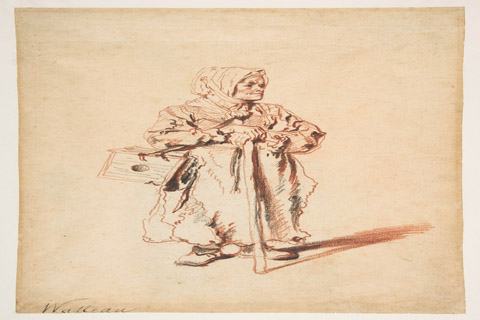
Standing Savoyarde with a Marmot Box, Antoine Watteau

Standing Savoyarde with a Marmot Box, Antoine Watteau

Eventually, some 150 years ago, they progressed from chimney sweeping to another tightly knit category, the "collets rouges", the official porters at Hôtel Drouot, the most famous and oldest auction house in Paris. 110 porters, all Savoyards, have the right to transport, sort, store and carry all the auction items in the Drouot precincts. Recently, there have been some "irregularities" discovered and porters have been investigated for serious wrong-doing, something the French do not seem surprised about!

But the wonderful connecting of dots that happened again for me was when I was reading about the clearly fabulous exhibition currently on at the Royal Academy, London, of Jean Antoine Watteau's drawings. I had known that Watteau drew all sorts of contemporary scenes in Paris, not just the "fêtes galantes" of the Royal Court and 18th century French society. But I had forgotten about his drawings of the Savoyards. The Royal Academy exhibition apparently has eighty-eight drawings, divided into five themes, of which one deals with the Savoyards.

The Old Savoyard, red and black chalk with stumping, 1715, Antoine Watteau, (image courtesy of the Art Institute of Chicago)

The Old Savoyard, red and black chalk with stumping, 1715, Antoine Watteau, (image courtesy of the Art Institute of Chicago)

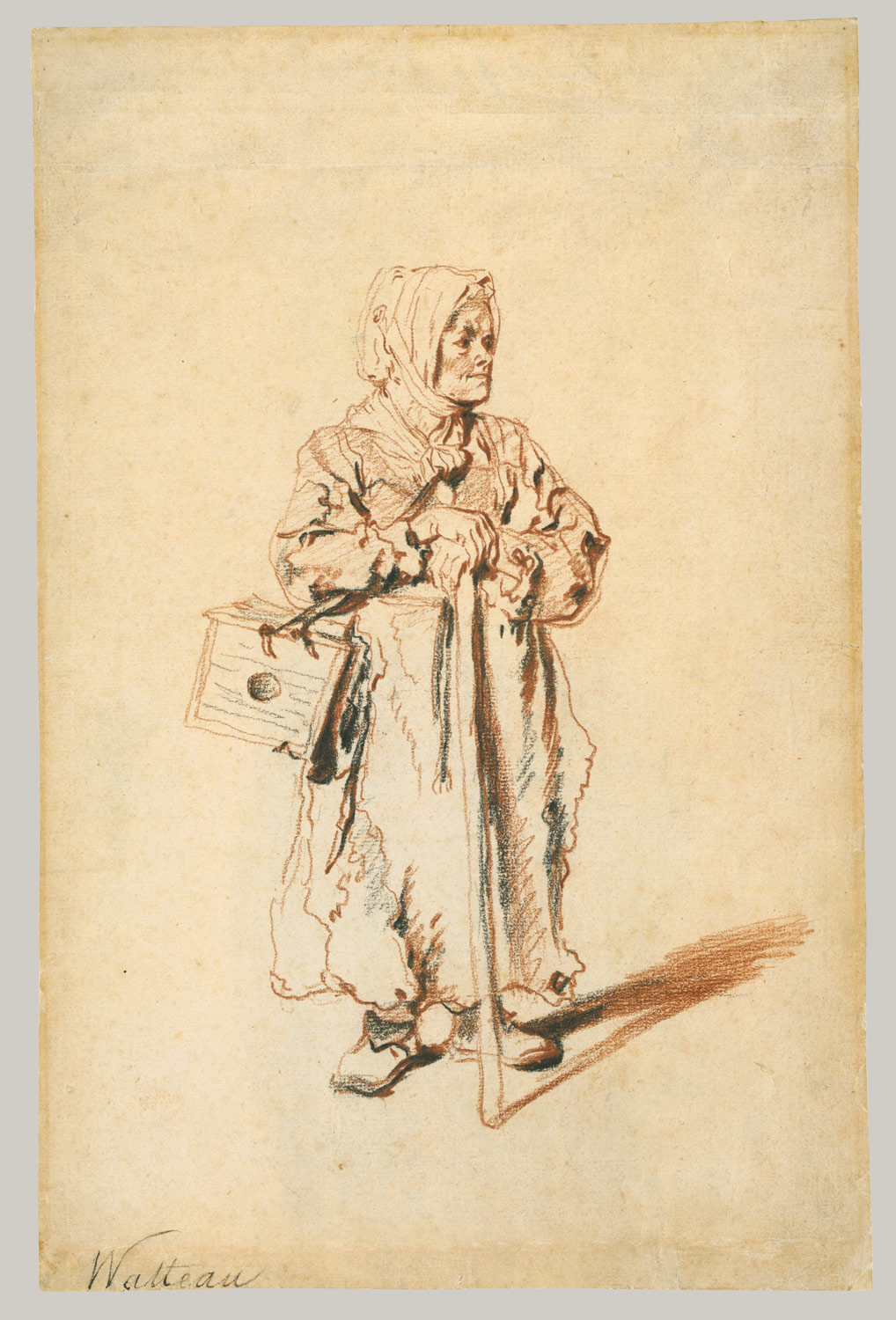
The Old Savoyarde,, 1715, Antoine Watteau, red and black chalk (image courtesy of The Metropolitan Museum).

The Old Savoyarde,, 1715, Antoine Watteau, red and black chalk (image courtesy of The Metropolitan Museum).

These two drawings of elderly Savoyards, impoverished and marked by hardship, date from 1715. The old lady carries a marmot box, for the Savoyards would train marmots and use them for street entertainment in their quest for survival. Watteau apparently executed about a dozen drawings of the Savoyards in total.

Only such a master draughtsman as Watteau could so vividly illustrate the dire straits of the Savoyards that Graham Robb describes.