Nature in our Lives by Jeannine Cook

It has been a week of dealing with consumer goods - to put it generically - that all seem to be falling apart in very short order after they are bought and installed. The antithesis of the natural world, these are man made objects that horrify by the implications of their impact on the planet's future health, during their manufacture and also during their disposal. Alas, they all seem to be necessary in our life - things like refrigerators, computers, even plastic nuts for bolts.

A welcome break from these concerns came today when I was present during a visit to my Darien exhibition by a group of charming ladies from a St Simons Island Garden Club. This exhibition, At the Edge of the Marsh, continues at the McIntosh Art Association Gallery until 27th May.

As I stood in the gallery, explaining to these visitors about silverpoint and how you create these silver drawings, I was forcibly reminded of a remark I read some while ago. Julie Lohmann, a German designer, said, "There is a paradox at work. On one hand we are distancing ourselves from nature as far as humanly possible, creating our own artificial world, but the more we do that, the more we long to be a part of nature and bring it back into our lives." (my emphasis).

The reaction of many of the visitors to my art today showed how eagerly they related to the depictions of flowers, of marsh scenes – in other words, of nature. It was as though I was drawing and painting a world with which they felt very comfortable, a world that they welcomed in their lives as a very important ingredient of well-being. Their comments made me feel that there is a very necessary counter-balance to our consumer-driven society: nature and the magical, infinite manifestations of its diversity.

Keeping Eyes Fresh by Jeannine Cook

I must have walked the sandy lanes of our neighbourhood thousands of times in the past years. I know the area well enough to feel comfortable walking in the dark, knowing which protruding roots to avoid in the road, where the overhanging branches almost touch one's head.

Yet I am constantly amazed and delighted at how different the familiar scenes look each time I venture forth. Yes, the light and temperature change, depending on the weather and the season. Yes, the seasons bring forth different stages of vegetation and thus variations in colours of leaves, subtle changes in the marsh grasses. But there is something else that happens.

If each of us sets forth, consciously with eyes open and aware of surroundings, a walk yields wonderful rewards. An artist, especially, needs to keep eyes fresh and alert. You never know what will suddenly hit you as being special, worthy of exploration as an ingredient in art-making. No matter how well you know your surroundings, they can suddenly appear in a totally different way, given a willingness to look. Perhaps it depends too on one's frame of mind, what is happening subconsciously in terms of art...

This past week, I was rewarded with a whole new, exciting series of subjects to draw. Trees which I love and know well began to "talk" to me, not as I usually see them in terms of mighty, elegant structures with green canopies far above. My eyes were riveted to their barks, the ways this outer casing rippled and cracked, swirled and split, peeled and shredded. Every tree is different, even within the same type of tree. And one side of the tree is different, in many cases, from the other side of the same tree trunk. Totally fascinating.

Live Oak Bark

Live Oak Bark

Live Oak Bark

Live Oak Bark

Oak Tree Bark

Oak Tree Bark

These are just three examples of the bark of the wondrous Live Oak (Quercus virginiana).

Needless to say, my walks have been slowed down a great deal, as I use my fresh eyes to explore these new terrains!

Connecting the Dots - again! by Jeannine Cook

A few months ago, I read the dense and absolutely fascinating book, "The Discovery of France" (with the additional title in the States of "A Historical Geography") by Professor Graham Robb of Oxford University. It is the most amazing work - the result of many years of research and some 14,000 miles cycled through France on his voyages of discovery. Graham Robb shows how the cohesive nation of today, "la belle France", was far from being either cohesive or civilised until very recently, really until the 19th century. Paris was an island of learning, culture and enterprise in a sea of very primitive, divided groups of people who had little concept of belonging to a nation and who, for the most part, did not even speak French until well after the French Revolution.

One of these groups, the Savoyards from Savoie, a beautiful area to the east of France, in the Alps region of Lake Geneva, had such trouble surviving in their inhospitable and highly taxed lands, that they would send their very young children to Paris for survival, of sorts. This had been going on for centuries, and these young children, virtually in servitude in many cases, would walk to Paris and there, they organised themselves into groups. They were especially famed as chimney sweeps because, being skinny small children, they could clamber up the narrow Parisian chimneys to clean them out.

Graham Robb tells a lot about these impoverished Savoyards, with their sense of solidarity, and their importance to their families back in Savoie to whom they would send money every year. Balzac and Victor Hugo wrote about the Savoyards, with their heroic attempts to survive, turning their hand to any job deemed unfit for others.

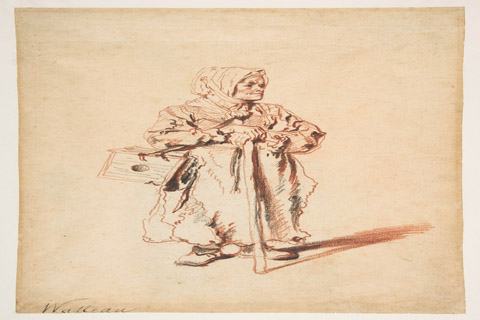
Standing Savoyarde with a Marmot Box, Antoine Watteau

Standing Savoyarde with a Marmot Box, Antoine Watteau

Eventually, some 150 years ago, they progressed from chimney sweeping to another tightly knit category, the "collets rouges", the official porters at Hôtel Drouot, the most famous and oldest auction house in Paris. 110 porters, all Savoyards, have the right to transport, sort, store and carry all the auction items in the Drouot precincts. Recently, there have been some "irregularities" discovered and porters have been investigated for serious wrong-doing, something the French do not seem surprised about!

But the wonderful connecting of dots that happened again for me was when I was reading about the clearly fabulous exhibition currently on at the Royal Academy, London, of Jean Antoine Watteau's drawings. I had known that Watteau drew all sorts of contemporary scenes in Paris, not just the "fêtes galantes" of the Royal Court and 18th century French society. But I had forgotten about his drawings of the Savoyards. The Royal Academy exhibition apparently has eighty-eight drawings, divided into five themes, of which one deals with the Savoyards.

The Old Savoyard, red and black chalk with stumping, 1715, Antoine Watteau, (image courtesy of the Art Institute of Chicago)

The Old Savoyard, red and black chalk with stumping, 1715, Antoine Watteau, (image courtesy of the Art Institute of Chicago)

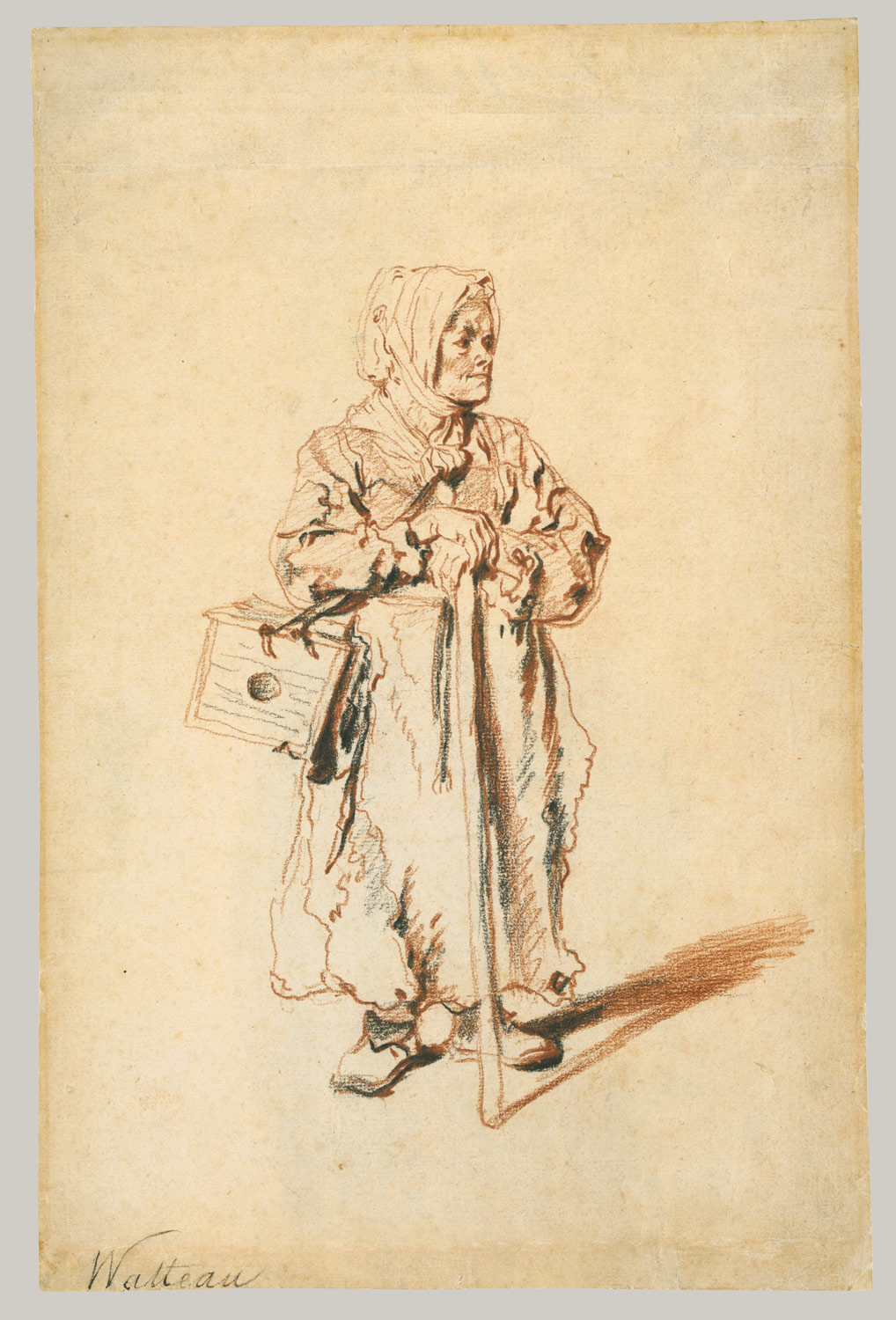
The Old Savoyarde,, 1715, Antoine Watteau, red and black chalk (image courtesy of The Metropolitan Museum).

The Old Savoyarde,, 1715, Antoine Watteau, red and black chalk (image courtesy of The Metropolitan Museum).

These two drawings of elderly Savoyards, impoverished and marked by hardship, date from 1715. The old lady carries a marmot box, for the Savoyards would train marmots and use them for street entertainment in their quest for survival. Watteau apparently executed about a dozen drawings of the Savoyards in total.

Only such a master draughtsman as Watteau could so vividly illustrate the dire straits of the Savoyards that Graham Robb describes.

Another Beautiful Art Form by Jeannine Cook

Circuses and high-flying trapeze artists are part of every child's education, I suspect. Those moments of delighted amazement that accompany feats of grace and daring on slender ropes and bars high above the ground are the stuff of circus legend. Circuses have long been the subject of artists too - think of Toulouse-Lautrec's penetrating and ultimately sad and solitary depictions of circus performers, Chagall's vibrant versions of circus life and of course, Pablo Picasso's Rose Period paintings of circus harlequins.

Au cirque Fernando, l'écuyère, 1888,  Henri de Toulouse-Lautrec, (Image courtesy of the Art Institute of Chicago)

Au cirque Fernando, l'écuyère, 1888,  Henri de Toulouse-Lautrec, (Image courtesy of the Art Institute of Chicago)

Circus Horse, 1964, Marc Chagall

Circus Horse, 1964, Marc Chagall

Circus Family, the Tumblers, 1905, oil, Pablo Picasso

Circus Family, the Tumblers, 1905, oil, Pablo Picasso

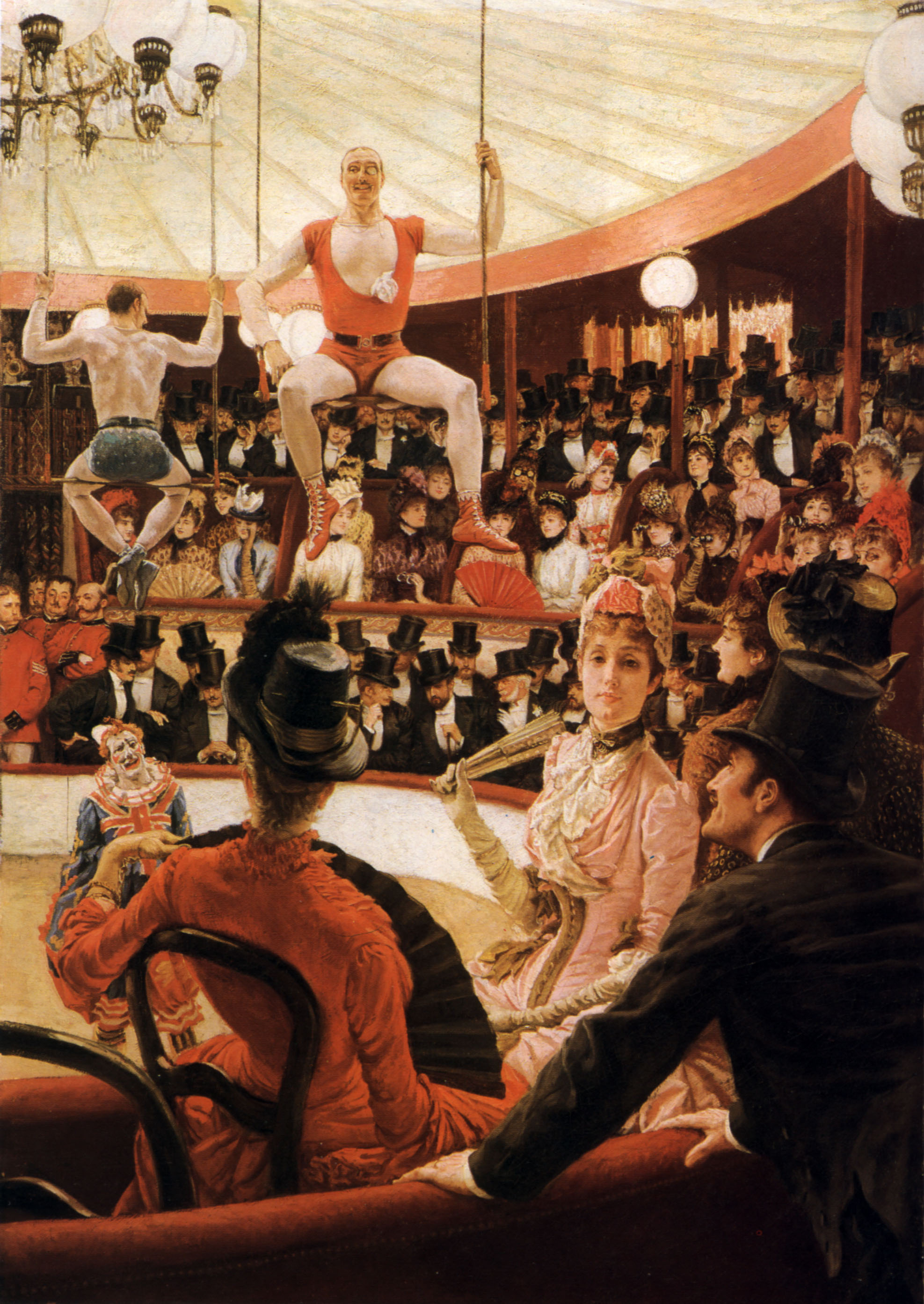
James Tissot, an accomplished French painter from Nantes, who lived from 1836-1902. painted Women of Paris, the Circus Lover,  showing the fascination audiences had with the high bars. Below, too, is the famous - but unfinished - Georges Seurat pointillist painting from 1890-91, The Circus.

Women of Paris, the Circus Lover, James Tissot, 1883-85, (Image courtesy of the Museum of Fine Arts, Boston)

Women of Paris, the Circus Lover, James Tissot, 1883-85, (Image courtesy of the Museum of Fine Arts, Boston)

The Circus,  1890-91,  Georges Seurat, (image courtesy of the Museé d'Orsay)

The Circus,  1890-91,  Georges Seurat, (image courtesy of the Museé d'Orsay)

Perhaps one of the most wonderful images of circus grace and skill is Edgar Degas' Miss La La at the Cirque Fernando, a mastery of draftsmanship. This oil painting, in the National Gallery, London, was painted in 1879 from four preparatory drawings Degas did at the Circus.

Cirque Painting - Miss Lala At The Cirque Fernando, Edgar Degas, 1889, (Image courtesy of the National Gallery, London)

Cirque Painting - Miss Lala At The Cirque Fernando, Edgar Degas, 1889, (Image courtesy of the National Gallery, London)

Other artists have painted dramatic pictures of the circus.  It is astonishing to find how many artists have been attracted by the subjects of clowns and circuses!

The Circus, 1917, watercolour and graphite, Charles Demuth, (Image courtesy of the Columbus Museum of Art)

The Circus, 1917, watercolour and graphite, Charles Demuth, (Image courtesy of the Columbus Museum of Art)

The Clown, Wassily Kandinsky

The Clown, Wassily Kandinsky

The Horse, the Rider and the Clown, in the Jazz  series, 1943,  Henri Matisse

The Horse, the Rider and the Clown, in the Jazz  series, 1943,  Henri Matisse

The same sense of wonder at seemingly effortless soaring and beauty, high above one, was what I experienced last night at a performance of Canopy Studio at the Ashantilly Center in Darien, GA. As the sun set and the swallows called high above the wide lawn in the evening sky, the lights came up slowly beneath an ancient, graceful live oak. Rigged carefully from its limbs were different harnesses, scarlet "ropes" and other lines.

These were for a performance of the "Royal Sequined Aerial Circus", with solo and duo aerial ballets that were diverse and beautiful. A wide selection of music allowed the young, beautifully trained women (and one delicious small girl) to move in ways that were true ballet, yet ballet that almost defied gravity. Against the backdrop of the mighty oak tree, it was magical.

I kept feeling that I should be trying to draw all the flowing, elegant movements, but the other half of me just wanted to sit there and savour of the pure beauty.

Trapeze Artists, pl 20 from portfolio Le Cirque, Pablo Roig Cisa, 1911, colour lithograph (Image courtesy of Fine Arts Museum of San Francisco)

Trapeze Artists, pl 20 from portfolio Le Cirque, Pablo Roig Cisa, 1911, colour lithograph (Image courtesy of Fine Arts Museum of San Francisco)

It did make me all the more aware of those 19th century artists who, long before cell phone cameras or other means of capturing images instantly, caught the essence of the aerial ballets they watched under circus tops.


The Awareness of Time by Jeannine Cook

While I was out drawing in the glorious sun we had today, I suddenly remembered an interesting statement I read last year in a March 31st entry on ArtDaily.org. It was made by artist and film-maker Lutz Becker, then Curatorial Fellow at Kettle's Yard in the United Kingdom. He curated a major exhibition at the De la Warr Pavilion in 2010, including 20th century experimental films, drawings and prints, that underscored two major trends in drawing, the gestural and the geometric.

Writing about his curatorial choices, he said, "It is the awareness of time as the measure of the distance between thought and realisation, of the value of the transient and sense of the fragility of the inspirational moment, that made me decide to show predominantly works on paper, drawing – no longer about the recording of appearances, but as a language reflecting its own becoming, often daring and experimental."

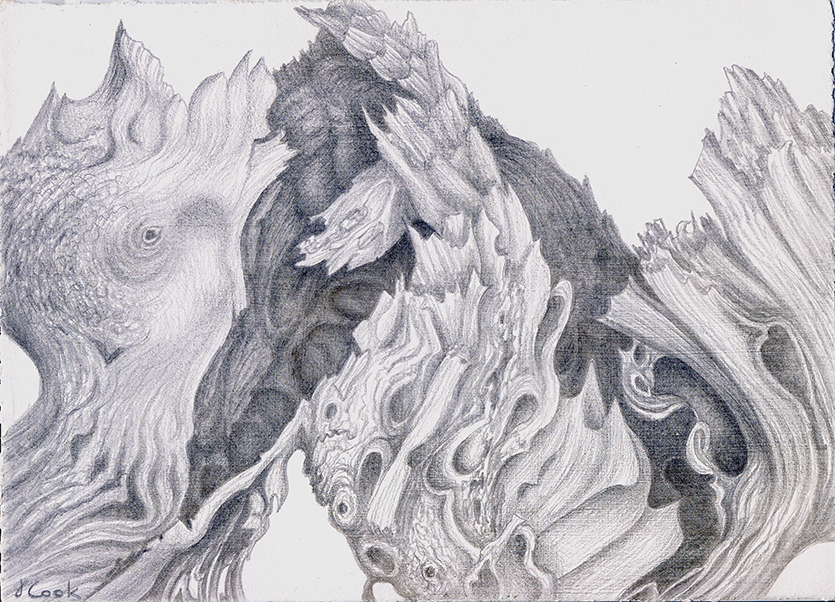
He was describing, in probing terms, the way I have been feeling as I explore the new vocabulary of drawing in silverpoint on a black surface. Since it is a version of silverpoint that seems to lend itself to more abstract drawings, more experimental ventures, I have been seeking subjects that talk to me in this language. Today, I was drawing a favourite dead cedar stump, a sprawling amazing sculpture that changes constantly as the light moves around it.

Cedar Lace, silverpoint, Jeannine Cook artist, Private Collection

Cedar Lace, silverpoint, Jeannine Cook artist, Private Collection

The awareness of time has always been a source of fascination and amazement to me as soon as one starts to draw or paint. Time becomes meaningless. But the fact that time could be "the measure of the distance between thought and realisation" is very perceptive, particularly when one is working plein air. Today's silverpoint needed to be done instinctively, basically without the time for any conscious thought. There would be time, later, for evaluation. It was more important simply to draw, to make marks that mattered. To listen to "inspiration" rather than any reason.

Silverpoint, in a way, is always such a leap of faith. You have to start somewhere, and then just go with whatever happens, fleeting and fragile as the moment may be. Since you cannot erase anything, the notion of time has to disappear, except in one respect. Since you cannot achieve real darks immediately, as you can with graphite, for instance, you have to wait for the silver mark to oxidise, and then you can go back in to emphasise more that dark. But that perception of time is more a pause in the rhythm of drawing, of mark-making, than any real awareness of a clock ticking away.

Silverpoint, to my mind, fits perfectly Lutz Becker's description of drawing "no longer about the recording of appearances, but as a language reflecting its own becoming", when time has little meaning.

Hanging an Art Show by Jeannine Cook

At least it was not pouring with rain today, but nonetheless, it is one thing to deliver art to a museum or gallery and leave. It is quite another thing to have to hang the art yourself for an exhibition! And today was a case of the latter.

Actually, I was very fortunate, as this was for the exhibition, Point and Counterpoint, at Savannah Hospice Art Gallery, with monoprints by Daniel E. Smith and my silverpoints as a total counterpoint. So Dan and I spent nearly three hours sorting, hanging, adjusting and measuring to get the show looking respectable.

Coastal Meditation, monoprint, Daniel E. Smith artist (image courtesy of the artist)

Coastal Meditation, monoprint, Daniel E. Smith artist (image courtesy of the artist)

Still Morning, monoprint, Daniel E. Smith artist (image courtesy of the artist)

Still Morning, monoprint, Daniel E. Smith artist (image courtesy of the artist)

As counterpoint to Dan's work, these are two of my silverpoint drawings -  Come into my Garden! and High Point Dance.

Come into my Garden!, metalpoint and white gouache highlights, Jeannine Cook artist, Private collection

Come into my Garden!, metalpoint and white gouache highlights, Jeannine Cook artist, Private collection

High Point Dance, metalpoint, Jeannine Cook artist

High Point Dance, metalpoint, Jeannine Cook artist

Mounting an exhibition is an every-challenging and interesting process. There is first the selection process - what art to exhibit? When there is a curator, obviously that person makes the decisions and "composes" the balance of art for his or her objectives. Themes, juxtapositions, contexts, styles and many other conscious or subconscious considerations operate in those choices to create the show. When it is the artist's choice on what to exhibit, it again is a series of choices that need to be made: firstly the title will be the overall guide. Then the coherence of the general body of work, with balance and variety, but nonetheless unity in the overall look.

When it is a two-artist exhibit, ideally the two artists need to have some feel for each other's work, so that there can be an interesting dialogue between the works. Playing off each other's styles, media, content, optic can lead to interesting effects that can enliven, albeit often subliminally, the resultant exhibition. When it is a group show, with many artists' works, things can get a little scattershot, but then there is an energy in a huge diversity of approaches.

Today, Dan and I decided to intersperse our work, rather than segregate our work into two sections. So colour and silverpoints are mingled, each contrasting well one with the other. Within that, there is a quiet pairing of similar (but not obvious) subject matter. Since Dan 's wonderful monoprints are in essence abstract, it is only through his "springboard inspiration" that the links can be made with my realistic silverpoint subject matter. Beyond that choice, there is then the rhythm along the wall to consider, especially when the display wall is a long one. We broke up the wall into all different shapes and sizes of work, trying to weave together a lively but diverse conversation of art.

The last and least fun part of the whole endeavour is ensuring that the art all hangs at levels that are coherent, given all the different sizes of frames, and that each piece hangs straight. Not always an easy achievement! The final step back to assess the whole exhibition is always a good moment. By that time, weariness has set in, as it is quite a physical workout too! The last touch: labels on the wall besides each work of art, and then the job is done. It was time for a rest! Now the show is launched and - one hopes - the dialogues begin between viewers and the works of art.

The exhibition will run from today until the end of June. The opening reception, to which all are invited, is on Thursday, 12th May, from 5.30 - 7.30 p.m. Come and assess the results of today's Point and Counterpoint.

Changing Vocabularies in Art by Jeannine Cook

Recently, a dear friend and truly wonderful artist, Susan Schwalb, galvanised me into doing something that I had been thinking about since my mother's death: drawing in silver on a black background, versus a white ground.

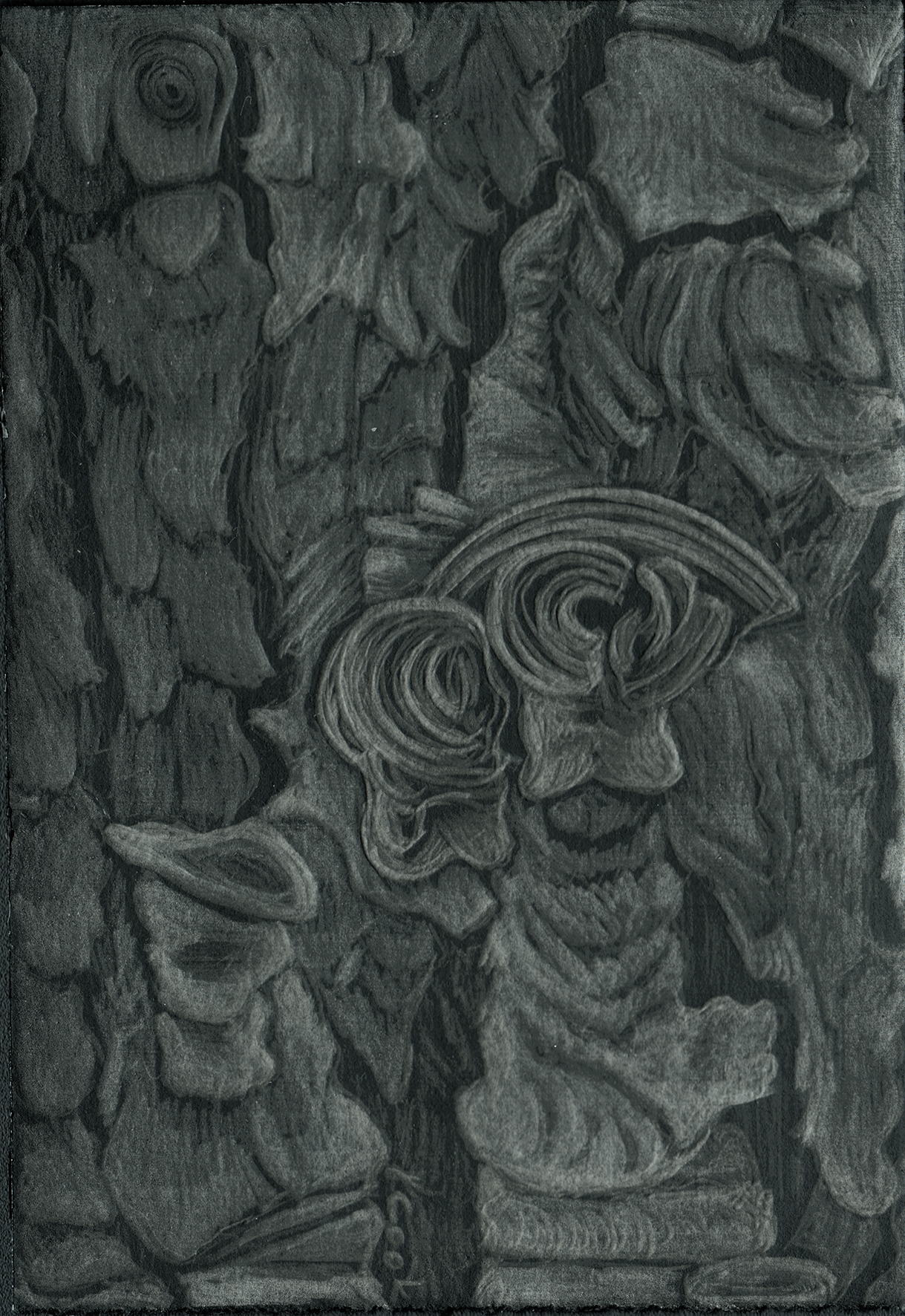
I had been feeling that perhaps a series of drawings in black might help deal with my mother's absence. So when I was in Spain, I prepared some small pieces of paper and launched myself into a new version of silverpoint. It soon became a fascinating exercise, for in essence, you suddenly change your visual thinking and vocabularly completely. You need not only to reverse everything, but detail of course disappears on the black ground unless you are very careful. So you need to select subject matter very carefully. I am still very much feeling my way, but it is a reinvigorating challenge!

I decided to do a series entitled Apoyos which is "supports" in Spanish. My mother loved trees; they were her literal and metaphorical supports on many occasions.

Apoyos I - coffee tree bark - silverpoint, Jeanine Cook artist

Apoyos I - coffee tree bark - silverpoint, Jeanine Cook artist

Apoyos II - Eucalyptus tree bark - silverpoint, Jeannine Cook artist

Apoyos II - Eucalyptus tree bark - silverpoint, Jeannine Cook artist

So I drew the bark of different trees she cherished, from a wild coffee tree grown from a seed from our farm in Africa , to a graceful elm, to a Mediterranean pine she loved and laughed about. I had transplanted it as a seedling, in preparation for a bonsai pine. It is now nearly forty foot high!

Apoyos IV - Pine tree bark - silverpoint. Jeannine Cook artist

Apoyos IV - Pine tree bark - silverpoint. Jeannine Cook artist

Each of these drawings is tiny, only 5 x 3.5 inches, but they helped me center myself and remind myself that there are so many different ways to express oneself in art.

Intersecting Clothes and Art by Jeannine Cook

I recently saw a wonderful production of Sleeping Beauty by the Moscow Ballet in Palma de Mallorca. It was a delight to see, for the quality of dancing was extremely high. One of the most interesting aspects, however, was the brilliant colours of the otherwise traditional costumes. I don't recall ever seeing such "technicolour" dresses and tutus, ranging from the most vivid wisteria mauves to turquoises, blues and citrons. It made for a vivid and arresting mixture with the dancers' skills, the pure lines of arabesques and the sense of movement in space.

I could not help but think that today's omnipresent brilliance of colour in television, on the web and everywhere else has an influence on such choice of colours for the costumes. We have all become accustomed to colours that are accentuated, often far beyond Nature's version of these colours. I find it interesting to see the same influence in art; with the ever-extending palette of colours in oils, acrylics, watercolours, a dazzling intensity of colour is easy to achieve. And, conversely, art produced in a "lower register" often appears dull and less noteworthy to the average viewer. For the most part, we do not seem to live in an age of subtlety.

While I was thinking about this role of colour in our current world, I fell on a fascinating article in CAM, the Cambridge Alumni Magazine for Lent 2011, entitled "A Sense of Proportion", a fellow at St. John's College, has published a book on "Dressing Up: Cultural Identity in Renaissance Europe" (Oxford University Press). In it, she states that "Clothes to me are no different from art in our contemporary sense of a human assembly of form. Clothes are rich in categories of visual interest and tell us so much about the peculiar sensibilities of an age. Their study can bring a fresh focus to the Renaissance and our own time."

Dr. Rublack talks of how the Renaissance was a time when not only was there an amazing influx to Europe of rich fabrics and furnishing as trade routes opened more and more to the Far East, but also an era when artists were increasingly depicting humans in paintings, sculpture, medals. Mirrors were also more and more available. How a person looked to the outside world became of great concern and interest. The author cites as a wonderful source of insights on this evolving sense of self, an album of watercolour paintings of MatthäusSchwarz, chief accountant for the Augsburg powerhouse Fugger family of merchants and bankers. The image at right was painted in 1517, showing him with Jakob Fugger. He lived from 1496 until 1564, so he was able to savour of all the energies and fashions in art and self-images that the Renaissance brought to Europe.

Office of Jacob Fugger; with his main-accountancy Matthaus Schwarz,  from biography of M. Schwarz; Herzog-Anton-Ulrich-Museum Braunschweig

Office of Jacob Fugger; with his main-accountancy Matthaus Schwarz,  from biography of M. Schwarz; Herzog-Anton-Ulrich-Museum Braunschweig

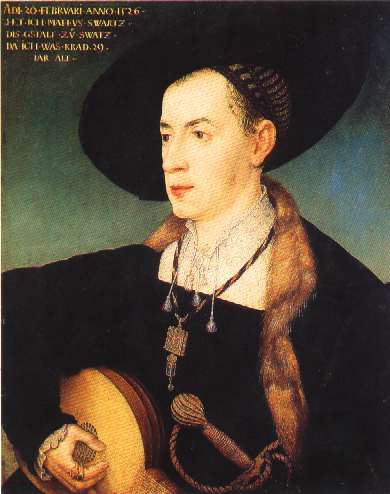
Portrait of Matthäus Schwarz by Hans Maler zu Schwaz, 1526, Musée du Louvre

Portrait of Matthäus Schwarz by Hans Maler zu Schwaz, 1526, Musée du Louvre

In July 1526, at aged 29, Schwarz commissioned the first portrait of himself, nude and slim. He went on to commission 135 more paintings of himself, dressed in many a garb as befitting the overt or subliminal messages he wished to covey to those who saw him or his painted image. They depict himself through his long life.

Matthaus, aged 19, A typical page from the Trachtenbuch.

Matthaus, aged 19, A typical page from the Trachtenbuch.

The images are wonderfully varied and let one savour of everything from his fencing outfit, with differing hose, to his sweeping hats and expensive fur collars.

Schwarz, Matthäus, Trachtenbuch des Matthaus Schwarz aus Augsburg,

Schwarz, Matthäus, Trachtenbuch des Matthaus Schwarz aus Augsburg,

In others, Schwarz carried green heart-shaped leather bags when he went out to court a lady - green being the colour of hope.

Matthaus Schwarz from behind

Matthaus Schwarz from behind

At aged 41, his courting days were suspended, as he records on this image of himself from the rear. He wrote "20 February 1538, when I took a wife, this coat was made". No mention of his amazing scarlet hosen!

Matthäus Schwarz' Book of Clothes or Klaidungsbüchlein is now held in the museum in Brunswick, Germany. A version of it has been published in French as "UnBanquiermis à nu".

My musings on the brilliant costumes in Sleeping Beauty are just a reminder that colour has long played a key role in our perceptions of the human body, its sartorial role in different cultures and its use for different messages. Art has been an integral part of that conversation.

Moments of Drought for Artists by Jeannine Cook

Every artist, no matter what the discipline or form of art, has times when artistic "drought" prevails. Pressures of daily life, illness, travel – there are many reasons which dictate that it is very hard to get down to creating work.

I was thinking about this situation recently, because I seem to be more wedded to driving and logistics than creating work at present. Yet there is a quiet little voice at the back of my head that says that when life slows down a little, the drought period will allow floating ideas to rise to the surface again.

I remember how Francisco Goya produced an amazing body of work during a long illness in Cadiz, around 1792-94. He was freed from the pressure of commissioned work, and perhaps too, his deafness during his illness made him a much keener observer of people for the portraits he executed. At any rate, as he recuperated, he experimented in his paintings, drawings and even the aquatint etchings which would become known, when published in 1799, as the Caprichos. His self-portrait, on the right, done in 1790-95, shows a self-scrutiny that is solemn and lonely.

Autorretrato ante el caballete, 1790-95, Francisco Goya, (Image courtesy of the Real Academia de Bellas Artes de San Fernando, Madrid)

Autorretrato ante el caballete, 1790-95, Francisco Goya, (Image courtesy of the Real Academia de Bellas Artes de San Fernando, Madrid)

Other works from this period of crucial artistic development are very sobering, for Goya developed a much more critical and introspective eye, producing profoundly penetrating psychological and social commentaries on his world. The image below is no. 79 of the Caprichos, entitled Nadie nos ha visto (No one has seen us).

Caprichos, no. 79, Nadie nos ha visto (No one has seen us). 1799, Francisco Goya (Image courtesy of the Metropolitan Museum,New York)

Caprichos, no. 79, Nadie nos ha visto (No one has seen us). 1799, Francisco Goya (Image courtesy of the Metropolitan Museum,New York)

Frida Kahlo is another artist who famously suffered periods of illness and difficulty, but she learned to use these times as springboards for her work. So as one goes along in life, trying to get through periods when art seems from another world, how does one keep in touch with that small inner voice?

Frida Kahlo, photographed by Guillermo Kahlo

Frida Kahlo, photographed by Guillermo Kahlo

I find, personally, that in order to keep at bay the gnawing feeling of emptiness that I experience when I cannot get to drawing, let alone painting, I need to keep thinking about art projects.

Whenever I have a moment of quiet, I try to summon an idea that I might have had, and I try to explore it in my mind's eye. The imagination is a far more adaptable "computer" screen than a real screen. No need for any image programme as you mentally try out a composition, move it around, add elements, change colours, explore ways to do something. Then I will leave the image alone, and move on with life. But later, I will come back to the image and try further to refine the whole concept and composition. Eventually, my "drought" period will end, and then I know that I have something that at least can start me back into the process of being an artist creating something. It is a form of bridge, but very helpful, I find.

Interestingly when this situation has happened in the past, and yes, it can happen quite often – that's life! – I later can look at the work I created, and know exactly what was happening in my life at that time. The work is a form of self-portrait, a moment in time, and it brings back vividly the emotions and thoughts of that period. In essence, these works of art that allow one back into the normal rhythm of being an artist can be the eloquent equivalent of entries in a private journal or memoir.

Meeting Artists by Jeannine Cook

The delightful bonus of judging an art festival is that you meet a variety of talented artists, working in any number of different media. I certainly found that to be the case yesterday when I judged the Art in the Park for McIntosh Art Association, Darien, Georgia.

My score sheets for judging that I had prepared served me well. There were indeed a variety of media and I found that having to answer criteria questions made it much easier to assess work. It was so interesting to talk to each artist that I was quickly losing track of time, to the slight dismay of those who were in charge of the award side of things! Nonetheless, it was important to learn from each artist about their work - they had spent a great deal of time creating work, bringing it to Darien and setting it up in display. The least I could do was to spend time understanding and looking.

There were some wonderful two and three dimensional pieces, but some stood out - as is always the case. Once I had officially acquitted myself as judge, and the awards and ribbons were distributed, I could then take off my badge and become an artist like all the others - a relief! One of the booths to which I then headed was that of an elegant set-up by a South Carolina-based artist, Kim Keats, whose work is entitled "Interlacements". She uses driftwood, wood and other natural found objects and weaves or binds them together to form the most wonderful pieces, often with a very Japanese feel to them. Small treasures and larger ones - elegant, imaginative and restrained. A delight to see.

There were several artists whose passion for nature and environmental concerns informed their work wonderfully. Lydia Thompson is a consummate expert on birds and uses that knowledge to depict birds in delicate prints that are elegant and most appealing. She is even using "green" ink in her printing processes. Another artist who is highlighting the environment's fragility is Nancy Adams, with a very different voice. She is using gourds as fine art - cutting them into the shapes of different species, painting them and then reassembling the pieces into sculptures of complexity and beauty. Hers is a voice that is memorable by its difference and passion.

As Vernon Square began to fill with people strolling and enjoying the art and music, the sun finally emerged from the clouds, and the day became a celebration of talents. It was a lovely way to mark the Blessing of the Fleet for Darien.