Judging an Art Festival by Jeannine Cook

It has been a rather crazy week, first delivering silverpoint drawings to a forthcoming show, "Lasting Impressions", in Jacksonville, FL, at the Women's Center on Colcord Avenue. Then I hung a solo show, "At the Edge of the Marsh", at the McIntosh County Art Association gallery at the Old Jail in Darien, GA, on Friday. Rain storms on both days made art delivery interesting.

Now the sun has reappeared in time for the big weekend in Darien- the Blessing of the Fleet, to celebrate the shrimping tradition and start of the new season.

Blessing of the Fleet, Darien, Georgia, along the Darien River

Blessing of the Fleet, Darien, Georgia, along the Darien River

As part of the activities, in Vernon Square, one of the gracious oak-shaded squares laid out in 1736 by Georgia's founder, General James Oglethorpe, there is an art festival, Art in the Park, and I was asked to judge the festival this year.

Vernon Square, Darien, Georgia

Vernon Square, Darien, Georgia

This started me reflecting on all the aspects of judging. As an artist, I have frequently been on the other side of the equation, with my entries to juried art exhibitions and the occasional festival being considered by one or more jurors or judges. Very soon, as one goes along in life, every artist learns that, given a level of competency and proficiency, the outcome of such judging is very much a matter of luck. Considerations of an overall exhibit's theme, space requirements and other aspects play a role in the final outcome, and being passed over is not necessarily any reflection on the quality of one's own work.

Nonetheless, I always wish more judges would give more specific feedback on work submitted. I suppose, realistically, that now there is such a large number of submissions to most art competitions that feed back would be too onerous. Such information would, however, help one grow and improve as an artist.

For artists who teach, there is another aspect to judging art competitions and festivals. Katie Lee, a wonderful botanical artist, teacher and judge (as well as being Kenya-born as I was!), writes eloquently about her desire for her students to succeed and be recognised. Her concern for their well-being is a very real consideration of any juror/judge; crushing talent and aspirations is always a great tragedy and waste.

Once an artist has been given the honour of judging his or her peers' work, it is a serious matter, where competency, fairness and clarity are all very necessary. Since each artist, no matter what the medium, has invested time, passion and money, in creating a work, it is only fitting that a judge/juror treat the work with respect and attention. I am, in truth, often left wondering when one reads of some shows where there are thousands and thousands of entries, and perhaps three seconds are accorded to each piece, usually now in digital image form. Need must – I recognise, that that is hardly a way to select work that might be magnificent, but done in a low key, subtle fashion which has trouble competing with the "high voltage", "hit-you-in-the-eye" works.

Judging an art show is frequently a little different from judging an art festival, insofar as the festival usually has many media. The line between fine art and crafts is also frequently blurred. For an art show, grosso modo, the judge is assessing visual design, technical competence and, above all, the highly personal consideration: does this work convey a clear, powerful message and does the work stop me in my tracks? Details of value (organisation of darks and lights into a good composition), colour (its use for harmony, feeling, repetition and pattern), shapes (their variation or repetition for interest, harmony and content), line (variation and use of lines) and organisation of a focal point all contribute to the unity and success of a work of art. Does the piece hold together and work to convey content and feeling?

Assessing the diverse work exhibited in booths in an art festival is perhaps more complex in some senses. I have found that scoring the artists' presentations according to a set of criteria, on paper, is helpful. It also means that the artists can later see how the judge scored things, which could perhaps provide some useful feedback. Since, de facto, a judge is working with apples and oranges, so as to speak - two and three dimensional work, crafts of different types, etc. - there has to be some coherence in the judging approach.

I tend to divide the score card into two sections - artistic merit and booth presentation. Under artistic merit, I score creativity and originality, quality of composition and design, clarity of theme/communication, technique and skill of creation and, finally, overall impression. Booth presentation looks at professional presentation, is the booth inviting to enter and does the booth set-up enhance/compliment/complement the work?

Suffice to say that if there are a large number of entrants in the Art in the Park festival tomorrow, I shall be busy for a while! I just hope that the award winners are happy and that everyone else has a really good festival!

Inate Artistry by Jeannine Cook

We have just been to a most beautiful concert at the Telfair Museum, in the Savannah Music Festival series of chamber music concerts with Daniel Hope and Friends, Accompanied and punctuated by huge claps of thunder from a dramatic storm, the musicians, playing Mendelssohn, Mozart, Beethoven and Brahms, created beauty and elegance that was soul-moving.

Yet, in the midst of all their amazing skill and the thrumming on the roof of the pelting rain, I could not help but marvel at their obvious delight and seriousness of enjoyment of making beautiful music. I was reminded of Picasso's statement that "Every child is an artist. The problem is how to remain an artist once we grow up." Whether in visual arts, ballet, music, singing, or whatever art form, the hallmark of a successful artist, it seems, is that the person remains childlike at some level. That sense of delight, of inquiry, of inquisitiveness and openness seems so necessary. It goes along with a sense of humour and an ability not to take oneself too seriously. Picasso, of course, embodied the impish and playful aspects of art amongst his many characteristics. Certainly his art bespeaks a childlike delight in the simple, the direct and the playful aspects of life.

The quiet camaraderie and sense of humourous enjoyment that showed in flashes between the musicians we heard today spoke to the same ability. Patrick Messina, the wonderful French clarinetist, or the cellist, Eric Kim, Daniel Hope with his extraordinary ability on the violin, or pianist Sebastian Knauer... all combine musicality with an obvious delight that Picasso would approve of. They have remained artists from childhood onwards. We all, in today's audience, were the richer for such artistry.

Hurray for Plein Air Days by Jeannine Cook

For a multiplicity of reasons, I have not been able to draw for the past few weeks. This means a feeling of serious "withdrawal" is beginning to prevail: I need to get back to creating art.

So it is with delight that I prepared my paper and pencils for a plein air session tomorrow, a workshop I am giving for local McIntosh Art Association members. The weather holds promise, I trust the insects will be blown away and that the local Georgia Wildlife Refuge at Butler Island, (an erstwhile rice plantation of considerable fame) in the mighty Altamaha River delta, will be in its full spring loveliness.

There is always the excitement of recognising that you have absolutely no idea what will strike you as subject matter, for drawing or painting, when you set off on a plein air session. You just have to let your subconscious mind tell you what matters, and then hope that whatever you create can be allied with your technical experience and personal identity, to make something worth while.

Henry Moore had it right - again! - when he remarked, "The observation of nature is part of an artist's life. It enlarges his form (and) knowledge, keeps him fresh and from working only by formula, and feeds inspiration."

Four trees charcoal, watercolour wash.ballpoint pen and pastel on paper, 1981, Henry Moore (Image courtesy of Mutual Art)

Four trees charcoal, watercolour wash.ballpoint pen and pastel on paper, 1981, Henry Moore (Image courtesy of Mutual Art)

A suitable thought to carry with me as I set off to Butler's Island in the morning!

Visual Communication by Jeannine Cook

As I yield to the siren calls of spring bursting forth in the garden, I find myself thinking about how plants communicate their needs. They grow lustily if they like where they are and have all their needs met. If they are in the wrong place in terms of light or moisture, the gardener soon knows that they are not happy - leaves yellow or droop - or worse! The same visual communications often leave me laughing when you watch a cat or do tell you, the "subservient" human, what they want, or don't want.

In the same way, visual communication in art is vital. Every artist realises, sooner or later, that it is not just enough to be able to execute technically perfect paintings, drawings or other works. Pretty pictures are ten a penny in the world. But, just as in the advertising world, visual images need to carry weight and impact. In advertising, the messages are deliberate, planned and directed at certain audiences.

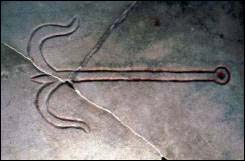
Usually in art, the situation is more diffuse. For a start, the communications are dependent on the times in which the artist lives. In early Christian times, for instance, there was an extensive vocabulary of symbols used to convey specific messages. In just one arbitrary example, take an anchor. It could symbolise hope in Jesus Christ, and represent sanctuary and commitment. It could convey safe arrival of a ship to harbour and thus mean faithfulness, shelter and hope. It also symbolised St. Clement, the poor unfortunate martyred 4th Bishop of Rome who was tossed into the sea with an anchor around his neck, one hundred years after Christ's death. (My thanks to the History of Painting website for this information.)

By extension, the anchor was a sign used for the hidden Christian burial chambers, the Catacombs in Rome, possibly because Hebrews 6 19-20 says, "We have this hope as an anchor for the soul, firm and secure." It was frequently used in conjunction with fishes, an obvious reference to Jesus telling Peter he would make them "fishers of men".

Anchor, Catacomb of Priscilla, Rome

Anchor, Catacomb of Priscilla, Rome

Two fish and anchor in the catacomb of Domitilla

Two fish and anchor in the catacomb of Domitilla

This image, courtesy of Heather, a moderator on art subjects in Good Reads is found in the St. Domitillia catacomb in Rome, the epitaph for one Antonia.  Sts. Domitillia, Priscilla, Calixtus and Coemetarium majus catacomb cemeteries are full of images of anchors.

Christian Roman epitaph of Atimetus from the catacombs of St. Sebastian on the Via Appia, Rome. Inscription flanked by Christian symbols, an anchor and a fish.

Christian Roman epitaph of Atimetus from the catacombs of St. Sebastian on the Via Appia, Rome. Inscription flanked by Christian symbols, an anchor and a fish.

Again, fishes and anchors are simple, powerful visual communications.

As the Renaissance artists developed an increasingly sophisticated vocabulary of symbols for their visual communication, their public understood the messages. Today, we might need to learn the interpretations of those works of art to understand fully what the artists were communicating.

One of the most wondrous examples of that time is Michelangelo's paintings in the Sistine Chapel

The whole work is a visual metaphor for mankind's need - and desire - for a covenant with God. Michelangelo uses images and symbols from the Book of Genesis as the main vehicles to convey man's need for salvation; every part of the work is as eloquent to us today as it was to the contemporary viewers. However, his contemporaries would probably have understood nuances more readily than many viewers of the ceiling do today.

Ssistine Chapel ceiling, Rome

Ssistine Chapel ceiling, Rome

Each era has developed a specific set of symbols to communicate messages visually, but in today's world, the vocabulary is more diffuse, in that we all have different optics on things, our belief systems are more diverse and the world is a much more universal and complex place. For an artist, it becomes perhaps a much more personal affair: what to communicate as a human being, tapping - hopefully - into universal values and beliefs that can resonate with others.

As Robert Henri observed, "Art cannot be separated from life. We value art not because of the skilled product, but because of its revelation of a life's experience."  

As artists, we need to live life in awareness and thoughtfulness. Ultimately, I believe, we need to have enough self-confidence and honesty to try to draw on our own souls and innermost core, to understand who we are and what we are trying to do and say. Only then can we develop a clear voice that is our way to communicate visually to others. Some people may hear that voice, others won't. That is the beauty of our diversity. But at least, an artist who dares to reveal his or her life experiences in artwork will be a unique person, conveying images that ring true. That is quite an ambitious goal.

Exquisite Timing by Jeannine Cook

The joy of coincidences and exquisite timing - there has to be a law about such matters! - has visited me again.

I returned from a lightening trip to Spain for a week: my gracious, beautiful and utterly lucid mother of nearly 93 years old had died. Today, I was listening to a programme I often find most rewarding, Krista Tippett's "On Being", on American Public Media. She was interviewing Joanna Macy, a lady of considerable talents, experiences and wisdom, with particular emphasis on her translations of the poet, Rainer Maria Rilke.

I listened with fresh appreciation to the allusively beautiful poetry, some of which I had read many years ago. And then came the gift to me, entitled "The Great Secret of Death", in a letter to Countess Margot Sizzo-Noris-Crouty on January 23rd, 1924. Rilke wrote, (in Joanna Macy's and Anita Barrows' translation), "The great secret of death, and perhaps its deepest connection with us, is this: that, in taking from us a being we have loved and venerated, death does not wound us without, at the same time, lifting us toward a more perfect understanding of this being and of ourselves."

How appropriate a thought for me at this moment. What exquisite timing!

Stumbling on Beauty by Jeannine Cook

Once in a while, in one of the art newsletters that I receive, I read something that really piques my interest. That happened today in a newsletter that I get periodically from Australia, ArtHIVES. There was an announcement about an artist now living in Brisbane who is short-listed for an art prize in Albany, Western Australia - Nicola Moss.

Looking at her website, and reading her comments about creating some of this beautiful art was rewarding. Not only does she create very sophisticated and compelling paintings, but her observations about the intricacies and fascinations of the natural world in which she works really resonate with me. Her concern for the viability of the natural environment in its tug of war with urban construction seems to underlie a lot of what she does. In her blog, "Layers of Life", she talks too of the time she spends working plein air. All artists seem to deal with the same elations and difficulties when working outdoors, no matter in what country. Nicola clearly has an eye for the small, subtle and elegant as she explores the amazing Australian biodiversity. Nonetheless, her resultant paintings are universal in their appeal.

It is worth going through the links to her website and clicking on the galleries to see her work. Nonetheless, thanks to Nicola Moss, I stumbled on a series of beautiful paintings today.

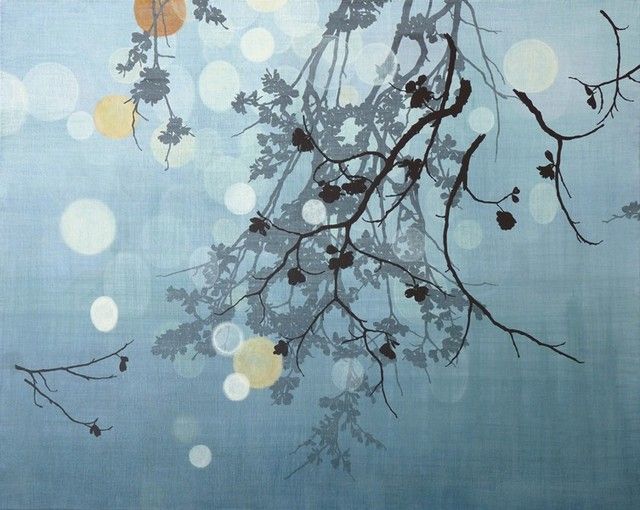
This Spring and the Next, Nicola Moss artist (Image courtesy of the artist)

This Spring and the Next, Nicola Moss artist (Image courtesy of the artist)

I walked along the water's edge – Magic happens here, Nicola Moss artist (Image courtesy of the artist)

I walked along the water's edge – Magic happens here, Nicola Moss artist (Image courtesy of the artist)

"Enchantment" by Jeannine Cook

Some while ago, I received an e-mail from Guy Kawasaki, of Alltop.com, asking if I would like to review his latest book, "Enchantment", prior to its launch on March 8th, 2011. I agreed to do so, because, as an artist, I was interested to see what I might learn from the book, given that its subtitle is "The Art of Changing Hearts, Minds and Actions".

enchantment.jpg


As I read through this relatively slender and very accessible book, replete with lists of suggested actions and real life stories to illustrate Guy's points, I had to chuckle. At one point in the book, in the chapter on "How to launch", Guy discusses the virtues of planting "many seeds". Given that the Internet has changed the traditional approaches to marketing upside down, he advises that one should "embrace the nobodies", because "anyone who understands and embraces your cause and wants to spread the word is worthy of your attention". He was carrying out his own modus operandi exactly when he asked me to review the book!

Nonetheless, I think this book, "Enchantment" can teach - or remind - every artist about a number of important aspects of his/her profession. As in many other ventures, art is ultimately about a conversation, a mutual acceptance and understanding, a shared passion about work that an artist creates in some medium. The more that artist can reach out to find a receptive, appreciative audience, the more successful he or she can be, not only in financial terms but in personal fulfilment. Accepting others, meeting people and maintaining frequent personal contact are pathways Guy advocates in this book. Achieving trustworthiness through what is known as noblesse oblige or a "Mensch" in the full Yiddish sense of the word, along with honesty, integrity and generosity, is another of the chapters in "Enchantment": vital conduct for a successful artist.

There are some examples of how to connect with one's potential audience/public which illustrate how memorably to explain why one creates a piece of art, and how it can connect with the viewer. Let's face it - most people love learning the "back story" about any piece of art and the artist's reasons for making it. Early in the book, Guy quotes Vincent van Gogh saying "You have first to experience what you want to express." If you can communicate your passion and knowledge about your artwork, people are far more receptive to it because they have embraced, to a degree, that creative act.

Guy also makes a wonderful case for how to get a potential collector first to acquire a small piece of art, which often leads to later sales of bigger work. As he later says, "Enchanters don't sell products, services or companies. Enchanters sell their dreams for a better future - cooler social interactions, a cleaner environment, a heart-stirring driving experience, or the future of publishing." Art is quintessentially about selling dreams. Guy elaborates cogently on how to sell those dreams.

The last major portion of "Enchantment" is a very useful commentary on the merits of Facebook, Twitter, LinkedIn, and the Web in general in terms of using this technology to achieve successful enchantment. Any artist would find useful comments in this section. Guy's Facebook page for the book carries out his own advice. Indeed, he is offering his previous book for free with "Enchantment" until midnight tonight as another "enchanting" action.

Guy Kawasaki enthusiastically makes a case for walking a path to success - professionally and personally - that is honourable, proactive, imaginative but above all that contributes to making our world a better place. He even provides interest and delight - indeed enchantment - when he creates an origami  butterfly to put on the book's cover.

It takes Dedicated People to Achieve Things by Jeannine Cook

Today is a day of sad remembrance for a wonderful friend who has just slipped away - Lillian Schaitberger, late of McIntosh County.

Rundle, my husband, and I met Lil, as she was affectionately called, through the local historical society, the Lower Altamaha Historical Society, soon after we moved to Georgia. She was the meticulous, dedicated treasurer of the society's funds, amongst many other virtues.

When Rundle was asked to spearhead an effort to get a replica of the 1721 blockhouse built at Fort King George Historical Site, in Darien, he accepted on one condition: that Lil Schaitberger be the treasurer of any fund-raising effort. She accepted... and the odyssey of the next two years of fund-raising meant that Lil became a very close friend and ally. Her dedication kept us all going. The funds were raised, the Georgia Department of Natural Resources kept their part of the bargain and the replica blockhouse was built according to the original blue prints drawn up in the early 18th century by John Barnwell. The dedication and opening of the Fort at Fort King George in autumn 1988 meant that Lil Schaitberger, Rundle Cook and many others could heave a sigh of relief.

Lil did much more, however, for her two British friends, in terms of dedication. I had written the draft of a book, "Fort King George: Step One to Statehood", potentially to help with the fund-raising. I had put it away in a drawer, until the Mills B. Lane Foundation generously underwrote its publication in 1990. When the pallets of books were delivered, it was to Lil's garage that they had to go for storage – she was doing far more than being treasurer for the venture. I was desperate to free up her garage and eventually "sold" the books to the Georgia Department of Natural Resources. With those monies, I was able to pay for the first of the replica cannon that are now fired out across the marshes to help recreate for today's visitors what life was like during the brief existence of the Fort in the 18th century. I requested that the cannon be dedicated to Howard J. Morrison, Jr. whose grant, through the Mills B. Lane Foundation, had been the seed money that validated the original fund-drive to build the blockhouse. Lil could at last park her car again in her garage!

Her wonderful friendship and dedication allowed another venture to succeed. In 1992, for the Quincentennial, under the aegis of a number of historical societies and universities, the book, seminar, video and relevant map, "Columbus and the Land of Ayllón" became reality in Darien, Georgia. This huge venture, which eventually spanned a number of years, sought to highlight Lucas Vázquez de Ayllón's ill-fated 1526 settlement, San Miguel de Gualdape, possibly in or near Sapelo Sound, McIntosh County. Lil was again my treasurer for this complex, Hydra-headed endeavour and without her hard work and dedication, it would have been infinitely more complicated. After the Carl Vinson Institute of Government at the University of Georgia requested to take over the Ayllón project so that it could be taught in Georgia schools, I accepted with alacrity, mainly because I could thus stop imposing on Lil's kindness and patience.

Lil was active in many, many other ventures in the County. Her courage and dedication were always a source of great admiration for us, and her sense of humour a joy. She epitomised the American "can do" attitude; her achievements, large and small, leave the County infinitely richer. Most of all, she was a true-blue friend to us.

Mark-making - Playing with Fire by Jeannine Cook

My artist friends in the silverpoint world are always guaranteed to surprise and delight with their creative inventiveness. I have just had a fresh reminder of this when Jane Masters, a fellow British/French import to the Northeast, sent me a notice about a show which she has just had at the Miller Block Gallery in Boston. She is a most successful artist with a wonderful resume of achievements to her name.

INstallaation View, Miller Bock Gallery show, Jane Masters

INstallaation View, Miller Bock Gallery show, Jane Masters

Entitled "Playing with Fire", this was clearly a most unusual exhibition and very well reviewed in the Boston Globe. This is an installation view of the exhibition she sent me.

Jane has, in addition to her wonderful silverpoint drawings, been extending her vocabulary to include mark-making by burning hand-forged steel brands on heavy-weight Arches watercolour paper. The resultant burnt drawings are wonderfully eloquent and energetic: the richly-hued burned marks and remaining smoke marks combine to form complex, sophisticated dances on the paper.

The images below are examples of this work.

Playing with Fire Curve, Jane Masters artist (Image courtesy of the artist)

Playing with Fire Curve, Jane Masters artist (Image courtesy of the artist)

Playing with Fire Circle, Jane Masters artist (Image courtesy of the artist)

Playing with Fire Circle, Jane Masters artist (Image courtesy of the artist)

Playing with Fire, Playing with Fire announcement, Jane Masters artist (Image courtesy of the artist)

Playing with Fire, Playing with Fire announcement, Jane Masters artist (Image courtesy of the artist)

The works  (Playing with Fire - circle) and  (Playing with Fire - Curve) are full 22 x 30" sheets of watercolour, while the centre image is a panel of four full watercolour sheets, or what is left of them after the creative and elemental forces are done. I am left awestruck, not only at the sheer dedication and skill of making such drawings, but also by the fact that beforehand, Jane makes the steel brands by hand-forging them. That is a labour of love and passion.

Jane shows the same passion (which I had seen in her silverpoints) when she also uses heated needles to pierce holes through the paper to create pinhole drawings that make me think of Victorian samplers, albeit with a lovely sense of humour in the messages she includes.

Jane Masters reminds me that there is such a multiplicity of ways to make marks on paper that become wondrous drawings. All it takes is creativity and passion. Bravo, Jane!

Private Art, Public Response by Jeannine Cook

Every artist is sometimes impelled to create art that is not really intended for the big wide world. It is art that is perhaps made in reaction to a situation, a response to something that is joyful, troubling or passion-stirring. Often, that work is put away and not displayed in public.

This has happened to me several times, and my flat file drawers can attest to these drawings and paintings. However, once in a while, there is a situation where I suddenly remember one that seems to answer the parameters of some juried exhibition, and I think, well, it is worth a try.

Vertebral Distractions, silverpoint, Jeannine Cook artist

Vertebral Distractions, silverpoint, Jeannine Cook artist

The San Diego chapter of the Women's Caucus for Art has started running an on-line series of juried shows. One of them, "Transformation", seemed an appropriate place to enter one of my "private art" silverpoint drawings, Vertebral Distractions. I had created it from a small print out that my husband had been given at the Mayo Clinic after a portion of his spine had been examined. This small image was eloquent proof of why he suffers so much from chronic pain. 

I was so dismayed for him that I tried to think of all the every day joys surrounding us that could distract him - perhaps! - from his pain. It was a moment when we had a juvenile  Black-Crowned Heron who had adopted a shallow bird bath on our front deck as his personal pond for the summer. Meanwhile, the Ruby-throated Hummingbirds were flying their marvellous looping displays, butterflies flittered and the phalaenopsis orchids were a-bloom.

I was thus delighted to learn that I had won a prize for this silverpoint drawing, Vertebral Distractions, in the SD-WCA show. It was a double validation from the Judge, Hazel Ross, because, as I have said, this was a very private work, not intended for public viewing. It makes me realise afresh that no matter what one's original intentions, if an artist creates something born of deep feelings, it will resonate with someone, somewhere... the eternal conversations of human creativity.