Backroom aspects of being an Artist by Jeannine Cook

Whenever I paint a watercolour, I then record it in digital fashion and, frequently, I continue to use up my stock of Kodak ASA25 35mm slide film as I am still straddling the two systems. I far prefer the Kodak version because the slide film is superior for colour rendition on most watercolour paintings. As long as I use a grey card, a tripod and a decent camera, I can pretty well ensure decent photographs - the old-fashioned way.

Photographing digitally is another subject altogether and I know reams have been written about how to take good digital photographs of paintings. My personal experience is that the surface of most cold pressed watercolour papers bounces the light all over the place and consequently, photos come out pallid and with very unimpressive colour fidelity. I usually only photograph big watercolours, and then resign myself to a long session in Adobe Photoshop, with the painting beside me to guide me back to colour accuracy.

For smaller works, both watercolours and silverpoint drawings, I have been using a flatbed scanner for ages. I had a really good Epson scanner (courtesy of my husband's careful choice), but alas, it gave up the ghost and I had to replace it. Now I have a large format Mustek scanner installed, and it does help that I don't have to knit so many images together from several scans.

The Bend in the Creek, watercolour, Jeannine Cook artist

The Bend in the Creek, watercolour, Jeannine Cook artist

Nonetheless, I conclude that I am into the same unbelievably time-consuming colour adjustments that I endure with digital photographs. Somehow, even with the best settings possible, the scanner does not like that slightly rough paper surface and all sorts of odd colours appear. Pulling the work back to what it really looks like is almost a question of luck versus skill. It seems almost as labour-intensive as actually painting a watercolour, which is ironic. The image is a recent watercolour, The Bend in the Creek. It cost me too many hours of scanning adjustments!

I wonder if other watercolour artists have the same problems? These backroom aspects to art are definitely not my favourite pastimes, but are necessary in the business of art. Back to the old adage of there being "no such thing as a free lunch"!

"Singing" of Spring by Jeannine Cook

These days of warm springlike weather are absolutely irresistible! I should be doing all sorts of other things, but I find myself rushing out to paint - for the sheer joy of being outdoors as an artist!

Of course, it is then instant humbleness as I struggle to accomplish what I hope to paint. The wind blows, the gnats arrive and I can't believe that what I deemed to be straightforward has suddenly become complicated. But underlying the whole experience is harmony, of "singing true" and almost a sense of completeness: I am privileged to be doing what I love to do, in a beautiful spring world.

I think Ingres knew about this sense of plenitude and harmony, in his paintings but also when he was drawing his astonishing graphite pencil portraits or his landscape drawings in Rome. He wrote, "Everything in nature is harmony; a little too much, or else too little, disturbs the scale and makes a false note. One must teach the point of singing true with the pencil or with brush as much as with the voice; rightness of forms is like rightness of sounds."

View of the Villa Medici, Jean Auguste Dominque Ingres, 1807, pencil on paper (Image courtesy of Musée Ingres, Montauban, France

View of the Villa Medici, Jean Auguste Dominque Ingres, 1807, pencil on paper (Image courtesy of Musée Ingres, Montauban, France

Urson Jules Vatinelle (1788-1881) 1820, graphite on paper, Jean Auguste Dominque Ingres, (Image courtesy of the Metropolitan Museum, New York)

Urson Jules Vatinelle (1788-1881) 1820, graphite on paper, Jean Auguste Dominque Ingres, (Image courtesy of the Metropolitan Museum, New York)

Somehow, the close observation of one's surroundings and an effort to create a harmonious composition and luminous painting help to make one grow as an artist. That always helps make life more fulfilling.


Artists' Evolution by Jeannine Cook

As the years pass and an artist continues to work and create art, it is often interesting to follow the evolution of what the artist creates. Sometimes an artist is "cursed with success" at an early age and is tempted to continue producing art in the winning formula, without much incentive to try new things and push for growth.

Every great artist shows change and development during his or her career - one only has to remember Vincent Van Gogh or Paul Gauguin, Claude Monet or Pablo Picasso, to name some artists rather at random. It should be axiomatic that artists evolve in their art for as human beings, we all change and develop as the years pass. Nonetheless, some artists are more dramatic in their evolution than others.

I was reminded about these potential huge leaps and changes that artists can make when I was reading about an exhibition running until 20th March at the National Portrait Gallery in London. Entitled Bridget Riley: From Life, it is a selection of the drawings that Riley did as a student at Goldsmiths College, London, in 1949-52. Most people think of Bridget Riley's work as the vibrant, brilliantly coloured, rhythmic compositions that dance and swoop in patterns in almost strobe-like fashion. An exhibition of such paintings, energetic and elegant, is also on view until May 22nd at the National Gallery, London.

Older Woman Looking Down, c. 1950, Bridget Riley (Image courtesy of the National Portrait Gallery, London)

Older Woman Looking Down, c. 1950, Bridget Riley (Image courtesy of the National Portrait Gallery, London)

Nonetheless, the drawings shown at the Portrait Gallery remind us that she started out very much involved and passionate about drawing from life, as well as closely studying the works of great artists - Raphael, Rembrandt, Ingres, Seurat, etc. - in the print room at the British Museum. Her drawings, such as Older Woman looking down, 1950, underscore the value she places on keen observation. She catches the sense of the body in space, how the head feels as the woman tilts her head reflectively, the resigned expression in the eyes. Riley's drawing practice helped her refine her immaculate sense of structure and taught her that there is a continuity in art's concerns down the ages. Her own drawing and her study of the Old Masters, she explains, "gave me the means to embark on my own work with confidence, and to this day this particular knowledge forms the basis of everything I do in the studio." As Andrew Lambirth also remarks in an article in the 5th February edition of The Spectator, "drawing gave her the necessary exercise in looking and organising information, and the means of bringing eye, hand and mind into fruitful relationship."

It is inspiring to measure the trajectory of such an artist: the serious art student carefully observing her portrait model at Goldsmiths evolves into a richly inventive, energetically wonderful painter, creating memorable abstract art, yet still closely linked to the great painters of the past.

Apricot and Pink, oil on linen, 2001, Bridget Riley (Image courtesy of the artist)

Apricot and Pink, oil on linen, 2001, Bridget Riley (Image courtesy of the artist)

Lines and Swirls, Dots and Spashes by Jeannine Cook

I am always fascinated to see the work of fellow artists in any group to which I belong in some fashion. The annual exhibitions of groups into which one has to be juried in some (often stringent) fashion are one example. The catalogues of shows by the National Association of Women Artists, the American Artists Professional League, Catherine Lorilliard Wolfe Art Club, the Pen and Brush or Georgia Watercolor Society, for instance, are wonderfully diverse, frequently of very high quality, and decidedly interesting overall.

Another group whose work I viewed today on the Web is formed by very distinguished artists whose work is in the New Hall Art Collection at Murray Edwards College, Cambridge, England. This is the pre-eminent collection of women's artworks in Great Britain. Artists in the collection were sent a small piece of paper and asked to create original art for auction on line to raise money for maintenance of the collection. I did a silverpoint drawing of an old cedar tree base, Cedar Lace.

Cedar Lace. silverpoint, Jeannine Cook artist, private collection

Cedar Lace. silverpoint, Jeannine Cook artist, private collection

Looking at the work now offered for auction on the New Hall website reminded me, once again, of the wonderful diversity of approach we all have as artists. Since each one of us had the same size piece of paper on which to work, it makes it even more interesting to see what each person has done. Lines and swirls, dots and splashes are indeed in evidence, with celebrations of so many different voices and ways of expression. New Hall has very sensibly made the initial bid very modest - £20 or $32.50 - and then you can bid in £5/$8 increments. Not bad at all as a way to own some of the top British artists' work.

I am reminded of the French exclamation: Vive la différence! It all makes for such an interesting world.

A Dedication to Line-making by Jeannine Cook

There is a very talented and dedicated artist whose work is currently on display at the Telfair Museums in Savannah, Georgia - Curtis Bartone. His ability to make lines sing and tell dense, thoughtful stories is remarkable.

I first met Curtis when we both were part of the 2006 Luster of Silversilverpoint exhibition at the Telfair Museum, and we later coincided with the second Luster of Silver exhibition at the Evansville Museum of Arts, Evansville, IN in 2009. When I first saw Curtis' fine lines in his silverpoint drawings, I was impressed and intrigued, for he uses his skills to make thought-provoking juxtapositions of human activity and nature.

Curtis Bartone; Forbidden, 2009; Lithograph on Arches 88; 22 x 28 inches; Courtesy of the Artist

Curtis Bartone; Forbidden, 2009; Lithograph on Arches 88; 22 x 28 inches; Courtesy of the Artist

In his current large exhibition at the Telfair, Domain: Drawings, Etchings and Lithographs, which runs from February 4th to June 26th, 2011, Curtis Bartone pulls one into realms that challenge one's assumptions about life on our planet, while leaving the viewer marvelling at his skills in etching and lithography, as well as in creating huge graphite or charcoal drawings and luminous silverpoints. Every work rewards careful study, like the print shown here, entitled Forbidden. In each drawing or print, dense lines build up compositions of flora and fauna against backdrops that jar, challenge and provoke our concepts of how we humans coexist with nature.

Domain is an exhibition that warrants repeated visits. The printer's skill and the draughtsman's skill, allied to an intense, informed series of disturbingly beautiful yet troubling messages, are such that you can't absorb everything all at one visit. Go and celebrate a master "line-maker" and draughtsman. Bravo, Curtis!

A Little More on Lines by Jeannine Cook

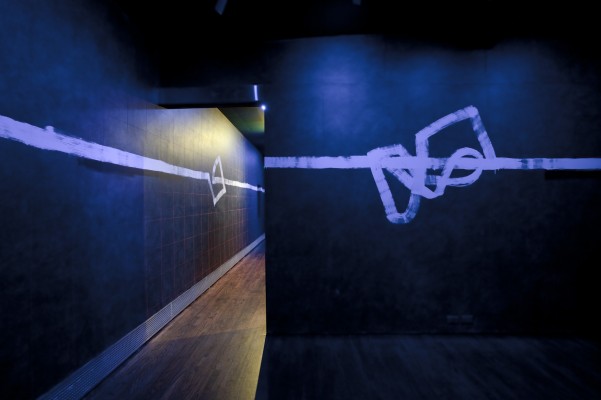
As so often happens, no sooner had I posted my blog on "Lines" than I read about Pat Steir's latest exhibit at Sue Scott Gallery in New York that ended last month. Entitled The Nearly Endless Line, it was a roughly brushed line that wended its way around corners and out of sight in a room, only to reappear, sometimes looping and squiggling to take on a life of its own.

My thanks to the Sue Scott Gallery for the image of Steir's installation.

My thanks to the Sue Scott Gallery for the image of Steir's installation.

Sometime emphasised by a slightly darker second line, it stood out from walls painted a deep royal blue that apparently was incredibly densely painted. The other magical ingredient was light, mysterious and other worldly. The immersion in this space, following this line around the room, could signify the passage of time in an almost hallucinogenic setting. Pat Steir, well known for her waterfall, drippy paintings, has also been creating wall drawings and installations for a number of years - I wrote a little about her work when she was showing Pat Steir: Drawing out of Line at the Neuberger Museum in New York at the end of 2010.

The power of a simple line is fascinating, particularly when it is large-scale, against a resonating colour and with appropriate lighting. Steir did Another Nearly Endless Line at the Whitney last year as well - not as powerful as the one at Sue Scott, but still one conveying a questing, thoughtful message.

I can't help thinking too of the power of a single sumi-e ink brush stroke in Chinese or Japanese brush drawings. These marks of beautifully nuanced tone can be a symphony of simplicity, yet make such an impact.

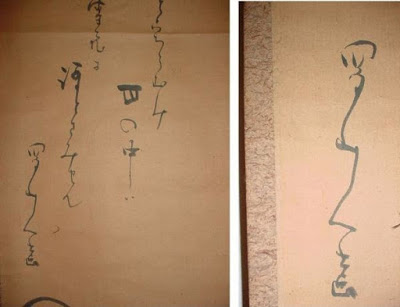
Look at these questing lines of calligraphy, Daruma, by Japanese poet and calligrapher, Ota Nampo Shokusanjin (1749-1823).

Shokusanjin - Ota Nampo - Daruma

Shokusanjin - Ota Nampo - Daruma

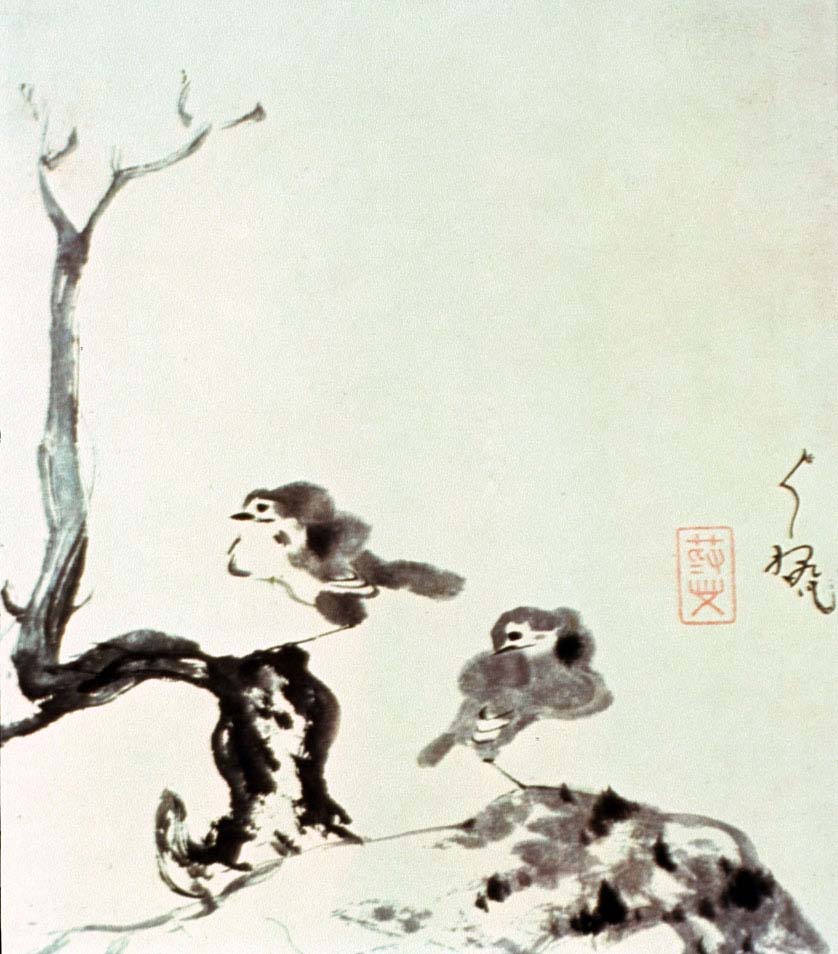
This brush painting of Two Birds is by Bada Shanren (c. 1625-1705), one of the masters of Chinese calligraphy.

Two Birds, Bada Shanren, 1705

Two Birds, Bada Shanren, 1705

Hakuin Ekaku (January 19, 1686 - January 18, 1768) was one of the most influential figures in Japanese Zen Buddhism and  one of the greatest Japanese Zen painters.

Blind Men crossing a Bridge, Hakuin Ekaku (1685–1768)

Blind Men crossing a Bridge, Hakuin Ekaku (1685–1768)

Death, Hakuin Ekaku

Death, Hakuin Ekaku

Each of these works rely on the same sureness of hand that modern draughtsmen and women need to achieve powerful lines, whether on paper, scrolls or walls. The implicit message in all these memorable works is - for an artist - practice, practice, practice. As well, of course, as inspiration.

Lines by Jeannine Cook

When you think about it, life is full of lines. Power lines, phone lines, railway lines, the lines that define buildings and streets, cobwebs and even the veins of leaves. For an artist, however, using lines in drawings can give rise to many different philosophies and approaches.

For instance, Paul Klee famously and deliciously said, "A drawing is simply a line going for a walk". That statement goes along with his whimsy and imaginative approach to creating art. Just like his statement that "a line is a dot that went for a walk".

Paul Klee "Lines, Dots and Circles"

Paul Klee "Lines, Dots and Circles"

This is beautifully illustrated by one of his numerous drawings. It shows that whilst Klee was clearly drawing very intelligently, and often with deliberate wit and parody, particularly as the Nazis rose to power, nonetheless intuition and pure creativity flowed happily.

Another artist who allows the line simply to flow from her, without premeditation, is Christine Hiebert. Very widely exhibited and heralded for her inventive approach to drawing with media ranging from blue tape to charcoal, she investigates the nature and language of line. She starts a drawing on a blank wall empty of ideas, not using a pre-drawn sketch. She says, "The final outcome is always something I didn't anticipate. The process can be unsettling, but that is how I prefer to work. For me, drawing starts with the problem of the line, how to form it and how to follow it. In a way, it ends with the line too. The line remains independent, searching, never completely absorbed by the community of its fellows." (Except from her Davis Museum brochure for Reconnaissance, August 2009.)

Untitled, charcoal and rabbit skin glue on paper, 2000, Christine Hiebert, (Image courtesy of the Metropolitan Museum, New York)

Untitled, charcoal and rabbit skin glue on paper, 2000, Christine Hiebert, (Image courtesy of the Metropolitan Museum, New York)

I find her approach of visual thinking through drawing fascinating, because there is also another, more traditional approach to drawing. That is based upon seeing or conceiving of an image which the artist then proceeds to translate, through line, into an permanent image. This has been an accepted way of creating line drawings in Western art since the monks began to delineate their illuminations on vellum and parchment and their heirs, during the Renaissance, brought the art of drawing to great heights. Not only were the lines then used to explore ideas and make studies in preparation for paintings, but the artists also made finished drawings, line after careful line. Indeed, for many centuries, skill in drawing was almost predicated on little erasure, in silverpoint (that permanent line won't budge!), but also in red chalk (the bravura medium), black chalk, pen and ink and even charcoal.

Today, many artists are pushing the definitions of using line or making drawings far beyond those traditional approaches. Perhaps it is only fitting in a world where man made lines - the power grids, the computer chips, or whatever - predominate.

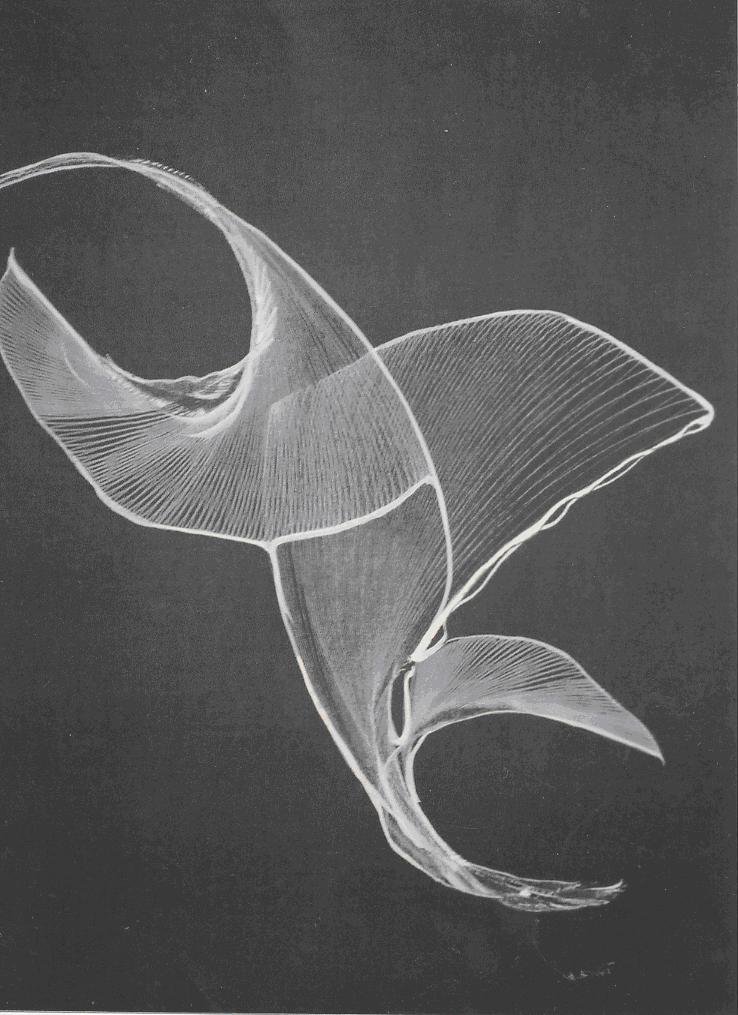
Wiki.Picture by Drawing Machine 2

Wiki.Picture by Drawing Machine 2

When a beautiful drawing can be produced by Drawing Machine 2, using a mathematical model, the lines indeed go for their walk. Paul Klee would certainly approve, I am sure. It is good to remember that any approach to lines is possible, as long as we artists allow ourselves to be creative and free. That is my definition of fun!

The Gift of Happiness by Jeannine Cook

Happiness, with all its definitions, often comes quietly into one's life from a direction least expected. Precious, often fugitive, and always a gift, it spreads through one's life in subtle ways. My - our - most recent gift was a diminuitive black kitten whom we found abandoned when we returned last summer from Europe. Rescued, christened Chutzpah - for obvious reasons - and installed, she soon transformed our life with her jaunty golden-eyed insoucience and ultimate absolute trust.

However, we soon discovered that she had been bitten by heart-worm-carrying mosquitoes and was the youngest cat our vets had ever seen to have heart worm – a death sentence deemed to be two years ahead, for there is no treatment for cats.

We decided that her time with us was a gift, that she should live as joyous a life as possible with us - and so it was. Last night, from being a vital, purring, beautiful little cat, within ten minutes, she was dead. Seemingly the heart worms were exacting their toll, not at two years but at ten months.

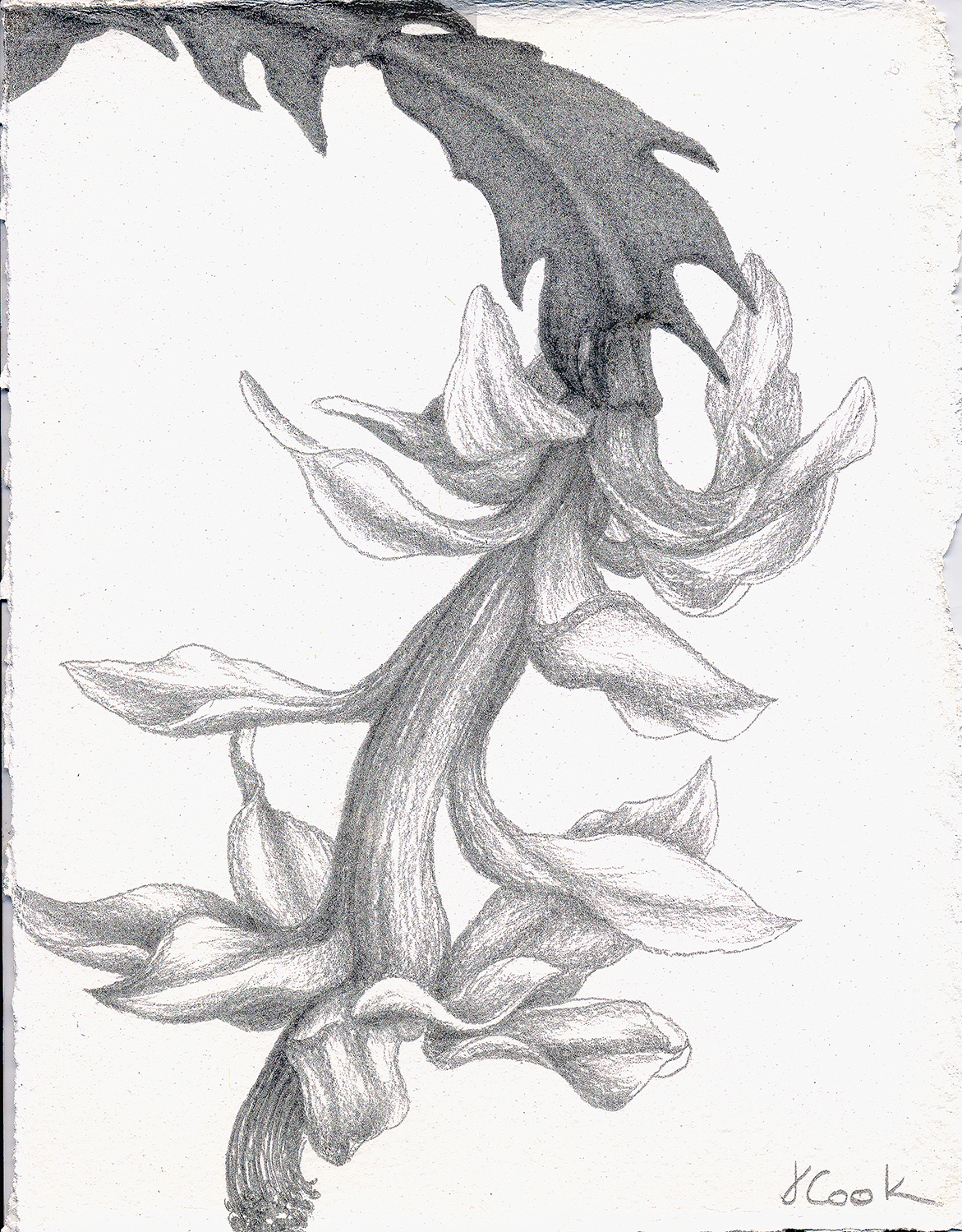
Now, amid our tears, I begin to measure, as an artist, how the happiness I experienced with her in our home has even filtered into my art. As I sat drawing at the table, she would sit on the next chair, peeping up at me, always happy to have a conversation of purrs and churrs and soft squeaks. Her repose and elegant slumber were a delight to look at when I needed to rest my eyes from the drawing. Her intense interest and curiosity when I was working on matting and framing art helped alleviate the tedium of the tasks. She threaded herself into our life as a golden strand of happiness, incredibly fragile, appallingly brief, but such a gift.

Christmas Cactus, silverpoint, Jeannine Cook artist

Christmas Cactus, silverpoint, Jeannine Cook artist

White Christmas Cactus, silverpoint, Jeannine Cook artist

White Christmas Cactus, silverpoint, Jeannine Cook artist

Resquiesce in pace et in amore, Chutzpah. I owe these two drawings of Christmas cactus flowers to you.

Touches of Nature in our Daily Lives by Jeannine Cook

Nature, in the form of winter weather, seems to have loomed over-large in many people's lives in recent weeks, whether in North America or even in normally sun-filled Palma de Mallorca. Two weeks there of often rather chilly weather left me indoors more than I would wish, but all is relative! It meant that I began to think about other aspects of nature that show up in our daily lives.

The world of art and design is still amazingly dependent on inspiration from nature. I was reminded of this as I looked at illustrations of products on display at the current International Gift and Jewellry fair, IFEMA (Semana Internacional del Regalo, Joyería y Bisutería), being held this week in Madrid. The articles covering the show in El País newspaper were full of photos of jewellry, furnishings, wallpaper, ornaments or clothing inspired by flowers, leaves, animals and birds. Perhaps as the world grows more urban, we all need more reminders of the nature we are forsaking and often destroying?

I started looking at touches of nature that show up on buildings in terms of adornment. Think, for instance, of Antonio Gaudi's Sagrada Familia full of concrete evocations of the natural world, an amazing ensemble still rising in Barcelona. Look at a turtle holds up a column at the Sagrada Familia.

Sagrada Familia Turtle column base

Sagrada Familia Turtle column base

Look up inside in the Sagrada Familia nave at wonderful columns that evoke sunflowers, daisies, whatever.

Detail of the roof in the nave. Gaudí designed the columns to mirror trees and branches. Sagrada Familia, Barcelona

Detail of the roof in the nave. Gaudí designed the columns to mirror trees and branches. Sagrada Familia, Barcelona

Even the wonderful soaring new El Prat airport in Barcelona, a magnificently quiet and well-conceived building, is made more restful and welcoming by its subtle evocation of sea and serenity; a foam green/aquamarine glass is used throughout the building inside and out.

Inside Barcelona airport

Inside Barcelona airport

Some of the most enduringly successful furnishings that have come down the centuries in France and elsewhere are full of evocations of elegant pastoral scenes, birds, animals and flowers.

Fabrics and wallpapers with such scenes abound -

Bamboo Indigo Katagami Fabric

Bamboo Indigo Katagami Fabric

19th century Katagrami-inspired carpetting

19th century Katagrami-inspired carpetting

William Morris-inspired wallpaper

William Morris-inspired wallpaper

Silver objects frequently evoke nature, in their stylised shapes on teapots, urns, trays, dishes. This is just one example, a wonderful George IV English silver urn, full of echoes of nature.

A George IV silver Tea Urn , 1823 , United Kingdom

A George IV silver Tea Urn , 1823 , United Kingdom

Furniture, too, has long hinted at animals' feet in the legs and finials of tables, chairs and other pieces. Marquetery has long evoked flowers in great richness. Inlaid stone tables have been an Italian speciality that can be wondered at in the Prado or V & A Museums, for instance.

Charles Cressent (French, Amiens 1685–1768 Paris), Commode, ca. 1745–49 (Image courtesy of Metropolitan Museum of Art, New York)

Charles Cressent (French, Amiens 1685–1768 Paris), Commode, ca. 1745–49 (Image courtesy of Metropolitan Museum of Art, New York)

(Image courtesy of The Wallace Collection, London)

(Image courtesy of The Wallace Collection, London)

An Italian scagliola table top, Florentine, second half 17th century.

An Italian scagliola table top, Florentine, second half 17th century.

The Japanese, Koreans and Chinese have always been famed for their extraordinary evocations of nature in the objects with which they have surrounded themselves in daily life. Kimonos and netsuke, lacquer objects painted and carved, basketry and furniture, ceramics - the list is endless, but eloquent of the respect in which Nature has been traditionally held. The same can be said for most cultures and countries around the world.

Flowers and Grasses with a Praying Mantis, attributed to Ryūsa (Japanese, active late 18th century), Edo period (1615–1868), late 18th century

Flowers and Grasses with a Praying Mantis, attributed to Ryūsa (Japanese, active late 18th century), Edo period (1615–1868), late 18th century

Sadly, most of us are so often busy and preoccupied that we don't notice many of the beauties of nature that are present in our world, in art and architecture, jewellry, furnishing, adornments or whatever. I am often fascinated to watch people walking - say, in an airport like Atlanta - on the beautiful granite polished slabs that now form the floors in many of the concourses. Most people never even really look at this marvellous touch of nature underfoot.

As an artist, I keep trying to remind myself simply to keep my eyes open and registering. Since I love to try to depict things in the natural world, I tend to gravitate to the touches of nature I find in my daily life. I find them uplifting and serene-making in many instances, and at the least, interesting, because they are also, often, interpretations of how other people have perceived that aspect of nature. Always fun, many times inspiring and enhancing.

Training more than the Eye by Jeannine Cook

I was thinking further about examples in the art world of kindness and courtesy, after blogging about West Fraser's Painting in a Tree programme. There is a further dimension, I decided, to being being an artist, and Vassily Kandinsky said it beautifully.

Kandinsky remarked that "the artist must train not only his eye, but also his soul". It is a succinct statement about the whole frame of mind in which an artist must live and work, one which again can contribute, or not, to the general well being of the community.

Kandinsky's wonderful paintings in the Composition series he did periodically; Composition VII of 1913, (image courtesy of the Museum of Modern Art.)

Kandinsky's wonderful paintings in the Composition series he did periodically; Composition VII of 1913, (image courtesy of the Museum of Modern Art.)

It is not just visual artists like Kandinsky with belief systems about how art can convey spiritual values but creative people in general who can make a huge, positive difference. Think of poetry, music, theatre, literature in general. Granted, many claim that the public and the marketplace demand works that are sometimes less than uplifting. There are indeed all tastes, but I do believe that each of us can contribute something that gladdens, interests, amuses, sustains.