Curiosity by Jeannine Cook

One of the aspects of the Telfair Museums' exhibition, Modern Masters. American Abstraction at Midcentury, that I found very stimulating was the quotes from each artist on the labels beside their paintings or sculpture. They were not only well-chosen, but in of themselves, they are thought-provoking and insightful.

An example of these quotes is one that accompanies the painting, Sea Image, by TheodorosStamos (1922-1997).

Sea Image, (Image courtesy of the Smithsonian American Art Museum) by TheodorosStamos

Sea Image, (Image courtesy of the Smithsonian American Art Museum) by TheodorosStamos

This early Abstract Expressionist New Yorker wrote, "Nature is so vast, with so many moods and the ocean is so large and every wave is infinite. And as long as we have the curiosity of children (and sometimes we have to be children), discovery is not only possible, but indispensable".

The need for curiosity is, I am convinced, absolutely central to life for everyone, but especially for an artist. Not only is it rewarding to find out about how something works, or is put together, or what it is made of, how it smells and feels, but also, this knowledge gives depth and distance to everything in life. Such insights help us determine what we want to paint or draw, how we want to portray things (whether realistically, abstractly, in two or three dimensions, in film, paint, video, whatever...) and why we are moved to do so. Every single day - ideally - should bring new knowledge, fresh enrichment and stimulation, more possibilities for fun and fascination.

Two curious kittens sniff out a tortoise. I(mage courtesy of Life.com)

Two curious kittens sniff out a tortoise. I(mage courtesy of Life.com)

Watching a kitten explore its world is a perfect metaphor for this curiosity. Everything is new and worth investigating, exploring, evaluating. We artists can be as bright-eyed and curious as any feline. It pays off too!


"No duality, everything is nature" by Jeannine Cook

There is a wide-ranging and fascinating exhibition currently on show at Savannah's Telfair Museums, at the Jepson Center, entitled Modern Masters. American Abstraction at Midcentury". With works from the Smithsonian American Art Museum, the explosive diversity of art made during the mid-20th century in America is celebrated with forty-three key paintings and sculptures. The exhibition is travelling the country for four years, and it will remain on display at the Jepson until February 6th, 2011.

It is a show worth visiting several times, because of its diversity and density. Not only are there canvases by stellar artists to contemplate and appreciate, but there are some fascinating sculptures that I found most arresting.

One of them, "Banquet", shown courtesy of the Smithsonian American Art Museum, stopped me in my tracks with its multi-layered knobbly forms and metal alloys that evoke stalagmites or primitive corals. It is by an artist with whom I was unfamiliar, Ibram Lassaw (1913-2003).

Ibram Lassaw, Banquet, 1961, bronze, Smithsonian American Art Museum, Ibram Lassaw, Banquet, 1961, bronze, Smithsonian American Art Museum,

Ibram Lassaw, Banquet, 1961, bronze, Smithsonian American Art Museum, Ibram Lassaw, Banquet, 1961, bronze, Smithsonian American Art Museum,

(As an aside, I find that being a permanent newcomer to every place I have lived in Europe and North America since I had to leave my home in East Africa, I am constantly having to "catch up" on art, law, history, society in general – It is a humbling but exhilarating situation!)

But back to Ibram Lassaw. He too was an immigrant, from Egypt, working in New York as an artist from the 1920s; he became an active participant in the avant-garde art world and was a founding member of the American Abstract Artists. He learned to weld while serving in the US Army during World War II, and continued experimenting with ideas and materials for the next two decades. He fused his ideas on art-making with concepts derived from extensive and catholic reading to reach a philosophy about the holistic nature of the universe and all that is contained therein. He suddenly had an artistic breakthrough in the 1950s, and began to create complex structures that evoked nature in many forms, cosmic and microcosmic.

He said that everything is nature, "every atom that makes me up is nature". He wrote, "I am constantly absorbed by things that are going on around me, the motion of people in the streets, the movement of clouds, the patterns of branches. There is no duality, everything is nature."

It was obvious from the work, "Banquet" that he was fusing ideas about many aspects of life and nature in this work, to achieve a delicate complex work that rewards with careful inspection and contemplation. What I found so interesting, however, was one of those delicious coincidences that occurs: soon afterwards, I saw a re-broadcast on PBS of Hunting the Hidden Dimension. The Most Famous Fractal about the late Benoit Mandelbrot's wonderful mathematical way of describing the "roughness" he saw all around him in nature. Before Mandelbrot, artists had indeed seen the "self-similarity" and "roughness" in nature, but mathematicians had considered these jagged, self-repeating shapes unmeasurable. Mandelbrot introduced fractals, the concept of another dimension, a fractal dimension, that lay between two and three dimensions. This dimension allows for mathematical measurements and thus, amongst other things, a deeper understanding of self-similarity - the endless repetition of stalks of broccoli, trunks to branches to twigs on a tree and its leaves.

As an example, the image below is that of a high voltage dielectric breakdown within a block of plexiglass - it creates a beautiful fractal pattern called a Lichtenberg figure. The branching discharges ultimately become hair-like but are thought to extend down to the molecular level. (Bert Hickman. http://www.teslamania.com/)

12" block - Captured Lightning scupture (Image courtesy of Theodore Gray)

12" block - Captured Lightning scupture (Image courtesy of Theodore Gray)

Lassaw's "Banquet", created in 1961, was in many ways an early evocation of the same wonderful complexity that nature offers, everywhere, all the time.

These happy coincidences are what I love about seeing an art exhibition. There is always some work of art that makes one more aware, more able to make connections and add new, rich dimensions to life. What fun!

The Highs and Lows of Artists by Jeannine Cook

I have a suspicion that every artist, writer and other creative person knows that there is an inevitable pattern to life. By pattern, I mean that there is an excitement, almost euphoria, when there is an event to prepare, such as an art exhibition. Then, after everything is over, there is a let-down, a flatness and almost, sometimes, a short depression, before life reverts to a more even keel.

This has certainly been the case for me over the years, especially with my Art-Tasting events. Lots of work to prepare, hang, exhibit the art, and ensure that the wine-tasting and party are organised... a week of steady preparations before the date. Then the day of the Art-Tasting comes. This year, the weather was perfect, the marshes were magnificently golden and wide-flung and the garden still unaffected by freezing temperatures. Lots of people came, at a steady tempo, and everyone seemed to enjoy themselves, the main objective of the party.

The hours fly past, the table empties of food, artwork disappears out of the house under people's arms... and then it is all over.

Clearing up is made easier by wonderful help, and in the subsequent days, I put the house back together, and take the art down from display. Slowly, slowly, the world returns to its more peaceful rhythm, and I recognise that I feel flat and devoid of creativity. Luckily, this is only a brief period, I now know, and suddenly, I will get excited again about something I see or think of. Then I become a practising artist once more, and life will flow into other channels. The period of highs and lows passes once more.

I wonder if this happens with writers who launch a book, composers who hear their music played for the first time, ballet dancers in a new performance – a hundred versions of launching one's creativity into the public arena.

600px-Yin_and_Yang_svg.png

Putting one's creative soul out into the wide world is exciting, challenging – but then there is the counterpoint, the emptiness, the let down. I suspect that everyone learns with time about the yin and yang of creative life, just part of the whole process of being an artist.

Believing in Life by Jeannine Cook

Each year, when I send out the invitations to my Art-Tasting open studio/wine-tasting party, I write a couple of paragraphs about something to do with art. It varies of course according, in a way, to what is going on in my life and thus colouring my optic.

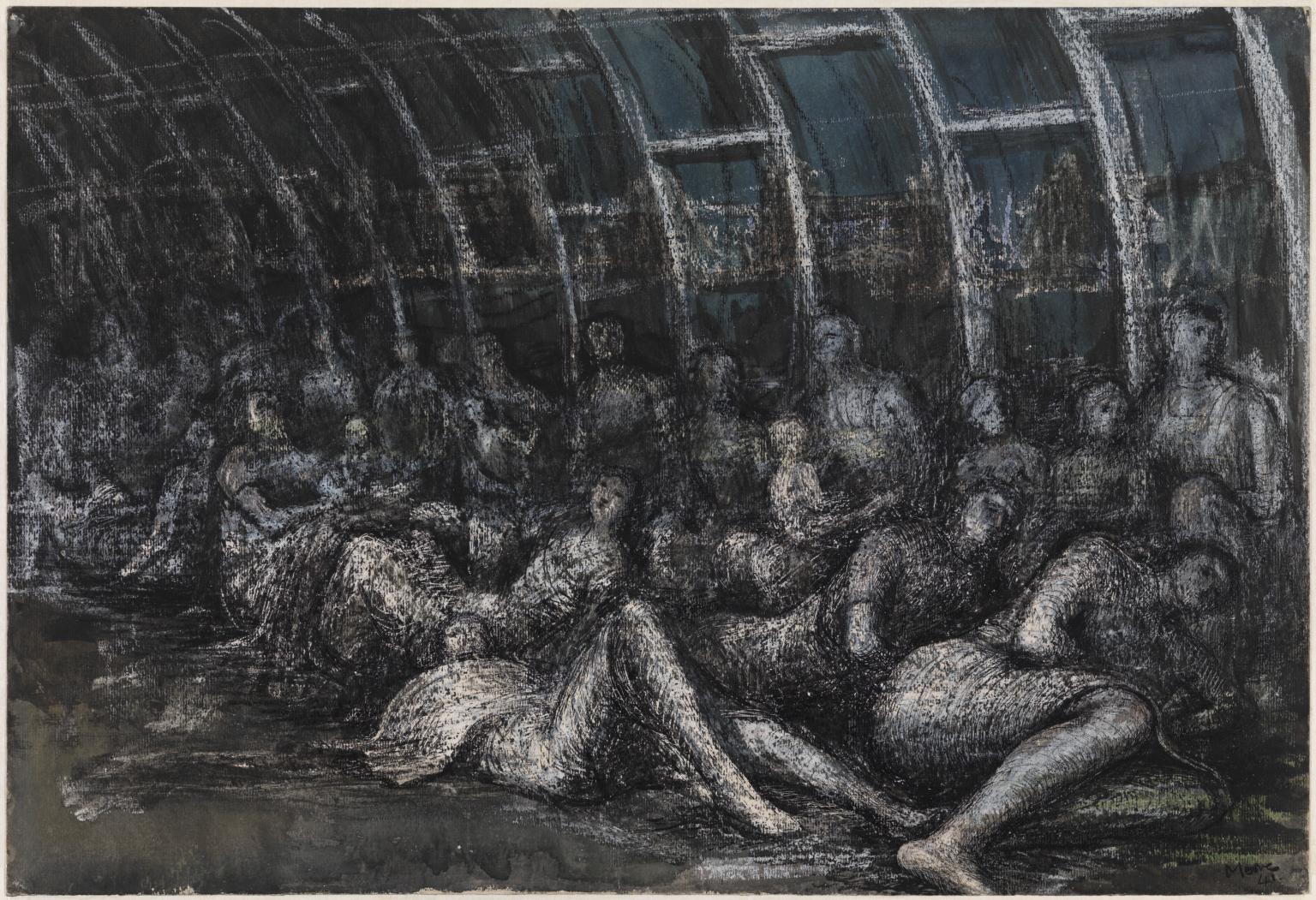
This year, I took Henry Moore's observation, "To be an artist is to believe in life" as the theme.

I wrote : " Henry Moore, best known for his powerful sculptures, saw aspects of life that were grim and depressing during World War II. His drawings of people huddled in the London Underground, sheltering from air raids, are eloquent testimony to life's hardships. Yet his creations are all vigourous and enriching assertions of his belief in life.

Shelterers in the Tube 1941, Graphite, ink, watercolour and crayon on paper, Henry Moore, (Image courtesy of the Tate)

Shelterers in the Tube 1941, Graphite, ink, watercolour and crayon on paper, Henry Moore, (Image courtesy of the Tate)

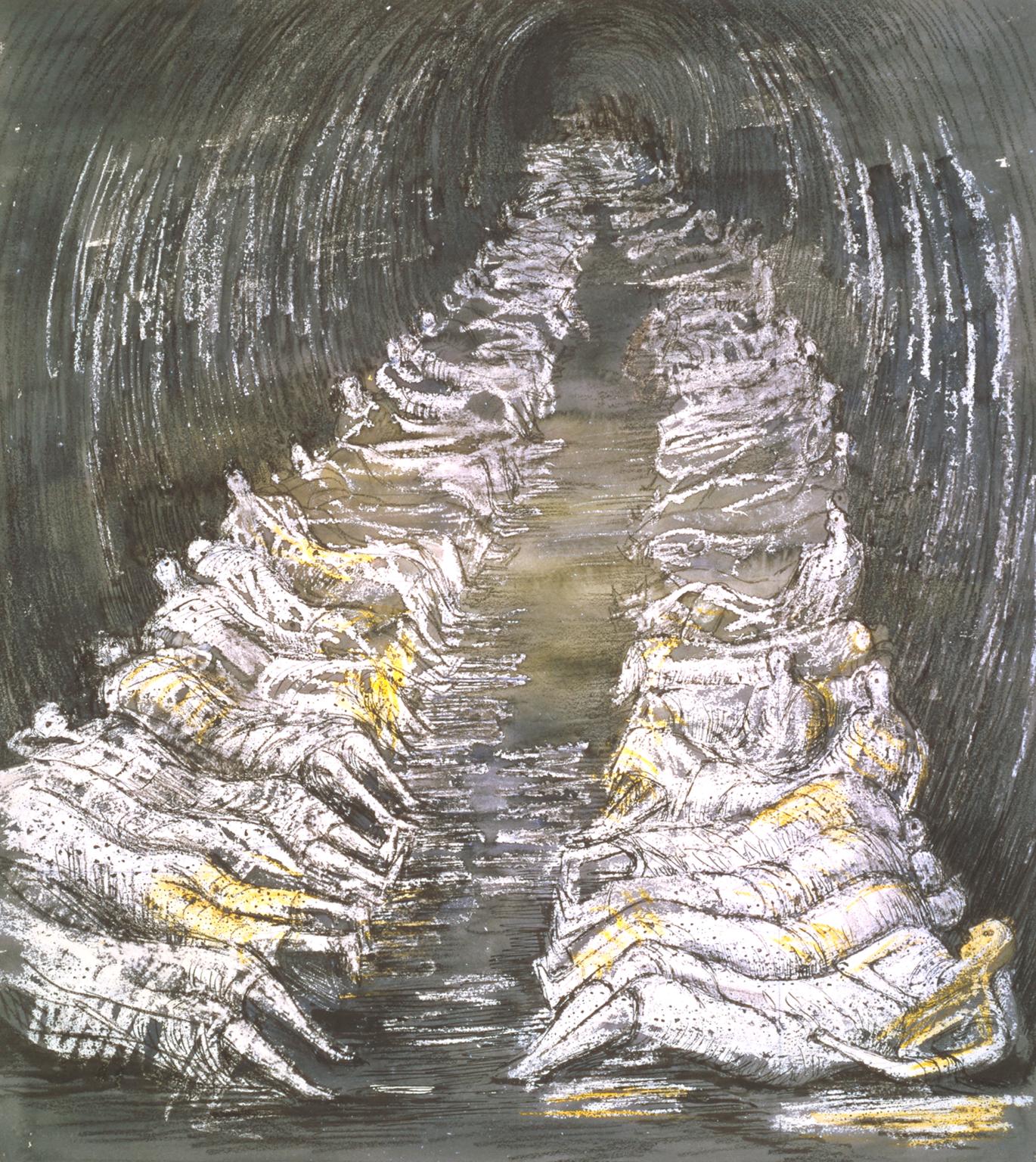
Henry Moore OM, CH. Tube Shelter Perspective. 1941 , Graphite, ink, wax and watercolour on paper (Image courtesy of the Tate)

Henry Moore OM, CH. Tube Shelter Perspective. 1941 , Graphite, ink, wax and watercolour on paper (Image courtesy of the Tate)

The label accompanying the drawing, Tube Shelter Perspective. 1941,  said:  " This picture was exhibited at the National Gallery in 1941. It was described in the catalogue as 'a terrifying vista of recumbent shapes, pale as all underground life tends to be pale; regimented, as only fear can regiment; helpless yet tense, safe yet listening, uncouth, uprooted, waiting in the tunnel for the dawn to release them. This is not the descriptive journalism of art. It is imaginative poetry of a high order.' "

"In today's complex world, artists can play many roles, all of which celebrate life. Art can calm and heal, bring joy and stimulation, challenge and widen horizons. Believing in life allows not only the artist, but those who see the art, to remember that our time here is fleeting, potentially beautiful and very precious."

The Two Aspects of Being an Artist - Creating and Selling by Jeannine Cook

This week is one of those times when being an artist in creative mode runs headlong into the other dimensions of art-making- namely, exhibiting to sell art.

Saturday next, 4th December, will be the sixteenth year that I hold my Art-Tasting, an open studio-cum-wine-tasting, at our home on Cedar Creek, above the golden marshes of McIntosh. It is a big party which means greeting a large number of friends, many of whom I have known for many years and who are faithful attendees of this event. Each year, too, the circle of attendees widens, something which I thoroughly enjoy, as people ask to bring friends. It is also, being an open studio, one of the main opportunities I have each year to have potential buyers view my art on display. The Art-Tasting is the culmination of a week of setting up the house to act as a gallery, hanging the art, preparing price lists and ensuring that everything else is in place, from wine to food, to lights, signs, wonderful friends to help me during the party. A thousand details. This all comes after a couple of weeks of hard work previously, during which I mat and frame my work, and another time preparing the personal invitations I mail out. The image below was on this year's invitation.

September Canna, watercolour, Jeannine Cook artist

September Canna, watercolour, Jeannine Cook artist

It is sometimes hard to change gears from being a solitary artist, trying to create work that is viable and meaningful, to an outgoing, social hostess and "gallerist". It means having to be ready to expose your inner self, which - almost in spite of yourself - you have revealed in your artwork, and have innumerable people assess what you have done, for good or for bad. Each person, of course, brings their own experience and optic to bear on what they see in the artwork, but they soon decide if they like or dislike what they are seeing. You are asked many times to explain and elaborate on what you have implicitly "said" in a piece of art. This means that you need to be lucid, concise and accessible in what you say about it... usually against a hubbub of talk and in a crush of people. There is too the awareness that what you say can tip the balance for or against a sale of work.

Selling is in part a gift, but also, I believe, an opportunity to reach out to people and share with them the joys and perils of creation. Honesty never goes amiss, I believe, and heavens knows, being an artist is a constant reminder of humbling endeavours. Nonetheless, there are so many moments of sheer delight that one experiences when, for instance, one is working plein air and the natural world is full of beauty and fascination. People can relate to such accounts, and I think it helps to amplify the understanding of a piece of art when you, the artist, share such experiences.

Meeting potential collectors personally, in my own home, has been a marvellous enrichment to life over the years. Most of our friends are muddled up, in some way, with my art. I used to have gallery representation, but I have realised that despite the effort it requires to try to represent myself and sell my art, the benefits of meeting kindred spirits far outweighs any inconveniences. It does not preclude showing in galleries elsewhere, but locally, I love meeting collector friends and friends who become collectors.

Nonetheless, after a couple of weeks of having my "selling" hat on as an artist, I have to admit that I revert to my quieter, creative mode with delight and some relief. I do recognise, however, that being able to reconcile the two Janus aspects of being an artist so pleasantly is a great privilege.

Using Women in Publicity Images - illustated by Jeannine Cook

When I was in Palma de Mallorca a couple of weeks ago, I blogged about my indignation at seeing beautiful women used to "sell" a new hospital, Son Espases. I still feel it is a completely inappropriate way to publicise the hospital, although I was fascinated to note that various Spanish men I talked to about it were surprised and amused at my reaction!!

Now, thanks to a dear friend's kindness, I can at least illustrate what I was talking about. I will be interested to hear what other people think.

Son Espases I.jpg

These billboards are all over the city and beyond, telling of the fact that Son Espases is (already) one of the best hospitals in Europe. The fact that the hospital has only just started admitting patients in limited numbers last week is apparently beside the point.

Son Espases III.jpg

Art that remains "Bang up to date" by Jeannine Cook

That perspicacious genius, Pablo Picasso, once said, about his art, "All I have ever made was made for the present, with the hope that it will always remain in the present."

His work has just been tested again from this point of view, with an exhibition, Picasso by Picasso, on show at Zurich's Kunsthaus, until the 30th January, 2011. This is a semi-repeat of an exhibition that Picasso himself selected in 1932; he chose 225 of his works from different periods and styles, and the show was very successful.

This time, one hundred of the original works selected have been reunited, and according to William Cook, writing in The Spectator on October 30th, 2010, the exhibition is again very successful. Since the works are all pre-1932, there is not the political element that appeared in Picasso's work after Guernica, and apparently, the works appear far more optimistic than later paintings. Most importantly, the exhibition passed the acid test of Picasso's work remaining relevant, present and with impact for today's viewers. In William Cook's words, the show still seems "bang up to date".

For art to remain in the present, what does it need? I am sure everyone has a different answer, but for me, it boils down to art that contains a passionate message about human values, aspirations, emotions... The great art that has come down to us from past centuries and from different cultures all touches a cord in us, reminding us of universal bonds. The art can tell us of people, places, plants and trees, animals - in stylised or realistic fashion - but there is always a depth of emotion in the overt or subliminal messages.

Think of a Rembrandt portrait with its psychological impact, such as this masterpiece from the Frick Collection

Rembrandt Self-Portrait, 1658 (Image courtesy of Frick Collection. New York.)

Rembrandt Self-Portrait, 1658 (Image courtesy of Frick Collection. New York.)

Or a Vermeer with the heart-stopping clarity and elegant stillness that nonetheless manages to encompass complex human moments. His Music Lesson is a wonderful example

A Lady at the Virginal with a Gentleman,  1762, Johannes Vermeer,  (Image courtesy of the Royal Collection in 1762

A Lady at the Virginal with a Gentleman,  1762, Johannes Vermeer,  (Image courtesy of the Royal Collection in 1762

Go back some six to seven thousand years to the  Man from Cernavoda,  the Romanian clay man seated with his elbows on his knees, who conveys just as much deep introspection today as when he was made - we can all relate to his pensive, eloquent melancholy. In this image, he is shown with his companion Woman.

"Thinker of Cernavoda" and "Woman of Hamangia"; Romania, 5000 BC, (Image courtesy of the National History Museum, Bucharest.)

"Thinker of Cernavoda" and "Woman of Hamangia"; Romania, 5000 BC, (Image courtesy of the National History Museum, Bucharest.)

Remember, too, Rodin's The Kiss, with its utterly memorable evocation of romantic love.

The Kiss, 1901-04, Auguste Rodin, Pentelican marble, (Image courtesy of the Tate)

The Kiss, 1901-04, Auguste Rodin, Pentelican marble, (Image courtesy of the Tate)

When one thinks of the innumerable works of art that bring joy, compassion, delight, insights and understanding, they all touch those cords that bind one to the present. William Cook, in the review to which I referred to above, also alluded to modern art as having become "introverted, a reflection of our times". This brought me up short, but then I remembered the works so prized today - of  Damien Hirst, Andy Wahol, or even Jeff Koons,  for instance - and I do rather wonder where many modern works will be in fifty years' time... In the basements or still in pride of place on display? Time is not kind to superficial art. Each century proves that out, with scores of now-forgotten artists who were lionised in their time.

For an artist to find a voice that talks of the universal "now" is truly a gift. It is a goal to which every artist aspires, for, in a way, that is the overwhelming "raison d'être" of making art - to remain in the present.

A Manifesto for Drawing by Jeannine Cook

I cannot resist reverting to the wonderful book, "The Hare with Amber Eyes" by Edmund deWaal. Not only was it a delight because of the story, the history of the Ephrussi family and the netsuke that now belong to the author, but because of the comments about art in general, and about drawing in particular.

Edmund deWaal's ancestor, Charles Ephrussi, who acquired the netsuke collection in Paris, was himself an author on Albrecht Durer's artwork and a noted art connoisseur.

The image is the famed silverpoint drawing the 13 year old  Dürer did of himself in 1484 – silverpoint is fiendishly obdurate in not allowing changes or erasures. This makes the drawing all the more amazing for this young artist to have achieved.

Self Portrait at 13, silverpoint, Albrecht Dürer (Image courtesy of the Albertina Vienna)

Self Portrait at 13, silverpoint, Albrecht Dürer (Image courtesy of the Albertina Vienna)

Charles Ephrussi's expertise in drawings led him to write about the intimate dialogue that a viewer has with them. Viewing a drawing allows us to "catch the thought of the art in all its freshness, at the very moment of manifestation, with perhaps even more truth and sincerity than in the works that require arduous hours of labour, with the defiant patience of the genius."

As Edmund deWaal noted, this is a marvellous "manifesto for drawing. It celebrates the moment of apprehension (my emphasis) and the fugitive moment of response - a few traces of ink or a few strokes of the pencil." As a very successful artist (potter) himself, he knows of this almost visceral moment of launching oneself onto the blank page, making marks that are instinctive, questing – without any real knowledge of what the ultimate results will be.

Edmund deWaal continued with a very important observation about Charles Ephrussi's book about Dürer. He talked about this study, written at a time when the Impressionists were launching their bold new way of seeing the world pictorially, as being Charles' way to remind people that art from different times can be mutually enriching. A Dürer drawing could "talk" in a very meaningful fashion to a drawing done by Edgar Degas. How true that is! Artists are constantly in conscious or subconscious dialogue with others' work; we cannot happily operate in a vacuum for too long. That is why art museums, art books, galleries and exhibitions are vital fare for us all, but especially for anyone who is a practising artist.

A final insight Edmund deWaal gives us, courtesy of Charles Ephrussi, is about  Gustave Moreau's painting. He cites him as describing Moreau's work as having "the tonalities of an ideal dream" and goes on to describe such a dream as being one where "you are held in a state of weightless reverie and lose the boundaries of your self." That is the magical state that each of us can experience when, for instance, you visit a museum and see works of art that take your breath away. Suddenly the world falls away, you are captured by a multiplicity of emotions and you stand in front of a painting or drawing, oblivious of anyone or anything else. In other words, a state of grace, in my book. These are the moments that feed one as an artist, that allow art to transcend time and place and enrich us all.

In the same way, this book, "The Hare with Amber Eyes" is enriching. It is already on my list of gifts for friends.

A Magical Tale of Netsuke by Jeannine Cook

I have always been enchanted with netsuke, those tiny and often exquistely carved toggles on Japanese kimono sashes. I learned about them from an early age, because of my family´s connections with Japan. Later, in the major European and American museums which have netsuke collections, I spent happy hours peering and delighting, but mourned the fact that none of them could ever be touched. They are essentially designed for touch, fitting so perfectly into the hand.

I was thus so delighted to learn, through the Christian Science Monitor´s book review page, of a book about a netsuke collection. Entitled ¨The Hare with Amber Eyes¨, by Edmund de Waal, it was published by Farrar, Strauss and Giroux in 2010. It is the story of the acquisition of this collection of netsuke, and uses the netsuke as the thread to trace onwards the history both of these works of art and their owners down the generations to today, when Edmund de Waal himself is their safekeeper.

The diversity, intricacy and beauty of these highly tactile small objects, linked to a fascinating family history, make for a remarkable book, layered with so many nuances that everything enriches. You learn of the original creator of some of these small netsuke, you learn of the Japan that came later (after World War II), you learn of the heady times of japonisme in Paris in the second half of the 19th century and accompanying rise of Impressionism... Later came Vienna, both opulent and then devastating as 1938 presaged the end of that world for Edmund de Waal´s family. Meanwhile, the netsuke survived - small animals, erotic scenes, old people, any manner of imaginative subjects.

In short, this is a book of magic, well worth reading for many reasons.

Using Women in Publicity Images by Jeannine Cook

In Palma de Mallorca, my home happens to be adjacent to the major regional hospital. The big event at present is that this hospital, Son Dureta, is being phased out and all activity is now transferring to a huge new hospital on the outskirts of Palma. Son Espases, this hospital city, is nearly complete, and consequently, as patients transfer and the staff sorts through the complicated geography and activities, there is a major advertising campaign underway about its launch.

One of the most promient hoarding advertisements about ¨Son Espases - one of the best hospitals in Europe¨ shows a very beautiful woman, her head covered with a surgical cap and a mask over her nose and mouth. Ready for the surgeon to start wielding the knife, in other words. She has wonderfully beautiful eyes. Behind her is a fainter silhouette of a similarly garbed woman.

My reaction initially was, what on earth has a beautiful woman got to do with the quality of a hospital and its services? My second reaction was irritation. Only in a male-dominated situation could it be concluded that a beautiful woman was the best way to sell a hospital! Really!

Images of women are of course habitually the choice way to advertise watches, clothes, accessories, even cars, and alcohol in Spain – but somehow it seems to me that it is time that women start protesting at some uses of their images. I wonder what other people think of using beautiful women to sell hospitals?