Ways of Protecting Nature by Jeannine Cook

Yesterday, the golden spring light invited us to visit the Harris Neck National Wild Life Refuge in McIntosh County. This small and diverse refuge has been protected since 1962, and it evolved from being a World War II airfield, with long tarred runways. Now it is a fascinating area of ponds which are home to many species of herons, egrets, wood storks, ducks, coots, turtles and alligators large and small. Beyond are areas of maritime forest, and an amazing area of tarred runways now crazed with cracks through which cacti, grasses and trees are inexorably forcing their way as nature reclaims dominance.

Wood Storks ,Mycteria americana, Building Nests Rookery, Harris Neck National Wildlife Refuge NWR, McIntosh County GA (Image courtesy of Brian Brown)

Wood Storks ,Mycteria americana, Building Nests Rookery, Harris Neck National Wildlife Refuge NWR, McIntosh County GA (Image courtesy of Brian Brown)

To me, as an artist who tries frequently to direct my energies to creating art that makes people aware of nature's complex beauties and importance, Harris Neck is the perfect example of undoing man's abuse (justified or not) on nature. Cicero said in his Second Philippic speech in 44 B.C. that "Destroyers of the forest are enemies of the public weal". For the last century and more, we have witnessed at an ever-increasing rate the destruction of forest and the environment in general. This assault on "the forest" makes federal, state and local protected areas all the more important for everyone.
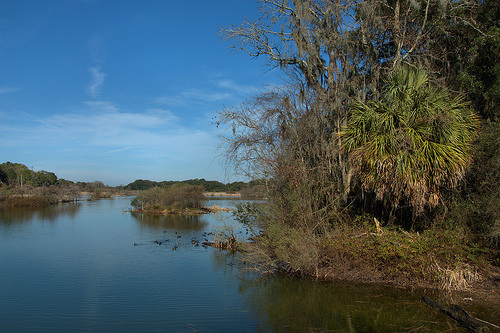
Woody Pond Habitat with Palm Tree Harris Neck NWR McIntosh County, GA (Image courtesy of Brian Brown, photographer)

Woody Pond Habitat with Palm Tree Harris Neck NWR McIntosh County, GA (Image courtesy of Brian Brown, photographer)

The efforts of artists of all stripes to help people understand and appreciate the magical beauty of such areas and their value to society are important. Drawing, painting photography and film, music, sculpture temporary and permanent, poetry and writing : all these disciplines are vital in this never-ending need to alert people that we must all, throughout the world, push back the "destroyers of the forest" and protect nature. The "public weal" demands nothing less, and I for one, as a visual artist, think it is a privilege to depict aspects of coastal Georgia's natural beauty. Harris Neck's magic reinforced my feelings as we visited it yesterday.

Audacity - in Life and in Art by Jeannine Cook

Audacity - it is a wonderful word that makes me instantly imagine someone acting with verve, bravery and decision! What made me think of it was finding a quotation by Winston Churchill: "Beginning with audacity is a very great part of the art of painting."

Just recently, I have been doing a fair amount of reading as I try to recuperate. Two of the most interesting books I have read are Charles Glass' Americans in Paris; Life and Death under the Nazi Occupation and Jimmy Burns' Papa Spy: Love, Faith and Betrayal in Wartime Spain. Of course, a central figure in both books is Winston Churchill, then the Prime Minister in Great Britain during those critical World War II years. His courageous sagacity and pragmatism were remarkable in dealing with the daunting aspects of the conduct of war, the relationships with General de Gaulle and the Vichy regime in France, General Franco in Spain who had just consolidated his power after the Spanish Civil War and the battle, both on and off the actual battlefields, with the Nazis.

Winston Churchill, 1941

Winston Churchill, 1941

His remark about needing audacity to paint is very much in the same spirit as he showed in the multiple other aspects of his remarkable and chequered career. He knew from his own painting sessions that launching oneself into a painting requires a leap of faith, a boldness and a belief that somehow one will succeed in producing a decent work of art. He was pragmatic enough to know that this is not always the case - but like every other artist, he kept trying. In fact, it is remarkable that he managed to produce a large number of very successful paintings, given how little early exposure he had had to art. His audacity paid off. He also remarked of art: "I know of nothing which, without exhausting the body, more entirely occupies the mind." When boldness, decisiveness and concentration are united, art-making usually rewards one with a decent result. Churchill certainly gave us all inspiration - in art-making as well as in many other spheres.

Nurturing the Inner Artist by Jeannine Cook

Hope does spring eternal. I assumed that once I was back at home from my hospital stay, I would soon be able to get back to creating art. Not quite so, I discover! An arm sling and other medical "accoutrements", plus a good dose of rummaged-around nerves and muscles don't yet make it easy to pick up pencil, silver stylus or paint brush.

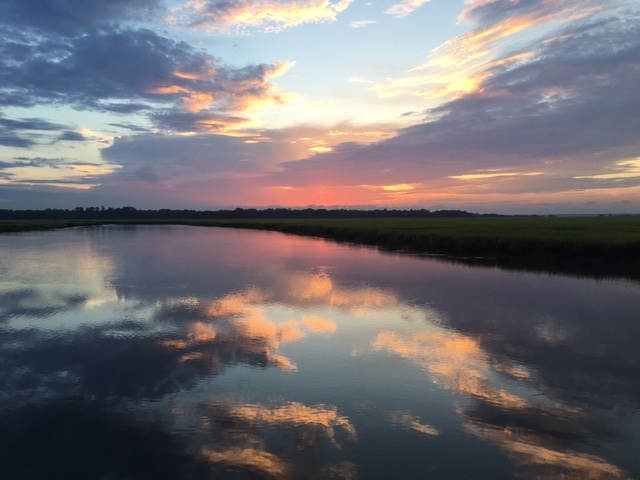
Nonetheless, one does not just turn off the artist's eye. As I first walk into our house, the golden, crystalline late afternoon light floods across the marshes and water in front of us, and I marvel. Still waters reflect a heron's white body catching the rose-orange glow of setting sun as it flies across the creek. At early sunrise, the next morning, the eastern sky's brilliance allowed enough light to sparkle rings of water in the creek below us: the otters were fishing for breakfast. At each of these marvellous moments, I find myself trying to remember, to store up the images so that later, they can, somehow, show up in my art, so that I can share these wonders with others.

Late afternoon view from our home in coastal Georgia

Late afternoon view from our home in coastal Georgia

Another view from our home in coastal Georgia

Another view from our home in coastal Georgia

Within the house, I look afresh at things I have not seen for ten days. Shapes of orchid petals, shadowed into sculpture, tillandsia flowers which have fully opened in my absence into elegant rhythms amid their undulating tendrils of ephiphyte energy, shadows of ornaments lengthened in the morning sun. These are all aspects of life that can be woven into art-making, I hope.

Tillandsia recurvata  Flowers, silverpoint and white gouache highlights, Jeannine Cook artist

Tillandsia recurvata  Flowers, silverpoint and white gouache highlights, Jeannine Cook artist

As I delight in the beautiful natural world in which I am so fortunate to live, I am also reminded of the diversity of optics that artists have on the very concept of making art. Catching up on the March issue of ARTNews, I found a remark which resonated : "Duchamp made it quite clear a long time ago, and so did Warhol, that art isn't an inherent form but a lens and a set of tools to interpret the world around us". (my emphasis). This was a remark made by Nato Thompson, chief curator of the non-profit public arts organisation, Creative Time, in rebuttal against questions and criticisms about whether works about community or social change are art. Carly Berwick was examining "A Different Way to make a Difference" in public art, methods that are poles away from my personal approach to art, but which are meeting the needs for socially engaged art, particularly in urban settings. The article reminded me forcefully that we are all very diverse as artists, with reactions and concepts that vary enormously, not only because of our surroundings but because of the stage in our individual life experience. So it is normal, and indeed vital, that each of us, as an artist, speak in our own voice, because society needs our diversity of inspiration and creation to help interpret and celebrate the world.

Threading art through life in hospital by Jeannine Cook

As someone who became an artist later in life, it is always a surprise - and delight - when I discover that art is now so entwined with my DNA that it is omnipresent, even in somewhat trying circumstances.

I have just emerged from a sojourn in hospital and as I stay at a nearby hotel with my wonderful husband, I realise, when thinking back over the last three weeks, how art has been quietly sustaining me. As I lay on beds for a MRI or a CAT scan, for instance, I found it easy to lie there quietly and simply design, in my mind's eye, a silverpoint/watercolour piece I keep working on about the Circles of Life, the coincidences and circularities of events as life progresses. I found myself so absorbed in changing the design here and there, or adding new aspects, as I visualised the artwork, that I was always astonished at how fast the time went during the often lengthy tests.

Later, as I lay in bed, overly tethered to tubes and pumps and drips, I again turned to subject matter I want to try and explore in artwork, starting to think of how to depict the subjects and how to design the pieces. It helped greatly to pass the time. Then when I was finally "emancipated" enough to be able to walk a little along the hospital corridors, I studied the art along the walls with great interest.

Since this is the Mayo Clinic and their two-year-old hospital is very much state of the art (with exemplary care, I have to emphasise), I was curious to see what they had selected as artwork for the new facility. In the Clinic proper, there has always been artwork, but often large and more tending to the decorative and local – pleasant but not often such that it stands out. The Hospital is a little different. The entrance hall is graced with a small gallery, showing at present a diversity of works by local and regional artists connected with the Women's Center of Jacksonville. Beyond is a glory of Dale Chihuly's skills: a big and joyous glass chandelier celebrating colour and life. At the end of that entrance corridor, by the elevators, there is the most wonderful wall with a huge, sectioned piece of marble, beautifully striated and stippled in warm golds and browns - Nature at its most wonderful.

Dale Chihuly's chandelier in the hospital foyer at the Mayo Clinic, Jacksonville, FL

Dale Chihuly's chandelier in the hospital foyer at the Mayo Clinic, Jacksonville, FL

Up on the hospital room floors, there are large pieces of art, grouped in threes, some prints, some originals. Here, nature predominated, but in diffuse and almost stylised depictions, in uplifting colour ranges. They were cleverly chosen for they all allow one's own imagination to complement and supplement the images and let one wander and linger in those worlds. Ideal for stressed relatives and half-doped patients, I suspect!

Nonetheless, this presence of art allowed me to feel sustained and "still an artist" - something that I know helps me heal faster and in a more serene fashion. Hurray for art!

Silverpoint and graphite drawings from Sapelo by Jeannine Cook

It is interesting how a beautiful place like Sapelo Island inspires one to do so many different types of art. Now that I have been able to look again at the work I produced last weekend on the Island as Artist-in-Residence, I realise that I managed to produce some very different pieces, ranging all over the place in subject matter and in approach.

Long after the Storm, silverpoint, Jeannine Cook artist

Long after the Storm, silverpoint, Jeannine Cook artist

It reminds me how one responds to places and situations in such varied ways. There seems, certainly in my case, to be some unspoken dialogue that goes on subliminally between what one's eyes are seeing and what one instinctively senses could become a drawing or a painting. It is almost beyond cogent thought. You just "know" that that will be a subject worth trying to tackle. It usually ends up humbling one, resulting in a somewhat different result that one visualised... in essence, the subject dictates the whole process. Scouting for possible subject matter is always initially instinctive. Only after one has decided that there is something there to be explored does one try to analyse what exact medium to use and how to go about actually physically doing the artwork. Often this whole process is rapid, because when working plein air, you know that the whole thing is fleeting. Light will change, the tide will alter, the birds will fly off, people might come along to fill the empty scene or whatever.

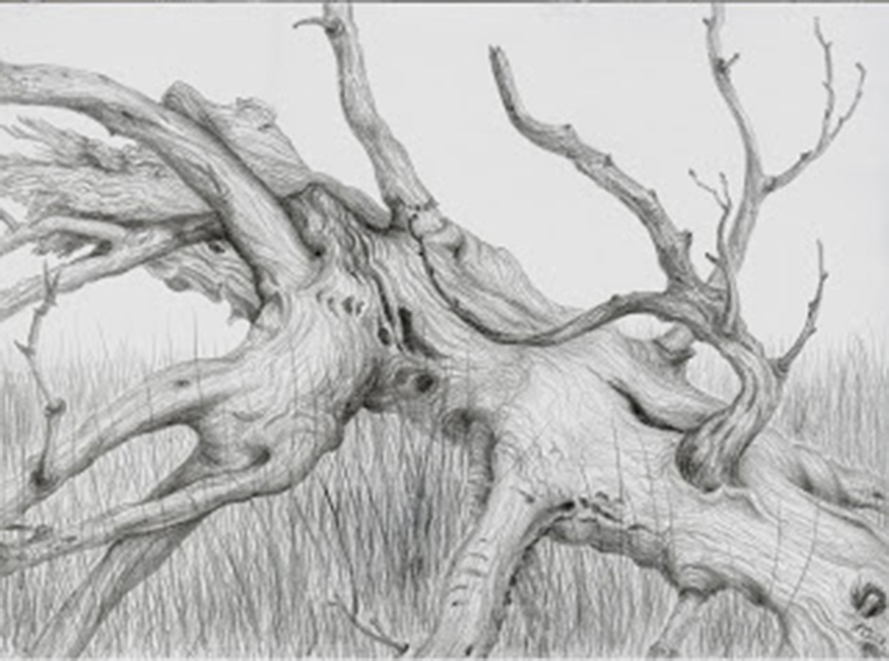
In any case, I found so many things of fascination to try and draw or paint. These three drawings I am posting are just examples. The Cedar Tree posted above, in silverpoint, was the crown of a huge old tree that had been blown down many years ago and was lying, burnished and reduced to its core, in deep marsh grasses.

Sapelo Dunes was an early morning silverpoint study of the different parts of the dunes facing the restless waves that aided the wind to shape these dunes. Holding the sand against these forces, the sea oats cling tenaciously, their roots amazingly long and lying exposed at the eroded face of the dunes.

Sapelo Dunes, silverpoint, Jeannine Cook artist

Sapelo Dunes, silverpoint, Jeannine Cook artist

The third drawing is a graphite drawing done as the sun was setting on the wide sweep of low-tide beach, the light glinting on the marvellous ridges left in the sand by the water's motion. I was racing the light and only had a very short time before darkness fell. No time for thought, just a fascination to try and make something of nature's marvellous complexity in Low Tide Tracery.

Low Tide Tracery, graphite, Jeannine Cook artist

Low Tide Tracery, graphite, Jeannine Cook artist

Creating art in beautiful places by Jeannine Cook

Sometimes the stars all align, the weather goods smile benignly and one finds oneself able to create art in a truly magical place. That was what I felt about being on Sapelo Island this weekend, when I finally got to return as SINERR Artist-in-Residence with Marjett Schille.

For two days of glorious weather, (the azure cloudless skies and gentle temperatures type of weather), we were free to go where we pleased and just devote ourselves to art. There is a marvellous transition: you get on a ferry and leave behind daily life. You only need to concentrate on choosing a site suitable for the next plein air painting or drawing. Considerations of light, time of day for that light, where the tide is (if you are working along the beach), what medium is suitable for the next project: those are the weighty matters to ponder! All against the backdrop of a most beautiful and ecologically diverse island that is protected and preserved.

Marjett and I tumbled out of bed early each morning and were hard at work by eight to catch the wonderful morning light raking the sand dunes or sculpting trees. We worked steadily until the picture got finished, or finished us for the moment. We both did about three pieces a day, with Marjett working larger scale than I did. As I had planned, I did mostly silverpoint drawings, which seemed to take an age to do compared to Marjett's swiftly executed watercolours. Later, we assessed what we had done and "titivated" anything that needed adding or correcting. Since we have worked together a lot, we both respect the other person's eye for critiques. For me, it is a wonderful opportunity, as I tend to work alone and don't often have another artist to assess what I am doing. It is always a perfect learning opportunity when one has that luxury. It is also fun to share ideas on what title to give the work done, for titles are an interesting and sometimes polemical subject.

Sapelo Island with Lighthouse,  Georgia

Sapelo Island with Lighthouse,  Georgia

Now we are back "on the hill" as the locals refer to the mainland – and the weekend remains glowing in my mind. The artwork needs to get scanned and catalogued, and life already begins to knock at the door again. Nonetheless, when one is lucky enough to be able to go off and create art in a truly beautiful and magical place, it is more than luck.

Silverpoint drawing ahead! by Jeannine Cook

I cannot believe it - the weather gods are finally relenting enough that I can get to Sapelo Island this coming weekend to be Artist-in-Residence again with my friend, Marjett Schille, courtesy of the Sapelo Island Estuarine Research Reserve. This is the third time we have planned this - third time lucky, I hope!

Hello, Sapelo Island

Hello, Sapelo Island

I have been packing my supplies for a plein air weekend, with lots of warm clothes as I don't think it will be that warm. But the main care has been to prepare enough paper so that I can get my teeth into some silverpoint drawing. I cannot wait!

Preparing smooth board or paper - archival of course! - with gesso, titanium white acrylic, Chinese white gouache or casein is the ritual one follows before embarking on a silverpoint drawing. The silver particles are pulled off the stylus by the very fine rugosity (fine, fine sandpaper, in essence) of the ground on the paper - that is how the silver marks are made.

Working outdoors, with shortened days at this time of year also means that I needed to prepare smaller sizes of paper for silverpoints. There just is not enough time to work on a large drawing, as this is a slow and meditative process. In order to achieve any serious darks in a silverpoint drawing, you need to let one layer oxidise, and then go back carefully over it again to lay down a slightly darker layer. All this takes time. If the weather is humid, there is always the danger of scoring the drawing surface when you go back over a previous layer of marks, so care is needed.

Sapelo Island, Georgia

Sapelo Island, Georgia

Nonetheless, silverpoint drawing seems to me to be an interesting vehicle to try and capture the luminous clarity of the marshes and vegetation in the salt-laden world that is a barrier island like Sapelo. Time will tell if I achieve any decent drawings... or perhaps I will have time too for some watercolour paintings. If the weather gods allow...

Colour in art, colour in our eyes by Jeannine Cook

The Louisiana Museum of Modern Art in Humblebaek, Denmark, has just opened an exhibit entitled Colour in Art. They combined works from their own collections with others lent by major collectors, Werner and Gabrille Merzbacher, to explore the role of colour in art and thus in daily life.

Colour underpins most artists' concepts in some form or another. The most obvious domain of colour in art is in paintings, done in many media. The perception of colour has changed considerably over the last 150 years or so, as societies and cultures have evolved. There has also been a huge evolution in the actual production of pigments and types of paint, which have increasingly allowed more brilliance and a more flexible approach to the creation of art.

Colour choices can be very personal, as we all know from the famous example of art to match the sofa demonstrates. Every choice we make in decorating our home is involved with colour in some way or another. So it is is no surprise that for an artist, the absence of colour (in a monochromatic work) or its presence - and in what fashion - both dictate a great deal about the creation of that particular work of art. Once created, artwork will then appeal to people through the colours used, to a great extent, whether the collectors and viewers realise it or not. Moods are created through a certain spectrum of colour, and people respond to those harmonies, even if only subliminally.

The Fauves - Andre Dérain, Henri Matisse, Raoul Dufy, Albert Marquet and others - used a bright, almost strident palette of broken colour to evoke the brilliant light and intensity of colour in the landscapes of the French Mediterranean coast. Nothing downbeat at all. By contrast, Picasso's Blue Period paintings are almost monochromatic and convey deeply gloomy and sombre sentiments. Picasso's close friend, Carlos Casagemas, had committed suicide in Paris in 1901. This affected Picasso deeply, and the resultant paintings of that period use colour to convey the melancholy and resignation he experienced.

Pablo Picasso, Self-portrait, 1901, (Image courtesy of Musée Picasso, Paris)

Pablo Picasso, Self-portrait, 1901, (Image courtesy of Musée Picasso, Paris)

The exploration of colour intensified as the artists of the mid-19th century began to move outdoors from their studios (mostly set up with northern constant light). They then got all excited about conveying the brilliance of light and its ever-changing qualities, when they worked plein air. After the Impressionists had pushed out the boundaries of colour use and perception, the field was wide open for everyone to experiment. Thus the Fauves and everyone else who followed, up to our time.

Meantime the development of new artificial pigments, types of paint binder and their presentation in the marketplace were following a parallel explosion. This is explored in the Louisiana Museum show, Colour in Art. There is also the interesting dimension evoked of the commercial use of colour, for logos, advertisements, etc., and the same colours used in art. As is cited in the article on this exhibit on ArtDaily.org, the blue which Yves Klein developed for his famous brilliantly intense canvases would be unlikely to be confused with the blue used in the logos and names of the United Nations, the European Union or even Nivea cream. In other words, context of culture influences our perception of colour. I am sure that in our digital (and globalised) age, where colour is intensified even more than previously, even cultural perceptions are constantly evolving.

IKB 79. 1959, Yves Klein, (Image courtesy of the Tate)

IKB 79. 1959, Yves Klein, (Image courtesy of the Tate)

Nonetheless, there is another dimension to colour, particularly in art. I found it an interesting juxtaposition to read about the Colour in Art exhibition and very soon afterwards, to find the following quote by Marc Chagall on Renée Phillips' Manhattan Arts International website: "In our life there is a single colour, as on an artist's palette, which produces the meaning of life and art. It is the colour of love (my emphasis)".

Something for us to think about.

How much should one change one's style as an artist over time? by Jeannine Cook

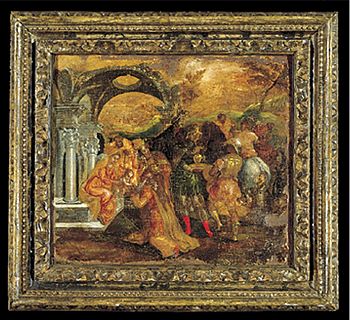
I have read a couple of enthusiastic reviews of an exhibition currently showing at New York's Onassis Cultural Center entitled The Origins of El Greco, the last of which was in February's edition of ARTnews. With a subtitle of Icon Painting in Venetian Crete, the show examined El Greco's early work when he, along with a flourishing school of artists, was a Master of religious icon painting in his native Crete in the 1560s. Young Domenikos Theotokopoulos was most skilled in creating shimmering gilt surrounds and stiffly gesturing figures that were part of the Byzantine heritage of Crete.

Adoration of the Magi, Domenikos Theotokopoulos (later known as El Greco), 1565-67, painted on part of an old chest, (Image courtesy of the Benaki Museum,Athens)

Adoration of the Magi, Domenikos Theotokopoulos (later known as El Greco), 1565-67, painted on part of an old chest, (Image courtesy of the Benaki Museum,Athens)

It is hard to credit that these early paintings are done by the same artist whom we know as El Greco, the artist whose elongated figures, clothed in strangely coloured garments, twist in religious fervour beneath dramatic skies. Ascetic-looking men with long faces gaze skyward with clasped hands of piety, while impossibly long-limbed men writhe and contort through the paintings. This later El Greco was, as a review of this exhibition by The New York Times' Holland Cotter observed, the result of "an ambitious career on the move" with Venice and later Spain his sources of patronage and success. By the time El Greco died in 1614, his style of painting had evolved radically from a strict medieval icon tradition to an expressionistic approach that embraced light, movement, colour, passion.

The Baptism of Christ, c. 1614, El Greco, (Image courtesy of Museo  Fundacion Lerma, Hospital de Tavera, Toledo)

The Baptism of Christ, c. 1614, El Greco, (Image courtesy of Museo  Fundacion Lerma, Hospital de Tavera, Toledo)

This account of the El Greco exhibition made me reflect on the problem-cum-challenge we all face as artists: how to evolve and grow, and yet remain true to ourselves? The examples of artists who have changed their styles over time are innumerable - Picasso is a salient example, Van Gogh, Gauguin, Monet, and so many others. But in our times of emphasis on marketing and branding, when presenting ourselves to the world as artists, how important is it to have consistency?

There is always the temptation for a successful artist, selling well in one type of art or with one approach and subject, to stay in that idiom, and if a gallery is involved, often there is more pressure to stay in the successful lane. Yet we should all be striving to grow as artists, and by definition, that means change and, hopefully, improvement. Sometimes, repetition of one type of art, one subject or medium, allows for a more profound and rewarding exploration. Yet repetition can become boring and a dead end.

There is also another message, I think, in the El Greco or Picasso examples of evolution as artists. That is that we must believe in ourselves as artists and dare to grow and change, even if it means abandoning a successful style and pathway in one's artistic career. Radical change takes courage. Artist Sharon Knettell, writing in the March 2010 issue of The Artist's Magazine, explained that she gets much of her inspiration for paintings while meditating and remarked, "I think meditation makes you fearless. You have to go to the point where your ideas scare and challenge you" (my emphasis).

I believe that point is when you dare to change your style because that inner voice tells you to take the next step in changing and evolving as an artist. What does anyone else think?

Discovery of a wonderful draughtswoman, Sky Pape by Jeannine Cook

Just recently, I read of an exhibition opening at New York's June Kelly Gallery entitled "Water Works: Surface Tension", with drawings by Sky Pape. I was intrigued and delighted: this Canadian artist, living in New York, is creating drawings that I find beautiful, sensitive and highly unusual.

Sky Pape is pushing out the boundaries of the definition of drawing in a way that marries physical - and I mean her whole body, not just arms and hands - with intellectual and true global awareness. She uses the traditional drawing media - save for silverpoint, apparently - but in totally new fashions. Her papers are from many sources, but all with environmental and societal considerations. Tibet, Nepal, Korea and Japan are some of the paper-making sources, and she views her work as "a collaboration with those distant paper-makers in Asia", as she folds, cuts, amalgamates and reverses the different types of paper to create her work.

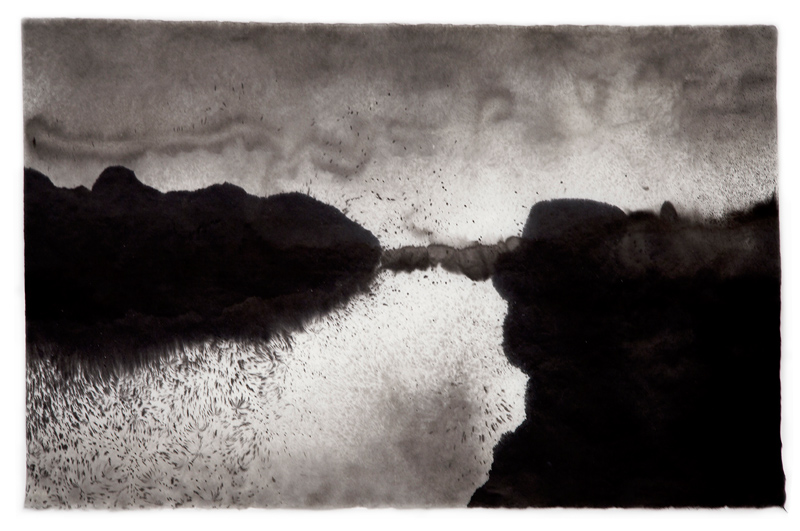
Untitled (Image 4584), 25"h x 38-1/2"w, water and Sumi ink on handmade kozo paper, 2010

Untitled (Image 4584), 25"h x 38-1/2"w, water and Sumi ink on handmade kozo paper, 2010

Her mark-making media range from graphite to coloured pencil to ink - humble, traditional and simple media, but she uses them in very different fashion. For instance, she blows ink through tubes and funnels onto these handmade Asian papers that she has spread on the floor. Building on her belief that drawing is at the centre of any art, she is combining a physical expressiveness with a recognition that the paper is part of the creative dialogue, and it too symbolises nature in all its manifestations. The minimalist and elegant drawings that result from these unusual approaches are evocative, and satisfying - even seen in digital form. How much more worthwhile they must be to see in person, one can only imagine.

Having had the fun of studying many of her drawings on her website, I am not at all surprised that she will be spending March this year in Bellagio, Italy, on a grant from the Rockefeller Foundation. There are many many wonderful draughtsmen working today, but I am always thrilled to find an artist who is not only pushing out the boundaries of drawing media but going so in an uplifting fashion that makes me go "Ah!" with pleasure and interest.

"Untitled (5467)," water and Sumi ink on handmade kozo paper, 25 x 30-1/2 inches

"Untitled (5467)," water and Sumi ink on handmade kozo paper, 25 x 30-1/2 inches

See what you all think of Sky Pape.