I wasn't the only one thinking of Henri Rousseau by Jeannine Cook

Little did I realise that there would be a major exhibition opening on Henri le Douanier Rousseau when I wrote about him on 3rd February on this blog. Let me add the information.

The Fondation Beyeler in Basel, Switzerland, has just opened an exhibition on Rousseau, as I learned from ArtDaily.org. Small portraits, landscapes of suburbs and the French countryside, as well as larger works of his jungle themes are apparently complemented by photographs, one of Rousseau's great interests. Examining Rousseau's role as a pioneer of modernism was the major thrust of curators Philippe Buttner, Curator of the Fondation Beyeler, and Christopher Green, Professor Emeritus for Art History at the Courteauld Institute, London.

Tiger in a Tropical Storm, (Surprised!), Henri Douanier Rousseau 1891

Tiger in a Tropical Storm, (Surprised!), Henri Douanier Rousseau 1891

I quote from the ArtDaily.org article: "Rousseau introduced a new approach to imaginative vision into painting. His perception of reality was based primarily on observation, imitation and transformation of the visible. In this way he taught modern artists how things known could be constructed using the building blocks of the known. He established a new logic and mechanics of compositional structure that profoundly affected subsequent artists, all the way down to the Surrealists."

The Dream, Henri Douanier Rousseau, 1910 (Image courtesy of MOMA)

The Dream, Henri Douanier Rousseau, 1910 (Image courtesy of MOMA)

Louis Agassiz Fuertes by Jeannine Cook

Many years ago, when we first moved to coastal Georgia, I had the delight of seeing an exhibition at Savannah's Telfair Museum of Art about Louis Agassiz Fuertes. Not being born in this country, I am always catching up on matters American, and this wonderful naturalist-artist was one such discovery.

I was reminded of his paintings and quick, skillful pencil drawings when I read of an exhibition which has just opened at the New York State Museum. Born in 1874, Louis Agassiz Fuertes was soon recognised as a very skillful artist, and his short life (he was killed in a car accident in 1927) was devoted to recording birds through North America. Cornell University, his alma mater, has a wonderful collection of his work.

Belted Kingfisher Megaceryle Alcyon by Louis Agassiz Fuertes

Belted Kingfisher Megaceryle Alcyon by Louis Agassiz Fuertes

This leading bird artist of his day was a dedicated artist who tramped through woods and vales to record birds in the wild, as well as using specimens back in the studio for his detailed paintings. He knew how to capture the essential character of each bird. His knowledge of habitat for each bird species was also superb. His work made him one of the important pioneers, following in Audubon's footsteps, for environmental awareness. We all owe him a huge debt of gratitude as his work made people aware of the need to protect birds and their habitat.

A pair of passenger pigeons (accompanied by a second work _, (Image courtesy of Askart.com)

A pair of passenger pigeons (accompanied by a second work _, (Image courtesy of Askart.com)

Look out for Louis Agassiz Fuertes' paintings and drawings - they are a huge delight.

Thinking about Henri le Douanier Rousseau by Jeannine Cook

I was in a waiting room yesterday, idly leafing though a magazine which detailed the 2006 Henri Rousseau exhibition at the National Gallery of Art. As I looked at the small reproductions of some of his paintings, memories came flooding back of the first time I had met his work.

I was a young girl, working and studying in Paris, and assuaging my homesickness for Africa by spending many hours in the Louvre, the Jeu de Paume, the Musée de Cluny, etc. One day, at the Jeu de Paume, I rounded a corner and came face to face with one of Rousseau's famed Jungle paintings - I am not sure now which one. I was dumbfounded. The painting was so unlike anything else that I was seeing on museum walls; it was seemingly tropical and yet did not ring true at all to me, since I was from the Tropics. The flat, vibrant depiction of these huge, urgent leaves and flowers, growing on strange plants and trees came across as totally hallucinatory. The monkeys swinging from the trees, and other touches of "exotica" were almost perverse in their nuances. The painting left me intrigued.

L'innocence archaïque, Le Douanier Rousseau, (Image courtesy of the Musée d'Orsay.)

L'innocence archaïque, Le Douanier Rousseau, (Image courtesy of the Musée d'Orsay.)

I learned more in due course about this late-blooming artist, Henri Rousseau, who was born in 1844 and was just ahead in age of another self-taught artist, Paul Gauguin, who embraced the tropics in even more extraordinary fashion. Henri Rousseau had the sobriquet, Le Douanier, added because his main employment, after the military and sundry other activities, was as a minor clerk in the local Customs office. His fellow Customs officials must have been a supportive crowd as apparently they gave him duties which allowed him to devote a lot of time to his art. Despite the recurring theme of tropical vegetation in many paintings, Rousseau never travelled to the tropics: his sources for the plants were the botanical gardens in Paris, especially the Jardin des Plantes. Another large body of work in his very varied opus was paintings of urban-suburban landscapes, complete with chimneys, the Eiffel Tower, streets and tree-lined parks.

Many of these paintings were based on small studies and drawings he did from real life - one of the early plein air painters, in fact. His approach to painting was that of a true Outsider, for he did not follow his contemporaries - Manet, Monet, Cézanne, Seurat, etc. - in their perspective, their realistic depictions, their use of light or even their use of paint. He painted in a flat, decorative fashion, often ignoring traditional perspective, with a Naif optic on subject matter and presentation. Nonetheless, he was eventually recognised as an artist with a great deal of charm and a wonderful imagination, offering a very different version of art. This was despite the long years of derision which greeted the works he submitted to the Salon des Indépendants from 1886 onwards. Henri Toulouse-Lautrec and Edgard Degas began to see in his work a move away from the prevailing naturalism in art, and by the early part of the 20th century, Picasso, Signac and others were showing enthusiasm for his work. Dreamlike worlds, with tigers, serpents, monkeys and buffalo peering though the "jungle", alternate with somewhat airless urban landscapes, portraits, still life studies and other pieces which do indeed prefigure Surrealism. Catalogue images, early photos, books - everything was grist to Rousseau's mill to mix with his everyday observations in these imaginative compositions.

If you want to spend time in a 19th century version of an alternate universe, albeit one which is the product of a fertile imagination allied to a direct vision, then look at Henri Le Douanier Rousseau's art. He led the way for so many later artistic trends - and, most importantly, he believed in himself even in the face of derision and rejection. He just kept on painting, and by the end of his life, in 1910, he knew much success and esteem.

Artists' Webs of Support by Jeannine Cook

Most artists are fairly solitary people, per force. It is therefore all the more magical - and important - when there is a web of people around who support, encourage and empower artists.

I have been reminded once again of this aspect of life. Living in a very rural part of coastal Georgia, artist friends usually live far away. Networks of fellow artists are much more present, in today's world, through the Internet and other such communications, than previously. That helps a lot. But artists' nearest and dearest family members are probably the most important sources of encouragement, honesty and appreciation. It makes a great difference if an artist can trust and respect the opinions and observations of a spouse, for instance. Whether it is painting, drawing or writing, I know that if I see a look of puzzlement or quizzical amusement on my husband's face, I need to go and do some rethinking about the project. He is the one who always reminds me, "Keep it simple" – very necessary often as I tend to love detail. He is my most respected critic.

The web of support. Spider's Web

The web of support. Spider's Web

Beyond family and fellow artists, there are other circles of support that are invaluable. Gallery personnel, if an artist works through gallery representation, forms the first circle, but for many of us who prefer to represent ourselves, the collectors of one's art become an important part of life. Many, many of the people who have been nice enough to like my art have become dear personal friends - a wonderful bonus. Their encouragement, especially when they return to acquire more art, carries one though periods of self-doubt. They help one to "hang on to one's star" and to continue listening to one's inner voice that tells one to go on trying to grow as an artist.

Another shining circle of supporters, that makes me feel validated and very lucky, is comprised of museum curators and directors, professionals in academia, the arts and others whose own achievements I hugely respect. When I turn to them for help or advice, I am very aware of the value of the support given by these busy people.

When I feel I am floundering as an artist, I remind myself of all these support webs around me. And then the word that comes into my mind is, "Adelante!" – a simple Spanish word for "get on with it!". And off I start again as an artist.

Definitions by Jeannine Cook

Here I am, defining myself for many a long year as an artist, and yet, yesterday, I was brought up short. I was reading a short article by Ruth Walker entitled Art, Artisans and artisanal grilled cheese in the January 24, 2010, edition of The Christian Science Monitor. In this article, Ms. Walker addresses the origins and meaning of the word "art". I realised that I felt totally ignorant about the whole subject. Abjectly ignorant!

I rushed off to my beloved Oxford English Dictionary to learn more. I knew that "art" came from the Latin "ars", a word that passed into French and then into early English, as did so many words. But the timing and nuances of meaning for "art" were fascinating. The first use of the word comes in 1225, when the word meant skill in doing anything as the result of knowledge and practice. According to Ms. Walker, the original Latin concept embraced a skill of things being "joined" or "fitted together". By 1386, Chaucer was talking of art as a human skill or human workmanship, as opposed to nature, while earlier that century, art was already included in general learning taught in schools, as well as the skills required in applying the principles of a special science.

Only in 1600 did the word "art" start to refer to the application of skills to subjects of taste such as poetry, music, dancing, etc. J. Taylor is cited in the OED as saying that, "Spencer and Shakespeare in art did excell". However, the use of "art" to refer to "the application of skills to the arts of imitation and design, Painting, Engraving, Sculpture, Architecture; the cultivation of these in its principles, practice and results: the skillful production of the beautiful in visible forms" only came into use after 1880.

From then on, art has mainly referred to the many aspects of the realm now referred to aesthetics, but it also now includes more negative aspects of studied actions, artful devices, trickery and cunning... hardly surprising!

What interested me, on digging further about the meaning of the word "art" as defined today, is how often that word "beautiful" creeps into the definition. In ReferenceDictionary.com, the first definition is, "the quality, production, expression, or realm, according to aesthetic principles, of what is beautiful (my emphasis), appealing, or of more than ordinary significance." In the Free Online Dictionary, they started the definition by, "the conscious production or arrangement of sounds, colors, forms, movements, or other elements in a manner that affects the sense of beauty (again, my emphasis), specifically the production of the beautiful in a graphic or plastic medium". In the Brainy Quote, they talk of, "the application of skill to the production of the beautiful by imitation or design, or an occupation in which skill is so employed, as in painting or sculpture".

The other word which appears often in the definition of "Art" is nature. In Your Dictionary, the first meaning is, "human ability to make things; creativity of man as distinguished from the world of nature (my emphasis)". In Answers, art is "a human effort to imitate, supplement, alter, or counteract the work of nature."

Whilst the 20th century saw many reactions against the concepts of beauty and nature in the visual arts, in particular, I think it is instructive that art has for so, so long been defined as having skills and knowledge that derive from and celebrate the world around us. After all, it was Plato who said that "art is imitation".

Plato. Luni marble, copy of the portrait made by Silanion ca. 370 BC for the Academia in Athens. From the sacred area in Largo Argentina.  (Image courtesy of the Capitoine Museums)

Plato. Luni marble, copy of the portrait made by Silanion ca. 370 BC for the Academia in Athens. From the sacred area in Largo Argentina.  (Image courtesy of the Capitoine Museums)

Repetition in Art by Jeannine Cook

When I was thinking about how I tend to return again and again to the same flowers to draw or paint them, I was interested to find a review by Andrew Lambirthin The Spectator of 2nd January 2010 of William Feaver's monograph of the artist, Frank Auerbach. The review was entitled "Master of Accretion", and in the review, Lambirth wrote: "Painting the same subjects does not produce staleness and repetition, nor the contempt traditionally ascribed to familiarity. In fact, Auerbach states that 'to paint the same head over and over leads to unfamiliarity; eventually you get near the raw truth about it.'"

Catherine Lampert, 1986, Frank Auerbach: 

Catherine Lampert, 1986, Frank Auerbach: 

Frank Auerbach: Speaking and Painting by Catherine Lampert, book review: Portrait of the artist as no ordinary man (Image courtsy of Malborough Fine Art)

Frank Auerbach: Speaking and Painting by Catherine Lampert, book review: Portrait of the artist as no ordinary man (Image courtsy of Malborough Fine Art)

Feaver, a noted author of books on artists ranging from Lucien Freud to Van Gogh, comments, "Constancy makes for opportunity and feeds the impetus for surprise. Then it's a matter of focus and nerve."

It is true, I think, for all subjects in art. The more you delve into a subject, drawing and painting it time and time again, in different lights, in different circumstances and places, the more you realise that you still have a great deal to learn about it. Perhaps that is the addictive magic of art - it is a constant voyage of discovery. Even if you understand how things "fit together" in, say, a flower, each time nature produces some slight difference, some surprise. It all keeps one on one's toes, and reminds one of the need of careful observation, without taking anything for granted. Even if one does not work as Frank Auerbach does, with paintings that are built up and up over a long period of time, perhaps with scrapings down again, but all representing a huge psychic and physical effort, you can still work layer upon layer of experience in art. Even drawings done again and again of the same subject afford deeper insights and surprises.

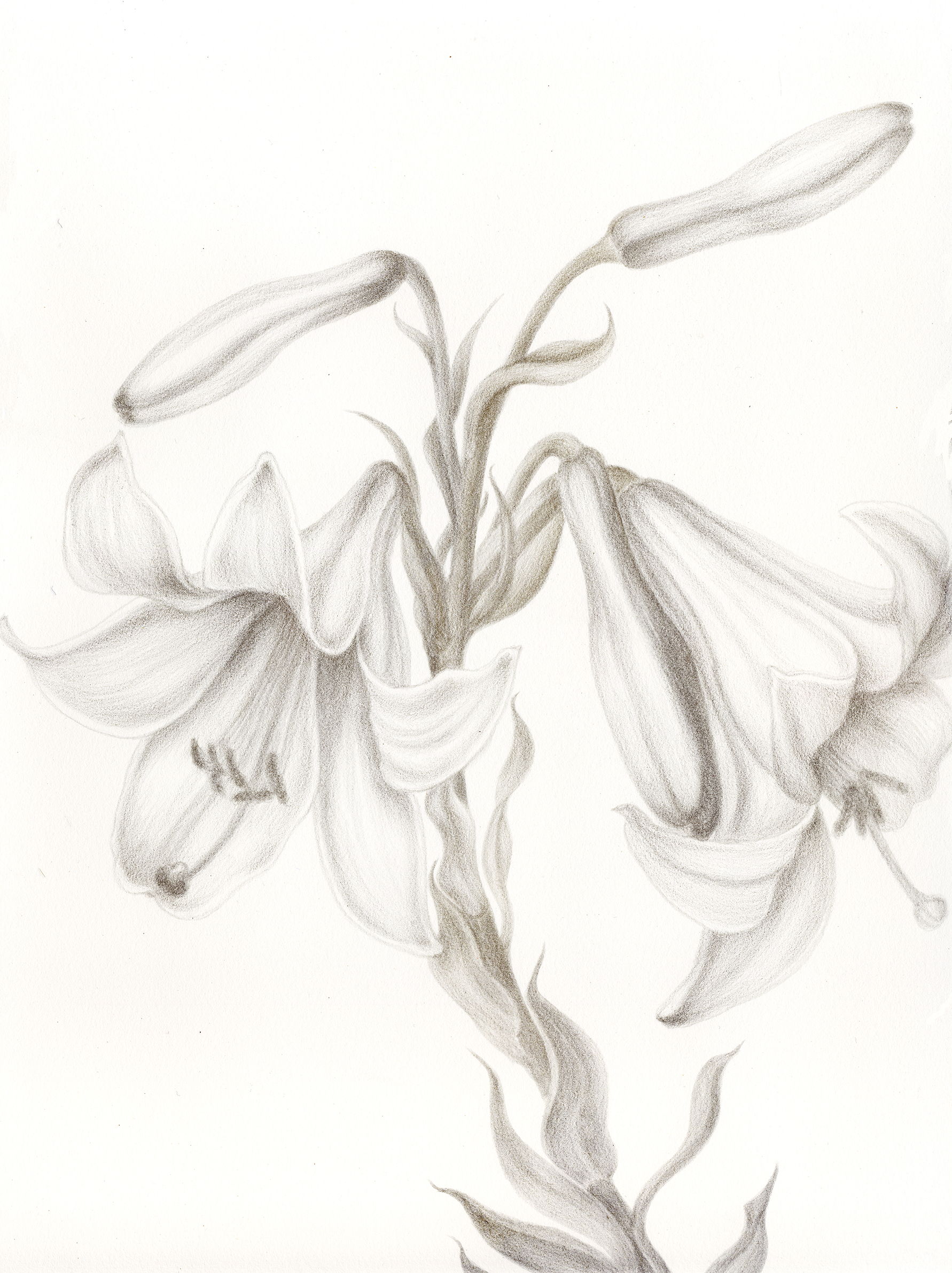
I illustrated my previous post about every artist having favourite flowers with a silverpoint drawing I did of a head of Regale Lilies. These fragrant lilies were growing in one pot. In another pot was growing another Regale Lily, whose bulb had been purchased at the same time and grown in exactly the same way.

Yet one lily produced tight bunches on the head of flowers; the other produced single, far more open flowers, with leaves down the stem that were completely different from the other plants.

Lilium candidium - so sweetly perfumed, silverpoint, Jeannine Cook aertist

Lilium candidium - so sweetly perfumed, silverpoint, Jeannine Cook aertist

Only when I drew them and studied them closely did the differences become really apparent. A casual glance, even an admiring glance, would not have revealed such variations in habit of growth. It taught me to look far more closely at each lily as it grows and flowers.

Lilium candidium - silverpoint, Jeannine Cook artist

Lilium candidium - silverpoint, Jeannine Cook artist

No wonder Frank Auerbach became such a assiduous student of the same subjects for his art. I am sure he must find it incredibly rewarding. I certainly do, in my drawings that I return to again and again - the delights of nature are unending!

Every Artist has Favourite Flowers by Jeannine Cook

While on the subject of flowers in art, I realised that each artist has favourite flowers to which he or she returns again and again, whether because of colour, form, symbolism, or whatever.

You only have to think of Georgia O'Keeffe - her depictions of calla lilies are numerous. She loved their sensuous shape, their wonderful designs. In fact, she said quite a lot about painting flowers which especially applies to her Calla Lilies: " When you take a flower in your hand and really look at it, it's your world for the moment. I want to give that world to someone else. Most people in the city rush around so, they have no time to look at a flower. I want them to see it whether they want to or not." She also remarked, "I decided that if I could paint that flower in a huge scale, you could not ignore its beauty. " She was quite right. When you walk into a room and see one or more of her Callas paintings, they stop one in one's tracks.

Calla Lily, Mallorca, silverpoint,, Jeannine Cook artist

Calla Lily, Mallorca, silverpoint,, Jeannine Cook artist

When you look at a calla lily painting or drawing, the symbolism is also implicit: since early Roman times, callas have represented celebrations and purity, hence their use for weddings.

Calla Lilies, Palma. silverpoint, Jeannine Cook artist

Calla Lilies, Palma. silverpoint, Jeannine Cook artist

Although they originate in Southern Africa ( perhaps why I love them so much, being from that part of the world), they bloom well in the dark of winter and symbolised the passage of the winter solstice for the Romans. That is perhaps why they are also used so much for funerals, at the darkest time of the year. They came to Europe many centuries ago, but the first known illustration of them was apparently in 1664, when a calla lily was growing in the Royal Gardens in Paris. Since then, countless artists, from Diego Rivera to Marsden Hartley and Ellsworth Kelly, have depicted callas.

I keep returning to calla lilies myself - they seem to lend themselves to silverpoint drawings, with their high key elegance and sensuous forms. They are living sculptures.

Another flower to which I alluded in my previous post about flowers in art is the Regale Lily, favoured in paintings about the Annunciation. It too is a wonderfully elegant, perfumed lily, which keeps calling me to draw it, every time that I find it blooming in my mother's garden in Spain.

Azucena-Regale Lilies, silverpoint, Jeannine Cook artist

Azucena-Regale Lilies, silverpoint, Jeannine Cook artist

Each time one is differently inspired - perhaps the light is different, perhaps the flower is slightly different or at a different stage of opening, but whatever it is, I love to return to these lilies, both callas and regales, just to celebrate their beauty. And while I am drawing them, time stands still, and the world comes into balance. Miraculous.

Flowers in Art by Jeannine Cook

After a week of much colder weather, the flower garden is definitely in winter mode, save for a few brave camellias now venturing to bloom again. They are one of the most beautiful aspects of Southern gardens for me, and I can never plant enough of them, particularly the whites and pale shell pinks.

Since there is so little variety outside, I have been going through flower paintings in my mind's eye. This was made all the easier as I have been thinking about medieval times, when religious texts were becoming more and more luxurious, with an increasing demand for Books of Hours by wealthy patrons. Many of these jewel-like small creations are bedecked with the most wonderful depictions of flowers, many of them with floral symbols to underline the religious truths of the texts. An introduction to some of these images, with colours glowing and flowers ranging from pinks to violets, asters, forget-me-nots, daisies or roses, shows that by 1410, artists were producing the most amazing Books of Hours for patrons such as Catherine of Cleves, Flemish or French nobility.

 Produced in the Netherlands in about 1460, this Book  of Hours is from the Euing Collection. University of Glasgow

 Produced in the Netherlands in about 1460, this Book  of Hours is from the Euing Collection. University of Glasgow

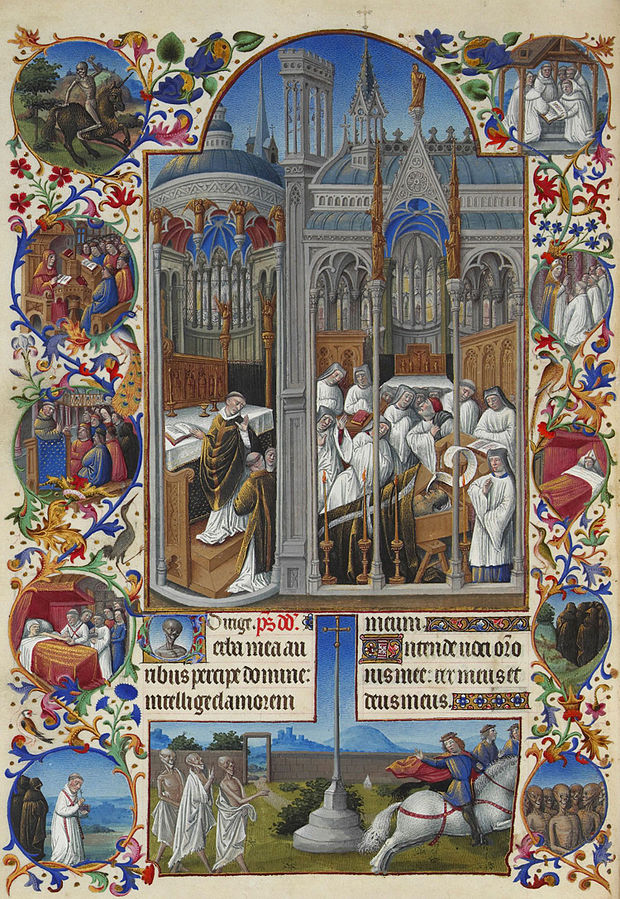
Perhaps the most famous is Les Très Riches Heures du Duc de Berry, painted from 1412-1416 almost exclusively by the three Limbourg brothers, Paul, Henri and Jean. Interestingly, there are not many details of flowers, but even here, in one image of a Funeral Service, campanula wander amongst the text on one column.

Très Riches Heures du duc de Berry. Folio 86, verso: The Funeral of Raymond Diocrès, between 1411 and 1416 and between 1485 and 1486

Très Riches Heures du duc de Berry. Folio 86, verso: The Funeral of Raymond Diocrès, between 1411 and 1416 and between 1485 and 1486

By 1500, the use of flowers in Books of Hours was widespread, as can be seen in this edition done in Rouen, France, held in the Bodleian Library, Oxford.

Palma's Book of Hours, silverpoint and watercolour, Jeannine Cook artist

Palma's Book of Hours, silverpoint and watercolour, Jeannine Cook artist

I created Palma's Book of Hours, done in silverpoint and watercolour, thinking of the tobacco/nicotiana  as the flowers opened and closed each day in a rhythm which marked off the hours for me in perfumed regularity.

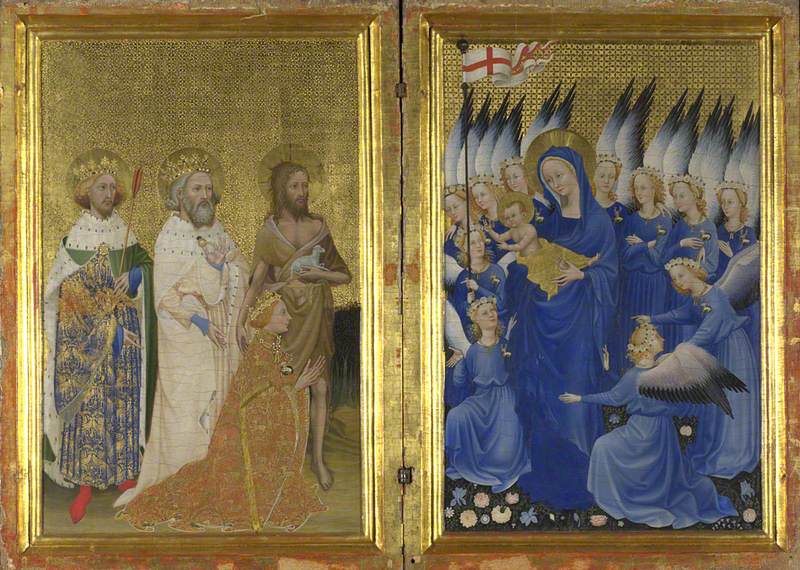
Another early devotional book, the Wilton Diptych, was created in England c. 1395-1399, for the purposes of accompanying its rich travelling owner. In one scene, pink roses adorn the angels' heads, but apparently they were originally the red Rosa Gallica, one of the earliest known rose varieties.

Richard II presented to the Virgin and Child by his Patron Saint John the Baptist and Saints Edward and Edmund (‘The Wilton Diptych’), Anonymous, ca. 1395, egg on oak, 53 x 37 cm, National Gallery

Richard II presented to the Virgin and Child by his Patron Saint John the Baptist and Saints Edward and Edmund (‘The Wilton Diptych’), Anonymous, ca. 1395, egg on oak, 53 x 37 cm, National Gallery

Detail of the Wilton Diptych

Detail of the Wilton Diptych

Detail of the Wilton Diptych

Detail of the Wilton Diptych

An image of this can be found, amongst others, on a wonderful web page on the BBC. This site depicts a wide variety of flower paintings down the ages and it underlines the continuous attraction for artists of flowers, in their beautiful diversity and elegance. This is hardly surprising when one thinks that we humans have always known flowers - they have been in existence for about 120 million years. Fascinatingly, they have apparently always played a central role for humans - archaeologists have found a burial site for a man, two women, and a child, in a cave in Iraq. They were Neanderthals, living in these Pleistocene caves. On this burial site had been placed a bunch of flowers.

The Greeks placed great store on flowers, such as violets and had them in their houses and wore them in crowns at feast times. The Romans did the same and held festivals of flowers to honour the goddess, Flora. Remember the fresco uncovered in Pompeii of Flora and her flowers. Roses were the flower of the goddess of love, Venus; roses too have always been celebrated by Confucians and Buddhists.

The early Renaissance artists loved to depict lilies in Annunciation scenes - Fra Filippo Lippi was one of the early ones in 1450, for instance.  Leonardo da Vinci did the most exquisite drawings of Regale lilies. You can almost feel the weight of the flowers as he studied them and drew them in pen and ink. The Pre-Raphaelites also loved lilies - on the BBC site I mentioned earlier, there is a reproduction of Dante Gabriel Rossetti's "Annunciation" with the lilies the most graceful complement. Then there is the wondrously atmospheric John Singer Sargent painting, "Carnation, Lily, Lily, Rose", done in 1885-6, with the children and beautiful tall, proud lilies in the luminous twilight.

The seventeenth century was also the heyday of Dutch flower painting, done by both men and women. One of the most successful was Rachel Ruysch, while another was Judith Leyster, who did some silverpoint drawings of tulips. Flemish-born Ambrosius Bosschaert was one of the first to specialise in flower paintings and others like Jan van Huysum and Jan Bruegel followed his footsteps with looser, often more brilliant styles. Since a lot of the Dutch flower paintings were also about Holland's wide-flung world power and dominance, as well as the flowers' beauty, the artists did not hesitate to mix up flowers from all parts of the world, which would never bloom at the same time. They composed the most astonishing mixes in their arrangements, requiring a lot of time and ingenuity to pull the complex compositions together.

France forged a different approach to flower painting. Pierre Joseph Redouté began his highly talented life as a flower painter under Queen Marie Antoinette's patronage, but the Empress Josephine hastened to continue the patronage after the Revolution. His wonderfully sensitive "portraits" of flowers and plants are so realistic one can almost smell the perfume, for instance, of his roses, and he managed also to combine careful science with astonishing art. He helped pioneer a whole sub-group of botanical artists whose numbers, today, have swelled amazingly and fruitfully throughout the world. Take a look at the American Society of Botanical Artists' website, for instance - I am proud to be a member of the burgeoning Society. (Dr. Shirley Sherwood, of London, has been one of the major supporters of this renaissance of botanical art, and now her collection is not only showing in many venues around the world, but also at Kew in a permanent, dedicated gallery.)

The second half of the 19th century produced some wonderful flower painters in France - Manet did some exquisite studies of flowers in vases, while Henri Fatin-Latour became famous for the way in which he painted roses and peonies, larkspur and other wonderful summer flowers. He would wait until the roses almost dropped their petals, so as to be able to capture that ultimate fullness of musky beauty in each petal. Monet delighted in his flower garden, culminating with the glories of Giverny and his lily pond, while Renoir and Degas were no slouches in their depictions of chrysanthemums, geraniums and other plants. Of course, everyone knows about Vincent van Gogh and his passionate sunflower paintings – he had moved far from the exquisite jewels of medieval flower painting, but left all of us the richer for both approaches. Odilon Redon comes to mind too for his pastel studies of flowers that were far beyond just the botanical and yet are brilliantly evocative in their somewhat strange feel.

The twentieth century seems to have always had its lovers of flower paintings. An interesting note I saw was that 55% of all art considered "decorative" and available today is floral art. No wonder there was a reaction against flower paintings in juried shows for a long time! Nonetheless, a lot of us artists have continued to celebrate flowers in art - they are just too important to ignore, and besides, when a garden is in the depths of winter, at least one can evoke warmer times by having paintings or drawings of flowers on the walls.


The Honesty of Drawing by Jeannine Cook

I found a quote by Sandy Davidson about drawing that I find interesting. She said, "Drawing is intimate and reveals exactly where we are, and in a culture that isn't comfortable with that, it frightens many. You just cannot cheat when you draw."

Considering that drawing, in its many forms, has enjoyed an amazing resurgence in popularity and interest these past few years, that statement begins to make one wonder: Are we as a society becoming more accepting of others' differences, of other tastes and cultures? Has tolerance begun to seep in at the edges of this complex world we live in, particularly in the United States?

Disperson, Julie Mehretu, 2002

Disperson, Julie Mehretu, 2002

If drawing, indeed a truthful and sometimes brutally direct medium, is being more widely understood, then it is holding up mirrors of ourselves to us and our fellow citizens that we can find more to our liking. Perhaps a note of hope at a time when society seems as riven as ever by divergencies of politics, ethics, beliefs.

Found objects - artists' treasures by Jeannine Cook

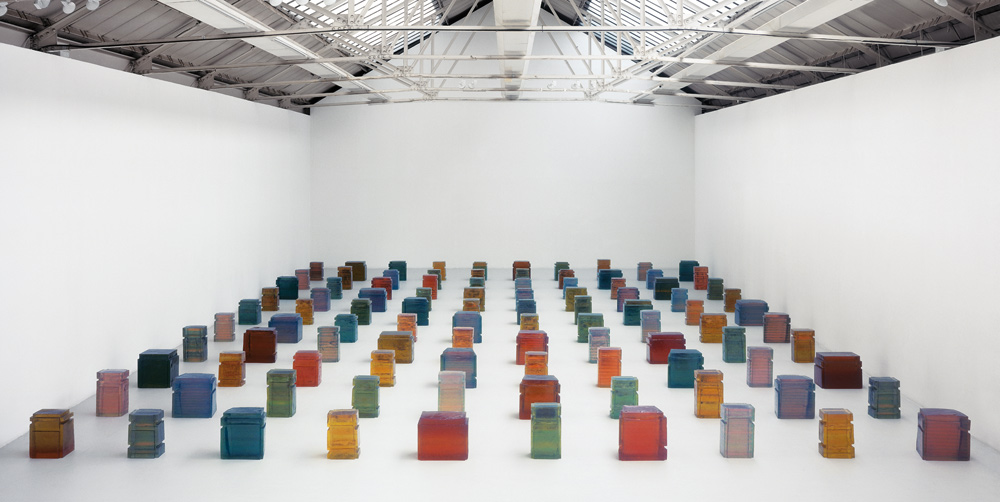
A short article on an upcoming exhibition, "Rachel Whitehead Drawings", at the Hammer Museum in Los Angeles, gave an insight into artists' habits which rang bells with me. The article, "Allegra Pesenti", (the exhibit's curator), appeared in January's issue of Art+Auction. It described how Rachel Whitehead, principally known for her resin cast sculptures, also has always had a concurrent creative activity, her drawing.

Untitled (One Hundred Spaces) 1995 Resin (100 units) (Image courtesy of the Sataachi Gallery)

Untitled (One Hundred Spaces) 1995 Resin (100 units) (Image courtesy of the Sataachi Gallery)

Study (Blue) for Floor, 1992, Rachel Whiteread (Image courtesy of the Tate)

Study (Blue) for Floor, 1992, Rachel Whiteread (Image courtesy of the Tate)

That seems hardly surprising as drawing is so often the underpinning of any creative conception - the mere act of drawing out possibilities and forms helps define what one is trying to say, in no matter what media.

The much more fascinating aspect of this curated exhibition, which travels later to the Dasher Sculpture Center in Dallas and finally to the Tate Britain, is Whiteheads's collection of found objects. She, like so many of us artists, is apparently a collector of sticks, stones and oddments that range from dental casts to shoe stretchers. She considers them sketchbooks parallel and complementary to her drawings.

I learned the joys of collecting stones and shells from the time I could walk, along the dazzlingly white - and in those days, deserted - beaches of Kenya and Tanzania. With the boom of surf beating on the distant reefs, the treasures to be found on the pristine sands were amazingly beautiful, not only for the diversity of tropical shells, but also for the reminders of long history, in the blue and white shards of early Chinese pottery and porcelain. Dhows, plying the Indian Ocean through millennia of trade winds, connected China and the Far East to India, the Middle East and East Africa: broken dishes used on the vessels would be thrown overboard.

These beautiful shards have been one of my treasures, and I found a way to include them in one silverpoint and watercolour drawing I did some while ago. "Three Generations - Braided Memories" used designs from the Chinese shards.

Three generations, braided memories of Kenya, silverpoint, silver foil, acrylic, Jeannine Cook artist

Three generations, braided memories of Kenya, silverpoint, silver foil, acrylic, Jeannine Cook artist

This was but the first of my many, many collections of found objects that I keep squirreled away. In the due and right time, they will become part of the creative process, I have learned. I know that many of my artists friends are inveterate pack rats too, but it is interesting that someone known mainly for her sculpture regards her collected objects as vital parts of her drawing activities. Good for Rachel Whitehead!