Dutch Utopia exhibit at Telfair Museum by Jeannine Cook

Savannah's Telfair Museum of Art has just opened an unusual and most interesting exhibition, Dutch Utopia. Using art already in the Museum's permanent holdings as a springboard, curator Holly Koons McCullough and her team have assembled a large number of works by American artists who worked in artists' colonies and small unspoiled villages in the Netherlands during the second half of the nineteenth century.

There are plenty of canvases large and small by artists who remain well known today, from John Singer Sargent to Robert Henri and William Merritt Chase. Then there are the delights to be savoured thanks to many artists whose names are less familiar today, from George Hitchcock to accomplished women artists like Anna Stanley and Elizabeth Nourse. Traditional compositions of landscape or interiors suddenly change to daring works which feel much more contemporary to us today. Watercolours hold their own with oils on canvas, some huge. It is an interesting mix of works and takes one to a totally different time and place, in a tight society living beneath amazingly luminous Northern skies, where wind and sea dictate every aspect of life and, according to one contemporary comment, there is a great deal of the colour blue in sunlight. The American artists lived there for varying lengths of time, but they all seemed to concentrate on eliminating from their work any hints of the changes that Europe had been undergoing as the Industrial Revolution reached its zenith. The Holland they portray had barely changed from the work Rembrandt and Franz Hals knew.

I found myself contrasting many of the scenes of Dutch women, be-coiffed and be-clogged, monumental and utterly Northern, with those by the Pont Aven school of artists who were depicting the Breton women with their typical coiffes and, yes, clogs too, on occasion. Working at about the same time, Gaugin, Sérusier, Emile Bernard and a host of other French artists were working in the sleepy little Brittany towns of Pont Aven or Le Pouldu. They were, to my eye, far more adventurous in their approaches than the Americans in the Netherlands, but each community produced some wonderful art.

The Ghost Story, 1887, Oil on canvas, Walter MacEwen , (Image courtesy of The Cleveland Museum of Art, Cleveland, Ohio)

The Ghost Story, 1887, Oil on canvas, Walter MacEwen , (Image courtesy of The Cleveland Museum of Art, Cleveland, Ohio)

In Holland, 1887,Oil on canvas, Gari MelchersGari Melchers Home and Studio, Fredericksburg, Virginia

In Holland, 1887,Oil on canvas, Gari Melchers
Gari Melchers Home and Studio, Fredericksburg, Virginia

The Telfair's exhibition runs until January 10th, 2010, before moving to the Taft Museum of Art in Cincinnati, the Grand Rapids Art Museum and the Singer Laren Museum in the Netherlands.
It is well worth seeing at one of its venues.

Different eyes, same area by Jeannine Cook

Yesterday, I talked of artwork that Marjett Schille and I created as Artists in Residence on Sapelo Island, courtesy of SINERR, the Sapelo Island National Estuarine Research Reserve.

Sitting virtually side by side, we created very different views of the same Green Pond area, because we are individuals, each bringing to the subject matter our own life and artistic experience and our artistic eye.

Another example of our different reactions to the same scenery is shown by two other pieces of art we created on the wonderful wild sand dunes fronting the Atlantic Ocean along Sapelo. We both focused on these sand dunes with their special ecology, so valuable to the protection of the island lying to their west. But these images show up the differences in approach.

Mafrjett Schille, Sapelo Dunes, mixed media (Image courtesy of the artist)

Mafrjett Schille, Sapelo Dunes, mixed media (Image courtesy of the artist)

 Sand Dune Colony, Sapelo, silverpoint, Jeannine Cook artist

 Sand Dune Colony, Sapelo, silverpoint, Jeannine Cook artist

My silverpoint of A Sand Dune Colony, is a huge contrast in approach to Marjett's lovely watercolour of the sand dunes themselves. Just looking at her image reminds me of the sea breezes softening the hot, hot sun beating down on us as we worked.

Each of us artists can produce a wondrous diversity of work from the same material. It really allows one to echo the French, "Vive la différence"!

Same place, different eyes by Jeannine Cook

I was preparing a CD of artwork images for an exhibition proposal yesterday and found it fascinating to look again at the art. The work was done by my dear artist friend, MarjettSchille, and me while we were Artists in Residence on Sapelo Island on the Georgia coast. The Sapelo Island National Estuarine Research Reserve (SINERR) staff had generously awarded us these stays on the magical barrier island.

Sometimes, working plein air, Marjett would go off in one direction and I would find something else to paint or draw. Other times, we would settle down side by side to depict basically the same scene. And as I was reminded again, the results are so different. See for yourselves.

The Green Pond, Sapelo, watercolour, Jeannine Cook artist

The Green Pond, Sapelo, watercolour, Jeannine Cook artist

the Green Pond, Sapelo, watercolour, Marjett Schille (Image courtesy of the artist)

the Green Pond, Sapelo, watercolour, Marjett Schille (Image courtesy of the artist)

The different approach between us points up the innate individuality of each artist. Each of us brings to a work our own experience, choices, eye, technical expertise and individual passion and concern. We thus make different choices as to what to feature, what to emphasise and highlight, what mood to portray. Some of these choices are subconscious, deriving from knowledge of the area and concerns about it. Others are very conscious and fall into the domain of artistic technique and skill.

Such diverse results enrich the public discourse about art, individuality and each artist's unique eye. The artist's eye, or - in essence - hallmark, enables that artist to produce work that is recognisable and coherent for the viewing public, even with diversity of subject matter. I loved being able to measure the divergences and convergences in Marjett's and my work as we both celebrate Sapelo's peaceful Green Pond.

Allusive abstractions by Jeannine Cook

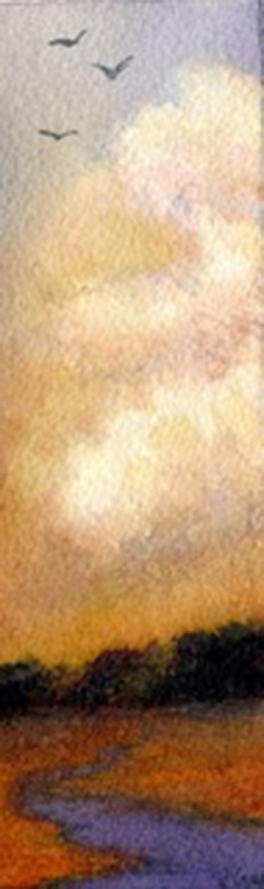
During a time when I seem to be doing everything except painting and drawing, I still find myself staring out of the window at the wonderful, wide salt marshes and seeing all sorts of magical images which I would love to capture.

Because the clouds and the light on the marshes are so fleeting and ever-changing, they require a gestural, allusive approach to catch their essence and somehow record it on paper. In this approach, it is really the viewer who needs to "fill in" the details, bringing his or her own experience and sensations to complement the art on view. Here on the Georgia coast, I think most people are deeply aware of the almost hypnotic beauty of these salt marshes, so they would readily understand such an approach to depicting these scenes.

Creighton evening.jpg

At the same time, as I gaze out at the marshes, I find myself watching for the abstract underpinnings of the landscape. The play of light and shade can belie the apparent realism of the scene and this interplay can become a valuable under-structure for a painting or drawing. These values can be used to ensure a strong composition of interlocking shapes. So I try to train myself to watch for these allusive aspects which can pitch into abstraction without warning. It is a fun game to play, even if I can't put them on paper at present!

Turner at the Tate by Jeannine Cook

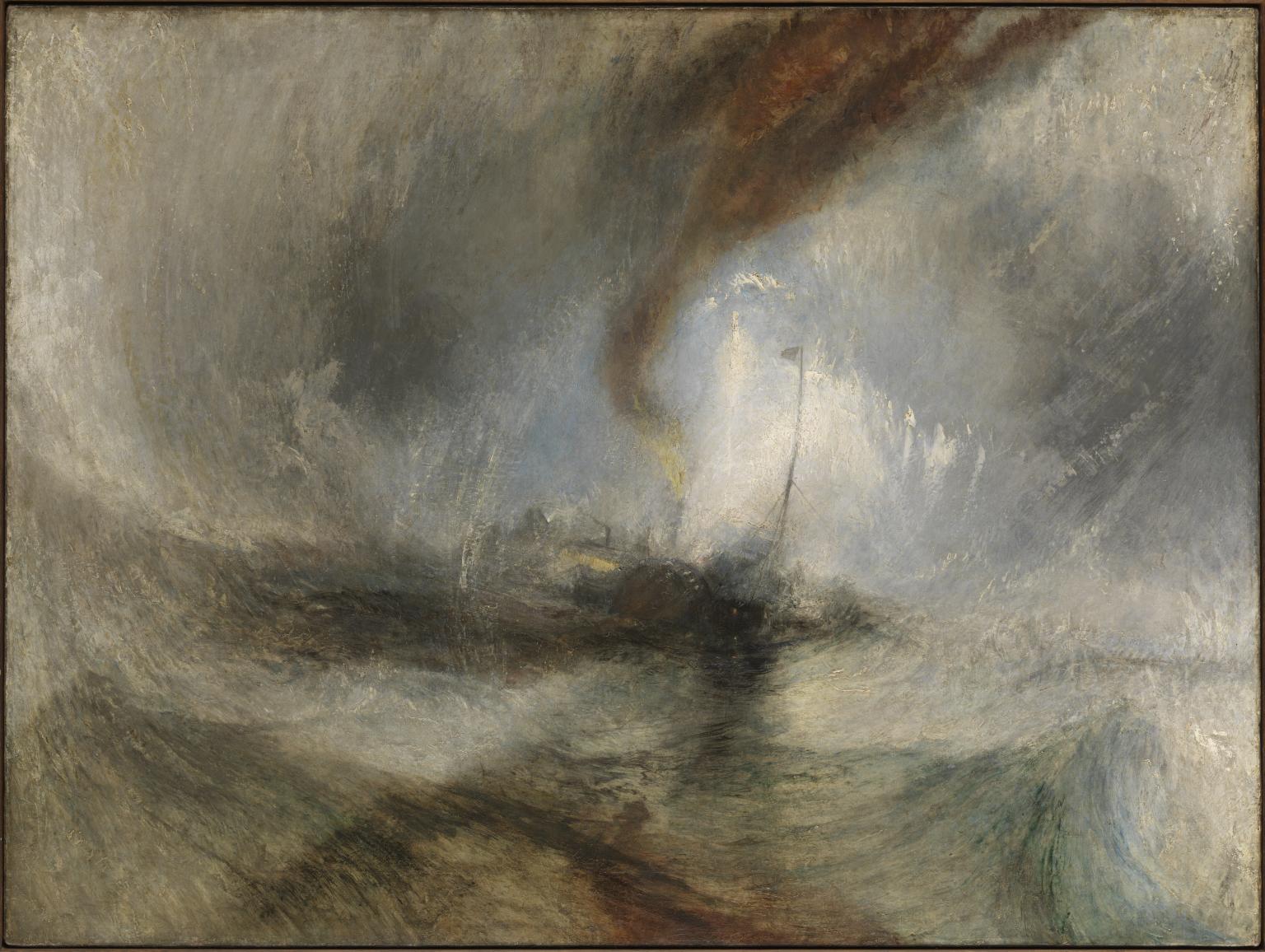
A discussion I heard today on the BBC World Service was well worth seeking out: Tim Marlow taking a walk around the just-opened exhibition at the Tate, Turner and the Masters. His discussion about J.M.W. Turner's early endeavours to make his way as an artist and his audacious attempts to measure himself against other master artists was fascinating. From Constable to Caneletto, Rubens, Titian and Rembrandt, Turner used their work as excuses to measure himself against them, to surpass them and to use them as a springboard to develop his own voice.

Snow Storm - Steam-Boat off a Harbour’s Mouth. exhibited 1842, J. M.W Turner (Image courtesy of the Tate)

Snow Storm - Steam-Boat off a Harbour’s Mouth. exhibited 1842, J. M.W Turner (Image courtesy of the Tate)

Light and Colour, Goethes-Theory, The Morning After The Deluge, 1843, J.M.W. Turner (Image courtesy of the Art Gallery of Ontario)

Light and Colour, Goethes-Theory, The Morning After The Deluge, 1843, J.M.W. Turner (Image courtesy of the Art Gallery of Ontario)

It was a fascinating series of insights about how even the most amazing and inventive of artists has to work, work, work and relentlessly push forward eventually to become a wonderful artist. Lots of food for thought.

When is a drawing "finished"? by Jeannine Cook

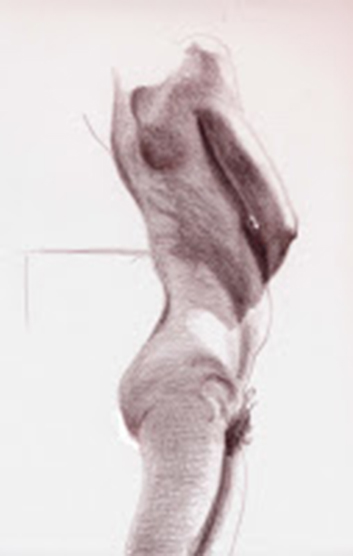
Sometimes when I am drawing, particularly life drawing, time runs out and the drawing can seem incomplete. But, on a second look, it can stand as a completed drawing, despite it being unfinished in some sense. Other times, it is hard to decide. I think it is a question of intent and whether the drawing makes sense for a viewer. The life study I did, on the right, was done in about thirty minutes, in Prismacolor, and it can, just, stand on its own, I believe. I would be interested in other people's views.

Life Study - 30 minutes, Prismacolor, Jeannine Cook artist

Life Study - 30 minutes, Prismacolor, Jeannine Cook artist

Life study - 45 minutes - Prismacolor.Jeannine Cook artist

Life study - 45 minutes - Prismacolor.Jeannine Cook artist

I did another Prismacolor study, in about forty-five minutes to draw, with this young man whose muscles are amazing, and the play of light on his back was fascinating. However, although the composition is perhaps more stable than the other life drawing, I am not sure it works as it stands. Nonetheless, I know that the next time I draw him, it will be more straightforward. Why ? Because, as Swiss essayist and writer, Alain de Botton, observed, "The very act of drawing an object, however badly, swiftly takes the drawer from a woolly sense of what the object looks like to a precise awareness of its component parts and particulars".

There is, however, another way of going in seemingly unfinished drawings. I tend to do drawings that don't leave loose ends, as it were, but there are plenty of artists who very effectively leave lines, blotches, splotches, blobs and squiggles in the drawing which actually all contribute to the effectiveness of the drawing, conveying immediacy, rhythms, drama, etc. An artist whose work I admired the first time I saw it, Lori-Gene, is a very good draughtswoman of this type of drawing. Her work, frequently combining motion, sound and sight, is a wonderful amalgam of energy. She often works with musicians and orchestras as they play, and the results convey the sense of music most successfully. The whirl of lines and marks on the paper is the perfect demonstration of the "unfinished" drawing which is beautifully finished.

Brass 1, Lori Gene, (image courtesy of the artist)

Brass 1, Lori Gene, (image courtesy of the artist)

Art and life by Jeannine Cook

Scrolling through the amazing amount of mail received on the Web, I sometimes come across an image of a painting or drawing that stops me in my tracks. Just as when you round the corner in a museum and come face to face with a work of art that takes your breath away...

Yesterday, I was reading the daily Art Knowledge newsletter and there was the image of a painting I had always loved, Rogier van der Weyden's St. Joseph, done about 1445. I know it from having seen it in the wonderful Museu Calouste Gulbenkian in Lisbon, where it is hung with another part of the original altarpiece, the painting of St. Catherine. Her painting is lovely, but it is the tempera painting of St. Joseph which is breathtaking.

St.Joseph, Rogier van der Weyden, between circa 1435 and circa 1437 , tempera and oil on panel, (Image courtesy of the Calouste Gulbenkian Museum, Lisbon)

St.Joseph, Rogier van der Weyden, between circa 1435 and circa 1437 , tempera and oil on panel, (Image courtesy of the Calouste Gulbenkian Museum, Lisbon)

Van der Weyden depicts an elderly, thoughtful man whose powerful expressiveness is remarkable. His portrait, direct and detailed, even to the whispy stubble on his chin and the lined, reflective face, depicts him three-quarters face, as if he were hesitating and thoughtful just before he turned to face one and say something gentle and considered. The Gothic architecture and slight landscape behind him are neutral and elegantly refined, a perfect complement to the directness of the portrait.

As I gazed at the digital image of St. Joseph, I thought of the quote I had found when Henry Miller wrote that "art teaches nothing except the significance of life". This portrait is a supreme example of that.

The portrait was being reproduced as it is presently being exhibited at the opening exhibition of an enlarged and updated Vander Kelen-Mertens municipal museum in Leuvens, Belgium. The link to Leuvens for Rogier van der Weyden is important - he apparently painted one of his most celebrated pieces there, the Descent from the Cross, another amazing work which is in the Prado, Madrid. Not only did van der Weyden achieve paintings of refinement and luminosity whose human dramas reach out to us across some six and a half centuries, but he also left us a work which I particularly love as a silverpoint artist. At the Boston Museum of Fine Arts, there is a wonderful self-portrait as St Luke done about 1440. He is making a drawing for his painting of the Virgin, in a setting he apparently copied from Jan van Eyck's Madonna of Chancellor Rolin. And he is making a silverpoint drawing....something I don't believe was depicted by any other artist.

Framing art by Jeannine Cook

I have been matting and framing artwork that I have done in recent months in preparation for exhibitions. I learned some while ago how to do my own framing as I was nervous about sending out fragile silverpoint and graphite drawings to be framed elsewhere. I invested in a big mat cutter and learned about the different museum mat boards, 2, 4 and 8-ply, which are totally acid-free and thus archival. The boards I use, made by Rising, come in shades of white and cream, and their merit is that they are double-sided, so you can't make a mistake on cutting in the wrong direction! The 8-ply mat board is what I use for silverpoint drawings and while elegant, it is a bit like cutting concrete if you don't have a really, really sharp blade in the cutter. I always feel as if I have gone to the gym double-time after I have dealt with this framing job!

The choice of mats and frames is a corollary of the actual art work, and this means that there are plenty of ways that people chose to go in complementing their artwork, let alone the choices made by purchasers of art.... In terms of coloured mat boards for works of art on paper, the more conservative route, mostly required if the work is to be considered for juried or group shows, is for creams or white. Personally, I tend to favour neutral whites and lots of breathing space for my art, which also means floating the image and not confining it within a mat. Double mats, sometimes with a flash of another colour or shade, can be effective. I follow a simple rule of thumb: how far the artwork itself needs to be spaced far away from the glazing. If I am dealing with a graphite drawing, for instance, I will devise a deeper mat area, either with doubled mats, an 8-ply mat or mats deepened with hidden layers underneath which create an extra space and depth.

Frames are a vast and complicated chapter. Historically, there are some absolutely wonderful frames which are works of art in themselves and indeed, there are sometimes exhibitions of frames alone, empty and beautiful. I always remember staring with entrancement at frames in an exhibition of early Masters' art from the Budapest Museum of Fine Arts. Their ornate carving and wonderful use of different woods alternated with other frames of the most complex gilded ornamentation. It was a frenzy of creativity that was entirely separate from the fabulous art enclosed within the frames.

When I frame, I am always mindful of various things - firstly that the frame, like the mat board and glazing (UV-protective acrylic in my case), should protect the artwork and not add to the dangers of damage to the art. I am also aware that if I exhibit the work in shows and send it elsewhere, there is always a possibility of damage being done to the frame, even by the most careful of art handlers. I am also mindful that frequently, if people purchase my work, they will want to reframe it to their taste and surroundings. So if I use a neutral, non-acidic, high-end brushed metal frame, the work is relatively safe and robust. The clean, simple look also matches the look that I want for my artwork, both watercolours and drawings, that speaks to light, space and air. From a practical point of view, this framing choice also makes it much more feasibly that I can do the framing myself, at home, with acrylic gazing, and end up with lightweight, simple frames.

So this is the world I have recently been working in... and I am really eager to return to actually trying to make art. That, for me, is the really fun side of being an artist!

Drawing... closest to pure thought by Jeannine Cook

Back to life drawing - oh bliss! And oh!! It is always such a humbling exercise, whilst at the same time, utter absorption and entrancement. It put me in mind of a quote I found from John Elderfield. the former eminent Curator at MOMA, who said, "Drawing, within the visual arts, seems to hold the position of being closest to pure thought". It is the medium that shows one up as an artist - there is nothing to hide behind, and it is thus always risky, just like thoughts that are unpremeditated.

Even finished drawings, in the pure sense of a drawing standing as a completed work of art and not something that is a step towards a painting, are very revealing. Take an artist like Giovanni Francesco Barbieri, or Il Guercino, one of the leading Baroque artists who lived from 1591 to 1666. Known for his speed of work, together with great discipline and constant practice, he left a wonderful collection of drawings as well as many famous paintings. This is somewhat ironic, in a way, for he was known as Il Guercino because he squinted. But it did not impede him from drawing magnificently. I see that a selection are on view now at the Kunstmuseum in Bern, Switzerland, which is a treat for anyone to see as drawings such as these travel rather rarely.

Esther and Asuhueerus,,pen and brown ink,brown wash, Il Guercino (Image courtesy of Christies)

Esther and Asuhueerus,,pen and brown ink,brown wash, Il Guercino (Image courtesy of Christies)

Il Guercino's drawings fall perfectly into this category of drawings as pure thought... And very successful thoughts!

More on John Marin's "bow" to landscapes by Jeannine Cook

I alluded in a previous entry to John Marin bowing to the landscape, and if it bowed back to him, he would then feel permitted and able to paint it.

John Marin, Hurricane, 1944. Collection of the Indianapolis Museum of Art.

John Marin, Hurricane, 1944. Collection of the Indianapolis Museum of Art.

I was reminded of this again while reading a fascinating book, "Beauty", by Roger Scruton which was published earlier this year by Oxford University Press. Professor Scruton meticulously examines the aspects and characteristics of beauty, point by counterpoint. At one point, he writes, "My pleasure in beauty is therefore, like a gift offered to the object, which in turn is a gift offered to me... the pleasure in beauty is curious, it aims to understand its object and to value what it finds."

That is exactly the way I find myself approaching and reacting to the beautiful landscapes I see here in coastal Georgia, or in Mallorca, for instance Not only does one savour of their beauty per se, but then, as one draws or paints, it is first a quest to see carefully and understand better what one is experiencing. Somehow, one needs to "process" all this information internally, almost intuitively, and then try to transmit the results of this wordless dialogue to paper, in one's own style and idiom. Scruton goes on to talk of the fact that only humans can look at - say - a landscape in an alert, disinterested way, "so as to seize on the presented object, and take pleasure in it".

Perhaps that is one of our privileges as humans. But it is also much easier to talk or write about apprehending the gift of beauty in landscapes than actually "bowing" back to the landscape as an artist and producing a decent work of art!