Thoughts on September 11th by Jeannine Cook

The passing of years since September 11th, 2001 has brought so many changes around the world that one can scarcely put oneself back in the frame of mind of that time. I suddenly remembered a painting that I did to deal, in some measure, with my own emotions after the Twin Towers fell and so many people perished in such frightful fashion. I had loved the brashness of the Twin Towers when we lived in New York. Taking visitors up to the top of the world, as it felt, on the top viewing deck, was so utterly New York in its drama and strange combination of elegance and a technological defiance of nature.

It seems that artists dealt with these events in a multiplicity of ways, many working on sculptures and pieces some years later. I found allusions to many of them again today in Tyler Green's blog at Modern Art Notes. In some fashion, the responses had to do with the degree of connection to New York, I think, and also, of course, the degree of political involvement of each artist. Personally, I painted and drew my piece about a month after September 11th, really before the Bush administration became, in my opinion, out of touch with many of the more admirable aspects of the American Constitution.

Twin Towers (after September 11th) watercolour-graphite, Jeannine Cook artist

Twin Towers (after September 11th) watercolour-graphite, Jeannine Cook artist

As a European, I had always been very aware of the legend of Manhattan's streets being paved with gold. Purple is also the colour of deep mourning in the world I know. Violets often signify faithfulness, watchfulness and modesty. Faithfulness to duty and cause, as far as the firefighters and police and other responders were concerned, watchfulness too, and modesty, in a way, for all those people who were going about their daily business in the Twin Towers. I tried to combine these aspects with the island of Manhattan, the flight paths of the various planes and then the unimaginable debris of the fallen towers.

It was strange to pull out this painting and look at it again today, but perhaps this, of all days, is the day to do so.
Open Eyes by Jeannine Cook

I marvel constantly at the wisdom and insights that I stumble across on the Web. Following a thread on my passion, drawing, I found this observation from the artist, Timothy Nero. He said, "Drawing keeps the eye fresh, the mind alive, and intuition nimble."

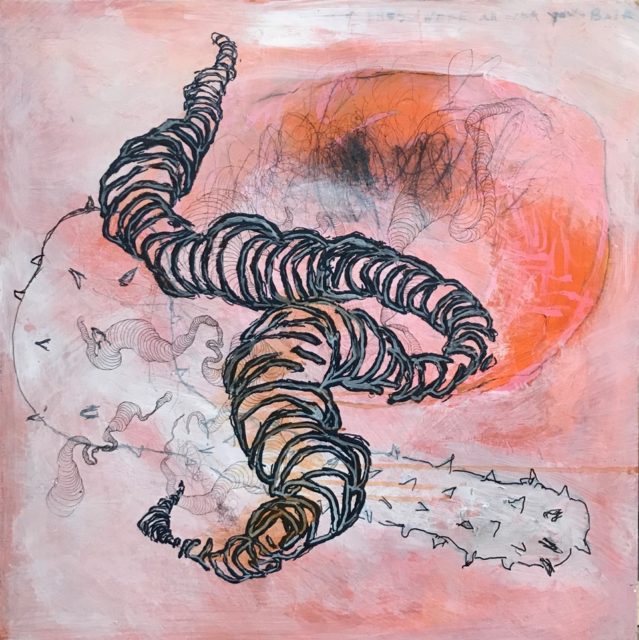
Timothy Nero, "Set and setting; An observation-all over your back," 24.75" x 25", acrylic on panel, 2017. (Photo: Courtesy of Timothy Nero)

Timothy Nero, "Set and setting; An observation-all over your back," 24.75" x 25", acrylic on panel, 2017. (Photo: Courtesy of Timothy Nero)

Every draughtsman knows instantly what he means. As you draw, you find you see things differently, more intimately, with more awareness of space, connectivity and light. Your mind works more alertly, even on a subconscious level, and your senses are honed and more tuned. The act of drawing is a very complex, alive-making affair and things happen in the drawing that you cannot foresee as the artist.

Interestingly, Marc Wilson, Director of the Nelson-Atkins Museum, made a parallel observation about viewing art in an interview reported today by Tyler Green on his Modern Art Notes blog. Mr. Wilson was talking about the galleries in his Bloch Building addition to the Museum and how art is presented there to the public. He said, "I'm not trying to teach you art history. I'm trying to open your eyes, your own senses and your own intelligence to what's in those works of art. That's the first step."

What art involves, whether in the making or the viewing, is basically, I would venture, a good dose of curiosity and having the willingness to open yourself up to new experiences and insights. It is a way of seeing and understanding another person's viewpoint, another version of reality or imagined "reality". In an era when open-mindedness is in short supply in many domains of society, it is to be celebrated that art has still the ability to break down barriers, inhibitions and prejudices. This situation does, however, imply quite a responsibility for each artist somehow to be the provider of keys to unlock doors to different, perhaps new experiences. Perhaps it is lucky that most artists are almost impelled to draw and paint, whether or not their results have this effect. Each of us, as artists, just needs that special feeling of being really alive as we work.

More on Landscapes - Canadian Style by Jeannine Cook

A group of artists who exchanged the most wonderful John Marin-like "bows" with landscapes in the early part of the 20th century was Canada's Group of Seven. Every time I see any of their work, I am captivated all over again, because I find in these paintings a directness, an elegant truthfulness and such a celebration of Canada's natural scenery. The Seven are Lawren Harris, A.Y. Jackson, Franklin Carmichael, Francis Johnson, J.E.H. MacDonald, Frederick Varley and Arthur Lismer. Others who were associated with them but not officially of the Seven were Tom Thomson and Emily Carr.

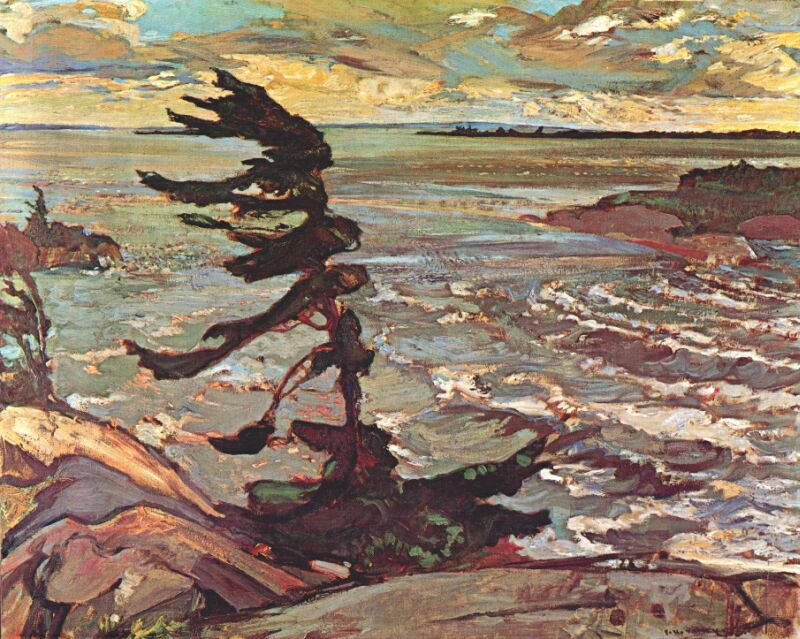
F.H. Varley, Stormy Weather, Georgian Bay, 1921

F.H. Varley, Stormy Weather, Georgian Bay, 1921

All of them began to go out into the Canadian provinces and explore the wilderness at a time, in the very early 1900s, when artists had considered that Canadian landscapes were in essence unpaintable. Yet, they started to travel and paint, encouraging each other to do more. By 1920, they were ready to exhibit their first collective body of work under the label of the Group of Seven, and show the world just how wonderful the dialogue between artist and landscape could be in the dramatic landscapes of Canada.

 In the Northland,  Tom Thomson (Image courtesy of The Montreal Museum of Fine Arts)

 In the Northland,  Tom Thomson (Image courtesy of The Montreal Museum of Fine Arts)

When you see collections of these landscape artists' work, at The National Gallery of Canada and the Vancouver Art Gallery (where there is currently a special exhibition of their work entitled "Dawn"), every landscape artist will find delight and inspiration. Many of their oil sketches are the typical small format plein air boards. A big display of these at the National Gallery is like a breath of fresh air in their directness and sensitive use of colour and form. If anyone ever doubted the importance of working plein air, time spent studying these studies/sketches would soon banish those reservations. The later, larger-format paintings are more considered and highly finished, more studied in composition and thus they lose a fraction of that headlong breathless excitement of the plein air work. But that is really cavilling... they are still wonderful, in my opinion. It is nonetheless very interesting to be able to compare outdoor sketch and finished studio painting.

Lawren Harris: Maligne Lake, Jasper Park, Oil on canvas. (Collection of the National Gallery of Canada).

Lawren Harris: Maligne Lake, Jasper Park, Oil on canvas. (Collection of the National Gallery of Canada).

These early 20th century painters embraced and understood the landscapes in which they worked - it shows. They sing easily - at least apparently - of their sense of place, and we share their celebration of the seasons and grandeur of Canadian landscapes, both intimate and majestic.

Landscapes and John Marin by Jeannine Cook

After I had been writing about the evolution of landscape painting and the attitudes towards it, I was fascinated to stumble on the following quote : "How to paint the landscape: First you make your bow to the landscape. Then you wait and if the landscape bows to you, then, and only then, can you paint the landscape." That was John Marin's observation.

From very early on, he believed in the importance and power of the visible, the need actually to see himself what he was seeking to portray as a landscape. His landscapes were amazingly individualistic and memorable. His "bows" to and from the landscape meant that he truly understood that scene and had processed it through eyes, brain and hand so that it became his own, his own version of it.

Franconia Range, White Mountains, No. 1, 1927, watercolor, graphite pencil, black chalk, John Marin (Image courtesy of the Phillipes Collection)

Franconia Range, White Mountains, No. 1, 1927, watercolor, graphite pencil, black chalk, John Marin (Image courtesy of the Phillipes Collection)

movementinred_pr_0.jpg

Vincent Van Gogh talked in a similar vein about the importance of the artist knowing the landscape well enough to create art about it. He said, "One can never study nature too much and too hard." Like John Marin, his landscapes can never be confused with anyone else's - he distilled what he saw and experienced in a totally individualistic fashion to create marvels.

The Real versus the Ideal by Jeannine Cook

I have been reading about the Middle Ages to remind myself about aspects of this key transitional era in our Western history. One of the delights is to have small illustrations of contemporary illuminated manuscripts by artists such as Loyset Liédet of Bruges, who did many of the illustrations for Jean Froissart's Chronicles in the text prepared for Luis de Gruthuuse, a wealthy Flemish nobleman. In these miniatures, people are the most important part of the image, and the landscape behind is purely secondary and very idealised. For instance, the painting of the Battle of Poitiers 1356, shows an idyllic backdrop of blue mountains and peaceful scenery which contrasts sharply with the battle depicted in the foreground.

The Battle of Poitiers, Jean Froissart (Image courtesy of Bibliotheque Nationale de France)

The Battle of Poitiers, Jean Froissart (Image courtesy of Bibliotheque Nationale de France)

The same treatment was meted out to landscapes in medieval wall paintings and tapestries; they were merely the background to human activity. Battles, religious events, societal changes were worth recording. Nature was not of much importance,

This state of affairs continued for many years, with artists paying some attention to landscapes and nature - think of Leonardo da Vinci's studies of dogs, horses, water flowing or landscapes in Tuscany... or Albrecht Dürer's studies of flowers, rabbits, countrysides. But in France, the landscape did not become an independent and valid subject for artists to paint and draw until the 1620s, when it became more of a specialised subject. Claude Lorrain was one of the pioneers in landscape painting, but his works were idealised and romantic to say the least. Interest in landscapes increased gradually until artists such as Jean-Baptiste Corot became a skilled interpreter of the landscape, even if he did do many "pot-boilers" to earn his living. By his time, landscape painting was being taught in the art academies in France, although it was a genre that was ranked pretty low on their "intellectual or moral content" scale. History painting and portraiture were still far more highly esteemed. Landscape painting, which did not require knowledge of anatomy, still had to be idealised really to win respect and admiration from connoisseurs and other artists.

Pastoral Landscape, oil on canvas, 1677, Claude Lorrain (Image courtesy of Kimball Art Museum)

Pastoral Landscape, oil on canvas, 1677, Claude Lorrain (Image courtesy of Kimball Art Museum)

Then came the radical change in France. Pierre Henri de Valenciennes worked hard within the Academy to establish a Prix de Rome for "historical landscapes", advocating that artists paint a "portrait" of a landscape. His publication, Eléments de perspective pratique à l'usage des artistes, (Elements of Practical Perspective for Artists, 1799-1800), was a key influence for artists painting landscapes for decades. By the 1830s, Charles-François Daubigny was painting outdoors in the Fontainbleau region, soon joined by others, like Millet, in the Barbizon School, while another group was forming on the coast near Le Hâvre, led by Eugène Boudin. Monet joined him as a student, and the rest, as they say, is history. Pisarro, Sisley, Renoir, Van Gogh, Cézanne and even Degas on occasions - they all worked outdoors. Edouard Manet tried his hand too at plein air when he painted a small work, "Effect of Snow at Petit-Montrouge", in 1870, when he was on guard during the siege of Paris in the Franco-Prussian War.

Edouard Manet - Effect of Snow at Petit-Montrouge, 1870

Edouard Manet - Effect of Snow at Petit-Montrouge, 1870

These artists had all completely altered the concept and quest for beautiful painted landscapes. No longer was anything idealised. Instead the 19th century French artists, and especially those who became known as the Impressionists, turned their energies and their passion towards portraying the landscape as real, as they saw it, experienced it firsthand and interpreted it. They showed not only nature's beauties but also its intricacies and vagaries. Nature had been transformed and placed centre stage, no longer subservient to any human presence in the work of art. A huge change from the careful, tiny depictions of background idealised landscapes of medieval times....

The Lines progressed by Jeannine Cook

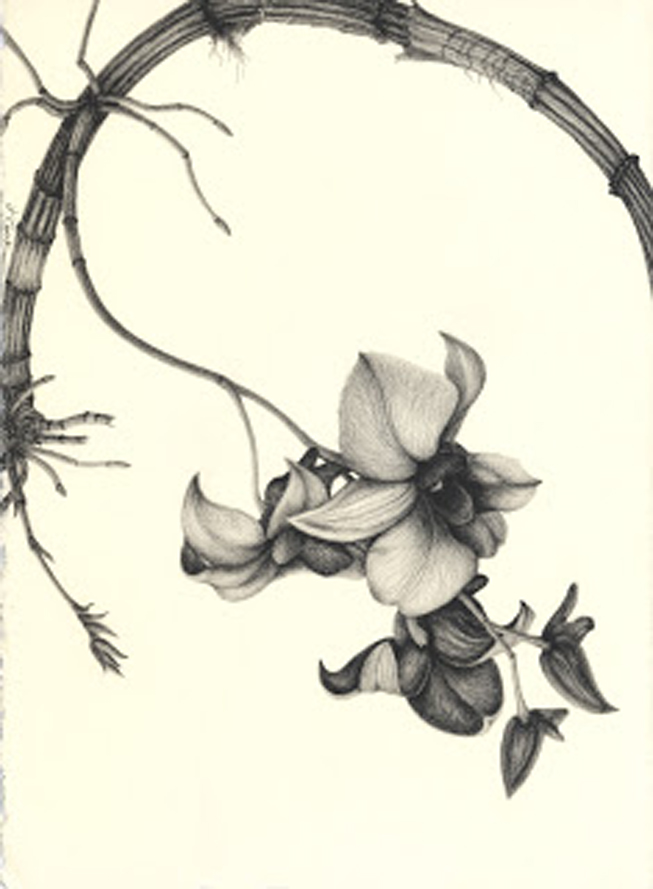
Well, the line-making slowly progressed on my Dendrobium Delight drawing in graphite and I eventually declared an end. By this time, the flower buds had opened and everything had moved around in the usual dynamic way nature has of reminding one who "rules".

Dendrobium Delight, graphite, Jeannine Cook artist

Dendrobium Delight, graphite, Jeannine Cook artist

Yet the act of drawing made me reflect on how any drawing is really a voyage into ourselves, to bring out we know not quite what, ahead of time. As that wonderfully thoughtful artist, Luisa Rabbia, remarked about artists in general: "In the end, we all talk about life, death, time and our presence on Earth." This became even more pertinent a remark for me, for while I was drawing, I was listening to Senator Ted Kennedy's memorial service on television and reflecting on his life and the many acts of quiet kindness and compassion. As Placido Domingo sang Panis Angelicus, with Yo-Yo Ma accompanying him so sonorously on the 'cello, the beauty of the music seemed to flow into my pencils as I drew. Susan Graham's wonderfully serene Ave Maria was balm to the soul - it must have seemed so to the countless people listening around the world as well as in the spacious Basilica.

This drawing of the vibrant Dendrobium will, I know from other experiences I have had when painting or drawing, now always evoke for me this time of music, celebration and mourning for Ted Kennedy. Resquiescat in pace.

The Gaze by Jeannine Cook

Today was a day of rain that played perfectly into a plan of meeting fellow artists and talking about different aspects of art-making - a good 'shop" day. Later, however I walked through a local gallery full of decorative art of high caliber which did not call out to me very much. I started thinking about the curious alchemy of "the gaze" - that moment when one's eyes fall on a painting or drawing, and it almost impels one to draw closer and look harder. You can look at countless pieces of art, in a gallery, in a museum, where ever, and then suddenly, bam, there you are - summoned and enmeshed, in a completely unexpected fashion. The typical French "coup de foudre".

What is it about this business of "the gaze"? Amanda Renshaw, Editor at Phaidon and coordinator of the book, "30,000 Years of Art. The History of Creativity" was being interviewed in El Pais (in Babelia, on August 1st, 2009) and said, "I believe that the gaze is a form of language, and using that gaze is the best way to connect ever closer and more successfully with art. the connection between the eyes and the brain and emotions is absolutely fundamental." She went on to explain that text about art on a museum wall, in a book about art or elsewhere is secondary in importance to the actual art images.

It is true - the artwork calls out to one long before one thinks of reading a label on a wall. The more one looks at art, however, the more each of us can hone that gaze to be not only one of interest, pleasure, amazement, but also of informed, knowledgeable appreciation. Gazing, seeing, really looking at art is one side of the equation. As an artist, the other aspect is the equally important action of looking hard at whatever one is trying to draw or paint, not only to understand it and record it, but to filter it deep into one so that, somehow, the alchemy of the gaze helps create a viable piece of art.

A Progression of Lines by Jeannine Cook

These hot, humid days make staying at home in air-conditioned coherence very attractive. This means that all of a sudden, I find that my "eye" spots potential drawings or paintings in places I normally don't expect. It is the bonus of quiet days at home mid-summer, I have learned.

Today's bonus was a beautiful dendrobium that obligingly reblooms on a regular basis - it has produced elegant, shapely flowers, but at the gravity-defying angles that hallmark my dendrobiums. Staking them, greenhouse fashion, doesn't seem to work for me! As I sat listening to music and starting to do a graphite drawing of the flowers and strange stem, I kept thinking back to remarks I had read by Luisa Rabbia when she was being interviewed in Art in America after her Residency at the Isabella Gardiner Museum in Boston. Talking about drawing, she said "Drawing is for me a way of writing, recording moments, the passing of time ... you change ideas so many times when you are working, and I like that. I start from something and never know where I am going to."

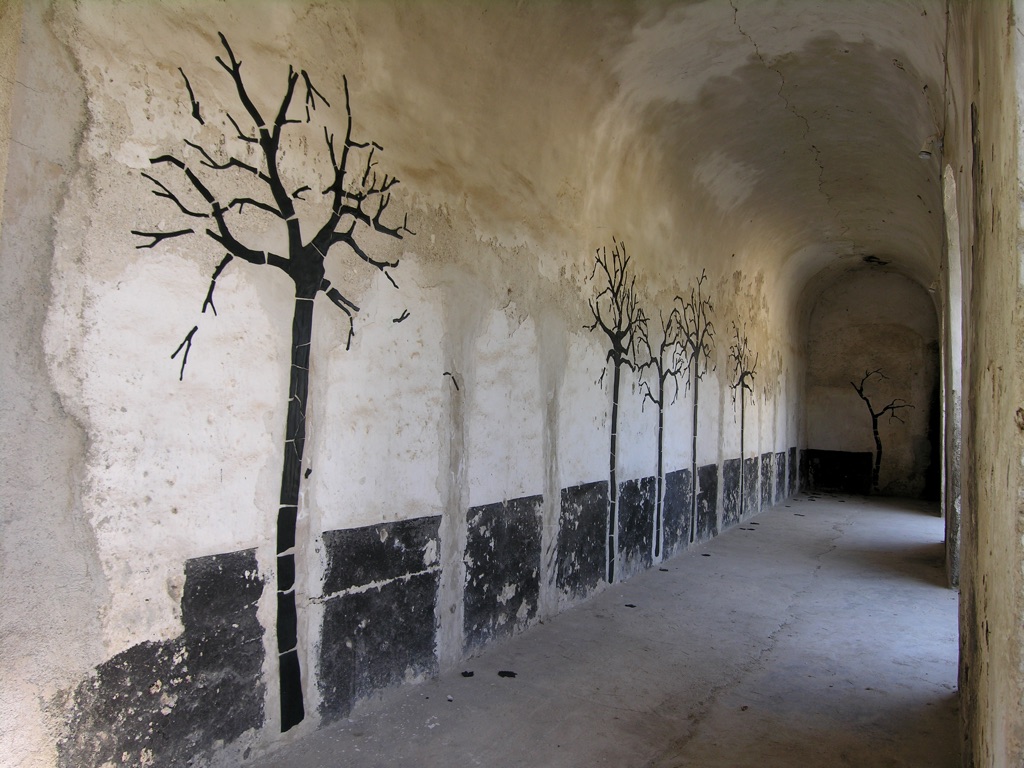
Prima della tempesta, 2006, certosa di Padula, Luisa Rabbia,  (Image courtesy of the artist)

Prima della tempesta, 2006, certosa di Padula, Luisa Rabbia,  (Image courtesy of the artist)

It is true. I find the same thing. I might start drawing, say, the dendrobium, but by the time I have worked for a while, the flowers I am depicting not only have changed themselves, but I had also added, subtracted, moved and generally altered things substantially. I draw for a while, then stop and make a cup of tea... the perfect way then to return to the drawing with a fresher eye, to assess a little where I am going, what needs next to be done. The original idea that sparked the drawing is still there in its core, but the drawing itself has taken hold of my initial passion and made it its own.

Luisa Rabbia was accurate and eloquent about drawing - "A drawing itself is a record of the development of an idea. You change ideas so many times.... For me, the shape of each line is determined by the shape of the preceding line and determines the shape of the following line. There is this progression of lines, thoughts and moments." It does not really matter what you are drawing - a landscape, an abstract, a still life or a flower... the process of drawing seems to follow the same progression and development. The drawing medium does not alter this process either. As Luisa also remarked, line "is like breathing". One line falls naturally into place after the previous one, almost involuntarily, until suddenly, a little voice inside one's head says "stop" and you know that you have reached the end of that particular drawing journey.

Fascinating and addictive, this drawing process...

Ironies of Art-making by Jeannine Cook

Back on June 14th, Gloria Goodale wrote in the Christian Science Monitor about "Fleeting Architecture", saying that "we are becoming a temporary society". In a more recent article on July 20th, about museums and their future, she wrote, "It’s not about the collections anymore,”… “It’s about community.”

As an artist, I am left slightly nonplussed by these statements which I suspect are totally accurate about society in general today. For me, drawing in silverpoint has always implied a sense of heritage from the 12th century monks who started this medium rolling when they drew in lead (and later silver) in their wonderful manuscripts. There are still many illuminations and silverpoint drawings which have survived, despite the ravages of time. A respect for archival qualities of the materials and methods one uses in drawing and painting have always seemed to me to be necessary, given that collectors - individuals or institutions - normally don't want artworks they have acquired to self-destruct. Horror stories abound about disintegrating paintings, sharks not holding up in formaldehyde or drawings on acidic paper disappearing in yellowed slivers.

Nonetheless, as Ms. Goodale remarks, "We used to place a huge value on permanence and place, but that's gone... we want the novel, the next, and we're happy to throw away and move on in order to accommodate that." How to reconcile that trend and the need actually to have something in the museums, for the "community" to view, observe, learn from or celebrate...?
We artists still need to produce something. Granted, installation art, provisional structures, video art, performance art all abound. But at the end of the day, museums still have - usually - walls and something needs to go on those walls. Yes, the Christo events, like "The Gates" in New York's Central Park, are huge cultural events and money-makers and people are more willing to travel just to see temporary installations.

The Thousand Portal Project, Christo

The Thousand Portal Project, Christo

Nonetheless, institutions like the Louvre, the Metropolitan Museum, the British Museum... still attract huge numbers of people seeking out the more permanent manifestations of art that have endured down the ages.

So as an artist, I have to decide, eventually, what kind of art to try and create - permanent or impermanent .. and just follow my passion. As Marina Abramovic remarked to Isabel Lafont in an article in El Pais in June 2009, "Art is like breathing, you just don't question that fact. You make art because life would be unlivable without doing so." ("El arte es como respirar, no lo cuestiones. Lo haces porque no puedes vivir sin ello.") She is completely right.

Art as a Mirror on the World by Jeannine Cook

In El Pais of 1st August, there was a long review of two books which had previously appeared in English - Julian Bell's Mirror of the World and 30,000 years of Art by various authors and published by Phaidon. These weighty reviews and compendiums of what, today, is deemed the most important, the best art, started me thinking about art as a general mirror of the world.

What each of us does as an artist is mostly work that comes to us as an expression of individual passion and concern, sometimes steered in one direction or another because the work is commissioned. Generally, however, the work reflects firstly each artist and secondly, the world around that artist. So in a way, each of us mirrors our own world, for good or bad. Artists who are more tuned in to the natural world will tend more to emphasise natural subject matter, urban artists often find their inspiration elsewhere. Today's world, however, becomes much more mixed up as more and more artists tap into the "world's contents, mingled in a vast collective potlach available by Internet, cell phone, TV, satellite and an ever-expanding inventory of connective gadgetry." (Art in America, March 2009) We can all avail ourselves of situations, sights, sounds, whatever, that we have never personally physically experienced. So the art-as-mirror idea potentially gets changed, perhaps distorted, potentially homogenised, worldwide.

Of course, you still have many, many artists quietly continuing to follow a personal vision and passion. Catherine Spaeth, art historian and art critic, in one of her pieces, talked of "the meanings generated by a work of art extend into the larger context of the world at large, and it is here as well that you are becoming art historical" Those meanings of the art generated reverberate out and speak to an audience willing to listen, to look, to ponder and evaluate. I am not sure artists set out always to address meanings/content to this end, but it happens nonetheless. As Emil Cadoo, the photographer working in the Sixties in Paris, once observed, "Only when an artist in any field touches universals can it last through time, can it survive the destruction of things."

Double Exposure, Emil Cadoo, c. 1960, (Image courtesy of phtographer)

Double Exposure, Emil Cadoo, c. 1960, (Image courtesy of phtographer)

Ultimately, it is for us artists simply to go on trying to work seriously, follow one's passion in creating the art that is important to us, as best we can. We will, even today in our ultra-connected world, be mirrors on our worlds, willy-nilly. And it will fall to those, like Julian Bell (artist and critic himself), or those at Phaidon who have selected the best works to represent artists for the last 30,000 years (quite a job!), to tell the next generations who (perhaps) are the best artists mirroring the world in which we all live. One does however have to season the selections a little, mindful of "Chacun à son goût"!