More than meets the eye... by Jeannine Cook

An exhibition of contemporary silverpoint drawings, The Luster of Silver, opens this weekend at the Evansville Museum of Arts, Science and History, in Evansville, Indiana. It will be of particular interest to me not only because my work is included, but because I helped curate it from digital images, along with fellow artist, Koo Schadler, and the Museum staff.

Assessing art from digital images has become much easier in recent times. However, because silverpoint drawings, with marks made in silver that are often faint and delicate, are very difficult to reproduce satisfactorily, even digital images are possibly not doing justice to the work. Consequently, it will be most interesting to see the actual work of the twenty-seven eminent artists included in the exhibition. I also wonder if digital images, generally, have the impact and veracity to allow us to delve deeply into the artworks involved.

When one is standing in front of a painting or a drawing, there is a potential dialogue that draws one in.... you can look closely at the brush strokes of paint, how the artist has handled the pen or pencil or silver stylus. You can let the artwork talk, loudly or in a whisper, of many things , as you stand before it. I am not sure that digital images have the same power. In a gallery or, in this case, in a museum, a silverpoint is a lustrous, shimmering drawing, full of life and contrasts. It can hint at things beyond the here and now, and push us to new ways of thinking. Thus I am eager to see if the show we selected for Evansville will allow us to consider dimensions and aspects of life that are really "more than meets the eye".
Tackling the New Art World by Jeannine Cook

The past year or more has been hard for everyone, but especially in the art world. Yet I am constantly impressed at how resilient and inventive artists are and how inventive they are in dealing with today's conditions. I was reminded again of this just now as I opened up this blog and read one of the entries alluded to by Paul Schmelzer in his blog, Eyeteeth (http://www.eyeteeth.blogspot.com/). It was about artists in Detroit who are setting up home in houses they have been able to purchase for $100 from the City, which is dealing with a glut of foreclosed homes. Artists are grouping together in such neighbourhoods in different cities - playing the all-important role of pioneers as they do so often.

Another aspect of artists' inventive flexibility was covered in a long article in this week's Christian Science Monitor (http://www.csmonitor.com/) entitled "Bedroom, kitchen, art gallery". Contributor Mark Guarino told of artists who are opening up their homes and apartments as galleries in Chicago, Dallas, San Francisco and beyond. Other galleries, temporary for the most part, are popping up in vacant store fronts, hair salons, gas stations, or even for single events to try to attract new publics for realtors selling real estate. Everyone benefits. The divisions between traditional galleries, non profit spaces, alternative exhibition spaces or underground galleries are disappearing as art lovers and consumers grow more accustomed to viewing art in all the interstices of life. Artists, too, are imaginative enough to find new places to make and exhibit art, no longer necessarily working in the traditional contexts.

It all really boils down to how important art is for each and everyone of us. People who consider art and art education to be a passion and a necessity for the enhancement of life will adapt and thrive in this new art world. In doing so, the public is actually confirming what has been shown in economic study after economic study: that art, in all its manifestations, is a wonderful economic stimulus to an area. One recent study, commissioned by the Columbia Museum of Art in Columbia, SC (http://www.columbiamuseum.org/) showed that the Museum and spending by museum visitors generated more that $23 million in economic activity in the Columbia area in 2008. Not only does the Museum itself buy goods and services locally, but the Museum Shop generates a lot of business, while the art tourism and arts education are major factors in Columbia's economic well being. I can attest to that personally, when I visited the Columbia Museum's wonderful exhibition, "From Turner to Cezanne", exhibited there from March to June this year. A hotel stay, restaurants, museum entries and purchases in the Museum Shop, gas stations, and so on - art does bring in income for an area.

Paul Cézanne The François Zola Dam, ca. 1877 Oil on canvas, (Image courtesy of the National Museum of Wales)

Paul Cézanne The François Zola Dam, ca. 1877 Oil on canvas, (Image courtesy of the National Museum of Wales)

In other words, we artists do indeed help this faltering economy turn around in innumerable ways. Hurray for artists!

Thinking out loud on paper by Jeannine Cook

I am back to drawing in silverpoint, tackling a large study of lily seed pods which have been "talking" to me for some time since I rescued them from the winter struck garden last year.

Since silverpoint, a medium that makes marks with a silver stylus on a prepared ground, precludes any erasures and thus requires a little thought and planning, I found this quote resonated : "Drawings were always ways for artists to think out loud on paper...". This was said about an exhibition of Old Master drawings in the Scholz Family Works on Paper Gallery at the Snite Museum of Art, University of Notre Dame (www.nd.edu/sniteart/collection/printdrawing/index.html), where it was also pointed out that drawings were called "studi, schizzi, pensieri" in Italian.

It is true that one does think, possibly out loud when alone, in the midst of drawing. As I started working with these majestic seed pods of a Madonna Lily, I kept thinking of the role of the Madonna Lily in all the Renaissance Annunciations paintings that I have seen over the years. The famous ones, by Leonardo da Vinci, Sandro Botticello, Raphael (Raffaello Sanzio) or Fra Filippo Lippi, are joined by many others painted by Italian Renaissance artists on canvas or fresco. The custom that the Angel who announces the amazing news to the Virgin Mary should carry a spray of Madonna or Regale Lilies seems to have pertained from the mid-1400s onwards, for about 50-75 years. Looking at a large selection of images on Wikipedia Commons (http://www.commons,wikipedia.org/wiki/category:Renaissance_paintings_of_Annunciation), it is fascinating to see how "standardised" the lilies were for all those artists.

Beyond the Renaissance memories, I keep thinking that these lily seed pods are metaphors for proud, elegant women who have born children and grown in stature and grace as they watch their progeny disperse. Their bone structures are refined and beautiful, they hold themselves erect, despite advancing years, they epitomise distilled, condensed wisdom and lore.

Enduring Elegance, (regale lily seed pods), silverpoint,  Jeannine Cook artist

Enduring Elegance, (regale lily seed pods), silverpoint,  Jeannine Cook artist

But as I think these thoughts, and many others, as I draw, I am left wondering if I will convey any of this when I finish this drawing... who knows? I can but hope so, but, in the meanwhile, I still have a lot of drawing, and thinking, to do!

Sunlight and Shadows by Jeannine Cook

Today is a day of heavy flat light, laden with humidity and heat, here on the Georgia coast. All contours are softened, distances are blurred and somehow the scene is flat and almost featureless. It is a day that makes me long for the bright sharp sunlight of the Mediterranean. It also makes me realise how much landscape artists are influenced by the ambient light.

Think, for instance, of Japanese artists. Down the ages, in their nature-based art, the Japanese have been very aware of the play of light on rocks, trees, architecture. Shadows, the corollary of sunlight, are a natural function of their architecture, for example, with the broad eaves on buildings casting wonderful angled shadows. The ultimate interpretation of the beauty of light can be seen in their black lacquer ware, flecked with gold or silver. Viewed by lantern or candlelight, this lacquer ware evokes their northern, sea-influenced light in haunting fashion.

At the other extreme are Western artists who work in the brilliance of Mediterranean light. Take, for example, two of Spain's artists, Joaquin Sorolla from Valencia and Joaquin Mir from Barcelona. Sorolla was multi-faceted in his art, ranging from wonderful luminous portraits to vast historical paintings and, my favourites, landscapes flooded with light. In fact, a quote by Edmund Peel from James Gibbons Huneker, in the book, The Painter, Joaquin Sorolla, says it all: "Sorolla – the painter of vibrating sunshine without equal". It is interesting to study Sorolla's paintings: many of his landscapes which include figures have dramatically bold, abstract shadows (such as his paintings of Valencian fisher women). Yet landscapes done in Javea, Valencia or Malaga, in mainland Spain's Mediterranean coast, are often painted in a very narrow range of values, without dramatic shadows. Even more deliriously high key are some of his depictions of the almost incandescent cliffs and headlands in Mallorca, especially the sun-drenched scenes of Cala San Vicente in the north-east of the island.

"El mar en Mallorca" , Joaquin Sorolla

"El mar en Mallorca" , Joaquin Sorolla

Interestingly, Mallorca, with its amazing light, was also the springboard for Joaquin Mir's greatest successes. A contemporary of Sorolla (who lived from 1863-1923), Mir was born in Barcelona in 1873 and lived until 1940. Colour and light were the keys to his art : "All I want is for my works to lighten the heart and flood the eyes and the soul with light", he said in 1928. He forged his own path to celebrating the Mediterranean sunlight and shadows, sometimes veering to realism, other times towards abstraction, but always seeking to interpret the beauty he saw in a delirium of colour and light. He borrowed the Impressionists' palette of colours, eschewing black, but he used the colours in his own highly original fashion. When you see Mir's works done in Mallorca, you can feel the wonderfully clear light pulsating over everything - the Es Baluard Museum has a number of these canvases (http://www.esbaluard.org).

Joaquim Mir i Trinxet (or Joaquin Mir, 1873-1940): Canyelles

Joaquim Mir i Trinxet (or Joaquin Mir, 1873-1940): Canyelles

Perhaps evoking the clarity of Mediterranean light will help banish the Georgian grey skies of humid heat – I can but hope!

Revisiting "a Sense of Place" by Jeannine Cook

I live in a place where trees - live oaks, red cedars and pines of many types - are a wonderful characteristic. They grace the area with shade and distinction, they offer shelter to innumerable birds and animals and they ensure a cool green world even when temperatures are soaring elsewhere. I have grown to love many of them as individuals, whom I have watched grow in size and majesty over the years.

November Light, Jeannine Cook artist

November Light, Jeannine Cook artist

It was thus with horror and desolation that I rounded a corner this week, on a walk, to find men with huge machines finishing the cutting down and annihilation of some of the most wonderful old. and healthy, pines in the neighbourhood. They apparently "obstructed" the view for a new house, and although they had existed for many a long year, they were cut down in a matter of minutes. One of them had become a particular friend for I had done a large pastel drawing of it.

When you sit and draw something as complex as a tree, you learn of its elegantly logical growth, the marvels of engineering which ensure that its branches can reach out to catch the sunlight and yet remain at an angle that is stable for the whole "edifice" of the tree. You also can get a serious crook in the neck, as I found in this case, as the pine tree was so tall. Another delight, as one sits quietly, grappling with the drawing, is that all the birds, raccoons, snakes or other denizens, just come and go about their own world and ignore you.

My sense of this area has been violated this week, alas. Now I have to readjust, mourn the passing of wonderful creations, and move on. I wonder how many other people regard the cutting down of wonderful, healthy trees in the same fashion? But I am glad that at least I tried to record one of the trees in a drawing.

The Health of the Art World in the US by Jeannine Cook

Wow, the preliminary report out from the National Endowment for the Arts (http://www.nea.gov/) about Public Participation in the Arts in 2008 makes depressing reading. "Persistent patterns of decline in participation for most art forms...", "Fewer adults are creating and performing art...", "Educated Americans are participating less than before...", etc. etc. Not cheery reading. Not only because it spells very hard times for all forms of activity in the arts world, but also because, to me, it presages continued impoverishment of the human spirit. Without art of one form or another, we are rendered less outward looking, less understanding of others, less able to find enrichment in our lives.

The best parts of the initial NEA report findings concern the Web. "The Internet and mass media are reaching substantial audiences for the arts", and "About 70% of U.S. adults went online for any purpose in the 2008 survey, and of those adults, nearly 40% used the Internet to view, listen to, download or post artworks or performances." Not surprising when one knows of the phenomenal growth of Facebook, for example, or when one watches what is happening in Iran at present thanks to the Web and connected media. More and more, it seems, our lives are being interwoven with the Web, and as an artist, one is keenly aware of needing to keep up and try and function in this new world. The rub, as always, is having enough time in the day to create art, deal with the Web, and still function as an ordinary person.

Nonetheless, when all is said and done, the Web is still only the vehicle that links visual art to a person who enjoys viewing it and, ultimately and ideally, a person who enjoys living with the art in daily life, off the Web. There is still that all-important dialogue that takes place between a piece of art and the person viewing it. This is where the NEA figures for museum attendance (an estimated 78 million or 35% of U.S. adults) are confirming what most museum directors already know with concern and alarm. Those dialogues with artworks are becoming less frequent, for previous years, such as 2002, showed that about 40% of adults went to museums.

A long article in the June edition of ART News (http://www.artnewsonline.com/) examines the role of museums and what the different directors are trying to do to stay viable and successful in the future. The options ranges from trendy to futuristic. Nonetheless, as Thomas Campbell, new director of New York's Metropolitan Museum, underlines, a great museum still has one essential mission : to enable a visitor to have that supreme experience of standing in front of some object, painting, drawing, sculpture, whatever... and "Suddenly you're responding to something physical, real, that changes your own perspective." That is what the arts are about, and that is why we need to keep the arts alive and healthy.

The Luster of Silver exhibit by Jeannine Cook

Time is marching on towards the survey of contemporary metalpoint drawings that I helped curate for the Evansville Museum of Arts, Science and History (http://www.emuseum.org/). The exhibit opens on June 28th, 2009. There is going to be a reception on 27th June, at which I will be speaking, along with my co-curator and marvellous artist friend, Koo Schadler http://www.kooschadler.com/). There will also be a gathering of many of the twenty-seven artists included in the show, which will be great fun as many of these very talented artists do not know each other in person, only through the Web.

To my delight, today, June 15th, on ArtDaily.org (http://www.artdaily.org/), the advance announcement of this exhibition ("Evansville Museum to present a Survey of Contemporary Silverpoint Drawings") has been published, along with one of the images I submitted from different artists. I have to admit that I am pleased - mine was chosen - Creighton Bones (after C. Pissarro). It was a large silverpoint drawing that I did based on a huge cow shin bone that I had picked up on a nearby magical Georgian island, Creighton. Silverpoint is perfect for high key subjects like white flowers, bones, shells...

Creighton Bones (after Pissarro), silverpoint, Jeannine Cook artist

Creighton Bones (after Pissarro), silverpoint, Jeannine Cook artist

I had remembered a tiny drawing Pissarro had done of the backside of a cow and it seemed the perfect way to pay homage to Pissarro, one of my favourite artists for his affinity to natural beauty of all types. This drawing is now in the permanent collection of the Evansville Museum.

"The eye is not enough..." by Jeannine Cook

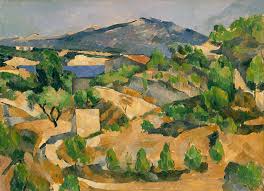
I found a wonderful quotation from Paul Cezanne in this week's Christian Science Monitor (http://www.csmonitor.com) . It was in an article about the French in Aix-en-Provence fighting the high speed railway that is possibly going to pass through the area Cezanne immortalised in his paintings of the area - think Mont Sainte Victoire, for instance (http://www.iblblio.org/wm/paint/auth/cezanne/st-victoire/). Cezanne was explaining his decision to leave the fast-paced urban sophistication of Paris and return to Aix, a very provincial, traditional, almost backwater town. He said, "The eye is not enough, reflection is needed".

Mont Sainte Victoire, 1895, oil on canvas, Paul Cezanne (Image courtesy of Barnes Foundation, Lower Merion, PA, US

Mont Sainte Victoire, 1895, oil on canvas, Paul Cezanne (Image courtesy of Barnes Foundation, Lower Merion, PA, US

It is a statement that goes back, in some ways, to the sense of place, and the need to allow that place to seep into one's subconscious. He was talking, I believe, about needing time to think deeply about what was important to him, what he wanted to try and say in his art in a genuine fashion, untrammeled by the much more relentless pace and demands of a big city. Some people thrive in a pressure-cooker environment, others don't. Cezanne had struggled to advance in his art in Paris, he had haunted the Louvre and frequented many other talented artists. But I suspect that many of us artists come to a stage where time and mental space are needed to allow changes and progress in the art we are trying to accomplish.

Cezanne also knew his home area well. He knew how and when the light would move over landscapes that he felt deeply about and thus wanted to explore in what would be innovative watercolours and oils. He knew the best seasons and times of day at which to paint Mont Ste. Victoire, for instance. He had the time to reflect on such rhythms and use them to his advantage. His canvases of the Jas de Bouffan landscapes show the same awareness of season and place. (http://en.wikipedia.org/wiki/Paul_C%C3%A9zanne)

Jas de Bouffan. The Pond, c. 1876, Paul Cezanne (Image courtesy of the Hermitage Museum)

Jas de Bouffan. The Pond, c. 1876, Paul Cezanne (Image courtesy of the Hermitage Museum)

He could reflect on how he wanted to depict still lifes, the people he knew well in Provence, the landscapes he loved. He had more time in Aix to create art that was pioneering, adventurous, highly individualistic and daring. He had been prescient to say that "the eye is not enough, reflection is needed". Perhaps we all need to remember this wise advice in our own paths in the art world.

Blog Followers by Jeannine Cook

Threading one's way through the multiple options on a blog site, let alone anywhere else on the Web, takes time. As an artist, it seems to be the eternal tug of war about allocation of time between art and the Web.

Nonetheless, the icon of "Follow Blog", up on the top left-to-middle of the top bar of the blog is apparently the easy way to ensure that you can return to my blog if you want to. Just follow the very simple instructions and you can then find the blog again without difficulty.

I would be delighted if you did. I love starting conversations with old and new friends.

Living Longer as an Artist by Jeannine Cook

Years ago, I remember seeing a wonderful film about Marc Chagall in which he came across as a vigorous, delightful man, even though he was by that time well in his eighties. At the time, I was impressed at how, clearly, being an artist was an invigorating, rewarding way of life that kept one healthy and vital.

the Concert, Marc Chagall, 1957, oil on canvas, Private collection

the Concert, Marc Chagall, 1957, oil on canvas, Private collection

Little did I realise at the time that I would myself become an artist - I was a linguist, a writer and many other things but not yet an artist. However, the more deeply I became immersed in the world of art, the more I found it to be deeply satisfying and rewarding. So it was with amusement and interest that I recently read of yet another study which confirms that creative people live longer. In fact, they apparently live on average seven years longer than the average population. And that is not all. More sexually attractive, more charismatic, and better at finding new ways to solve problems: artists are no longer just regarded as bohemians, apparently!

The aspects of problem solving make a lot of sense, in fact. New ideas being formed show up as activity in the front part of the brain, which in turn are changed and assimilated by the memory and experiences part of the brain, found in the centre of the brain. All this activity means that the various neural connections are activated and enhanced. Everybody can be creative, artists don't have any exclusivity in this domain, and everyone can enhance their brain activity. If you go for a random walk or do something you don't normally do, avoiding any preconceived plan or pattern, you open the way for new ways of seeing or reacting to the world about you.

Interestingly, this ability to embrace new concepts and then assimilated and remember them has also led humans (and a few other primates) to be one of the only species able to perceive reds and yellows in the colour spectrum. It is theorised that man watched fruits turning red or yellow and learned that that was a sign of the fruit being ripe enough to eat. In turn, the fruits evolved to ensure that their signs of ripeness, reds and yellows, were clearly visible: they would then be eaten and their seeds disseminated for furtherance of the species.