A walk in the park by Jeannine Cook

I have always believed that artists are, to an extent, deeply influenced by the world around them. The art that we produce reflects our environment, our optic on life and an understanding of life that is very personal. Granted, when artists are commissioned to produce art, that is a different situation as someone else is dictating requirements for the art and its content. But if an artist is just producing art driven by his or her own passion and vision, then that art is often a mirror of that artist and the surrounding world.

As society grows more urban, it is inevitable that the art produced will reflect more urban concerns, ethos and mores. That is the world in which the artist moves, to a great extent. The artists who live in more rural settings are frequently producing a different type of art, influenced by their surroundings, whether consciously nor not.

I found it interesting, in this context, to read of new research done by Marc G. Berman at the cognitive neuroscience laboratory at the University of Michigan, Ann Arbor. In a recent study, he tested people who had been walking either in a park or in downtown streets. Those who had been for a walk in the park had higher scores for memory and attention. The conclusion was that a natural environment, one that man has been used to since time immemorial, favoured mental reflection and restoration. Conversely, an urban setting, with traffic distractions, noise, people - all visual and auditory stimulation - required full attention and didn't allow mental peace.

.  Rhythms of the Old Wharf, watercolour, Jeannine Cook artist

.  Rhythms of the Old Wharf, watercolour, Jeannine Cook artist

I could not help wondering if those factors do not also play into the creation of art - of all forms - as well. Peace and quiet, in today's world, are rare, and the complex beauty of nature is also often hard to find. I know that if I am drawing or painting, even in the studio, and I run into a problem, a walk (beneath the magnificent live oaks, along a sandy lane fronting the marshes and salt water creek near my home), is sure to sort out my head and thus help me forward in the artwork. Of course it is a personal preference, but I am always delighted to return to rural quiet when I have been in a big city. It really is a case of chacun a son gout - to each, his choice - but it does seem to show up in the art we all produce.
 

Leonardo da Vinci's advice on viewing art by Jeannine Cook

Leonardo da Vinci advised art viewers that the perfect distance from which to view a painting was the length of the human face. To me, that is a fascinating dictum, because it tells a lot about how Leonardo planned his paintings. Firstly, despite his living in Italy where the Mediterranean light is frequently sunny and bright, Leonardo must have factored in the darkness of building interiors and flickering illumination when considering how his paintings were to be viewed. He must also have wanted his paintings to be appreciated fully in all their subtle detail and nuance, only possible from a close examination. That short distance between viewer and art also tells of the intimate dialogue Leonard wanted to set in motion when he created art.

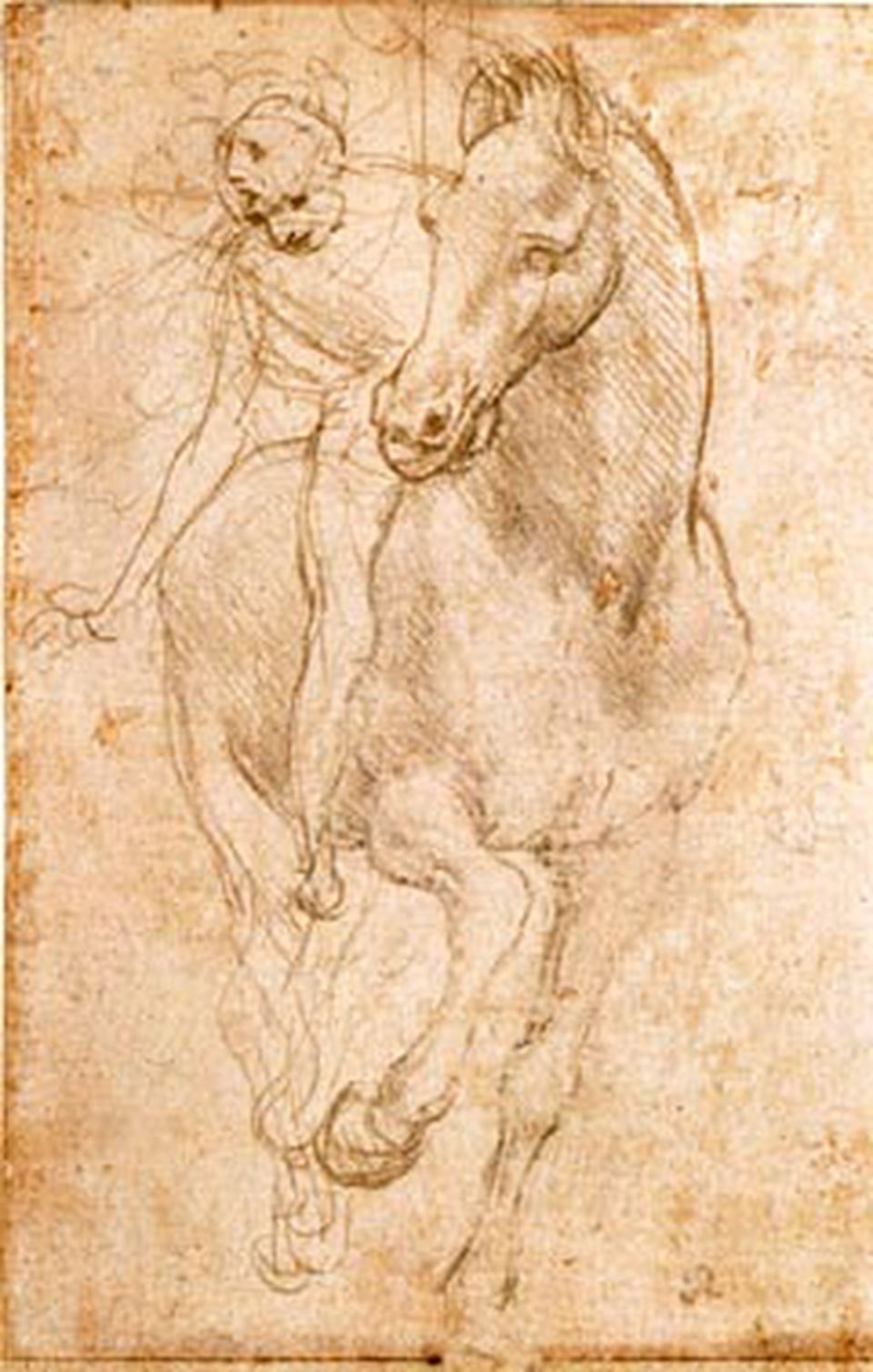
When you see Leonardo's drawings, particularly his silverpoints, this intimacy is even more salient. Most of his silverpoints are perhaps two to three inches by four to five inches, at most. They are tiny. But despite their diminutive size, they are incredibly powerful.

Study of Horses, Leonardo da Vinci, silverpoint

Study of Horses, Leonardo da Vinci, silverpoint

His notebooks and drawing books, too, are very small indeed and it amazed me, when I saw some of them at the Louvre in a wonderful exhibition, that he had such control of his hand on such a restricted surface, especially when all the writing was "backwards". Drawings have always been considered intimate media. Silverpoints, chalks, pen and inks, graphites, charcoals, pastels and even watercolours - they all invite close inspection, a whispered dialogue between art and viewer. Historically, drawings were to be displayed (and protected) in muted light, in the inner sanctum of an art lover's home, in the "cabinet de dessins". Usually of a scale that is in function of the human hand and the marks it makes on paper or vellum, a drawing is ideally viewed by a single person at a time, a very human scale in concept and proportionality.

Plant-bush study, Leonardo da Vinci (Image courtesy of the Royal Collection)

Plant-bush study, Leonardo da Vinci (Image courtesy of the Royal Collection)

The scale of art is an endlessly interesting consideration, with a huge effect on the viewer. Every artist gets involved in this issue each time a work of art is conceived, as you have to decide what size the work of art is going to be. At present, we seem to live in a world of extremes - there are diminutive, often gem like creations and then there are the colossal works which often have trouble fitting even into large public spaces. These are works conceived for viewing from a long distance, with the art often dominating the space in dramatic and often vividly coloured fashion, with robust content and form. Perhaps an obvious example of a large canvas is Picasso's passionate antiwar Guernica, measuring 11 x 25.6 feet, now at the Reina Sofia Museum in Madrid (http://www.museoreinasofia.es/). Viewing gives a visceral jolt, but I always feel I need to back away quite a distance fully to understand its powerful messages.

Another series of large paintings that come to mind are the 14 Mark Rothko paintings in the Rothko Chapel adjacent to the Menil Collection in Houston, Texas (http://www.rothkochapel.org/).

The Rothko Chapel

The Rothko Chapel

Their size, (11 x 15 feet or larger in the triptychs), the chapel built to house them and the general ambiance created by these vast dark canvases are utterly memorable. This is the artist who declared back in 1942, about his and Adolph Gottleib's work, "We favor the simple expression of the complex thought. We are for the large shape because it has the impact of the unequivocal..." Interestingly, in the next decade, he replied to critics who were claiming that he was working on a large scale to compensate for a lack of substance in his paintings. He wrote, "I realise that historically, the function of painting large pictures is painting something very grandiose and pompous. The reason I paint them, however ... is precisely because I want to be very intimate and human. To paint a small picture is to place yourself outside your experience, to look upon an experience as a stereopticon view or with a reducing glass. However you paint the larger picture, you are in it. It isn't something you command!"

And yet, Rothko circles back to what Leonardo said, in terms of the viewer's ideal distance from his paintings. The span of centuries does not change this recommendation: Rothko suggested that eighteen inches are an ideal distance from which to view one of his canvases. Like Leonardo, Rothko knows that at those close quarters, a sense of intimacy leads to a dialogue with the art that can take the viewer far beyond self into the realm of the unknown.

Art, an underground stream flowing through life by Jeannine Cook

In a wonderful PBS American Masters piece on Philip Glass, the composer talks of music being an underground river always flowing, into which one needs to tap by listening carefully and attentively. (http://www.philipglass.com/)

In the same way, I think that visual art is part and parcel of many people, another underground stream flowing through their life. The more you learn to see, the more you can tap into the underground stream - whether that seeing leads to the creation of art or the active enjoyment and collection of art. The stream usually starts flowing early on in life, even if one is unconscious of it at the time. Many artists draw on early visual memories in the creation of later work, even if the memories are transformed. One of my fellow Visiting Artists at Spring Island, SC, is the perfect example of this transposition - Brian Rutenberg, from the Charleston area, uses his "underground stream" of visual experiences to paint wonderfully abstract evocations of those remembered places. Even though he does not live in Charleston now, those childhood memories flow on for him into his art.

Pavilion, 2008-09, by Brian Rutenberg, oil on linen, courtesy of Jerald Melberg Gallery, Charlotte, NC

Pavilion, 2008-09, by Brian Rutenberg, oil on linen, courtesy of Jerald Melberg Gallery, Charlotte, NC

In the same way, I find that my memories of East Africa will periodically become part of my art.

Patterns of Africa, silverpoint, watercolour, Jeannine Cook artist

Patterns of Africa, silverpoint, watercolour, Jeannine Cook artist

This alchemy of the subterranean presence of art being transformed, often almost in spite of oneself, into art is so important that one needs to learn to trust that inner voice, that inner eye. It is part of the experience that is built up over time in the creation of art. Educating one's eye to see potential drawings and paintings, honing one's skills, studying and appreciating other people's art, from all periods, particularly in museums, are all part of tending that underground stream flowing inside each of us.

In a strange way, it makes me think of a description of a French winegrower about the way wines are created. He talked of the slow and noble evolution of the wines, "carrying with them hopes for a prolonged life." With vineyards that have existed for generations, surviving all manner of calamities from disease to war to revolution, there is always the promise of a fresh harvest, a continuing wine making cycle. Indeed, these cycles of wine cultivation and creation represent "a taste of eternity". (War and Wine, a wonderful book by Don and Petie Kladstrup, published in 2002 by Broadway Books). The winegrower was perhaps, in his own way, talking of the same sense of a continuum, an underground stream into which to tap as he created his wines.

"Art is everywhere" by Jeannine Cook

American sculptress, Louise Nevelson, once said, "I always wanted to show the world that art is everywhere,except that it has to pass through a creative mind."  I find that a wonderful optic for an artist to embrace, because it gives one carte blanche to seize upon any and everything as grist for the mill in creative terms. It means that ideally, one's antennae are up and working all the time, because you never know when you will find a new idea that leads to doing something creative.

Not only does one needs to be attentive to the world around one, but also, I personally find, there needs to be time to be quiet and not particularly active in thinking about creating art. It is at almost meditative times- when ironing, walking, lying half-asleep at night, etc. - that I find ideas comes floating into my head, or connections between things I have seen or heard are made that can lead to something creative. More and more, I understand that art-making, for me, seems to be a function of being comfortable in one's skin and head, so as to speak, when trust exists in what might float up and happen, leading to ideas and new dialogues. You never know what will surface, but you just need to know that indeed there is art potentially everywhere to be welcomed. It can be the most humble of things or the most amazing of sights. Frequently, I will pick up something on a walk and get a look of surprise from my husband. But later, the resultant art will be greeted with a nod of understanding!

Sapelo Lichen, silverpoint, white gouache highlights on tinted ground), Jeannine Cook artist

Sapelo Lichen, silverpoint, white gouache highlights on tinted ground), Jeannine Cook artist

When you think of what Louise Nevelson picked up by way of discarded "rubbish" and then turned into amazing creations, it gives every artist licence to use any and every resource as a bridge to creation. Not only creation, in fact, but the new interpretation and/or version of whatever has been created serve potentially as a source of fresh dialogue and understanding between people around the world, transcending borders and cultures. Art is everywhere and its presence allows more art to flourish in the future.

One Step at a Time by Jeannine Cook

I have just been sent a beautiful video, The Daffodil Principle, with glorious photos of fields of daffodils blooming and a message that not only pertains to everyday living, but to artists in particular (http://www.slideshare.net/azharabbas/the-daffodil-principle-1076680).

Daffodil Fields

Daffodil Fields

Daffodil Fields

Daffodil Fields

The story tells of five acres of these daffodils and other spring bulbs which surround a modest home. On the porch of this home is a sign giving the answers to the obvious questions: how many thousands of bulbs have been planted, one lady planted them all, bulb by bulb, year by year, etc. The nub of the question is: when did the lady start planting her wonderful display? The answer: 1958.... in other words, fifty years previously, this good lady already had a plan, a vision, of what she wanted to create and achieve in terms of a magnificent glory of spring flowers. She did not put it off until another day, another week, another year: she just got on with planting bulbs, systematically, deliberately.

Artists are advised to have a long-term business plan, for instance, but not often do I hear a long term plan advocated in terms of artistic growth. I don't mean for what type of art one should create x number of years ahead or how many pieces of art one should create, year by year. Just like the daffodils, one never knows what will sprout from any seeds - or bulbs - that one might plant in terms of artistic endeavour. But I think that if one is a passionately committed artist, determined to grow and flourish as an artist, there has to be that deliberate, step-by-step feel to everything one tries to do. Like the good lady planting her bulbs, you can work a little here, work a little there, incrementally, all the time mindful of the longer term goals you aim to achieve. Drifting too much helps neither artists nor gardeners. Procrastination, waiting for inspiration, the right moon, whatever - it does not achieve much. You have to be driven to accomplish something. Day by day.

Perhaps the key is the overarching desire to create works of beauty - yes, that troublesome word, with so many shades of meaning, in the art world! - that will touch other people in the future. Like the lady planting her bulbs for posterity, we need to be mindful of the wider world, all those people out there who could potentially see and be enriched by what is created, even if briefly, like the fleeting days of spring.

The White of Paper by Jeannine Cook

I have drawing on Stonehenge paper, which I find so responsive, and the white of the paper came again to the fore. It is fascinating how the white of the surface on which one is painting or drawing suddenly takes on its own life and begins to dictate.

Initially there can be the white paper fright - rare, I have to admit, but it happens. This is when one is totally intimidated by that pristine white surface facing one on the drawing board. It is so pure, so virgin, so unsullied. Where on earth does one start? And CAN one even start sensibly? But then that stage passes, usually pretty quickly because one is already all involved with the project already and anxious to move ahead.

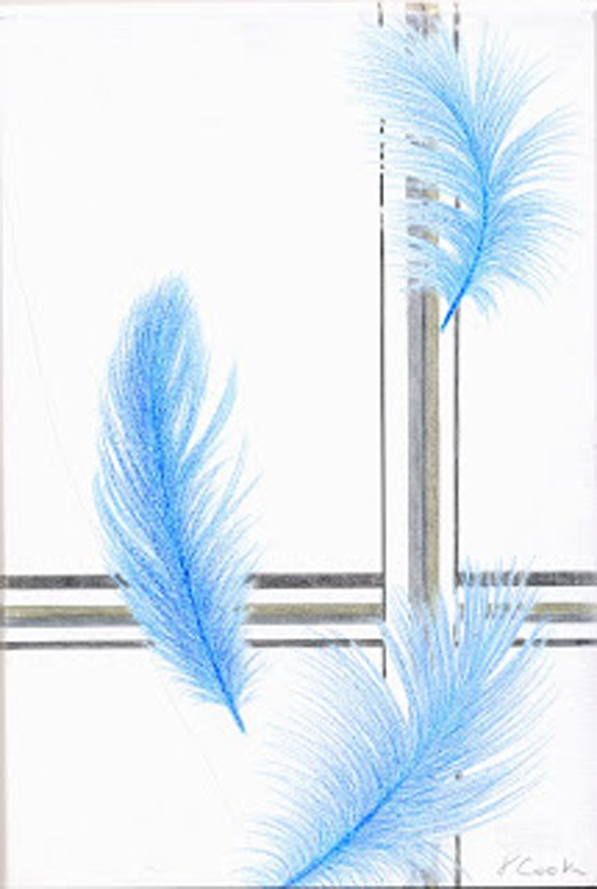
The Three Feathers, metalpoint/watercolour, Jeannine Cook artist

The Three Feathers, metalpoint/watercolour, Jeannine Cook artist

Once into the work, the decisions as to where to leave the white of the surface, or even if to do so, become more interesting. And the paper itself begins to talk and dictate. White is a powerful colour; it is not just the negative part where one has not put colour. It can hold its own against all comers, and can even dominate too much unless care is taken. And, of course, it does not have to be pure white - I draw on cream papers where the same situation pertains. Since, ideally, I try to adhere to the concept of "less is more", that plays hugely into the role that white can play, particularly in a drawing. It is all a balancing act, where a sense of composition becomes important. And of course, it becomes fun and interesting, because you never know if you or the white of the paper is going to "win".

I think every artist should cultivate their own personal relationship with that powerful player, Lady White, because it can lead to endlessly rewarding dialogues and good art.


Art - a Golden Thread through Life by Jeannine Cook

Art seems to exert an extraordinary power over so many different people. Artists, understandably, have a passion for what they are doing. But then there is the other side of the equation - the collectors, the public that views art of all description, the sponsors and all those who form a constituency for art. It is no wonder that more and more people view art not only as an investment per se but also as an economic driving force for communities who actively embrace the arts.

Historically, for instance, the great museum collections of the world have been largely formed, at least initially, by wealthy private art collectors who then donated their collections. Names such as Frick, Morgan, Getty, Guggenheim, Whitney, Rockefeller, Mellon or Annenberg all evoke remarkable monies and energies poured into collecting art. In the same way, kings and nobility in Europe and beyond had done the same thing down the centuries. Early in the 20th century, Sergei Shchukin and Ivan Morozov carried on that tradition in Russia. Today, a plethora of collectors worldwide follow suite - from Baron Thyssen to Charles Saatchi, Ronald Lauder or Francois Pinault. But beyond the wealth and connoisseurship, there is a driving force involved with art - people just get hooked.

We have all experienced it at some point. You round a corner in a museum, or walk past a gallery window, and you spot a piece of art - painting, sculpture, drawing, whatever... It stops you in your tracks. You are drawn back to it, to look more closely at it, to ponder, to enjoy, to understand, to remember... often eventually to buy for yourself, if possible.

That is when the golden thread of art re-twists itself around you, enriching and expanding your world. The artist may not even be aware that the created work will have such a reaction in a viewer, but the passion in the art clicks with a passion evoked in the viewer. Of course, there are innumerable sensible and hopefully educated criteria by which to judge and appraise a work of art. In the end, however, a true collector and lover of art will boil down all the considerations to one : do I love this piece of art enough to want to live with it?

Art's golden, silken thread weaves though life in so many unexpected ways. You never know when you are going to fall in love with a piece of art, nor what form that art will take. From the artist's point of view, you never know what form inspiration will take next nor where your art will take you in the creative process. Nor, for that matter, what experiences will present themselves or which kindred spirits one will meet through art.

The more I travel though life as an artist and art-lover, the more I understand how necessary it was already to our ancestors of 30,000 years ago that Lasceaux, Altamira, Chauvet and other caves were being filled with wonderful art. People knew even then how important it was to the human psyche that art should grace our lives.

Artistic independence by Jeannine Cook

Every time I open a magazine or paper addressing the art world at present, there seems to be another indication of the closing of galleries, shrinking of museum activities or general hard times for artists. As in every other field, there is an on-going shake-out and re-evaluation of the recent assumptions and priorities.

But it is also a time to be opportunistic as an artist, to do some personal re-evaluation and to try and grow professionally. I found a wonderful quote from Georgia O'Keeffe which I felt is a really fitting sentiment for now : "I have but one desire as a painter - that is to paint what I see, as I see it, in my own way, without regard for the desires or tastes of the professional dealer or the professional collector....". That is a clarion call if there ever was one! And one, I believe, that each of us can learn from, because artistic independence is an oft-shaded affair, especially when a certain type of art that one is producing is selling well. It is so tempting to go on doing the same thing, the same formula, but in the end, that does not often lead to artistic growth. The same tendency can come from dealers who find that a certain type of art sells better than another type, so they "suggest" that one stays in the winning lane.

Georgia O'Keeffe Grey Lines with Black, Blue and Yellow c1923 Museum of Fine Arts, Houston

Georgia O'Keeffe Grey Lines with Black, Blue and Yellow c1923 Museum of Fine Arts, Houston

When all bets are off in terms of what art will meet with financial success, it rather liberates an artist. Each of us is free to produce art that is personally important in terms of convictions, passions, experiments, etc. Only time will tell whether these new ventures will meet with financial success, but in the interim, you probably will grow as an artist. And surely, as Georgia O'Keeffe proved so wonderfully, that is what it is all about, at the end of the day.

Art and Meditation by Jeannine Cook

I recently read a fascinating review in Art in America (April 2009) by Edward M. Gomez, entitled Altered States. It was a review of the just-closed exhibition at the Guggenheim Museum on "The Third Mind", which examined the influence of Asia on earlier generations of artists. Apparently, many of those artists meditated, a result of their interest in Buddhism. Their ability to pay attention to matters deemed "ordinary" and to be able to "suspend time" derived, it was thought, from their practice of meditation. Artists as diverse as Arthur Dove or John Cage were cited in the article.

Thinking about the role of meditation in my own experience made me realise that although I do indeed meditate, I find that the act of making art is in itself a form of meditation. Most artists I know find that time becomes a very variable affair, since we all lose track of time very easily when creating art. However, I also find that I become much more efficient at using the rest of my time, away from art, to do all the other daily chores when I am working on a painting or drawing. I wonder if that is a common occurrence? It is also easy to pay close attention to whatever art and subject of art I am involved with, although I don't know that I would attribute that aspect of art-making to the practice of meditation.

When I am not able to work as an artist, I find I get really dislocated, and so it is a relief to revert to mediation to make life more serene. Brain circuitry in artists must be predicated on a daily "fix" of art, apparently!

The rhythm of observation and creation, drawing and looking, is indeed addictive. Even when I find myself inside because of bad weather, as happened when I was Artist in Residence once at Wild Acres in the Blue Ridge Mountains, there is a meditative peace and serenity from trying to create harmony and yet accuracy in a silverpoint drawing. Even with the most humble of materials!

This was the result of two days of solid rain and yet I had little realisation of how much time elapsed during the execution of the drawing.

Blue Ridge Mountain Meditation, silverpoint 11 x 15" image, Collection of Evansville Museum of Arts, Science and History, Evansville, IN

Blue Ridge Mountain Meditation, silverpoint 11 x 15" image, Collection of Evansville Museum of Arts, Science and History, Evansville, IN

Perfumes, sound and light by Jeannine Cook

I have just spent time in my other home in Palma de Mallorca, Spain. There, it is a green and beautiful spring after bountiful rains this year, and the island is celebrating with exuberant growth on mountain slopes and down stony valleys.

I had some time to paint and draw, and once again, my sense of place was expanded and extended. I know that wherever one is working outdoors as an artist, you become conscious of all your surroundings. It seemed to be especially the case this spring in Spain: the perfume of orange blossom, lemon blossom, jasmine and roses floated everywhere on the air.

Citrus sinensis Osbeck painting by Mary E. Eaton from a 1917 issue of National Geographic

Citrus sinensis Osbeck painting by Mary E. Eaton from a 1917 issue of National Geographic

As the sun warmed, each morning, and the sky became brilliant, the perfumes intensified and became intoxicating. The light grew more brilliant - oh, that Mediterranean light! And as I sat quietly, totally enraptured with all this light and drunk on these exquisite perfumes, I was serenaded by blackbirds singing their wondrous melodies, or tiny serins buzzing excitedly high in the trees above.

I was soothed and inspired. As the light changed and the flowers I was depicting opened, moved and faded, I was enveloped in this world in which I was sitting. I felt a bond and a sense of kinship with all the wonderful artists who have worked in the Mediterranean region down the ages - Italian masters like Botticelli or Guercino, Corot, Monet, Renoir, Matisse, Cezanne or Raoul Dufy in France, even Joaquin Sorolla y Bastida, just to name one Spanish artist who celebrated so superbly the brilliant light of Spain (go to this site if you speak Spanish or this one for English). They all responded to the same light, perfumes and sounds. From the flowers painted on the walls of ancient Egyptian tombs to the frescoes on walls of opulent homes in Pompeii, artists have always gloried in the beauties of flowers growing in the Mediterranean world. I felt it was a great privilege to be immersed in this world of brilliant light, intoxicating perfume and liquid bird song, as I celebrated Mallorca's spring flowers in silverpoint and watercolour.