Lines by Jeannine Cook

Lines loom large in all our lives from a very young age. Who hasn't taken a pencil, a pen, even a lipstick, and made energetic, happy scribbles on all sorts of surfaces from early childhood? Those were our drawings, and they often won praise and encouragement.

Later, lines become the underpinning for paintings, the punctuation marks for long columns of additions in arithmetic or the scaffolding for musical notes on a score. So many uses and so many meanings... But for anyone interested in art, a line becomes more and more nuanced and meaningful. Not only does one learn to use line to express oneself in silverpoint, graphite, pen, paint, charcoal or any other medium, but you also see line much more clearly all around you. For me, the contour lines traced out in grassy strips between ploughed fields to prevent erosion on our farm were some of the earliest memories of line. Even an avenue of trees is two parallel lines that speak of time, order, shade, beauty and horticultural skill - another childhood fascination.

When I draw in silverpoint, lines can whisper or speak loudly, in a metaphorical sense. Just like the lines drawn in space by a violin bow as it moves across the instrument, softly, sensuously, vigourously or hesitantly. Or like the traces of an insect when it walks on a sandy surface. I drew this set of tracks on Sapelo Island, Georgia, in the sand dunes.

Sand Dune Colony, Sapelo - silverpoint, Jeannine Cook, artist

Sand Dune Colony, Sapelo - silverpoint, Jeannine Cook, artist

When one looks at lines drawn by Albrecht Durer (www.en.wikipedia.org/wiki/Albrecht_D%C3%BCrer) in a silverpoint drawing, such as those in his 1520-21 Diary of A Journey to the Netherlands, they run the gamut of effect and message. As he records an amazing variety of people, places and things he sees during his trip north, the silverpoint lines show his questing eye, trying to understand the anatomy of a dog, the pattern of a tiled floor, the bone structure of a woman's face... Lines in a drawing can show how the artist's eye, brain, hand and paper surface are connecting together; that is why drawings are so often considered so immediate and fresh.

Dog resting, silverpoint, from 1520-21 Sketchbook, Albrecht Dürer (Image courtesy of the British Museum)

Dog resting, silverpoint, from 1520-21 Sketchbook, Albrecht Dürer (Image courtesy of the British Museum)

Frequently lines become like a golden orb spider's magnificent web, linking together in complex fashion to become a drawing, a painting, an architect's structure. Every time we start to work with lines, something unique evolves. A simple line, short, long, interrupted or continuous, can be an amazing creation.
What is the value of art? by Jeannine Cook

With the current economic woes affecting people around the world, artists are on the front line of those adversely affected. The value placed on art becomes ever more important, for everyone involved in the artistic world. So a heartening piece of news is yesterday's announcement that TEFAF Maastricht 2009, the most important and prestigious art and antiques fair in the world, has been a successful fair, with sales strong and museums still buying (www.artdaily.org/index.asp?int_sec=28int_new=29771).

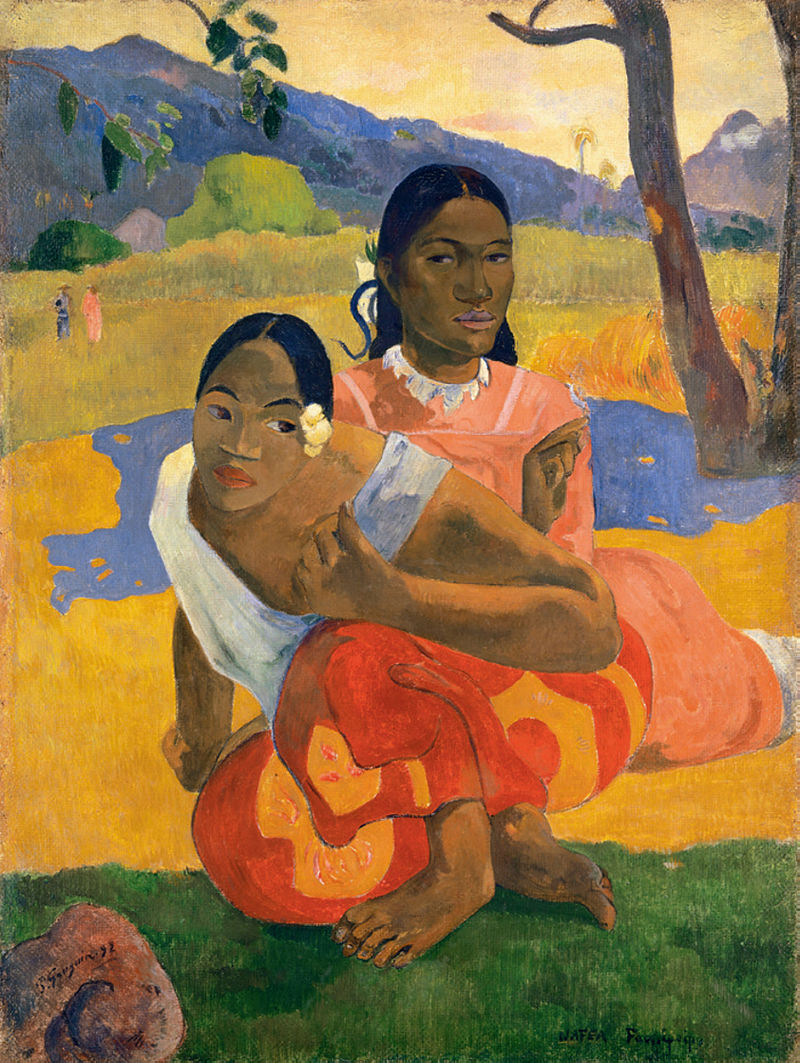
Paul Gauguin, Nafea Faa Ipoipo? (When Will You Marry?) 1892, oil on canvas (Image courtesy of the Beyeler Foundation)

Paul Gauguin, Nafea Faa Ipoipo? (When Will You Marry?) 1892, oil on canvas (Image courtesy of the Beyeler Foundation)

One still is left with the nagging question : are we into a new era now, where a higher value is placed on a piece of art for its content, its aesthetic, its humanism... rather than just the value placed on it by the market place, with all its fashions, fads and tendency to treat art as a commodity?

It is always said that an individual buyer should buy a piece of art because he or she likes it and wants to live with it. That dialogue with the art can take innumerable forms but the bottom line is that ideally, there should be a genuine positive reaction to the art. Since art can enhance, enlighten, amuse, inspire, calm, instruct, distract..., on a daily basis, the value placed on the art can end up being rather subjective. Nonetheless, in stressful times such as these, it seems that people increasingly turn to art, music, poetry, and other such creative ventures. Thus their value is much more than monetary. The WPA art projects are an eloquent reminder of how valuable art was held to be during the Great Depression.

If there are still buyers willing to pay high prices for art esteemed to be of high quality, it seems that connoisseurship is trumping fads and fancies of the moment. That is good news for those who value art that addresses aesthetic and humanist aspects and what each work is trying to say.

"Art should be a rebellion" by Jeannine Cook

The wonderful Lebanese bard, Marcel Khalife, was interviewed in late February on PBS by Jeffrey Brown during the Newshour (http://www.pbs.org/newshour/art/blog/2009/02) about his music and life. Khalife evoked the song he sings, Passport, which uses the words of a haunting poem by the late extraordinary Middle Eastern poet, Mahmoud Dawish. The gist of what he said at one point was that art should be a rebellion, and it should not submit to ordinary life.

Perhaps one of the problems people have with the concept of beauty in art, (see my blog entry of 22.2.2009) is that often art implicitly challenges comfortable assumptions we have about our world and our opinions. A large percentage of artwork, in all media, is overtly or covertly rebellious. Politics, social customs, economic situations - a whole host of issues is addressed by artists in their work. If one is even vaguely aware that there are "subversive" messages in the art, one's opinion can thus possibly be coloured as to whether the art is beautiful or not.

An Act of Rebellion

An Act of Rebellion

Not submitting to "ordinary life", challenging the status quo, can take many forms in art. Even using art, as I often do, to draw attention to our collective potential loss when fragile and often beautiful environments are destroyed, is a certain form of resistance. Coastal Georgia is frequently under assault from "development" and so-called "progress"; any challenge to the notion that destroying places for personal enrichment is perfectly acceptable can be seen as rebellion. Every artist finds issues about which passions are stirred - those issues become that artist's personal rebellion. Society needs lots of artists - their rebellions are ultimately our collective conscience.

Concepts of Beauty by Jeannine Cook

It is interesting to follow the often passionate debate in the art world about beauty. Some people almost seem to reject the notion that beauty might be part of the artistic dialogue, while others feel that some form of beauty is an integral part of artistic creation. Even the definition of beauty is fluid, according to different eras and personal concept.

Whilst the art world is seemingly unsure about any hard and fast rules on concepts of beauty, the photographic world and its related media are much more straightforward on the issue. Beautiful photographs, on a myriad subjects, abound and are enthusiastically recognised as such. Perhaps the camera's eye, focusing on something that exists in the world around us, is sufficiently analytical that it allows us, the viewers, to enjoy the image without feeling quite the need for the aesthetic analysis expected of us when viewing a painting or drawing. Whatever the difference, we are all aware that today's photographers are documenting earth's extraordinary beauties in ever more detailed and dramatic fashion. Whether it is animal, bird or plant photography - on a macro or microscopic scale, in colour or black and white - we can sense the power and beauty of the image. Photographs showing glaciers tumbling into the sea, icebergs forming, marine life deep below the sea surface or innumerable other images documenting the world all resonate with us, and no one cavils at their being labelled beautiful.

Photographers can have just as many concepts and messages behind their images as any visual artist. Their profession is just as demanding as that of a painter, often far more so in terms of danger. The difference perhaps lies with us, the viewing public, in our acceptance of what is beautiful, in what form and done by whom. Today, people are more at home with digital images displayed everywhere. Ideally, we should become just as comfortable with forms of visual art being displayed ubiquitously. Perhaps then we can all relax about what is beautiful and just enjoy the enrichment these creations -digital, painted, drawn - bring to our lives.

"Drawing should be like nature" by Jeannine Cook

Charles Baudelaire, in his statement for L'Exposition Universelle in Paris in 1855, wrote, "A good drawing is not a hard, despotic, motionless line enclosing a form like a straitjacket. Drawing should be like nature, living and reckless... nature shows us an endless series of curved, fleeting, broken lines, according to an uneering law of generation, in which parallels are always undefined and meandering, and concaves and convexes correspond to and pursue each other."

Today, I was celebrating an incredibly beautiful spring day with friends on a wild and unspoiled barrier island. As we walked along its shoreline, the red cedars and live oaks sprawled towards the marshes, their roots tangled and tenacious. Oyster shells lay glistening white, carpeted above high tide levels by the warm golden russet of freshly fallen live oak leaves. Everywhere I looked, there were joyous, ebullient abstract drawings waiting to be done of the roots of these trees as they twisted and clung, embraced and snaked. Baudelaire could have been thinking of such scenes as he described what a good drawing should be. I am not sure I could live up to the "good" part of his definition, but I do know that I need to return soon to do more silverpoint drawings of this amazing area where marshland meets high ground in reckless turbulent celebration of life and survival.

Tenacity amid the Oyster Shells, silverpoint, Jeannine Cook artist

Tenacity amid the Oyster Shells, silverpoint, Jeannine Cook artist

In truth,I have always loved these tangles of red cedar roots, oyster banks and sunlight, as shown by these are two silverpoints I did in coastal Georgia several years ago.

Sunlit Fugue, silverpoint, Jeannine Cook artist

Sunlit Fugue, silverpoint, Jeannine Cook artist

Rendering life itself by Jeannine Cook

Sitting this evening in the Rotunda Gallery of the Telfair Museum of Art in Savannah, Georgia, I was listening to violinist Daniel Hope and his friends create the most wonderful chamber music on the second day of the Savannah Music Festival. Around me on the walls of the museum were works of art large and small from the museum collection, dating mainly from the late 19th or early 20th century.

I thought back to a quote I had read by Roger H. Boulet, that "Life's ephemeral quality has always been evoked by artists". Composers and visual artists alike strive to convey their visions of life itself, or what they perceive that life to be in time. The searing passion and serene beauty of Samuel Barber's Adagio from String Quartet seemed to be the epitomy of Boulet's quote. Dvorak's Piano Quintet in A Major was full of romantic energy and melody: it echoed in feel some of the paintings on the museum walls that harked back to earlier, perhaps less complex times.

For each artist, rendering life itself is complex, intensely personal and usually the result of passion, technical skill and tenacity. Working out what you want to say in paint, pencil, music or any other medium is one thing; finding the right vehicle through which to express that message is another thing. Sometimes an artist knows clearly, ahead of time, what the work of art will be like. I find on occasion that I can envisage clearly the drawing or painting I want to do, down to a very detailed level, and yet, when I actually work on the piece, it inevitably acquires its own life and dictates to me how to proceed. In a way, I feel this is "rendering life itself", because life is flowing through me to the artwork and back again, to form an ongoing dialogue. The act of creating art (and I am sure, music or any other medium) is one part one's own will and input, but two parts the energy and life emanating from the piece being created. One always hears of novelists talking of their characters becoming "alive" and telling the author how to proceed in the novel. And yet, in each case, the act of creation is reflecting life's ephemeral quality as it is a moment in time: that art will never again be created in quite the same way.

The music I was lucky enough to hear performed this evening was definitely a wonderful sampling of art created to celebrate and render unique and fugitive moments in time. We are the richer for this music, just as we are richer for the other arts we inherit and enjoy in the world community.

The energy of art by Jeannine Cook

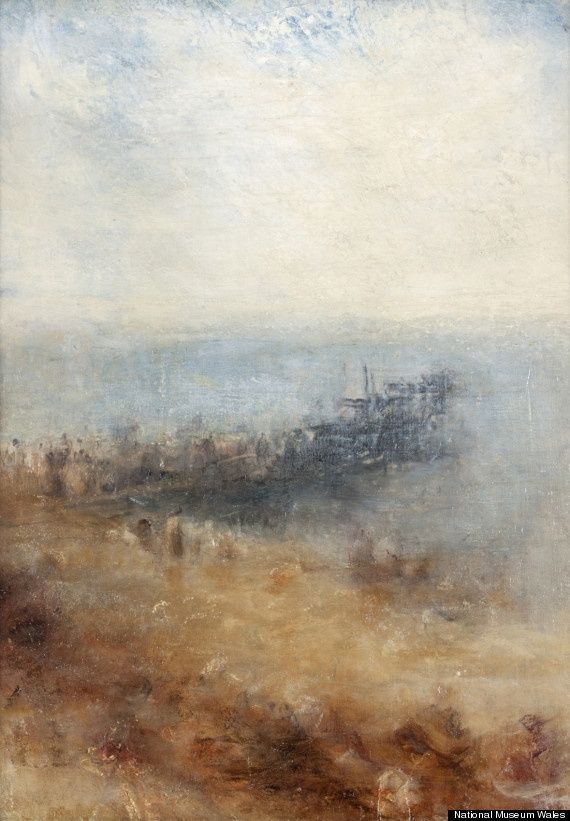
During a visit to South Carolina to see the recently-opened exhibition from the Davies Collection, National Museum Wales, Turner to Cezanne, at the Columbia Museum of Art, I was struck afresh at the energy and magic created by art.

Not only was the exhibit a delight, with small canvases of great interest and often great beauty, but the whole experience of seeing the show was fascinating. The exhibition galleries were thronged with excited, but well behaved school children being taken around by docents. Their energy and fresh reactions to the art were a delight to be a part of as one looked at the art more slowly than they were able to. In amongst the school groups were numerous adults, clearly enjoying and appreciating the exhibition too. Why did I find this so striking ? Well, apparently this is the the most important show the Columbia Museum of Art and its supporters have brought to the city, and despite the current economy, the response from the public has been massive. In the first week already, the museum has seen huge numbers of visitors, both local and from elsewhere.

To me, the public excitement generated by this exhibition reminds one again how art brings people together and strengthens communities. By the time my husband and I had emerged from the museum, we had talked to countless people and even exchanged addresses with new friends. Each painting in the exhibition, from France mainly, but also from England, Wales, Belgium and Holland, quietly or dramatically "spoke" of different landscapes and places, different people and their mores, diverse optics on life in general - all a wonderfully subtle and beguiling way of learning of other lands, their history and culture. Each artist, whether it was Turner, Monet, Van Gogh, Manet, Pissarro, Whistler, Renoir or Cezanne, passionately told of their experiences and convictions, beauties and visions.

Jospeh Mallord William Turner Margate Jetty, National Museum of Wales

Jospeh Mallord William Turner Margate Jetty, National Museum of Wales

People were smiling, obviously interested and learning, marvelling at different aspects of the art. In other words, the visit to the exhibition moved visitors, made them feel better and made their day special.

What a perfect prescription - go to see an art exhibition to make one feel energetic, inspired and even joyous!

Shadows by Jeannine Cook

I recently reread the quote, "There is no beauty without shadows", from Junichiro Tanizaki's 1933 slender book, In Praise of Shadows. Tanizaki was, in part, contrasting the Western and Japanese concepts of beauty, amongst other subjects. Shadows for him represented the obliqueness of nature-based arts, weathered naturalness, the play of light on moss, a single candle light bringing alive black lacquer flecked with gold or silver - in other words, the subtle, understated traditional versions of beauty so esteemed in former times in Japan.

His celebration of transient beauty found in shadows made me remember all the Japanese woodcuts with which I grew up. My grandparents lost everything in the 1923 earthquake and fire in Yokohama, Japan. My grandfather stayed on for two years afterwards to help in the city's reconstruction. In order to help the devastated Japanese artist community, he and other Western businessmen clubbed together to commission a series of woodcut prints, based on traditional Ukiyo-E (pictures of the floating world), from a group of artists. A set of prints came to East Africa with my grandfather and graced the wall of the home in which I lived in Tanzania. In these woodcuts, the shadows are subtle, elusive and allusive. From this art, I learned that shadows are really far more revealing than light.

A Japanese Beauty, after Kogyo Terasaki, woodcut (Jeannine Cook collecton)

A Japanese Beauty, after Kogyo Terasaki, woodcut (Jeannine Cook collecton)

As an artist myself, I love the abstract underpinnings of a drawing or painting created by the play of shadows. It is like magic: you try to capture the fleeting shadows on a flower, a tree, a landscape, and suddenly, from this seemingly inchoate medley of darks, you have a comprehensible image. The gradations of shadow are also endlessly revealing, describing the object in space. Within those shadows too, are so many colours, local, reflected, warm, cool - you can look and look and always learn more. Next time you are glorying in a sunny day, look at the shadows and marvel. Tanizaki was right to say, "There is no beauty without shadows."

Personal signatures by Jeannine Cook

For anyone, not just an artist, standing out from the crowd is increasingly difficult. Too many people, often crowded together in busy places, mostly wearing the same types of clothes, all buyers of the same consumer goods. No wonder artists need to dream up really unusual angles to get noticed and become successful. The same is true, really, of anyone trying to do anything, especially in the creative world.

An interesting commentary on the different ways people try to distinguish themselves in society is an exhibition now showing at La Salle University Art Museum in Philadelphia entitled Second Skin. The artist, Susan Moore, does drawings of people in faint charcoal, but then paints or draws in ink bold tattoos, burns or scars on these body images. She is highlighting how people are rebelling against our increasingly grey and uniform world by trying to distinguish themselves, to give themselves a clear identity, by using, for instance, tattoos. Moore also underscores the ironic fact that the more people use tattoos, themselves a real mish-mash of images taken from a wide variety of sources, the more they actually rejoin the common crowd from whom they were seeking to distinguish themselves. In fact, they are rather following the tribal practices of scarification on face or body to proclaim their membership of a tribe or group, submerging personal identity into that of a larger group. Susan Moore certainly found a thought-provoking theme for her exhibition of drawings, as well as a very skillful way to distinguish herself with her dramatic drawings.

Studio view, Susan Moore artist (Image courtesy of the artist)

Studio view, Susan Moore artist (Image courtesy of the artist)

When silence is the better path by Jeannine Cook

In the dialogue between artist and the public about work created, there is often a time when silence is preferable. There was a perfect example of this premise this morning during a NPR Weekend Edition interview Scott Simon did with Israeli composer, Avner Dorman. Mr. Dorman was talking about his compositions and how he reacts when they are played by individual musicians and/or orchestras. Whilst orchestras are usually very structured in their interpretation of the music, thanks to the conductor, he remarked that he frequently stays silent when soloists begin working with his compositions. He finds that often these musicians find other aspects in his work he had not been aware of (thanks to their own life experiences), and consequently, he does not intervene to talk to them of his music until late in the process. He referred to his compositions as "living organisms", with their own independent life.

In the same way, visual art has an independent life and should be able to survive on its own, to have a dialogue with each viewer that is meaningful. In fact, many artists find it invidious that artists' statements are so often requested to accompany paintings, drawings or other media before an exhibition. The work should, ideally, be able to stand alone, allowing a dialogue with viewers that is not guided by the artist. In other words, again, silence could often be ideal. Perhaps lack of confidence on the part of many in the viewing public about what to think and what to look at or for in visual art contributes to the need for an explanatory guide to understanding the art. However, learning to trust one's inner voice or instincts is a wonderful addition to enjoying art, music and so many other things in life. It is part of defining oneself as a human being, just as the artist, in creating the work, had to remain true to his or her artistic identity.

Wheat Field with Cypresses, Vincent van Gogh, (Image courtesy of the Metropolitan Museum)

Wheat Field with Cypresses, Vincent van Gogh, (Image courtesy of the Metropolitan Museum)