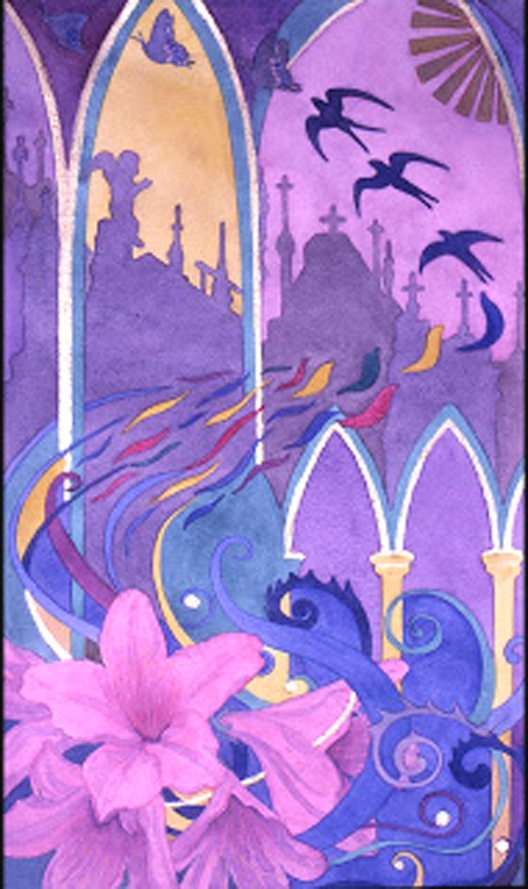
Artists' dialogues with viewers by Jeannine Cook

Defining yourself as an artist is really only one side of the equation in art. The other side is what each viewer brings to your art by way of life experiences which will influence that act of viewing. That mix of experience will complete the dialogue the artist started by creating a piece of art. Viewer and artist, the inseparable pair. And every dialogue will be different, which makes the whole process endlessly fascinating.

Ideally, an artist's vision will afford meanings and evocations of aspects of life far beyond the mere life-like rendering of whatever subject matter. But since each viewer's experience of life is individual, he or she will interpret the artist's work slightly differently. Often, when there is a great enough consensus about a piece of art, then it will be recognised as good art. However, as with everything else, each generation has a somewhat different set of criteria for art, based on that time, and so there are often revisions and fashions in esteem for art. As Sir Michael Levey, the late Director of Britain's National Gallery, was quoted in ArtNews (March 2009) as once remarking about the National Gallery's version of Van Gogh's Sunflowers, "It stands like a beacon of yellow fire, reminding us that outside the museum, art is always evolving – we only have to look" (my italics). Artists and viewers alike have to remember that those vital dialogues are endlessly changing and evolving as the years go by.

Fourth version, exhibited at the National Gallery, London, 1880s, Vincent v an Gogh, (Imae courtesy of the Van Gogh Museum)

Fourth version, exhibited at the National Gallery, London, 1880s, Vincent v an Gogh, (Imae courtesy of the Van Gogh Museum)

On a personal basis, I have found it totally fascinating to work with other artists and see the diversity in the resultant art, even when using the same subject matter. The most obvious example is when a group shares a model for life drawing: each person's drawing will be utterly different. Similar diversities will occur when those drawings are viewed, for each viewer will dialogue with each drawing in an individual fashion. Each viewer may respond to the artist's intensity, vitality and power to evoke beyond the merely descriptive, but there will be a very personal resonance for each person. And yet, even within the narrow confines of life drawing as one aspect of art, there is an implicit message. For any art to endure, it must be true to the spirit of its own age. Today, that art needs to be able to sustain a dialogue with viewers who are saturated with vivid imagery from so many sources, digital or otherwise, and whose life experiences are vastly different from those of even the previous generation. Artists, implicitly, need to dig deeper and work harder than ever before to sustain a rich dialogue with viewers. Quite a challenge!

More on identity by Jeannine Cook

Yesterday, I mused about the role of drawing in defining one's identity as an artist. Unlike painting, with its more elaborate statement and stage-like set-up, drawing allows an artist to explore and lay out all sorts of different ideas. There is often more flexibility and honesty shown in a drawing, which reveals the artist more readily.

Daring to draw and reveal an inner core requires an act of trust for the artist. Trust that one's own voice will come through and show the artist to be an individual, with a personal style. Basically a high wire act on many occasions, but worth the effort. The more one draws, the more one learns to trust that eye coordination with hand, the inner voice which dictates which marks to make, what to include, what to omit.

Drawing marathons help too - if you push yourself beyond the limit, as in any other discipline, you discover new strengths, new horizons as an artist. You refine who you are as a draughtsman and, by extension, who you are as an artist.

Photo of New York Studio School of Drawing, Painting & Sculpture - New York, home to Drawing Marathons (Image courtesy of Yelp.com)

Photo of New York Studio School of Drawing, Painting & Sculpture - New York, home to Drawing Marathons (Image courtesy of Yelp.com)

Defining your identity as an artist by Jeannine Cook

Defining yourself as an artist is a lifelong endeavour. Each of us aspires to have a singular voice, a hallmark style and an artistic identity unlike anyone else. Achieving one's own style as an artist is complex, on-going and both technical and psychological. First of all, I believe, it has to do with defining who you are as a person and what you want to say, overall, through your art. It also has to do with hanging on to your belief in yourself, being willing always to learn and adapt, but nonetheless, being true to your own core identity. Sometimes that can be hard, especially when tough economic times demand lots of compromises.

One tool which I find very useful to help me define my identity is drawing. Whether it is with charcoal, graphite, pen and ink, conte crayon, chalk or silverpoint, it does not matter. It is the act of drawing that helps strip things down to bare bones, to try to get at the core of what I am trying to say. In other words, to define my art and thus to define me as an artist. Drawing is a tool with two rather different uses. The first is to make a finished drawing, a work of art that stands alone. The second is to draw small, quick studies for composition, distribution of lights and darks, etc. in preparation for a painting.

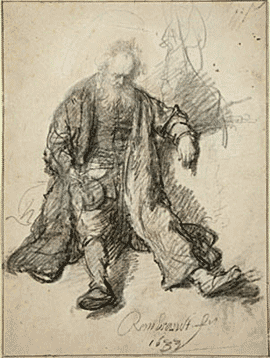
Lot Drunk, Rembrandt, 1632

Lot Drunk, Rembrandt, 1632

Rembrandt, Jesus and the Adultress

Rembrandt, Jesus and the Adultress

Drawing, unlike painting, is a direct, spontaneous act, indicative of emotions and thoughts in fresh and unadorned fashion. Many of the great Old Master drawings will leave errors and show corrections - a new line of a cheekbone on top of one that was off in proportion, an arm which has changed position slightly since the first line was put down, a tangle of lines where the artist was thinking of how to depict something or even blobs of ink where the pen "misbehaved". Rembrandt had many a tussle with his pens and ink but very frequently, that drawing could be readily recognised as one done by Rembrandt.

Try using drawing, any drawing, as a pathway to defining more clearly who you are as an artist. It is often a surprising and enlightening exercise - and fun as well.

Is creating art a process of discovery? by Jeannine Cook

It is often said that curiosity lies at the heart of all good art. Frequently, one has an idea about a subject to paint or draw, and the next thought is: why not try it in such and such a way technically, what if one includes x or y subject matter, or what if one approaches the subject altogether differently? In other words, how best to convey the inspiration? Since most artists are innately curious and observant, each drawing or painting turns into a voyage of discovery. Every piece of art has its own "voice" as well. So the artwork will, in essence, tell the artist how to draw or paint it. It is a question of being open, intuitive and attuned to what is happening on the canvas or paper.

Whatever the art being created, the artist will learn from the process of painting or drawing. I find that when I am doing a silverpoint drawing, I observe closely the subject I am depicting, partly because I want to understand it better but also because I am mindful that silverpoint is a severe taskmaster. You cannot erase the lines you make with the silver stylus on the prepared paper, so you live with what you put down. It is a good discipline because you try to understand the subject matter in order then to draw spontaneously. That spontaneity leads in turn to a stronger evocation of the subject.  Just as in other media, the silverpoint drawing technique should be the "silent partner" in the art making duo, playing the important but supporting role to the artist's curiosity and passion which engendered the art in the first place.

Think of Vincent Van Gogh's passionate curiosity. He embarked on extraordinary voyages of discovery every time he started a new painting, whether it was landscapes and scenes in and around Paris, Sunflowers, Dr. Gachet, the Yellow House or Cypresses. Each painting taught him something new and led him on to the next one in his headlong fevered creativity. 

The Yellow House, 1888, oil, Vincent van Gogh, (Image courtesy of the Van Gogh Museum, Amerstdam)

The Yellow House, 1888, oil, Vincent van Gogh, (Image courtesy of the Van Gogh Museum, Amerstdam)

Each of us, as artists, aspires to retain that freshness and energy needed to exercise curiosity, to go on voyages of discovery. Those voyages can lead to the creation of good art.

Does "a biological sense of place" help in creating art? by Jeannine Cook

Yesterday, I alluded to the question that I kept thinking about when I was working as Artist in Residence in Dinan, Brittany, through Les Amis de la Grande Vigne: does it help an artist to know well the area when he or she is painting, either en plein air, or creating work that is connected to a sense of place?

I think that a sense of comfort and familiarity frees up the artist to concentrate more on the actual art. It is really almost the same as "terroir", the biological sense of place that wine-growers talk of when they refer to specific geographical areas dictating certain characteristics in the wine produced from those regions. If you intrinsically know the place where you are working as an artist, you know, almost intuitively, the possible plays of light on the scene, the patterns, the rhythms of tides or seasons, the soils, the type of plants that grown there, etc. Because you already have this knowledge deep inside you, you can factor things in more easily as you are working. Understanding how the area "functions" means that you are not struggling so much to convey its character when you are drawing or painting.

Claude Monet is perhaps one of the most famous artists who used his sense of place, or "terroir", to allow him to produce extraordinary art. Starting with his famous series of 25 paintings of Haystacks, for instance, in 1890, Monet got to know those stacks of hay in all their times of day and weather.

Haystacks - Snow Effect, 1891, Claude Monet (Image courtesy of the J. Paul Getty Museum)

Haystacks - Snow Effect, 1891, Claude Monet (Image courtesy of the J. Paul Getty Museum)

His interest in producing series of paintings continued almost unabated until the end of his life in 1926. He explored the different aspects of Poplars along the river banks in all weather and times of day. Rouen Cathedral was another series which showed his fascination with this mighty structure in its amazing diversities of light. Perhaps the most celebrated, in terms of his sense and knowledge of place, is his huge body of work , "Les Nympheas", painted at his home, Giverny, based on the waterlilies growing in the pond he created. There are 250 canvases in the series, many showing his eyesight problems with cataracts. Nonetheless, his knowledge of Giverny was almost visceral, since he had virtually created the place. This familiarity allowed him to paint masterpieces that have captivated the world ever since.

Monet's example makes a very good case for an artist to get to know an area as thoroughly as possible when creating art. Maybe "terroir" is as desirable for artists as it is for wine-growers!

La Bretagne, terre fertile pour les peintres by Jeannine Cook

Lors d'un séjour récent en Bretagne, grâce aux Amis de la Grande Vigne, j'ai eu l'occasion de vérifier de nouveau l'attrait extraordinaire de ce pays breton pour les artistes. Cette Association fait sélection d'artistes pour les faciliter pendant un mois un Atelier d'artiste situé au port de Dinan (www.musees@dinan.fr).

Pendant mon séjour, je me suis retrouvée éblouie par les beautés naturelles si diverses de la campagne, de la mer et de la vallée de la Rivière Rance. Les villages et villes offrent également une richesse d'images à peindre ou à dessiner. Néanmoins, il m'a fallu un certain temps pour m'accoutumer, pour trouver "mon oeil" artistique. Même le climat demande une adaptation pour l'aquarelle car l'humidité et les changements très brusques de temps offrent des défis lorsque l'on travaille en plein air. J'ai bientôt compris pourquoi les peintres comme Henri Rivière et Mathurin Méheut ont utilisé la gouache pour leurs études en Bretagne: la gouache sèche bien plus vite que l'aquarelle.

La Baie de Radegonde, aquarelle, Jeannine Cook artiste

La Baie de Radegonde, aquarelle, Jeannine Cook artiste

Cette expérience merveilleuse de travailler, en tant qu'artiste, en Bretagne m'a fait réfléchir de nouveau à la question posée par Mme. Marthe R. Severens dans son livre, Une Artiste, un Lieu et une Époque, sur l'artiste de la Caroline du Sud, Alice Ravenel Huger Smith. Est-ce que la stimulation de visiter et de connaître d'autres paysages inconnus aide beaucoup l'artiste dans sa quête de travailler bien? Ou est-ce que ce dépaysement empêche l'artiste de créer une oeuvre approfondie jusqu'à ce que une connaissance plus ample du lieu mène à des possibilités de peindre (or dessiner) quelque chose qui ne soit simplement qu'un "joli tableau"?

En fait, je trouve, personnellement, que plus je connais un endroit, plus il m'est facile de me retrouver libérée et ainsi prête à faire une interprétation personnelle artistique du paysage. Raison de plus, alors, pour me retrouver sous peu en Bretagne!

"The 10,000-Hour Rule" for Art? by Jeannine Cook

I was reading a piece by Malcolm Gladwell about the "10,000 Hour Rule" talked about by scientists. Gladwell, author of the bestsellers Tipping Point and Blink, has also written about the secrets of successful people in his recent book, Outliers: the Story of Success. The 10,000 hours in question are linked, it seems, to achieving success in no matter what field. Whether it is writing, computer programming, composing music or creating art, it apparently applies.

I deduce a simple, forceful message for artists from this: no matter what your medium, practice, practice, practice. You may or may not initially have huge artistic talent, but the message is that if you apply yourself intelligently and diligently to creating art, you can and will become a better artist. I find that both challenging and encouraging. The "Painting a Day" movement is really a marvellous step towards this concept, and one all artists should try and embrace, even if the results are not put on the Web. All the artists one sees going around in public spaces, a drawing book in hand, or quickly catching some scene with deft lines, are doing themselves a huge favour too.

Now that I have publicly reminded myself what I should be doing this very moment, I must be off to do some silverpoint drawing!

An example of one-a-day-Painting

An example of one-a-day-Painting

Art inspired by Music or Music inspired by Art by Jeannine Cook

I find that inspiration from music comes at all sorts of unexpected moments. This watercolour painting, "Palestrina at St. John's Cathedral", came about one spring because I was lucky enough to go to a wonderful concert by the Tallis Singers in St. John's Cathedral, Savannah, Georgia, during the Savannah Music Festival (http://savannahmusicfestival.org). While I sat listening to ethereal notes of Palestrina, I found myself composing this painting, based on the beautiful polychrome interior of the Cathedral.

Palestrina at St. John's Cathedral, watercolour, Jeannine Cook artist

Palestrina at St. John's Cathedral, watercolour, Jeannine Cook artist

Inspiration occurs in the other direction too, of course. Just this last weekend, February 21-22, 2009, in the Leisure & Arts section of The Wall Street Journal, Morten Lauridsen wrote a fascinating description of how Francisco deZurbaran's "Still Life with Lemons, Oranges and a Rose" (www.nortonsimon.org) was the inspiration for his composition, "O Magnum Mysterium". The intensity of feeling conveyed by the lemons, oranges, orange blossom, single rose and fine china cup depicted against the dark background, together with their eloquent placement on the table, helped Lauridsen define what he wanted to say in his musical composition. It is an article well-worth seeking out for its insights into how one form of art allows for great inspiration and creativity in another form of art.

Art inspired by Music by Jeannine Cook

This week, Fred Child, on the public radio programme, Performance Today, (http://performancetoday.publicradio.org) was talking about the public selecting a piece of music to which the poet, C. K. Williams, will then write a poem.

This makes me think back to artists who use music to inspire them. Henri Fatin-Latour was inspired by Hector Berlioz to do a whole series of lithographs. Marc Chagall used many composers' music as springboards for his art: Mozart's Magic Flute, Tchaikovsky's Swan Lake and Stravinsky's Firebird, among others. Jazz has inspired numerous artists, from Matisse onwards.

Music has already inspired me to create art, particularly silverpoints. There is somehow a similar feel between a fine silver line and the purity of a soprano voice, particularly in some early choral music. This is a silverpoint drawing I did some time ago, entitled "Spem in Allium (after Thomas Tallis)". Drawing in silver is as risky a one-time-shot as singing - if you get it right, it is marvellous. If not, well - try again!

Spem in Allium (after Thomas Tallis)

Spem in Allium (after Thomas Tallis)

“Nature, however beautiful, is not art.” by Jeannine Cook

The Coming of Night at Keckliko, Alice Ravenel Huger Smith, 1920s


In Martha R. Severens’ book on Alice Ravenel Huger Smith, An Artist, a Place and a Time, (http://www.gibbesmuseum.org/) she quotes Birge Harrison saying that “Nature, however beautiful, is not art. Art is natural beauty interpreted through human temperament”. This was a tenet Alice Ravenel Huger Smith kept very much in mind when she was painting her luminous watercolors of the Low Country around Charleston.

It is an observation that constantly resonates with me as I try to interpret the landscapes of coastal Georgia or places I visit in Europe. What to select first, when one is choosing a scene? How to portray the subject one has chosen? What medium is best? Why is one attracted to that scene chosen – what makes it so special that one wants to spend time and energy depicting it?

Working plein air is a wonderful exercise in humility. The light changes, the insects bite, one loses the initial spark of excitement, the wind blows – so many challenges! But if one keeps on going and tries to remember why that scene called out to be drawn or painted, somehow one struggles on through to some form of conclusion. Later, the studio is the place for consideration and evaluation of what one has tried to accomplish. Watercolor and silverpoint drawings are both unforgiving so it is hard to make many changes. Nonetheless, sometimes, the natural beauty does get interpreted in successful fashion and the landscape painting or drawing works out. That leaves me with a good feeling and makes me all the more eager to go out looking for the next installment of “beautiful nature”.