Getting down to work in art by Jeannine Cook

I wonder if everyone else has a hard time getting down to work again after the holiday period? As an artist, I find it is so easy just to let the days slip by, to think about what I am going to do, do office work, drift and dream.

Then I reread a quote I had noted some time ago from Julia Cameron's The Artist's Way. She remarked crisply, "Art is not about thinking something up. It is the opposite - getting something down." Ho - ho! Time to get doing – to stop devising the way to do something new and different, and just get down to trying to do it.

It is, in essence, putting into practise what I was drawing - namely getting the fire going again – like this silverpoint drawing I did, which I entitled

Flames of Oak, silverpoint, Jeannine Cook artist

Flames of Oak, silverpoint, Jeannine Cook artist

What to do and how to do it are perpetual questions that each artist asks of him or herself. Even beyond those questions, there are other considerations, such as one that was evoked by a thoughtful friend recently. She was describing walking along a beach and collecting sharks' teeth with delight. She remarked that she tended to disdain shells for most of them had some imperfection. She then questioned her own judgement - who was she to judge of the merit of a shell, its state and level of beauty? And how did one know when something was beautiful? What are the criteria that the definition of beauty should meet?

These are all questions every creative person grapples with at one point or another. I replied that I thought the definition of beauty was, to a great degree, dependent upon the life experience one brought to the consideration, and was a very personal affair. Nonetheless, personally, there is a still, small voice in my head - or my heart, who knows - which says insistently - that is beautiful, that is worthy of intense scrutiny and appreciation. Stop and look - hard.

That is when, for me, the process of "getting something down" in art begins. Something magical has gone "clic" and then it is simply the nitty gritty of getting myself organised, out of my holiday optic – and getting down to work. Mañana!

Drawing by Jeannine Cook

One of the nice aspects of the contemporary art world is how drawing is thriving.

Twenty-five or thirty years ago, when I started seriously learning of the American art world, draughtsmen and women seemed to have a rather thin time. It was a very rare connoisseur, especially in the United States, who either knew much about drawing media or appreciated drawings for the sake of drawings. The Drawing Center in New York, for example, was founded in 1977. Interestingly, it claims in its mission statement still to be the only not-for-profit fine arts institution in the country to focus solely on the exhibition of drawings, both historical and contemporary.

Few young artists were taught to draw - it was not really considered necessary, it seemed. Life drawing was the domain of the few, and eye-hand coordination skills were seldom talked about. The Natural Way to Draw, Nicolaides' now-famous book, completed after his death by a friend and student,Mamie Harnon, was little known, I learned. Silverpoint drawing was virtually unknown - there were very few artists using this medium.

Slowly, slowly, there has been a groundswell in the drawing world. A few exhibitions here and there, more and more institutions, like the Arkansas Arts Center, seriously collecting contemporary works on paper which were mostly drawings in different media... more courses taught. For silverpoint, there was the seminal exhibition in 1985, curated by Dr. Bruce Weber, at the Norton Museum of Art in Palm Beach, Fl, called The Fine Line: Drawing with Silver in America.

Now, there is a wonderful change. Not only are there regularly Master Drawing exhibits around the country, but there is a great deal of interest generated by the institutions famed for their drawing collections, ranging from the National Gallery or the Metropolitan Museum of Art to the Morgan Library in New York. Courses are widely offered, magazines devoted to draughtsmanship. Galleries are more willing to show contemporary drawings. You know there is wide acceptance of an art form when art fairs begin to focus on it. For instance, this is the sixth year that the fair, "Master Drawings New York", is being held across twenty blocks of New York's' Upper East Side, for nine days , as of 20th January. Its co-founder, Crispian Riley-Smith, is quoted in this month's Art+Auction magazine, as saying, "Drawings are quite intimate, and people need to take their time to look at them."

Another indication of how widespread is the acceptance and practice of the many drawing media are now is to glance through one the the art catalogues that land in one's mail box (surprisingly in today's on-line commercial world!). Jerry's Artarama, for example, has 51 pages in its "Drawing" section, and that does not include any of the pages devoted to Paper (which constitutes another 48-odd pages....). The total catalogue has some 560 pages for everything, from paint to frames... so you can judge how important drawing has become to the purveyors of art materials.

As with every skill that becomes more widespread and more accepted, there is a flowering of ideas, of innovations and approaches. New materials used, fresh combinations of media, different ways to express oneself - the state of drawing is vibrant and healthy. What fun and how wonderful to see this happen. A good omen for 2012.

Art as a Mirror by Jeannine Cook

As we enter a year of elections, not only in the United States, but elsewhere in Europe and beyond, minds turn inevitably to all the contentious issues of left, right, roles of government, the place of religion in society, jobs and the economy and how to improve life for people. There is, nevertheless, an interesting aspect to national discourse as Jawaharlal Nehru once sagely remarked, "The art of a people is the true mirror to their minds".

I don't believe I have heard a politician, in recent years, ever talk about how the mood and ethos of his or her nation can be read by looking at the art produced. Yet, if you think about it, it is a very good indicator of a lot of things. Even the size of art that is being produced is often tied, to some extent, to the state of the economy! The content and styles of art produced reflect or herald issues and attitudes prevalent in the country. Artists are often barometers of society but also, having to earn their living, they try, to some extent, to produce art that is saleable because it provokes a favourable response amongst the viewing public. In recent times of bubble-affluence, quite different art was being heralded as marvellous to what is now "in fashion".

If one thinks back to pre-Renaissance times, for instance, when the Roman Catholic Church was pre-eminent in society, artists were far more likely to achieve success by securing commissions to paint altar pieces or works that celebrated religion and their patrons' religious devotion. As religious diversity spread through Europe, artists adapted and many more genres of art - from floral ebullience to landscapes to portraits and beyond - became the norm. People became more worldly, and their tastes were mirrored in their support and choice of art.

Whether it is Western art, Japanese art, that of Iran, India or elsewhere, down the ages, art helps us understand the evolution of that country's society. Art is the mirror by which today's historians, architects, fashion designers, interior designers and others can learn of what previous generations deemed important, how they lived, dressed and behaved, even what political and religious attitudes they espoused.

Margate Imperialists, 1930s Roy Eastland metalpoint drawing  (Courtesy of the artist)

Margate Imperialists, 1930s Roy Eastland metalpoint drawing  (Courtesy of the artist)

I am left wondering what future generations will deduce from today's art about the state of our societies, country by country. I have a nasty feeling that it will not be a pretty picture shown in many of the mirrors left by artists as the creative representatives of their nation. But, in the spirit of a New Year promising better days, I hope I am wrong!

Play by Jeannine Cook

As the old year wanes and there are these few final days during which to think about the incoming New Year, I suddenly remembered a little statement that I had caught during the fascinating PBS film, A Murder of Crows. It seems something important to remember - for me, at least - as 2012 dawns.

"Play allows the mind to develop and thus the crows become more creative." I think that pertains to us all, corvids, humans, and everyone in between.

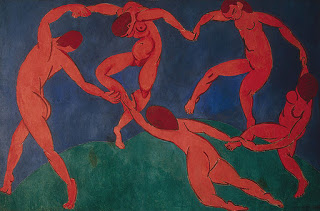
Dance, Matisse, 1909-1910, (Image courtesy of the State Hermitage Museum)

Dance, Matisse, 1909-1910, (Image courtesy of the State Hermitage Museum)

As artists, it is so important to play, to revert in a way to a childlike mental state, to relax. Every time I remember to do this, I find that the art I am trying to create seems to flow better.

Think of some of Henri Matisse's dancers; here, he seems to have distilled his art to a marvellous sense of joyous play. Above is a second version of Dance that Matisse did in 1909-1910, the version now in the State Hermitage Museum . But then fast forward to 1947, when Matisse had to resort to paper cut-outs, papiers coupes, because his infirmities precluded him from painting. He still retained a sense of play, and his creativity was undimmed.

Icarus (Jazz), papiers coupes, 1947, (image courtesy of the Metropolitan Museum of Art, New York).

Icarus (Jazz), papiers coupes, 1947, (image courtesy of the Metropolitan Museum of Art, New York).

How more eloquent an example of play allowing creativity to flow can one get! The crows can certainly teach us a lot. So can Matisse!

Happy New Year to all, and joyful play.

The Sistine Chapel by Jeannine Cook

By way of sending good wishes for a wonderful day today to all my friends, I thought I would add a link sent to me that is amazing in its beauty and technological wonder as well.

It is views of the Sistine Chapel that none of us would really have, in today's crowded world, if we were physically craning our necks to see Michelangelo's masterpieces above.

Go to the Sistine Chapel. To view every part of the Chapel, simply click and drag your mouse arrow slowly in any direction you want. You can see every nook and cranny of the place. To zoom in very close, use the plus sign at the bottom left of the screen, and of course, the minus sign to zoom out. The music is a lovely bonus.

Happy viewing and happy holidays to all!

Black in Art by Jeannine Cook

I remember being firmly told, when I was being taught how to paint in watercolours at school, that black was not something to use straight out of a tube. You achieved a huge spectrum of blacks by mixing other colours, such as reds and greens. Along the way, when learning of oil painters, there seemed to be some who historically used black in generous amounts, while others avoided its use in their work.

Viejos comiendo sopa, Francisco Goya, (Image courtesy of the Prado Museum)

Viejos comiendo sopa, Francisco Goya, (Image courtesy of the Prado Museum)

One of the most famous artists to be associated with black is perhaps Francisco Goya. His "Black Paintings" are somber indeed in their generous use of black, but, in this case, the subject matter is also associated with very dark themes. Goya painted this series of 14 paintings on the walls of his house, the Quinta del Sordo, outside Madrid when he lived there from 1819-1823. He was deaf by this time, he was afraid of going mad, and he had a very bleak view of humanity, having lived through the savage Napoleonic Wars and having watched the disasters of Spanish government. He painted these works without title, and by painting them directly on the walls, he clearly did not intend others to see them. This image, transferred to canvas from the wall of the house, was later titled Two Old Men eating Soup.

Edouard Manet comes to mind immediately when I think of later 19th century artists who began to use black very effectively. He turned away from subtle modelling and simplified, even flattened, the images he portrayed. Not only did he outline in black, but in such paintings as the "scandalous" Olympia - a painting which seemed to shock everyone when it was first exhibited in 1863, his use of black was extensive.  Like other contemporaries in France, Manet also was influenced by Japanese woodcuts, where the use of black was widespread and powerful.

Olympia, Edouard Manet, 1863, (Image below courtesy of the Musee d'Orsay)

Olympia, Edouard Manet, 1863, (Image below courtesy of the Musee d'Orsay)

He continued his use of black even after he became close to many of the Impressionist painters.

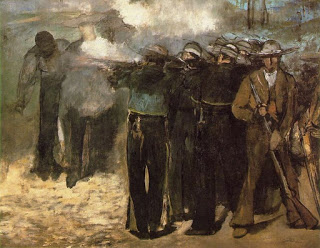
The Execution of Emperor Maximilian, 1867.. (Image  courtesy of the Fine Arts Museum, Boston)

The Execution of Emperor Maximilian, 1867.. (Image  courtesy of the Fine Arts Museum, Boston)

This is one of his three paintings of The Execution of Emperor Maximilian, painted in 1867. Again, his use of black is striking.

Pierre Soulages, black painting

Pierre Soulages, black painting

When one thinks of artists in the 20th century who are noted for their use of black, Pierre Soulages is one artist who stands out. He began to concentrate on the use of black after 1979, and pushed the possibilities of black by manipulating the surface of the paint to enhance texture, reflectivity, character. In fact, Soulages remarked that, "There are people who refuse to accept that you can create light on a black canvas." He calls his use of black outrenoir, ultra-black. He talks of black as being like another country, and has commented, "I like the authority of black. It is an uncompromising colour. A violent colour, but one that encourages internalisation. Both a colour and a non-colour. When light reflects on black, it transforms and transmutes it. It opens up a mental field of its own." At 92, Soulages is one of France's most noted artists, now linked inextricably to his huge opus of black paintings, none of which have titles. These are two illustrations courtesy of his website.

Pierre Soulages, black painting

Pierre Soulages, black painting

Perhaps I have become more interested recently in the use of black in art because of my increasing use of black as a ground for silverpoint drawings. It is certainly a colour that arrests the gaze and transforms - I feel as though I too am straying into a totally different country with my silverpoints on black.

Simplicity in Art by Jeannine Cook

It is thought-provoking for every artist to see Albrecht Dürer's statement that "Simplicity is the greatest adornment of art". In some ways, it is a bit ironic for Dürer was perfectly capable of making complex, crowded works of art, especially his woodcuts.

Hands of an Apostle, Albrecht Dürer,  (image courtesy of GraphischeSammlung Albertina).

Hands of an Apostle, Albrecht Dürer,  (image courtesy of GraphischeSammlung Albertina).

Nonetheless, the image that of course comes first to mind when I read his remark is his super-famous Hands of an Apostle, a grey and white drawing on his favourite blue paper. This drawing was done in preparation for the Frankfurt church altarpiece that Jakob Heller commissioned him to paint in 1508. This is indeed a devastatingly simple drawing in one sense, but look at the rendering of the skin texture, the way Dürer conveys the gentle meeting and touching of the finger tips, as well as the effort of keeping the hands together, despite their weight. The blue paper used, "cartaazzurra", was a new enthusiasm for Dürer; he learned about it when he went in 1507-08 to Venice. Artists in Northern Italy had been using it since 1389, and Venetian artists favoured it because it allowed them to use wonderful chiaroscuro effects.

Twelve-year Old Christ, drawing, Albrecht  Dürer (image at right courtesy of the GraphischeSammlung Albertina).

Twelve-year Old Christ, drawing, Albrecht  Dürer (image at right courtesy of the GraphischeSammlung Albertina).

He was using this paper again for this study of the Twelve-year Old Christ, an extraordinary, sensitive and yet very straightforward drawing.

Dürer continued to use this paper and took a goodly supply of it back home to Northern Europe. I remember reading somewhere that when he ran out of it, he went to great lengths to find alternative blue papers. This drawing of the Arm of Eve was again, a very simple, powerful drawing Dürer did on blue paper in 1507.

Arm of Eve, drawing on blue paper, 1507l Albrecht Dürer  (image courtesy of the Cleveland Museum of Art)

Arm of Eve, drawing on blue paper, 1507l Albrecht Dürer  (image courtesy of the Cleveland Museum of Art)

I think that it is a real discipline for each of us, as an artist, to try to simplify our work, to distil it to its essence, not to dilute and maybe obscure the message. There is always the temptation to add in more detail, more complexity. When you think of it, however, that a simple study, drawn 503 years ago on a small piece of blue paper, can remain so memorable, so vivid, so powerful is a total confirmation of Dürer's statement about simplicity being the greatest "adornment of art".

Artists' Antennae by Jeannine Cook

While listening to the BBC World Service on the radio today, I heard an interesting interview on The Strand programme with South African composer Kevin Volans. He was discussing the multiple influences on him and sources of inspiration for his compositions.

He made the remark that a musician needs to have his ears open at all times to all the sounds around him, because he is thus "fed" and inspired - I am paraphrasing. I thought it was the perfect reminder to me, as a visual artist, that artists' antennae should be up at all times, our eyes open and registering actively and our senses receptive to the world around. No one ever really knows what will stimulate some new creative idea – that is perhaps what makes being an artist so endlessly interesting and exciting.

Volans was talking of living in South Africa and listening to Zulu being spoken on the street all around him. When he went to Germany and heard German being spoken, it made him very aware of the differences in sound and in fact, drove home to him his links to Africa.

I relate to that statement, because I grew up with melodic Kiswahili being spoken all around me, and somehow those sounds still mingle with brilliant African light and tropical colour in my mind. Antennae, for artists, don't just register visually; rather, we all should be aware of sounds, light, colour, motion or stillness – the world around us in multi-dimensional form. Sharpening one's powers of observation always brings rewards, because whatever the artist is seeking to create comes across more powerfully and authentically when there is knowledge behind the creation.

The Large Piece of Turf, Albrecht  Dürer, watercolour and gouache on paper, 1503 (Image courtesy of the GraphischeSammlung Albertina, Vienna)

The Large Piece of Turf, Albrecht  Dürer, watercolour and gouache on paper, 1503 (Image courtesy of the GraphischeSammlung Albertina, Vienna)

Thinking about artists' antennae being up and registering actively makes me think of those wonderful examples of Albrecht Durer's work, the watercolour studies of humble aspects of nature that became great art because of Durer's keen attentiveness. Perhaps my favourite example of this is his Great Piece of Turf, done in watercolour and gouache on paper. How many artists, then - in 1503 - or now - would think of painting a small sample of the grasses in a field, let alone be so aware of the exquisite details in the turf? In the same way,  Dürer's awareness of the beauty and intricacy of this Muzzle of a Bull is amazing. (Image courtesy of The British Museum.)

Muzzle of a Bull , 1523, Albrecht Dürer  (Image courtesy of The British Museum.)

Muzzle of a Bull , 1523, Albrecht Dürer  (Image courtesy of The British Museum.)

Dürer painted this study in watercolour in 1523, many years after he painted the turf, but he was still looking very carefully at nature. In fact, Albrecht Dürer was so noted for his studies of plants and animals that in the years after his death in 1528, those were the aspects of his art that were most admired and emulated by fellow artists and subsequent generations of artists.

Perhaps part of being an artist, in any discipline, is to have one's eyes and ears really working. Certainly all the great artists confirm the need for these well-honed antennae.

Leonora Carrington by Jeannine Cook

A really wonderful book on Leonora Carrington has just helped me fill in all sorts of blanks in my knowledge about this high-voltage Surrealist painter, who died earlier this year at the age of 94. The book, in Spanish, is simply entitled "Leonora", in the form of a novel, but clearly hewing very close to reality, because the authoress, Elena Poniatowska, knew Leonora well in Mexico City.

A rebel from the very start, Leonora Carrington spent her privileged youth in Britain in a series of acts of defiance against her father, Harold Carrington, the then powerful and very wealthy head of Imperial Chemical Industries. She soon developed a very lively imagination and fascination with Celtic folklore, as well as a deep love of horses, a motif that appeared frequently in her paintings.

Leonora Carrington and Max Ernst

Leonora Carrington and Max Ernst

Her love of art helped sweep her into a world where she met Max Ernst, the Dada and Surrealist German painter. Ernst influenced her way of painting, hardly surprising for they had a passionate love affair in Paris and the South of France until Ernst was arrested and interned after the Germans invaded France. Their circle of friends included most of the artists and celebrities of pre-World War II who spent time in Paris, from Picasso to Andre Breton, Dali, Paul Eluard and Miró .

After Ernst was arrested, Leonora suffered a horrific nervous breakdown. She escaped to New York after so-called treatment for the breakdown at an expensive clinic in Spain, an escape from war-ravaged Europe that was only possible because she married Renato Leduc, working at that time in the Mexican Embassy. Peggy Guggenheim was also awaiting passage to New York and the whole group of Surrealist authors, artists and their entourage continued to see each other in New York, where Peggy Guggenheim helped secure exhibits for the Surrealists.

Leonora painted but she also wrote a large number of books that garnered her a loyal following, especially after she moved with Leduc to Mexico City. There, she and Leduc separated and she married the Hungarian refugee Surrealist photographer, "Chiki" Weisz who had been the darkroom manager for his friend, the photographer Robert Capa.

Chiki Ton Pays., Leonora Carrington

Chiki Ton Pays., Leonora Carrington

Leonora's life in Mexico City was enriched by friendships with other artists, such as Remedios Varo, as they explored Mexican folklore, pre-Columbian art, alchemy, Jungian and Freudian thinking, Gudjieff's writings – in wonderfully diverse intellectual questings. All these strands showed up in some form or another in Carrington's paintings, and she became one of the most celebrated artists in Mexico. The mythical worlds she created on canvas (and in sculptures) wove magical beings and animals together, literally (for she would turn cobras into goats or transform blind crows into trees) and metaphorically.

Lepidoptera,.1968, Leonora Carrington

Lepidoptera,.1968, Leonora Carrington

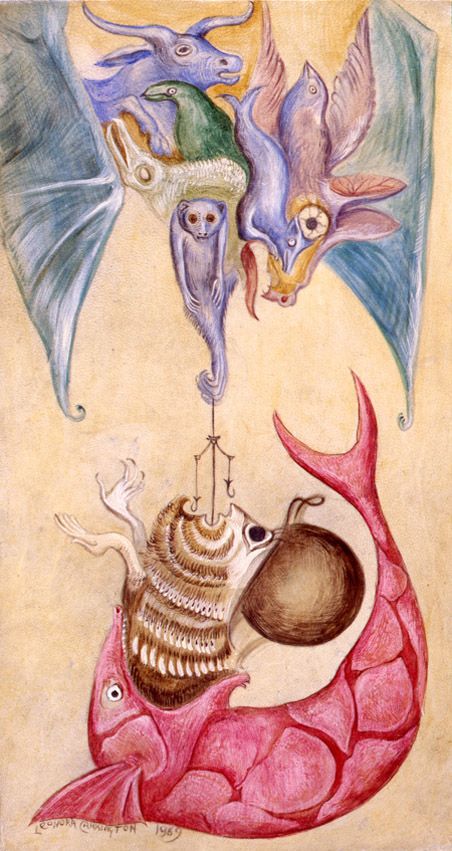
Untitled,1969,  gouache on  vellum, Leonora Carrington (Image courtesy of Guggenheim Museum)

Untitled,1969,  gouache on  vellum, Leonora Carrington (Image courtesy of Guggenheim Museum)

Leonora Carrington's life is an inspiration to us all as artists. She dared defy traditions and pre-conceptions. She drew on such diverse sources for inspiration, from childhood, from fairy stories and folk art, from religions. She was endlessly creative and inventive, in her writing, in her art and in her relationships with friends and acquaintances.

When Elena Poniatowska's book, "Leonora", is translated into English, as it surely will be, I highly recommend it. It is a fascinating way to learn more about this remarkable Surrealist artist.

Trees by Jeannine Cook

It's funny - when you are scrolling though masses of art images, there is sometimes one that stops you, grabs you and makes you investigate carefully. This happened to me the other day when I was trying to find out more about the Iranian poet and artist,  Sohrab Sepehri, who lived from 1928 to 1980. His poems are beautiful, but it was his paintings that interested me.

Trees, 1970, S. Sepheri, (image courtesy of the Grey Art Gallery, New York University Art Collection.)

Trees, 1970, S. Sepheri, (image courtesy of the Grey Art Gallery, New York University Art Collection.)

He apparently had a love affair with trees all his life and did the most wonderful renditions of their trunks.  He spent time in the early 1960s in Japan and was very much influenced by Japanese art, especially woodcuts, and Japanese haikus. He later had a very successful international career in art, and spent time working on a series that he called The Tree Trunk Series.

 House of Kashan,  S. Sepheri, 1978-79. oil on  canvas

 House of Kashan,  S. Sepheri, 1978-79. oil on  canvas

Apparently shy and retiring, Sepehri found a means of expression, as a painter, in his renditions of trees and landscapes, using soft brush strokes and a restrained palette to create these semi-abstracted portraits of trees that are very arresting, yet somehow very specific to place and implying great space beyond the canvas. His huge canvas, painted in 1978-79, is called House of Kashan and below, an earlier work in the Tree Series. As was commented in an auction catalogue on Arcadja, "To him the tree was a symbol of benevolence and stability in a world corrupted by ignorance and malice, his majestic portrayals capture absolutely the quiet grandeur of ancient forests and harbour an undeniable mystical quality." Painting trees kept him anchored in a world in which he felt very comfortable, particularly when he had to deal with places like Manhattan, in which he felt very alien.

In the Tree Series, S. Sepehri

In the Tree Series, S. Sepehri

I suppose these paintings and the commentaries I have been able to read about Sepehri's optic on trees, both in his writings and in his art, all resonate with me, because I too love depicting trees. I find each one to be utterly individual, powerful and very much worth of a portrait. I realised that I keep returning to trees as subject matter, especially for my drawings in graphite and especially silverpoint, because I was selecting work to put up on another website to which I was invited this week. Since one travels in hope in life, this site is apparently aimed at designers and decorators - who knows! Nonetheless, my making a selection of art led me to posting a series of tree images.

What is always so interesting is to see how each artist approaches interpretation of trees. Since we all bring our life experience to the art-making, that is logical. The main point is to celebrate trees!