Courtesy by Jeannine Cook

Having lived in many countries and been exposed to different cultures, I am always keenly aware of how courtesy and consideration to others are valuable passports in life. In the art world, I believe it is vitally important, basically to say "please" and "thank you".

I thought about this again with a short exchangeof e-mails I have just had with Jason Horejs, owner of Xanadu Gallery, a brick-and-mortar gallery in Scottsdale, AZ, and also a website representing juried artists on the Web. I had requested consideration for inclusion on the website (part of the New Year energy and resolutions to try new ventures!), and in very short order, I had a charming letter back from him. My page is now up on the Xanadu site.  There was an exchange of "thank yous", and I assume he felt as I did, that it had been a constructive and pleasant transaction.

Even if an artist does not succeed initially in some endeavour, there is no guarantee that life will swirl around again and offer another opportunity from an unexpected quarter. If the artist has been polite, businesslike and pleasant generally, that overall positive impression certainly cannot harm in any future consideration. Added to which, a professional artist, like any other professional, ideally has some savoir faire, French for knowing how to behave in a civilised fashion.

Etiquette is the general term for social behaviour, a huge and fascinating subject. One of the early, stellar examples of an artist who was gracious and noted for his courtesy was Raphael Sainzo of Urbino, the Renaissance artist who was famed both for his paintings and his drawings. Raphael was endowed by "nature with the goodness and modesty to be found in all those exceptional men whose gentle humanity is enhanced by an affable and pleasing manner, expressing itself in courteous behaviour at all times and towards all persons" (History of Art: the Western Tradition. Horst WoldenmarJanson, Anthony F. Janson).
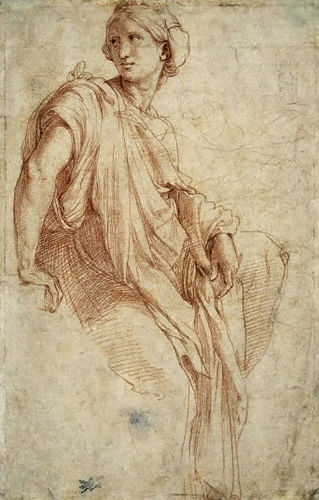
Raffaello Sanzio (b. 1483, Urbino - d. 1520, Rome) The Phrygian Sibyl (1511-1512) Drawing,  Department of Prints and Drawings, (Image courtesy of the British Museum)

Raffaello Sanzio (b. 1483, Urbino - d. 1520, Rome) The Phrygian Sibyl (1511-1512) Drawing,  Department of Prints and Drawings, (Image courtesy of the British Museum)

Giorgio Vasari noted that Raphael was very skilled in running a harmonious and efficient workshop full of apprentices and was extremely diplomatic in relationships with both his patrons and his assistants. Clearly Raphael was an artist with whom people enjoyed working and who was esteemed for his skill and his pleasant demeanour. He gave every artist a wonderful example to follow.

Thoughts on Life Drawing by Jeannine Cook

The New Year is really getting going again in my art world, with talk of exhibits which are happening and planned. The more important aspect of art, however, is starting seriously to work again after the holidays - does one actually call it "work"? It is more joyful, more absorbing.

Life drawing started again too, with that wonderful silence of concentration of a dozen artists grappling with this discipline. I thought back to a piece I read of some while ago in ArtDaily.org about an exhibition held at the Cantor Arts Center, Stanford, CA, of work by Frank Lobdell. He is a highly imaginative, often playful but very sophisticated abstract artist, painting in oils. Lobdell started participating in weekly life drawing sessions very early on, back in the late 1950s, with his friends Richard Diebenkorn, Elmer Bishoff and David Park. He continued the practice when he moved to Stanford in 1966.

Even though one can detect the trace of life drawing's effects in some of his early work, it is a very far leap from life drawing to his colourful and very abstract work. Described as "essentially a non-figurative artist", Lobell apparently regarded these life drawing sessions as an important source of ideas, a "springboard to develop a vocabulary of abstraction (my emphasis) that was informed by a study of the human body and grounded in the formal issues of expressionist gesture and line".

I have always found it most interesting to watch my fellow artists drawing in our life drawing sessions and then see what kind of art they produce. Like Lobdell, each of us can follow very individualistic paths, seemingly far removed from the human bodies we draw, and yet, all of us benefit enormously from life drawing in ways obvious and not-so-obvious.

Links with the Past by Jeannine Cook

I am sure that many people feel a sense of wonder and amazement when they realise that they have become serious artists and that it has happened despite there not being any artists in previous generations of their family. That little question, "Where does it come from?", pops into the mind.

This certainly happened to me when I began to get more and more involved in art, long after I had trained in other disciplines and ventures. However, despite the fact that none of my immediate forebears were painters, I was aware of a keen sense of artistry in my mother and her father, both skilled and successful photographers. So I assumed that I had simply chosen another form of expression.

Nonetheless, I found myself excited and gratified when I realised that one of my great-grandfathers had done beautiful renderings of sailing ships, simple and elegant. They seemed gentle messages of encouragement from the past. Then, just before the turn of this year, I discovered with a jolt of delight that I had another art link with the past. My great-great-grandfather, William Carmalt Clifton, was a landscape painter and draughtsman, as well as being the P & O Shipping Company agent in Mauritius and, later, in Albany, Western Australia, from 1861-1870. His last panoramic painting of Albany, done from his yacht in King George Sound, is now in the Western Australian Museum.

Interestingly, we have had in my family various miniatures of him as a young man and a larger oil on canvas painting of William Carmalt Clifton as a 13 year old. The 1832 painting above is  a copy of one by Jacob Thompson, a Penrith artist (1806-1879) noted as a landscape and portrait painter who had Lord Lonsdale as his patron.

William Carmalt Clifton, aged 13 years, from painting by Jacob Thompson 1832 (HENRIETTA.RADCLIFFE/1955/ AFTER JACOB THOMPSON 1832)

William Carmalt Clifton, aged 13 years, from painting by Jacob Thompson 1832 (HENRIETTA.RADCLIFFE/1955/ AFTER JACOB THOMPSON 1832)

Miniature of William Carmalt Clifton, now in family collection at Western Australian Museum (Image courtesy of Western Australian Museum)

Miniature of William Carmalt Clifton, now in family collection at Western Australian Museum (Image courtesy of Western Australian Museum)

Interestingly, we have had in my family various miniatures of him as a young man and a larger oil on canvas painting of William Carmalt Clifton as a 13 year old. The 1832 painting above is  a copy of one by Jacob Thompson, a Penrith artist (1806-1879) noted as a landscape and portrait painter who had Lord Lonsdale as his patron. We also have this photograph of the same  Clifton forebear.

William Carmalt Clifton, probably taken after 1872

William Carmalt Clifton, probably taken after 1872

It is indeed fun to find links - and thus validations - of one's choice of profession and passion that stretch back centuries into the past. Plus ça change, plus ça reste le même, as they say.

Design by Jeannine Cook

National Public Radio can always be guaranteed to provide interesting listening on the most diverse of subjects. This afternoon, in "All Things Considered", there was a piece about the "Behind-the-Scenes Partnership at Apple" between CEO Steve Jobs and head designer, Englishman Jonathan Ive. Apparently, ever since Steve Jobs discovered Ive working in a basement amidst a welter of creative inventions and designs in 1996, when Jobs had returned to Apple and was re-evaluating everyone and everything, the two have formed a very felicitous partnership.

What interested me was the parallel - in truth, hardly surprising - between the concepts espoused by Apple for design and those which an artist follows, ideally. It was apparently regarded as somewhat revolutionary in that industry that design was considered right from the beginning when a new product was being worked on. As Ive said, everything defers to the display, whether in the I-Phone, I-Pod or I-Pad - "getting the design out of the way". The user experience is the only important consideration, everything else is subservient.

In art, the design, or composition, is one of the important sub-structures of the piece. It should ideally be so discreet and integral to the work that it should not be noticed. The art should just look and feel "right". And the skill and experience to achieve this important underpinning of the work comes only with practice, thought and application. Indeed, one of the descriptions of Jonathan Ive at Apple in the NPR piece was "relentless", always working to get the thing "just right". That could, and should, be a description for everyone of us artists as we try to get our work "just right". Often, quite a challenge!

Art and Play by Jeannine Cook

It is the time of year when we all hear murmurs of New Year resolutions that we should be thinking about, in the knowledge that most of the good resolutions don't last very long after January 1st has passed.

Nonetheless, one resolution that I think would be good for me to try and adhere to is keeping a playful and enquiring optic about making art. Perhaps almost the attitude of "let's just launch out into space and see what happens in the art", something I often have misgivings about, especially in unforgiving silverpoint. Stephen Nachmanovich, the noted improvisationist violinist and, amongst other achievements, author of Free Play: Improvisation in Life and Art, said, "Play is the taproot from which original art springs. It is the raw stuff that the artist channels with all his hearing and technique." He could just as easily have said "seeing and technique". He maintains that every time we open our mouths to say something, we are in fact improvising, and that creativity is in the same category, given to everyone.

In truth, when one is about to launch into a plein air painting or drawing, it is very much an act of improvisation. Since weather conditions, light and innumerable other aspects can change from one moment to the next, one has to regard the whole endeavour as play, as a challenge that is fun. In other types of art, the mere act of turning off the left hand side of the brain and ceasing to think turns it all into a much more venturesome affair, where there is indeed a sense of playfulness and a sense of gambling. Perhaps one of the best demonstrations of that type of art is when an artist is creating a painting or drawing as music is performed live. My fellow artist and friend, Lori Gene, epitomises this sense of play in a very sophisticated fashion in her art created alongside musicians as they play.

I always remember Marc Chagall, in his eighties, saying that every artist should retain a childlike optic on life. Indeed, his sense of play was the source of amazingly original art. Perhaps it would indeed be good to resolve to be more playful in art making as the New Year rolls in.

Creative viewing by Jeannine Cook

Before the glory of Christmas cactus flowers fades on my different Schlumbergera, I have been drawing them in silverpoint, especially the delicate white-flowered ones.

Christmas Cactus

Christmas Cactus

As I gazed at the elegant cactus flowers, I could not help remembering a quote I found some time ago by Monet.

He said, "To see, we must forget the name of the thing we are looking at." It is almost as if I needed to blank out my conscious mind and just let the rhythms and undulations of the petals and the strange leaves tell me where to go and how to compose a drawing. It is absolutely academic what it is that is the subject of the drawing - only the aspects of it that resonate and excite one are the ones that drive the mark-making. In fact, as soon as the left hand side of the brain begins to get active, defining or thinking consciously, that is when one gets into trouble with the drawing. And in silverpoint, that is a bad place to reach, given you don't erase the marks made in silver.

Claude Monet knew well about the need to view things in a different fashion. His wonderful use of colour and Impressionistic techniques are testimony to this philosophy. When you think of his extraordinary series of paintings of Rouen Cathedral, for example, his was a very creative view of this wonderful structure. Given the very complicated act of painting this immense building, with the light that was ever-fleeting and the unreliable weather of this maritime city, Monet was amazing in his ability speedily to record light, darks, abstract shapes, atmosphere – as in this painting done between 1892 and 1894, entitled Rouen Cathedral Facade (Morning Effect).

Rouen Cathedral Facade (Morning Effect), 1892-94, Claude Monet (Image courtesy of Museum Folkwang, Essen, Germany.

Rouen Cathedral Facade (Morning Effect), 1892-94, Claude Monet (Image courtesy of Museum Folkwang, Essen, Germany.

There is another interesting optic on creating a piece of art, whether recording a cathedral's glory or drawing a Christmas cactus flower.

William S. Burroughs observed that "Nothing exists until or unless it is observed. An artist is making something exist by observing it. And his (or her!) hopes for other people are that they will also make it exist by observing it." A perfect description of "creative viewing"on the part of artist and then the public. I am sure that most of the French who walked past their looming cathedral did not see it in any way similar to Monet; they probably did not often raise their heads to its soaring facades as they went about their daily lives. Yet after Monet painted his series on Rouen Cathedral, certainly many more people became aware of its massive structure and the extraordinary play of light on it as the seasons turned.

Monet has made the Cathedral "exist" for art lovers ever since he began his series of paintings there in the 1890s. They, in turn, validate Monet by observing his paintings and completing the circle of creative existence.

In the same way, an artist who embarks on a painting, drawing or other form of depiction of something "real" is, in essence, bringing that thing to life, creating it according to his or her artistic eye. This gives one wide licence to create, to bring into existence, but it also implies an often revealing personal involvement - assuming that the art is being created with passion. Sobering thoughts, but mercifully, during the painting or drawing, as Monet wisely observed, we need first to turn off our brains.

Christmastime Beauty by Jeannine Cook

As a small child growing up in East Africa, on the Equator, Christmas caused me considerable perplexity because all the traditional Yule time images were of snow clad lands, twinkling lights, tall fir trees clad in decorations. None of that was believable really because the tropical world was brilliant, un-winterlike and generally very different. Churches were distant, friends as well, and the family was obliged to follow Nature's dictates and care for the farm and its needs, even on Christmas Day.

Nonetheless, I learned early of the great beauty that is generated and connected to Christmas, no matter where one is in the globe. Whether one is very religious or not makes no difference to the special feeling to Christmas, because of the beauty of music, art and every other form of creativity connected to the celebration of these days of festivity. When the only sources of patronage, and thus livelihood, were the Church or very rich people, artists and musicians were able to work, creating wondrous works that have endured down the centuries and enriched all our lives. Much of this heritage was also created in and for the remarkable churches, basilicas and cathedrals that we all cherish today. A remarkable synthesis that enriches the Western world even today... as one sees especially at Christmastime.

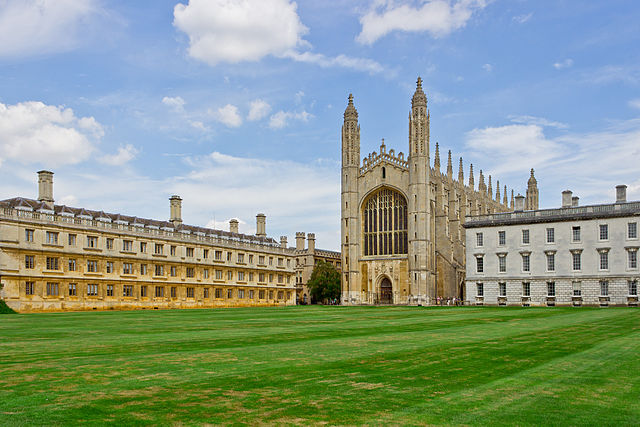
King's College Chapel, Back Court, Cambridge

King's College Chapel, Back Court, Cambridge

Think of the ethereal voices of the choristers singing in King's College Chapel in Cambridge (at right) for the Christmas Eve service. Or Johann Sebastian Bach's Christmas Oratorio which was first performed in St. Nicholas' Church in Leipzig in 1734. While the music fills our ears, often around us in these churches, the stained glass windows accompany in their glory and the statues in the chapels are graceful and evocative. Imagine listening to a Christmas concert as you are sitting in Sainte Chapelle, in Paris' Ile de la Cité , with these stained glass windows glowing above one's head,

Sainte Chapelle, Paris

Sainte Chapelle, Paris

Even small pieces are powerful reminders of the beauty we all inherit, such as Lucca della Robbia's glazed terracotta Nativity Scene, created in 1460.

Nativity, Lucca della Robbia, glazed terracotta,1460, (Image courtesy of National Gallery of Art, Washington_)

Nativity, Lucca della Robbia, glazed terracotta,1460, (Image courtesy of National Gallery of Art, Washington_)

There are so many wondrous paintings that depict the Nativity, the Holy Family, the Virgin and Child and related subjects that everyone is spoiled for choice. It is fun to scroll through the troves of these images now so easily available on the Web, and suddenly, one chances on something totally unfamiliar and captivating.

Guercino (Giovanni Francesco Barbieri) , early 1630s, red chalk,  Madonna and Child with an escaped goldfinch(in the Andrew W. Mellon Collection at the National Gallery of Art).

Guercino (Giovanni Francesco Barbieri) , early 1630s, red chalk,  Madonna and Child with an escaped goldfinch(in the Andrew W. Mellon Collection at the National Gallery of Art).

One could go on and on celebrating Christmas with the extraordinary diversity of beauty previous generations have left us. Even in times of tawdry Christmas commercialism, it is easy to step away from it and lose oneself in wonderful creations. The Web makes this beauty even more accessible to everyone - what a Christmas gift.

Merry Christmas to everyone who reads these lines. May your lives be filled with beauty!

Curiosity by Jeannine Cook

One of the aspects of the Telfair Museums' exhibition, Modern Masters. American Abstraction at Midcentury, that I found very stimulating was the quotes from each artist on the labels beside their paintings or sculpture. They were not only well-chosen, but in of themselves, they are thought-provoking and insightful.

An example of these quotes is one that accompanies the painting, Sea Image, by TheodorosStamos (1922-1997).

Sea Image, (Image courtesy of the Smithsonian American Art Museum) by TheodorosStamos

Sea Image, (Image courtesy of the Smithsonian American Art Museum) by TheodorosStamos

This early Abstract Expressionist New Yorker wrote, "Nature is so vast, with so many moods and the ocean is so large and every wave is infinite. And as long as we have the curiosity of children (and sometimes we have to be children), discovery is not only possible, but indispensable".

The need for curiosity is, I am convinced, absolutely central to life for everyone, but especially for an artist. Not only is it rewarding to find out about how something works, or is put together, or what it is made of, how it smells and feels, but also, this knowledge gives depth and distance to everything in life. Such insights help us determine what we want to paint or draw, how we want to portray things (whether realistically, abstractly, in two or three dimensions, in film, paint, video, whatever...) and why we are moved to do so. Every single day - ideally - should bring new knowledge, fresh enrichment and stimulation, more possibilities for fun and fascination.

Two curious kittens sniff out a tortoise. I(mage courtesy of Life.com)

Two curious kittens sniff out a tortoise. I(mage courtesy of Life.com)

Watching a kitten explore its world is a perfect metaphor for this curiosity. Everything is new and worth investigating, exploring, evaluating. We artists can be as bright-eyed and curious as any feline. It pays off too!


"No duality, everything is nature" by Jeannine Cook

There is a wide-ranging and fascinating exhibition currently on show at Savannah's Telfair Museums, at the Jepson Center, entitled Modern Masters. American Abstraction at Midcentury". With works from the Smithsonian American Art Museum, the explosive diversity of art made during the mid-20th century in America is celebrated with forty-three key paintings and sculptures. The exhibition is travelling the country for four years, and it will remain on display at the Jepson until February 6th, 2011.

It is a show worth visiting several times, because of its diversity and density. Not only are there canvases by stellar artists to contemplate and appreciate, but there are some fascinating sculptures that I found most arresting.

One of them, "Banquet", shown courtesy of the Smithsonian American Art Museum, stopped me in my tracks with its multi-layered knobbly forms and metal alloys that evoke stalagmites or primitive corals. It is by an artist with whom I was unfamiliar, Ibram Lassaw (1913-2003).

Ibram Lassaw, Banquet, 1961, bronze, Smithsonian American Art Museum, Ibram Lassaw, Banquet, 1961, bronze, Smithsonian American Art Museum,

Ibram Lassaw, Banquet, 1961, bronze, Smithsonian American Art Museum, Ibram Lassaw, Banquet, 1961, bronze, Smithsonian American Art Museum,

(As an aside, I find that being a permanent newcomer to every place I have lived in Europe and North America since I had to leave my home in East Africa, I am constantly having to "catch up" on art, law, history, society in general – It is a humbling but exhilarating situation!)

But back to Ibram Lassaw. He too was an immigrant, from Egypt, working in New York as an artist from the 1920s; he became an active participant in the avant-garde art world and was a founding member of the American Abstract Artists. He learned to weld while serving in the US Army during World War II, and continued experimenting with ideas and materials for the next two decades. He fused his ideas on art-making with concepts derived from extensive and catholic reading to reach a philosophy about the holistic nature of the universe and all that is contained therein. He suddenly had an artistic breakthrough in the 1950s, and began to create complex structures that evoked nature in many forms, cosmic and microcosmic.

He said that everything is nature, "every atom that makes me up is nature". He wrote, "I am constantly absorbed by things that are going on around me, the motion of people in the streets, the movement of clouds, the patterns of branches. There is no duality, everything is nature."

It was obvious from the work, "Banquet" that he was fusing ideas about many aspects of life and nature in this work, to achieve a delicate complex work that rewards with careful inspection and contemplation. What I found so interesting, however, was one of those delicious coincidences that occurs: soon afterwards, I saw a re-broadcast on PBS of Hunting the Hidden Dimension. The Most Famous Fractal about the late Benoit Mandelbrot's wonderful mathematical way of describing the "roughness" he saw all around him in nature. Before Mandelbrot, artists had indeed seen the "self-similarity" and "roughness" in nature, but mathematicians had considered these jagged, self-repeating shapes unmeasurable. Mandelbrot introduced fractals, the concept of another dimension, a fractal dimension, that lay between two and three dimensions. This dimension allows for mathematical measurements and thus, amongst other things, a deeper understanding of self-similarity - the endless repetition of stalks of broccoli, trunks to branches to twigs on a tree and its leaves.

As an example, the image below is that of a high voltage dielectric breakdown within a block of plexiglass - it creates a beautiful fractal pattern called a Lichtenberg figure. The branching discharges ultimately become hair-like but are thought to extend down to the molecular level. (Bert Hickman. http://www.teslamania.com/)

12" block - Captured Lightning scupture (Image courtesy of Theodore Gray)

12" block - Captured Lightning scupture (Image courtesy of Theodore Gray)

Lassaw's "Banquet", created in 1961, was in many ways an early evocation of the same wonderful complexity that nature offers, everywhere, all the time.

These happy coincidences are what I love about seeing an art exhibition. There is always some work of art that makes one more aware, more able to make connections and add new, rich dimensions to life. What fun!

The Highs and Lows of Artists by Jeannine Cook

I have a suspicion that every artist, writer and other creative person knows that there is an inevitable pattern to life. By pattern, I mean that there is an excitement, almost euphoria, when there is an event to prepare, such as an art exhibition. Then, after everything is over, there is a let-down, a flatness and almost, sometimes, a short depression, before life reverts to a more even keel.

This has certainly been the case for me over the years, especially with my Art-Tasting events. Lots of work to prepare, hang, exhibit the art, and ensure that the wine-tasting and party are organised... a week of steady preparations before the date. Then the day of the Art-Tasting comes. This year, the weather was perfect, the marshes were magnificently golden and wide-flung and the garden still unaffected by freezing temperatures. Lots of people came, at a steady tempo, and everyone seemed to enjoy themselves, the main objective of the party.

The hours fly past, the table empties of food, artwork disappears out of the house under people's arms... and then it is all over.

Clearing up is made easier by wonderful help, and in the subsequent days, I put the house back together, and take the art down from display. Slowly, slowly, the world returns to its more peaceful rhythm, and I recognise that I feel flat and devoid of creativity. Luckily, this is only a brief period, I now know, and suddenly, I will get excited again about something I see or think of. Then I become a practising artist once more, and life will flow into other channels. The period of highs and lows passes once more.

I wonder if this happens with writers who launch a book, composers who hear their music played for the first time, ballet dancers in a new performance – a hundred versions of launching one's creativity into the public arena.

600px-Yin_and_Yang_svg.png

Putting one's creative soul out into the wide world is exciting, challenging – but then there is the counterpoint, the emptiness, the let down. I suspect that everyone learns with time about the yin and yang of creative life, just part of the whole process of being an artist.