"Washing away the Dust" by Jeannine Cook

Autumn seems finally to be here, with a crisp sunny day that implored one to go out and enjoy it. I managed to get the chores of daily life either done or postponed and went out to draw, feeling a fraction harassed and short of time.

Then - bliss! I settled down to draw a wonderful old oak tree which had split in two. One portion had simply fallen over into the marsh mud, and has now died. But since it is a live oak, the graceful skeleton will remain as a frame for the marshes and salt water creek for many years. It was a peaceful afternoon with just soft bird songs and a gentle Labrador friend who came to greet me with a wagging tail.

The Fallen Oak, silverpoint, Jeannine Cook artist

The Fallen Oak, silverpoint, Jeannine Cook artist

I was working in silverpoint, so it was slow and meditative work. The world fell away from me, and by the time I had finished the small drawing, I was feeling much better, albeit a bit weary. I then remembered a wise statement (of the many!) that Pablo Picasso purportedly made. He remarked, "Art washes away from the soul the dust of everyday life". He was exactly right.

What We See as Artists by Jeannine Cook

Having grappled for two days with an ever-evolving but beautifully perfumed ginger lily that I was trying to draw, it really resonated when I found a quote by Paul Klee. He said, "Art does not reproduce what we see; rather, it makes us see."

I am always in amazement at the photo-realist artists who manage - often thanks to photographs - to reproduce in art exactly what seems to have been their subject matter. I find that when I am drawing or painting, I seem constitutionally incapable of reproducing exactly what I am seeing. I always want to alter something, move something elsewhere, eliminate something, exaggerate something else.. in an attempt to render a decent composition as well as an evocative work of art. Perhaps it is also the gardener in me - pruning, transplanting, fertilising; it does translate in a way to art-making!

I think that there is nothing more important for an artist than learning to see, really see – the nuances of light and shade, colour gradations, forms and shapes, how things interlock one to another. Life drawing is a wonderful way of training one's eye and making one's hand coordinate with one's eyes. Once really learning to look becomes second nature, then there is somehow an authenticity in what an artist is doing, even if it is not always realistic.

This painting is a perfect example of the results of his carefully looking at the scene and then transmuting what he saw into art.

Highways and Byways, Paul Klee, 1929, (Image courtesy of www.paulklee.net)

Highways and Byways, Paul Klee, 1929, (Image courtesy of www.paulklee.net)

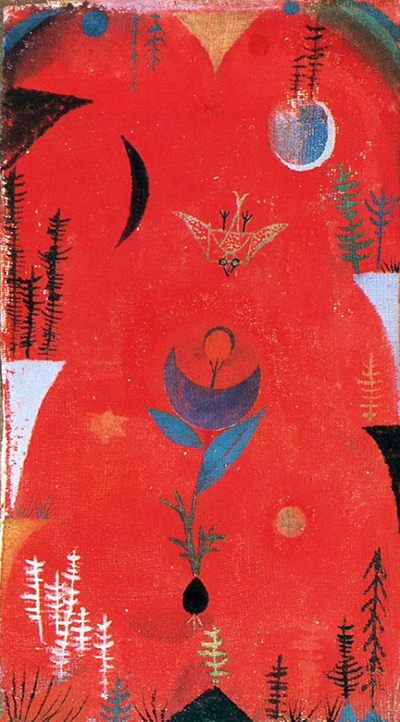
Think of how Paul Klee deals with this image of a flower, entitled Flower Myth.

Flower Myth, 1918, Paul Klee, (Image courtesy of the Sprengel Museum, Hannover, Germany).

Flower Myth, 1918, Paul Klee, (Image courtesy of the Sprengel Museum, Hannover, Germany).

He does know very well how a flower is made and put together, but he is now comfortable with turning it into a work of art, because he has "seen" it properly before.

My sessions with my ginger lily obliged me to do somewhat similar alterations, simply becauseI looked and looked at the flowers, but tried to wend my way through their profusion and short life to produce a decent drawing.

Shadows by Jeannine Cook

I have always loved the way shadows are the underlying abstraction in even the most realistic of paintings or drawings. Perhaps because I have spent so much time in countries where white walls are the most perfect surfaces for shadows, I frequently find them more interesting than their "source objects".

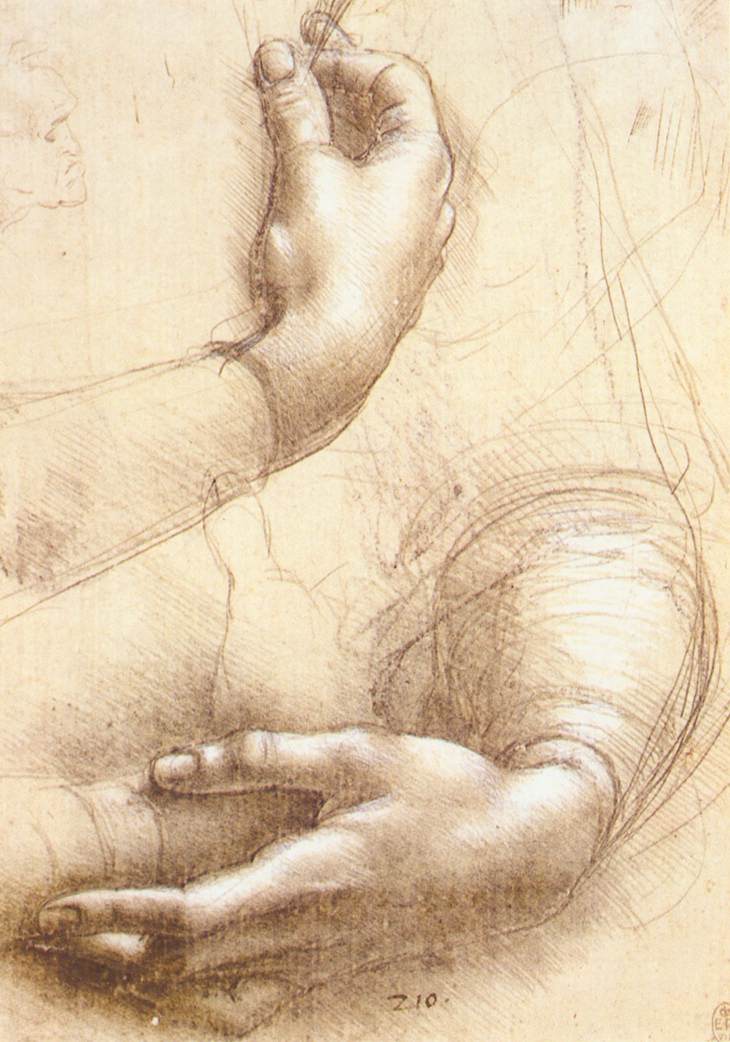
Leonardo daVinci once said, "Shadows have their boundaries at certain determinable points. He who is ignorant of those will produce work without relief; and the relief is the summit and the soul of painting." He was one of the pioneers of chiaroscuro, the play of light and dark that helps describe an object; before the Renaissance, artists did not depict objects or people using this system of darks and lights. Leonardo's study of hands and arms illustrates his study of the shadows that help define these arms and hands.

Study of Female Arms and Hands, Leonardo da Vinci (Image Courtesy of Royal Library, Windsor)

Study of Female Arms and Hands, Leonardo da Vinci (Image Courtesy of Royal Library, Windsor)

What is Leonardo's subtext is his message - look, look, look at what you are depicting. Study the way the light falls on the object. Examine the shadows, the way the shadow is darkest near the object and tapers out as it gets further from the object casting the shadow. Remember to look for the reflected light near the object that is bounced back into the shadow from any light-coloured object, like an egg.

The shadows define the curves and angles of every object, allowing us to understand their configurations - like a visual language whose vocabulary one needs to acquire and practice. As all the light outside comes from the sun, the shadows will move, change, evolve as the sun moves across the sky. Leonardo's Study for the Kneeling Leda, done with bold in hatching, shows what he was talking about in the use of shadows.

Study for a kneeling Leda, 1503-07Black chalk, pen and ink on paper, 126 x 109 cmMuseum Boijmans Van Beuningen, Rotterdam

Study for a kneeling Leda, 1503-07
Black chalk, pen and ink on paper, 126 x 109 cm
Museum Boijmans Van Beuningen, Rotterdam

Accurate observation of light, and thus shadows, will implicitly tell the viewer what times of day the artist was working, and even indicate at what latitude the painting was done if carefully examined. The constant change in light is one of the main challenges to plein air art. It is a non-stop gallop as one can never work fast enough, it seems, to catch up with the movement of light and shadows. That is where quick sketches indicating shadows and light angles can help greatly later on. The light situation is also one of the main reasons why artists resort to photographs as the shadows are suddenly frozen. Nonetheless, working solely from photos tends to produce airless art, even if it is easier and an artist can control the process a little better than just working plein air.

I am reminded that there is another dimension of this need to look at shadows to find the "relief" for a drawing - at the moment, I am in the middle of doing a silverpoint drawing of ginger lilies, those wonderful, fragrant white butterfly-like flowers. I picked the head with the buds half open. With the indoors warmth, the flowers are opening fast, changing all the time, and of course, the plays of lights and darks are constantly altering. Since silverpoint is slow, this is a constant juggling act to keep a coherent composition going, remain reasonably faithful to the flowers and yet use the light and shadows to tell about the graceful forms of these flowers. Using artificial light, even my faithful daylight-accurate Ott Lights, makes the shadows so harsh that it is not appealing, so I am working in daylight, with its own set of challenges.

Challenges, yes, but Leonardo was right – the play of light and shadow can be the summit and soul of a piece of art.

Drawing Nature by Jeannine Cook

As I work with other silverpoint artists on finding exhibition venues for contemporary silverpoint drawings, I have had the luck and pleasure to "meet" some truly wonderful artists, even if we have not met face to face. Since, by definition, drawing in silver requires a very sure hand and an appreciation of subtleties of light, form, composition – these artists are good draughtsmen and women. It is fascinating to see the hugely diverse use of this medium, both in technique and content, especially considering that the technical parameters of silverpoint are narrower and much less flexible than, say, graphite.

One artist friend who deservedly has been garnering much success with his drawings is Timothy David Mayhew. Whilst he does the most magnificent paintings of animals and birds, as well as wonderful small plein air landscapes, it is his drawings that I find breathtaking. Elegant in the extreme, they are done with a variety of old master media and techniques that Timothy painstakingly researched and reconstructed for his personal use. Nature is his master and inspiration. Ever since I first got to know him a little, he has alluded to time spent in different - and often difficult - environments, where he hikes and observes, following animals and birds in their own habitat. The resultant artwork, often done in the field, rings true, because he knows his subject intimately.

Four studies of a black-crowned night heron, Timothy Mayhew West,  (Image courtesy of the Museum of Wildlife Art) 

Four studies of a black-crowned night heron, Timothy Mayhew West,  (Image courtesy of the Museum of Wildlife Art)


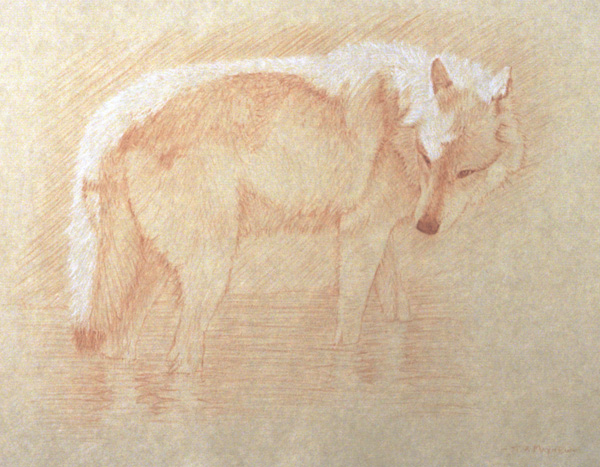
Timothy frequently wins both kudos and awards. Recently, for instance, at the National Museum of Wildlife Art, during the "Western Visions" exhibition, he was awarded the Robert Kuhn Award for a drawing entitled Study of a Gray Wolf wading in Water, a natural red chalk drawing. It was apparently a double delight for him as Bob Kuhn had been his friend and mentor, introducing him to drawing live animals together in studio and zoological settings.

Timothy David Mayhew, Right side study of a gray wolf wading in water, natural red chalk and natural white chalk, (Image courtesy of the artist)

Timothy David Mayhew, Right side study of a gray wolf wading in water, natural red chalk and natural white chalk, (Image courtesy of the artist)

Drawing Nature, in all its aspects, is always fascinating but extremely challenging. It requires endurance - there are always insects, heat, wind, sun, rain and humidity, difficult terrain, or a combination of them to deal with! Living creatures don't just stay obligingly still and in view. One needs to work quickly when opportunity presents itself. Once one has got organised on these aspects of art-making, it is often nothing short of a miracle to produce a work of art of consequence. Particularly one that is in silverpoint/metalpoint, chalk or any of the demanding and unforgiving media that Timothy uses.

It is well worth checking out Timothy David Mayhew's work. His drawings sing.

Celebrating Drawing by Jeannine Cook

It used to be that drawing and drawing exhibitions were almost a rarity, not too many years ago. Now, wonderfully, it seems to be the opposite situation.

I thought about these contrasts when I read that Pat Steir, a pioneer in redefining drawing in America, is having a 25-year retrospective at the Neuberger Museum, Purchase, NY. Pat Steir: Drawing out of Line was first shown at the Rhode Island School of Design and has just opened at the Neuberger, until mid-December. I remember seeing her huge wave drawings back in the eighties. Impressive in size and even more impressive in their energy and vigour, they were done on long rolls of paper attached together. Steir made her abstract, flowing marks almost in dance movements, using her whole body, to attain a powerful fluidity that was very individual. Yet there was something about this motion of the drawings that brought one back to Hokusai's waves, as if both artists were tapping into underlying forces of nature. Steir dared to do things differently and redefine what drawing was all about, whether it was later depicting waterfalls almost by force of sheer gravity, or returning to minimal line in her most recent work.

Wind and Water', color soap ground, aquatint with soap ground , aquatint reversal, spit bite aquatint and drypoint, Pat Steir, 1996 (Image courtesy of the artist)

Wind and Water', color soap ground, aquatint with soap ground , aquatint reversal, spit bite aquatint and drypoint, Pat Steir, 1996 (Image courtesy of the artist)

In another reminder of how important drawing has become to so many people today - just check out the Web for Internet-driven group drawing events such as Urban Sketches , SketchCrawl or Drawing Day 2010 - I read with amusement an article entitled "Naked All Night" in the September 2010 issue of American Artist. Like the Drawing Marathons run for a number of years by Graham Nickson at the New York Studio School, Pratt Institute, in Brooklyn, NY, has apparently been running an annual Draw-a-Thon for the last 22 years, during which some 550 people turned up to draw for seven hours, all night. Seven drawing studios, six drummers, pizza and soda and lots of enthusiasm for artists of all stripes – and apparently about 200 people lasted through the whole night. That is an eloquent testimony to today's state of drawing, I'd say!

Another Kind of Beauty by Jeannine Cook

I have been thinking about all kinds of beauty recently because I have just finished the most delightful book, "Wesley the Owl". It is not about art. It is the story of a young biologist, Stacey O'Brien working at Caltech who adopts a four-day-old owlet, a barn owl, who cannot be released into the wild. The next nearly two decades of her life are totally entwined with his.

Not only is a wonderfully moving account of this highly intelligent, fascinating creature, but it is also very much a book written by an observant, thoughtful scientist. The beauty of this barn owl's appearance, the beauty of the relationship with Stacey and the elegance too of scientific rigour and observations - all these are other facets of beauty that delight the senses and enrich a reader of this book.

Barn Owl

Barn Owl

Somehow the magic of such creatures, as we learn more about their marvellous attributes, feeds into making art and celebrating life in different creative ventures. Perhaps it is all about being passionate about life in general. Certainly "Wesley the Owl" is one of those books that helps make life sparkle. Do yourself a favour and read it if you have not already done so.

Art and Beauty by Jeannine Cook

Beauty - in all the arts - is part and parcel of the creative endeavour, to some, but not to everyone. For ages, in the United States, it seemed that the concept of beauty had become almost effete, out of favour, something to be ignored, denied or ridiculed, in many circles. Then, of course, there has been a reaction, and the word "beauty" seems to have crept back into artistic vocabularies. Especially into vocabularies about the visual arts. Perhaps in our rather dismal, complicated times, we all need something to uplift and cheer us, something bigger and more noble than our mundane daily lives, something that gives pleasure to our senses.

It has always seemed to me that beauty is something almost magical, because so often, it catches one unawares, stops one in one's tracks, and blows the whole world wide open into wonderful new dimensions. It can be anything - a painting, a drawing, music, sculpture, a bird song, scenery, light falling onto something, cloud formations... But instinctively one knows that one is registering something special and uplifting - the day becomes better and often more serene, even for a moment. I am sure that there are wonderful analyses of the brain lighting up in its different parts as a person registers some form of beauty; ironically the more illustrations I see of brain functions, the more beautiful I find them to be as well!

As an artist, it is always demanding, humbling and fascinating to try and convey, on paper or canvas for instance. something which one has found to be beautiful. So seldom does one ever succeed in doing the subject justice. But an artist is impelled to try. Since I am also aware that every person who looks at the art one has produced is bringing to the equation his or her own life experience and therefore form of perception, the melding of my endeavours and that person's "eye"can help (or hinder!) in the rendering of beauty.

Ansel Adams was truly correct when he observed, "Art is both the taking and giving of beauty". It is an important dialogue to have, an exchange that can be priceless.

Ansel Adams with his Camera

Ansel Adams with his Camera

Jeffrey Pine, Ansel Adams photographer (Image courtesy of anseladams.com

Jeffrey Pine, Ansel Adams photographer (Image courtesy of anseladams.com

Defining Drawing by Jeannine Cook

September is the renewal of life drawing sessions for my group after summer. It is good to be drawing again, reminding of the need to observe closely, to trust one's eye and – just go with it! What I also noticed afresh is how differently each artist draws, both physically as well as stylistically.

The body movements, the gestures, that each artist makes as he or she draws are individualistic. Some stand at an easel, making huge, sweeping motions as they make the marks on the canvas or paper, almost like a violin player with a lively bow. Others sit and barely move their arms. The resemblance to dance movements is often remarkable. No wonder artists have always felt a close kinship to dancers. Add in music and the resemblance between mark-making and dance becomes clearer.

In a way, the definition of drawing becomes more murky when you see such artists working. Are they drawing in the air or on a solid surface? Things get even more complex if you consider that today, drawing does not have to be contingent on pencil and paper, or any other traditional mark-making combination. Film/video, digital routes, even three-dimensional means to break up space, within a defined area - all are used to lay out an image. Lines can be made with so many means - from tape, to beads, to tools, to thread, to stylii, even cell phones.

This drawing, for instance, was done with silverpoint, graphite, watercolour and silk thread. I called it "Symphony in Blue".

Symphony in Blue, silverpoint, graphite, watercolour and silk thread, Jeannine Cook artist

Symphony in Blue, silverpoint, graphite, watercolour and silk thread, Jeannine Cook artist

The traditional definition of drawing, since the early 14th century, is pretty straightforward: "a graphic representation, by lines, of an object or idea, as with a pencil; a delineation of form without reference to colour - a sketch, plan or design, especially made with pen, pencil or crayon" is one dictionary definition, very much echoing others. But now, as I have said, all bets are off.

One exhibition which should be very interesting to see in this regard is coming up at MOMA, New York, from November 21st onwards. On Line: Drawing through the Twentieth Century is apparently a wide-ranging examination of different approaches to drawing done by many artists from different lands. It should be very thought-provoking for anyone who loves drawing.

Plein air painting large scale by Jeannine Cook

When the weather improved (i.e. less humidity and heat) as hurricane Earl went north far off the Georgia coast, it was the first opportunity of the summer to go outside to paint. Bliss!

I had been looking at a scene out over the marshes and water, and felt it required a full sheet of watercolour, 30 x 22 inches. That is about the maximum size I can cope with outdoors as otherwise the board and paper become a sail as soon as it is windy. Since I sit and don't use an easel, I also find that my arm needs to "lengthen" to reach the top of the painting. There is another consideration too - because of the size, the painting tends to take much longer to do. This usually means returning to the same spot several times to catch the same light conditions on different days, always a gamble with our changeable weather.

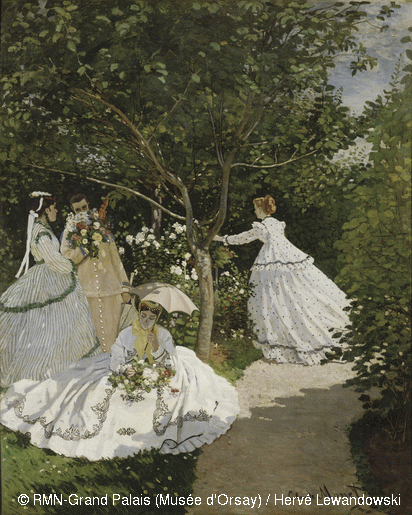
Indeed, I am now into week two of trying to complete the painting, which makes me listen carefully to weather forecasts. But as I was painting, I remembered back to the famous story about Claude Monet when he decided, in 1866, to execute a large canvas outdoors in preparation for the juried Salon. He was in a rented house in Ville D'Avray, a Parisian suburb, living with his model-mistress, Camille. Since he chose to paint this huge canvas, over 8 ft. high by nearly 7 ft wide (2.55 x2.05 metres), he dug a deep trench into which to lower the canvas so he could reach the top whilst remaining at the same vantage point. He also rigged up a pulley system to raise and lower the canvas. Monet was intent on depicting light and shade, air movement and the sense of outdoors, although the ostensible subject was the four women (modelled by Camille). Femmes au Jardin or Women in the Garden was a huge undertaking; apparently Monet was rigorous about being faithful to the light, even to the point that he refused to paint the leaves on the trees if the light was "wrong".

Claude Monet (1840-1926),Femmes au jardin, Vers 1866,Huile sur toile H. 255 ; L. 205 cm (Image courtesy of  Musée d'Orsay, Paris)

Claude Monet (1840-1926),Femmes au jardin, Vers 1866,Huile sur toile H. 255 ; L. 205 cm (Image courtesy of  Musée d'Orsay, Paris)

His friend, the journalist/writer, Emile Zola, was witness to this herculean effort and remarked that Money had a "very exacting eye for contemporary life". The final irony of this whole effort was that Femmes au Jardin was refused by the Salon. However, in 1921, Monet had the satisfaction of seeing it acquired by the French Government for a goodly price (and it is now on view at the Muséed'Orsay). So much for his most ambitious plein air painting venture.

At least I am not into trenches and pulley for my latest painting! But I still need to get on and finish it before the scene changes completely with autumn coming.

Art and Music by Jeannine Cook

I think that every artist is very aware of how necessary music is to his or creativity. Listening to music, classical, jazz or anything else, can help get the juices flowing, inspire and mesh with painting, drawing or any other creative activity. Most life drawing groups, for instance, that I have ever been part of have music playing in the background as a helpful adjunct to the drawing process.

It was thus with no surprise but considerable fascination that I read recently in the August 14th, 2010 edition of Science News about the latest research about "A Mind for Music", an entire section devoted to music, its effects on the human brain and thus its role in societies. One of the most interesting aspects was how far back our connections with music have been tangibly shown to reach. Vulture bone flutes, dating from 35,000-40,000 years ago, have been found in the famous HohleFels cave, near Ulm, Germany.

35,000 year old bone flutes from Hohle Fels

35,000 year old bone flutes from Hohle Fels

Nine thousand years ago, wing bones from red-crowned cranes in Jiahu, China, were fashioned into flutes with five to eight finger holes. Five thousand years ago, harps were played in ancient Mesopotamia. Before all these instruments, there were most probably percussive stones, bones or sticks being played. How many of the early musical sounds were inspired by nature is of course open to speculation, but it puts me in mind of Lord Byron's verse: "There's music in the in the sighing of a reed;/There's music in the gushing of a rill;/ There's music in all things, if men had ears:/ Their earth is but an echo of the spheres."

The noted neuroscientist, Daniel J. Levitin, who is a specialist in matters neuro-musical as well as being a consultant in the music industry, once remarked, " Music may be the activity that prepared our pre-human ancestors for speech communication and for the very cognitive representational flexibility necessary to become human." Since we now know that almost all the areas of the brain are affected in some fashion when we listen to music, his theory makes eminent sense. It is also interesting that visual art also shows up so early in the early records of human beings, as another form of communication and celebration of life. (See my earlier blog about evidence of art-making 164,000 years ago.) Vital roots that enrich us all today, so many thousands of years later.

There are countless examples of artists who weave music into their creative lives - not only in paintings and drawing, but in videos, installation art, and beyond. One interesting example of the role of music in art is Edgar Degas: his paintings and drawings not only address the playing of music but the movement of dancers to music and opera scenes. He apparently was friends with many of his contemporary French composers and musicians, and had had a musical childhood with family members singing and playing the organ. The close links between his art and music were explored in an 2009 exhibition, Degas and Music, at the Hyde Collection in New York's Lake George region. A good description of the exhibition and Degas' deep love for music which ran through all his art can be gleaned from David Brickman's blog. It makes one regret not having seen the exhibition.

Other artists use the music itself as inspiration for art. Paul Klee and Kandinsky come readily to mind, but many of the early 20th century artists turned to jazz and other current forms of music to act as a springboard to art creation - Gino Severini in Italy, August Mackeand fellow German Abstract Expressionist Franz Marc, and Russian KazimirMalevich.

I find myself sometimes moved to create a piece inspired by music. This silverpoint, Spem in Allium, is inspired by Thomas Tallis' music of the same name.

Spem in Allium, silverpoint and acrylic, Jeannine Cook artist. Private collection

Spem in Allium, silverpoint and acrylic, Jeannine Cook artist. Private collection

We are all heirs of those early flute and harp players who knew that "music is the poetry of the air", as Jean Paul Richter observed some two centuries ago.