Art's Accessibility by Jeannine Cook

Back in March 2009, famed art and culture critic and enfant terrible Dave Hickey wrote a long piece in Art in America about "Addictions". In it, he said that "in the last two centuries, the opportunity to make good art and literature has continuously expanded. In response to this broadening franchise, elite cultures have striven to defend their domain by escalating the level of 'difficulty' demanded from serious art and literature. The larger the field of runners, in other words, the higher the hurdles. Two centuries of expanding opportunities confronted by an escalating standard of difficulty have led to this consequence: today, anyone can make a work of art that nobody can understand." He ended a long plaint about the opacity of many contemporary works, the suspicion that greets any efforts to explain such works, and even the dulling and homogenising effect of art school curricula with a plea to bring "the fire from wherever you find it to an art world that needs it."
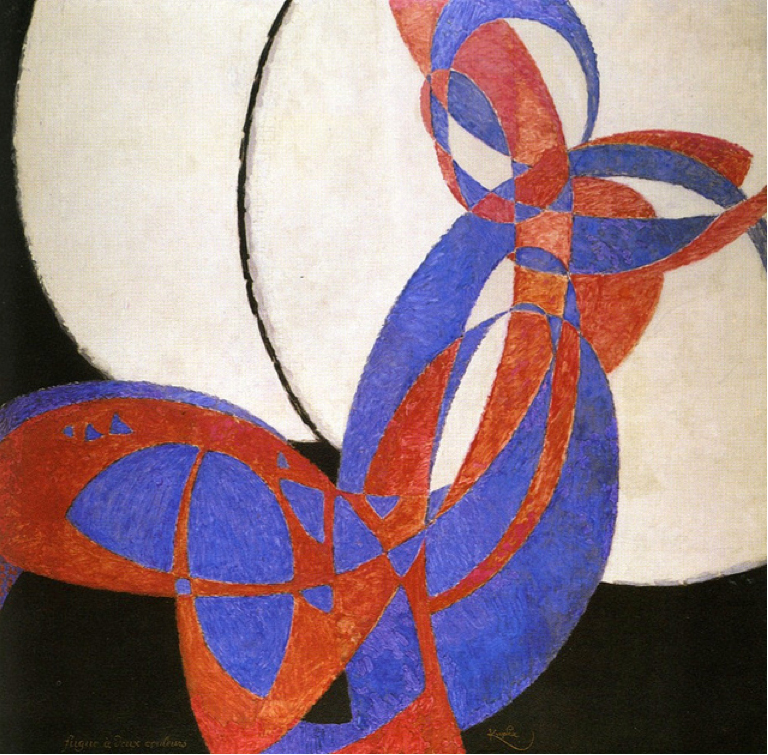
František Kupka, 1912, Amorpha, fugue en deux couleurs (Fugue in Two Colors), (Image courtesy of Narodni Galerie, Prague)

František Kupka, 1912, Amorpha, fugue en deux couleurs (Fugue in Two Colors), (Image courtesy of Narodni Galerie, Prague)

Amongst the proliferating world of blogs about art and websites promoting every imaginable form and aspect of art, there is a new endeavour which brings more "fire" into the public discourse about art. Today, PBS announced the launch of a new website, PBS Arts, to diffuse to new audiences their work on visual arts, crafts, and architecture.

It seems that the more the arts are "de-funded" by government, the more Public Radio and Public Television are taking up the challenge of informing the nation about artistic endeavours, accessible or opaque in nature. Awareness of what is happening in music, visual art, theatre, poetry, literature, crafts and architecture enriches us all, even if the coverage is, inevitably, only a small proportion of what is happening nationwide. Learning about the arts of today renders them much more accessible and interesting to everyone, negating to a degree the controlling influence Hickey ascribes to the "elite". There is another aspect of this wider accessibility: seeds are sown in people's minds which lead, later, to deeper interest and knowledge about the arts in many instances. More fire in the art world.

Embankment by Rachel Whiteread. Turbine Hall, The Tate Modern, Bankside, London. 12 November 2005
Embankment by Rachel Whiteread. Turbine Hall, The Tate Modern, Bankside, London. 12 November 2005

Art that alludes to the Sacred by Jeannine Cook

Ephraim Rubenstein, a wonderful artist and fellow silverpoint artist, has just sent me the announcement for his forthcoming solo exhibition at the George Billis Gallery on West 26th Street in New York. Entitled Temples and Cathedrals, it is a show of large-scale mixed drawing media depictions of European Gothic cathedrals and massive Greek temple ruins. It will certainly be a dramatic and impressive array of drawings.

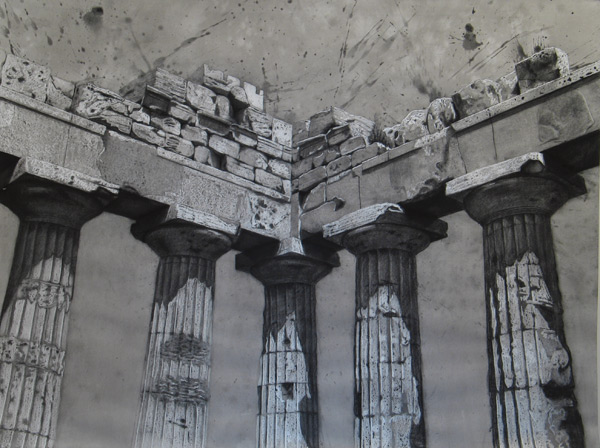
What I found interesting were Ephraim's concepts behind this body of work. In both the pagan temples and the cathedrals, he evokes the "magisterial quality of these sacred spaces". Scale, architecture, play of light are all devices used in sacred structures to impress and convey a sense of the presence of the divine. There can be few of us who have not been silenced in awe at the sight of the mighty harmony of soaring Gothic arches or the dazzling glory of huge rose windows enclosed by lacy stone. Similarly, Greek temples, no matter how shattered by time and man's depredations, evoke the centrality and the power of the gods in man's daily life by the extraordinary elegance and drama of columns, friezes, pediments.

Selinunte I (mixed media, 38×50), Ephraim Rubenstein  (Image courtesy of Artists Network)

Selinunte I (mixed media, 38×50), Ephraim Rubenstein  (Image courtesy of Artists Network)

Cathedral VII (mixed media, 38×50), Ephraim Rubenstein, (Image courtesy of Artists Network)

Cathedral VII (mixed media, 38×50), Ephraim Rubenstein, (Image courtesy of Artists Network)

By playing these very different types of structures off each other in his dramatic monochrome renderings of temples and cathedrals, Ephraim reminds us of man's perpetual quest for the sacred. As he points in his press release about the exhibition, the metamorphosis of man's religious beliefs, from paganism to Christianity, is echoed even in the stones of the different sacred structures. Many of the cathedrals were built with stones taken from earlier temples. Another form of Sic transit.

Knowing how beautiful Ephraim Rubenstein's art is, I am certain that this will be an exhibition well worth visiting if you are in Manhattan.

The Power of Art by Jeannine Cook

One of the most eloquent reminders I have met recently of the power of art to overcome even the most appalling of situations and experiences is the 1963 novel by the Czech writer, Josef Bor, entitled The Terezin Requiem. I found this slender book, republished in 2006 in French in the Livre de Poche edition, at Barcelona airport; it was a fortunate purchase. If you are lucky, I think it can be found in English, sometimes with the title, The Theresienstadt Requiem.

Although this is a novel, it is based on a true story. Josef Bor, a legal expert, was sent to Terezin, "the antichamber to Auschwitz", in June, 1942. Most of his family was killed in Poland, Terezin or Auschwitz. He was eventually liberated from Buchenwald in 1945, and in 1963, he published this book. It is about the Czech pianist and orchestra director, Raphael Schächter, who spent from November 1941 until October 1944 in Terezin; he was then transported to Auschwitz. During his time at Terezin, after eighteen months of the most determined and heroic work, he managed to put on a concert of Giuseppe Verdi's Requiem, with four soloists, a choir of one hundred and fifty singers and two pianos en lieu of an orchestra. To achieve that, he had to teach and rehearse with at least five hundred prisoners, because the Nazis kept sending off the singers to Auschwitz to be exterminated.

Image of deceased Czech composer Rafael Schächter

Image of deceased Czech composer Rafael Schächter

The book is a most beautiful and moving paean to the power of art to advocate for liberty and justice. Verdi's Requiem becomes the vehicle to assert the essence of human dignity, the absolute rejection of Nazi barbarism. Bor writes superbly, moving one through the incredible labours and odyssey of Schächter rehearsing and achieving the performance of the Requiem, which, as in real life, was ultimately produced - by a quirk of fate - with Eichmann, Moese and fellow SS high command in the audience.

Verdi's music is used to tell the story of the emotions, the suffering, the deeply shared empathies of the musicians. Aria by aria, the words, written by an Italian and rooted in the Catholic faith, are sung by Jewish prisoners as the ultimate resistance to their Nazi oppressors. Bor makes one understand just why this musical art can be so potent, so universal.

I don't think I will ever listen to Verdi's Requiem again without having in mind this beautiful account of music's redemptive, triumphant power in the name of freedom.

The Arts and Joy by Jeannine Cook

I was listening to the BBC in the car today and heard a piece by the singer-songwriter, Tracy Chapman, talking of her acclaimed song,"Fast Car" and others. What I found interesting were her observations about the creative process being "very mysterious", in that she does not set out to deal with any specific issue. She apparently just sits down "for the joy of it" to create, using her love of music to develop whatever "inspires me". Although everything is autobiographical in some sense, she allows the creative process to evolve and lead her.

I kept thinking about the joy of the creative process, because of course, it resonates with me and every other artist in no matter what field. I could not help reflecting that it is indeed seldom that one hears of someone in business, finance or many other occupations who talks about experiencing "joy" in what he or she does. Perhaps that helps to explain why so many things go wrong!

For an artist, joy is an emotion that is complex, marvellous, fugitive and very precious. It is also highly unpredictable. Allowing time, space, quietness and personal happiness in one's life are all ingredients that feed into the joy of the creative process. Ultimately, for many people, creating is as simple as breathing, and as necessary.

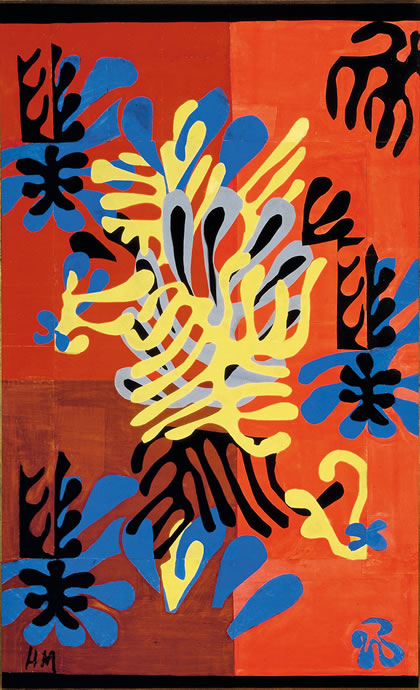
Henri Matisse, Mimosa, 1949-51, Gouache on paper, cut and pasted, mounted on canvas (Ikeda Museum of 20th Century Art, Ito, Japan)

Henri Matisse, Mimosa, 1949-51, Gouache on paper, cut and pasted, mounted on canvas (Ikeda Museum of 20th Century Art, Ito, Japan)

Dominant Curve, oil on canvas, Vassily Kandinsky,1936,  (Image courtesy of Solomon R. Guggenheim Museum, New York, Solomon R. Guggenheim Founding Collection)

Dominant Curve, oil on canvas, Vassily Kandinsky,1936,  (Image courtesy of Solomon R. Guggenheim Museum, New York, Solomon R. Guggenheim Founding Collection)

The Joy of Color, acrylic, San-T (Image courtesy of the artist)

The Joy of Color, acrylic, San-T (Image courtesy of the artist)

From the perspective of someone whose mission it was to try and introduce people to this joy, awareness of the arts is key. Dana Gioia, former Chairman of the National Endowment for the Arts, said,"the purpose of arts educators is to create a complete human being who can lead a productive life in a free society." To achieve a greater respect for the arts, he felt that experience was the best path. He evoked sitting in a concert hall and being "moved to the deepest centre of your humanity", going to a museum and being "simply ravished by what you see".

Yet in order to be moved, ravished, uplifted, each of us has to benefit from fellow human beings who have experienced the joy and inspiration of creativity in some fashion and given us works of art. It is an extraordinary chain of gifts down the generations from time immemorial.

Annual Newsletters about Art by Jeannine Cook

Writing a newsletter about one's activities in the art world is an interesting exercice, I have decided. For many years now, I have written one every summer, mostly just to touch base with my friends and art collectors. Many people who have collected my art have become friends, which is one of the nicest bonuses of all.

When an artist sits down and reviews what has happened during the previous year, it is sometimes instructive. You can assess clearly whether you are making an effort to put your work out in the marketplace and what the results have been. Measuring yourself against your peers is another important aspect of trying to grow as an artist: acceptance in shows that are juried or curated by respected authorities in the art world is always a plus, particularly for one's resume. But more than that, it is a benchmark in the quest to improve one's artistic skills.

A review of a busy year can yield clues as to what activities have been the most successful; it can also show up what lacunae may need perhaps to be attended to in the future. Outreach can take many forms, from exhibits to talks to articles in the press, or - as with this blog - on the Internet. All these can help foster the image/brand that you are endeavouring to present to the world as an artist. The philanthropic side of art shouldn't be forgotten either; art can help people and causes in many different ways.

Over the years, however, I have also realised that the personal side of being an artist needs also to be alluded to a little in a newsletter. Artists are human beings, with a personal life, and it influences hugely what sort of art is produced. I found that out very clearly earlier this year when illness and my husband's illness almost obliterated any energies for art for a while.

Gerard ter Borch in his famous painting: Woman writing a letter, oil on panel, 1655, (Image courtesy of the Mauritshaus, The Hague)

Gerard ter Borch in his famous painting: Woman writing a letter, oil on panel, 1655, (Image courtesy of the Mauritshaus, The Hague)

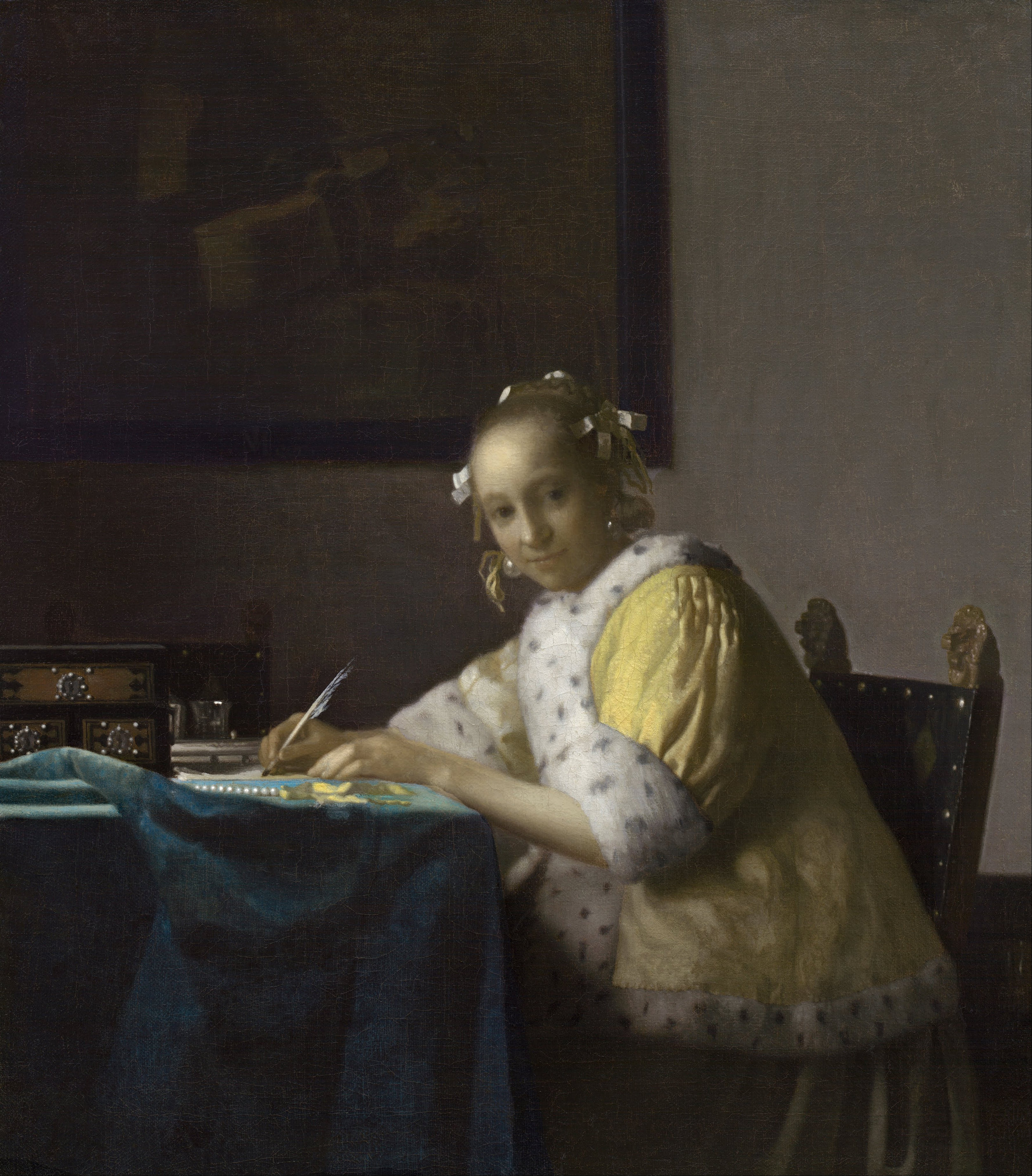
Johannes Vermeer, A Lady Writing (c. 1665); oil on canvas. Gift of Harry Waldron Havemeyer and Horace Havemeyer, Jr., in memory of their father, Horace Havemeyer. National Gallery of Art

Johannes Vermeer, A Lady Writing (c. 1665); oil on canvas. Gift of Harry Waldron Havemeyer and Horace Havemeyer, Jr., in memory of their father, Horace Havemeyer. National Gallery of Art

Lady writing a letter with her Maid, c.1670, (oil on canvas) by Jan Vermeer,(Image courtesy of the National Gallery of Ireland )

Lady writing a letter with her Maid, c.1670, (oil on canvas) by Jan Vermeer,(Image courtesy of the National Gallery of Ireland )

It can be very encouraging to see that despite the feeling that one has accomplished little in the previous twelve months, there are in fact exhibitions, actions and results to reassure one that, yes, I am a professional artist. Somehow, twelve months rush on in headlong fashion and it is easy to forget what has been accomplished. Try doing a yearly review and share your successes with your friends and collectors. It can be a worthwhile exercice.

"Forgetting about Art" by Jeannine Cook

John Constable, the consummate English Romantic observer of nature and artist of magnificent landscapes, once observed: "when I sit down to make a sketch from nature, the first thing I try to do is to forget that I have ever seen a picture."

I was thinking about this remark of Constable as I settle into my newly furnished studio in Spain and decided I wanted to inaugurate it by painting whatever my eye lit upon as I looked out of the windows. It was an interesting exercise, as in truth, there was a lot of beauty, but nothing that especially spoke to me as potential subject matter. Too many leaves, too much tumbling brilliance of bougainvilleas - in short a jumble of shapes. But I decided I would press on. The result was this small watercolour. I deliberately tried to keep my mind blank and just work by reaciton.

From my New Studio Window, watercolour,  Jeannine Cook artist

From my New Studio Window, watercolour,  Jeannine Cook artist

Another remark Constable made was equally relevant to this watercolour exercise. Only someone who has worked a lot plein air could have such accurate insights. He said, "No two days are alike, nor even two hours; neither were there ever two leaves of a tree alike since the creation of all the world; and the genuine productions of art, like those of nature, are all distinct from each other."

He was right about the fig tree having a wonderful diversity of leaf forms. He was equally so about the every-changing light, the fugitive shadows, the change in intensity of flower colour... But it was fun to do this study - in a brand new and lovely studio.

When did Art become an Integral Part of Man's Way of Life? by Jeannine Cook

It's been a day of fascinating coincidences.

Before I go further, I should just say that I am very much a child of Africa, I spent many, many blissful hours as a child along the seashores of Kenya and Tanzania and I still have treasured collections of the seashells I gathered there long ago.

Those reasons were enough to prompt me to read with attention an article from August's Scientific American magazine which my husband waved under my nose. Entitled " When the Sea Saved Humanity", it is an account by archaeologist Curtis W. Marean of how his findings in a cave above the rocky coast near Mossel Bay, South Africa, have afforded insights into how the very small and endangered population of Homo sapiens could have survived the dry, cold glacial age that rendered most of Africa uninhabitable from 195,000 to 123,000 years ago. South Africa's coastal bounty of shell fish and its very nutritious underground geophytes or tubers allowed this small group of people (from whom today's nearly seven billion inhabitants descend!) to survive.

Excavations from this cave, PP13B, at Pinnacle Point, have shown that man began living there 164,000 years ago. Evidence from the cave and others in the same area has pushed back to these very early dates proof of human cognition, technological abilities, tracking of time through lunar phases and sophisticated use of marine resources. But they have also shown another highly important sign of human "cognitive modernity", namely the evidence of art and its symbolic usage.

This is where, as an artist, I read with fascinated glee. Amongst the other artefacts found in the cafe at Pinnacle Point were countless pieces of red ocre, carved or ground to powder to mix with some binder, such as animal fat, to make paint for body or other surface adornment. By 110,000 years ago, red ocre and sea shells, collected and saved for their aesthetic appeal, made their appearance in the cave. These point to the existence of the concept of art and other symbolic activities. Another British archaeologist, Ian Watts, has found worked and unworked pieces of red ocre by the thousands at other sites in South Africa, dating from 120,000 years ago. (Remember - the earliest European cave paintings that use red ocre on the cave walls date from 32,000 years ago.)

Curtis Marean also mentions the discovery, in Blombos Cave, to the west of Pinnacle Point, of pieces of ocre with systematic, abstract carving by Christopher S. Henshilwood of the University of Bergen. Along with the ocre rocks, he found refined bone tools and beads, all dating from 75,000 years ago.

The image of the abstractly-decorated rock is courtesy of Christopher Henshilwood and Francesco d'Enrico, via National Geographic.

Red ocre incised brick, 75,000 years old from Blombos Cave, South Africa (Image courtesy  of National Georgraphic, Italy)

Red ocre incised brick, 75,000 years old from Blombos Cave, South Africa (Image courtesy  of National Georgraphic, Italy)

This afternoon, I listened to Alix Spiegel, on NPR's All Things considered programme, asking "When did we all become mentally modern?" Symbols again.

Shells like these, into which holes have carefully been drilled by hand, were used as beads. The beads, which were found at Moroccan Middle Paleolithic sites and are believed to be about 82,500 years old, were used as symbols and indicated status an…

Shells like these, into which holes have carefully been drilled by hand, were used as beads. The beads, which were found at Moroccan Middle Paleolithic sites and are believed to be about 82,500 years old, were used as symbols and indicated status and beliefs, much in the way modern wedding rings or religious iconography do. (Image and text courtesy of NPR.org)

Professors Francesco d'Enrico and Marian Vanhaeren published these illustrations of the beads in the Journal of Human Evolution.

All these amazingly early datings of evidence of art and its use in man's daily life give one an even deeper feeling of the centrality of art's role in our lives. We ignore this heritage at our peril.

Reactions to Art by Jeannine Cook

I have previously talked in this blog about the organisation, The Art Connection, in Boston. They accept artists' donations and then enable non-profits to obtain art for their walls. I have been working with The Art Connection for some time now, because I think it is a very worthwhile cause and is good both for artists and people who otherwise might not be able to see original art that could be uplifting and healing.

In a summer e-newsletter I received from The Art Connection, they included the following piece about reactions to art by participants who were selecting art for their agency. I found it interesting, and it is revealing in many ways. I quote it verbatim, with acknowledgement to The Art Connection editors.

"57% identified that participating in the (art selection) process was a challenge. The reasons why:

- It was challenging because it was hard to make choices when there were so many good pictures to choose from!
- It was challenging because there were a lot of beautiful choices and we could not take them all!
- It was challenging because choosing art specifically for the agency is different from choosing art based simply on personal preference.
- It was challenging because different people like different things and there were a lot of opinions in the room.
- It was challenging because there were too many to choose from!

Top three identified reasons for selecting artwork : Colour, Content/theme and Visually stimulating.

Participants also shared their interesting, and sometimes surprising, thoughts on what impact they think the art will have:

- The art will improve morale and stimulate dialogue; and hopefully impact our reputation to some extent too.
- The patients will love the art and the center will also be recognised for its unique art style.
- The art will help the building have an amazing welcoming aura.
- Homeless people deserve great art as much as anyone! It will create self-esteem and respect for the home.
- I think the clients will have a sense of pride living in a program with such beautiful artwork.
- Each piece can evoke a different reaction from different individuals. I personally think the artwork will add beauty, and get students and staff talking, whether they like the art pieces or not."

The reactions expressed in these responses to The Art Connection during the art selection process really seem to run the full gamut of reactions that the general public has to art. I have watched similar reactions during art exhibitions as well. It all underscores for me that art is really, really important in people's lives, whether they realise it or not. Art is a reflection of the health of a society, and as such, should not be short-changed in the name of economic hardship.

A Fascinating Book on Art by Jeannine Cook

Between starting to paint and draw in my new studio and rushing off to swim in the chrystalline Mediterranean, I have been savouring of a most interesting book on all aspects of art. The Art Detective: Fakes, Frauds and Finds and the Search for Lost Treasures by Philip Mould is the perfect book for summer reading. Published last year in the UK by Viking, it appeared this year in the United States.

Philip-Mould-2015-by-Travis-Simpkins-the-art-detective.jpg

Not only is the account a fascinating story of finding lost or mis-identified art, especially by early British artists, but the author is generous with his insights and knowledge about art, good art, and how artists achieve their successful effects. His familiarity with the characteristics and idiosyncracies of artists' methods of painting, especially those of the 17th and 18th centuries, is very instructive. In fact, it is a book well worth re-reading, after the summer!

Many of us will be familiar with Philip Mould from his role on the BBC's Antique Roadshow so this book is a delightful addition to the erudition for which he is already recognised. What impressed me are the layers and layers of analysis, historical and artistic knowledge, technical expertise backed up with technology, and - ultimately - gut feelings that are brought to bear on a work of art. No wonder he is called an Art Detective. And he makes it all fascinating and fun.

It's a book well worth reading.

A New Art Studio by Jeannine Cook

It's completed! I am sitting in my new art studio in Spain, marvelling in space, light and all sorts of new possibilities. I now know a little better the excitement of which I have read countless times - when an artist gets his or her new studio.

From being a dark and damp garage built in the late 50s, this studio has metamorphosed into a high-ceilinged space filled with the brilliance of Mediterranean light. White walls, large windows and a large mirror all make that difference. A speckled cream tiled floor completes the airy look. I have spent the last week or so finding simple, functional furniture to install, complemented with comfortable chairs and wide table surfaces.

Beyond, through the windows, I am watching doves sip water at a bowl shaded by gracious elms, while blackbirds are carefully inspecting the wonderfully sculptural fig tree to see how ripe the figs are after the intense heat we had last week. Not ripe enough! No matter, they and the other fig-lovers (semi-wild rowdy parakeets and humans alike) will be watching carefully, day by day. The intense luminous cerise of bougainvilleas punctuate the dappled greens of trees, while the cascade of blue plumbago flowers tumble out of cypress trees to meet the lemony white or shocking pink of oleanders. Today is cool and almost springlike, to the relief of all, save - perhaps - the northern tourists at the beach. Black caps and Sardinian warblers join sparrows in song as they flit amongst the white bougainvillea and jasmine.

The studio is such a delight that it is almost inhibiting. Will I be able to produce art worthy of this space...? Time alone will give me that answer. But at least I can now savour more fully what each artist feels when he or she moves into a new dream studio.

My first silverpoint done in the new studio, The Herald of Spring - Fig Tree, Jeannine Cook artist

My first silverpoint done in the new studio, The Herald of Spring - Fig Tree, Jeannine Cook artist