Those who love drawings by Jeannine Cook

Back on 3st May, I wrote about how I felt sad for people who simply by-passed a drawing on a wall in favour of a painting and thus missed the intimate and fascinating dialogue that is possible with such works.

Very soon afterwards, I read Souren Melikian's article, "An Inspiring Case of Schizophrenia" in the June issue of Art + Auction. I should first say that over the years of reading this magazine, I have become a huge admirer of Mr. Melikian and his deep, encyclopedic knowledge of so many branches of art and antiques, from his main love, 16th century Persian literature and Iranian art, to old master paintings and drawings. This particular article, sub-titled "Paintings and drawings belong to different worlds. So do the collectors who seek them out", dealt essentially with the same attitudes towards drawings as I had been writing about earlier. Souren Melikian was writing about the March Salon du Dessin, in Paris, where an atmosphere of rapt, close attention is the norm on the gallery stands, totally different from the "bustle and boom" of other art fairs. He went on to describe some of the interesting and beautiful drawings to be seen, some of which had been discovered to be studies for later paintings after considerable connoisseurship and sleuthing.

"Great works on paper do not lend themselves to hype, nor can they be summed up in the sound bites that are so dear to the media and auction houses alike." Not only that, Melikian continued, they do not command the same prices, especially if the drawings cannot be linked to a painting. As most artists know, drawings are private works, often done to express thoughts and feelings without regard to the public arena. Often too, mediocre painters can produce dazzlingly wonderful drawings, even though the market place has difficulty in accepting such works. It takes someone who loves drawings for themselves and has developed a deep knowledge of them to appreciate such buying opportunities.

An interesting point made about drawings historically by Melikian is that they often herald, by many decades or even centuries, new artistic trends in painting. One example he cites is of 16th century drawings by the Genoan artist, Luca Cambiaso, who reduced human figures to simple geometrical figures in a way that could - or should - have led to a Cubist movement in Italy in the 1500s.

The Visitation, c. 1580, pen & brown ink brown wash on paper, Luca Cambiaso (Image courtesy of the Art Gallery of South Australia)

The Visitation, c. 1580,
pen & brown ink brown wash on paper, Luca Cambiaso (Image courtesy of the Art Gallery of South Australia)

Other artists he referred to include Victor Hugo, who was a pioneer in abstract art in the 1850 and 1860s with his amazingly atmospheric black ink drawings, many done while he sought political asylum from Napoleon's Second Empire in Jersey and later Guernsey in the Channel Islands. Another artist who could already be termed an Abstract Expressionist in his drawings of 1855 was the Spanish artist, Eugenio Lucas Velazquez, who signed himself Eugenio Lucas. A minor painter, his arresting drawings in black ink or pencil could easily be read as abstract works, a century ahead of his peers.

Eugenio Lucas, Madrid 1817–1870 Madrid,Priest Declaiming, ca. 1850, Black chalk and brown wash (Image courtesy of the Morgan Library, New York)

Eugenio Lucas, Madrid 1817–1870 Madrid,Priest Declaiming, ca. 1850, Black chalk and brown wash (Image courtesy of the Morgan Library, New York)

As Souren Melikian underlined, it takes faith in one's own eye and a knowledge of drawings, old or contemporary, to allow one to enter this quiet and rewarding world that runs parallel to that of paintings. When one does, the delights, surprises and rewards do not fail.

More on "Artists' Eyes on the Skies" by Jeannine Cook

I heard a fascinating addendum to my blog entry of June 7th about artwork helping to unravel meteorologist mysteries of the past on NPR today. With the title, "Scientists pinpoint Monet's Balcony", host Guy Raz interviewed John Thornes, Professor of Applied Meteorology at Birmingham University.

Like other scientists looking at artists' work to learn of past weather conditions and other situations, John Thornes has been studying Claude Monet's paintings which he did in London in the winters of 1899-1901. These famous paintings of Waterloo and Charing Cross Bridges and along the Thames to the Houses of Parliament - 95 images in total - were painted from the balcony of his rooms at the Savoy Hotel. As Monet did so often, he worked on different canvases as the light moved. He apparently used the morning light to depict Waterloo Bridge, the midday hours to paint the Charing Cross Bridge and ended his busy days capturing the sunsets along the river towards the Houses of Parliament.

Impression, Sunrise,  1872, oil on canvas, Claude Monet, (Image courtesy of the Musee Marmottan)

Impression, Sunrise,  1872, oil on canvas, Claude Monet, (Image courtesy of the Musee Marmottan)

Professor Thornes and his team used solar geometry and historical weather data to determine exactly which balconies of the Savoy had become Monet's painting sites, based on the sunlight that Monet painted in each canvas. Monet, like many other artists, was amazingly accurate in his representation of the prevailing weather, so the visual coloured record of wintertime London is also one of the famous "pea souper" conditions that prevailed for so long in the smoky, foggy city. Monet, in fact, damaged his health by exposure to all that pollution, even though he apparently considered all the smog as an "envelope" between him and the scenery.

Clearly scientists have a rich resource to mine in artists' observations of the skies and world around them. For John Thornes, for example, the next of Monet's paintings to be examined for meteorological information is his Impression, Sunrise, the canvas painted at Le Havre that purportedly gave rise to the name of Impressionism. It must be a thrill to combine one's passions for art and science in these sleuthing ventures.

More Proof of the Value of Art in Education by Jeannine Cook

Although most artists instinctively know how valuable a tool art is in all aspects of their life, helping in so many ways that don't seem directly connected with art-making, it is always interesting to have it "officially" confirmed.

The Guggenheim Museum in New York has just held a conference entitled "Thinking like an Artist: Creativity and Problem-solving in the Classroom". This is the culmination of a four-year research initiative focusing on the Art of Problem Solving, using arts education as a pathway to foster creativity and help problem-solving techniques. The U.S. Department of Education funded the study and conference.

The bottom line at the end of the study is that the Learning through Art instruction methods help in developing different skills: flexibility (the ability to rethink or revise one's plans when faced with challenges), the connection of means of achieving goals and the results achieved (the ability to assess the success of meeting the goals one had set out in the work of art) and resource recognition (the ability to identify additional materials that could be used to complete the project). Imagining, experimentation and self-reflection are other benefits mentioned in the study.

So, after four years and a million dollars spent, we can all know for certain what artists knew already: art is hugely helpful for problem-solving and general coping with life. An earlier study done under the same auspices had already confirmed that Learning through Art improved students' literacy and critical thinking. But as a result of these studies, more children might at least acquire more tools to prepare them for life if they have art incorporated into their curriculum. That would be really good.

Art as Witness for Ourselves as Humans by Jeannine Cook

A well-respected and prolific Spanish writer, poet and essayist, Felix de Azua, has just published an Autobiography without Life or Autobiografica sin vida (Mondadori 2010) which sounds fascinating and thought-provoking.

Starting with the book cover which uses an image from the 30,000 year-old drawings of horses found in the Chauvet Caves in France, he traces his own life, that of his generation and, in a wider sense, that of western art in general by images of artwork down the ages. His thesis is that the art we humans create bears witness for us as human beings. For century after century, representative art has reflected our place in the world, showing what surrounds us, and what matters to us. At the same time, that art also acts as a substitution for the reality depicted.

For the people frequenting such caves as Chauvet, Lascaux or Altamira, the magic of the rock face art was potent. Its power still reaches us. (As a confirmation of this, I read this week that the Spanish authorities have decided, despite the chorus of opposition from the scientific community, to reopen the Altamira caves to public visits.)

Rupestrian Art, Altamira Caves, Spain

Rupestrian Art, Altamira Caves, Spain

Chauvet Cave Art Paintings (Image courtesy of Bradshaw Foundation)

Chauvet Cave Art Paintings (Image courtesy of Bradshaw Foundation)

But over the generations, Felix de Azua contends, this magic has been diluted, dissipated, stolen from art - he cites David's Marat, Goya's Disasters or even Rothko's work as having converted art's magical qualities into shadows and undiluted (maybe soulless?) representation culminating in today's performance art. In Azua's opinion, the nuclear bomb unleashed at Hiroshima not only proved to all mankind that our species is capable of total self-destruction, but it also caused a huge rift in the history of art.

Azua feels that we are thus in the early days of a totally new era in art, one that is full of complexities, given man's awareness of his own potential disappearance. Our awareness of the nuclear threat may be only subliminal now, but the threat does influence today's forms of art. Nonetheless, the magic inherent in art-making still exists or can exist. This "communion with the cosmos" is still necessary for us as humans, in art, in literature, in falling in love. As Azua remarks, "I also know that we cannot do without art, just as we cannot do without religion or science."

Artists' Eyes on the Skies by Jeannine Cook

I am sitting on a hotel terrace in the Thousand Islands area of the St. Lawrence Seaway, Ontario. A rainy day has yielded to golden light and jewel-like sparkles in the water in the early evening, with hours of light still remaining - in these northern climes. The River is sprinkled with small islands, mostly crowned with a cluster of trees, which are ebulliently vivid in their variety of greens above the ochres and greys of the granite rock shorelines. Limpid reflections shimmer on smooth waters. Above, osprey hover and dive, while great blue heron wing purposefully west above the pine tree crowns on the distant shore.

I have been watching this wonderful parade of light and magic because I have my artist's eye turned on. I keep analysing the scene in terms of how to depict what I see. I don't mean literally, in terms of representation, necessarily, because I am always "pruning" and editing the scene I am looking at, trying to select the most relevant details. Nevertheless, at the back of my head, I am aware that the veracity of a painting of drawing is underlined by the references, direct or indirect, to the climate, the light, the prevalent weather ... In the days that I have spent here, the light has been amazingly varied but always wonderful and very northern and cool, compared to the light of coastal Georgia or the Mediterranean.

Artistic fidelity to weather and atmospheric phenomena has proven useful on occasions. I have read that meteorologists have consulted paintings done in previous centuries to confirm weather events, volcanic eruptions, meteor showers and more. We were all recently reminded about the amazing sunsets caused by volcanic ash. I heard Simon Winchester talking on PBS about the insights into wind patterns circling the globe that were obtained from paintings done around the world by artists enthralled by the sunsets drama caused by the eruption of Krakatoa in 1883.

Constable's drawings and paintings of clouds and related weather in 18th/19th century England have also yielded good science, thanks to their accuracy. He spent many an hour studying clouds and drawing them in their fugitive glory. I felt considerable empathy with him when I was Artist in Residence in Brittany in autumn, 2008, because there, too, the weather is never the same for more than half an hour!

Seascape Study, Boat and Stormy Sky, 1824, John  Constable  (Image courtesy of the Royal Academy)

Seascape Study, Boat and Stormy Sky, 1824, John  Constable  (Image courtesy of the Royal Academy)


Another benefit of artistic fidelity to weather conditions was written about by Dan Falk, an environmental journalist writing on June 6th, 2010, in the Toronto Star. A Canadian artist, Gustav Hahn (1866-1962), depicted a west Toronto neighbourhood in the winter of 1913. Above, the night sky shows the constellation, Orion, and also a bright series of objects streaking across the sky. Hahn, also an amateur astronomer, was recording the famous Canadian Fireball Procession of 1913, a very rare event when meteors graze the earth's atmosphere at a very low angle and break up into glowing fragments. This painting yielded all sorts of insights for Donald Olson, a physicist at Texas State University, who is known as the world's leading "forensic astronomer". He mines classic works of literature and art for references to our universe - the moon, the stars and the sun - and calculates where and when each piece of art was created. For example, Olson has calculated the exact spot and time when Van Gogh painted Moonrise: 9.08 p.m. on July 13th, 1889. Another piece of art that became important in Olson's studies was a painting by Hudson River School artist, Frederic Church, entitled The Meteor of 1860, showing a peaceful late evening river scene, with a brilliant array of meteors streaking across the sky on an almost horizontal trajectory. Olson later deduced that Walt Whitman, in New York, had witnessed and then written of the same event in one of his poems. Both conclusions were buttressed by his having seen a copy of Hahn's painting of a meteor procession. Olson's analysis is appearing in the July issue of Sky and Telescope magazine.

Painting of The Meteor of 1860 by Hudson River School artist Frederic Church. (Credit: Frederic Church courtesy of Judith Filenbaum Hernstadt).

Painting of The Meteor of 1860 by Hudson River School artist Frederic Church. (Credit: Frederic Church courtesy of Judith Filenbaum Hernstadt).


Without the keen watch that artists keep on the skies above, we would all lose a lot of fascinating information.

Tuning into Drawings by Jeannine Cook

A remark that was made by Andrew Lambirth in the Spectator magazine in mid-April has stayed with me. Writing about a recent exhibit at Tate Modern, Arshile Gorky: A Retrospective, he wrote, "One of the chief pleasures and revelations of this show is the drawings. The five works here, including 'Study for the Liver in the Cock's Comb', are rich enough to merit a couple of hours' study, and yet most people only glance at them en route to the paintings." (my emphasis).

The Plough and the Song, 1947, Arshile Gorky. (Image courtesy of Allen Memorial Art Museum, Oberlin College.)

The Plough and the Song, 1947, Arshile Gorky. (Image courtesy of Allen Memorial Art Museum, Oberlin College.)

These cursory glances at drawings en route to paintings in exhibitions make me sad. For many a long year, particularly in the United States, the average person has somehow retained the impression that drawings are very much a second class affair, unworthy of much attention and still less worth acquisition. Since drawing as a medium fell out of fashion during the time when abstract art reigned supreme, it is somewhat understandable. Yet drawing permits a depth of understanding, appreciation and - yes - delight in a viewer willing to pause and really look.

Drawings seldom are as commanding as a painting; their presence is more discreet, more intimate. Yet a drawing is not only a pathway to understanding the artist's paintings, it is also a porthole allowing one to see the artist's inner workings and concerns in the most direct and unadorned fashion. Drawing also allows such an enormous variety of approaches and methods that it makes painting - in oil, acrylic, watercolour, encaustic or egg tempera - seem positively staid. Take Gorky's drawings, with their extraordinary inventiveness of form and use of colour - many of them were the result of numerous repetitions and permutations based on drawings done in the fields and meadows of Virginia on his in-laws' farm. At the other extreme is the delicacy of a silverpoint drawing done by someone such as Koo Schadler, who works in classical media today.

There are - happily - more and more exhibitions of drawings, master drawings for the most part. The public which appreciates drawings is a minority, but a very appreciative and passionate one. Ideally, the task of every artist today is to convey to their supporters and collectors how important drawing is in the artistic process, whether it is a working drawing or a finished one which stands alone. If a viewer understands that a drawing is an "open sesame" to understanding that artist and his or her work, then the whole artistic experience is enriched.

That a drawing merits more than a glance - that's the goal! For each artist and then for each viewer.

An Admirable Art Project by Jeannine Cook

On Morning Edition this morning, I heard of a really wonderful art project. Artist Matthew Mitchell, whose studio is in Amherst, Mass, is painting One Hundred Faces of War. Apparently one third of the way through the project, he is doing portraits of men and women who have served in the military in recent times, from very different ranks and varied walks of civilian life. He reflects the faces of veterans of Iraq and Afghanistan, people who have chosen to journey forth from America to these distant lands. Accompanying the very accomplished portraits, some posthumous, are statements written by the people themselves or by their survivors.

This project struck me as brilliant, not only because it is a wonderful way to make one's way professionally as an artist, with all the attendant publicity and exhibitions, but also because it seems a very necessary and important thing to do for society in general. As artist Mitchell remarked himself in the NPR interview, he did not know people in the military when he started out on this project. This is very frequently the case, I suspect. Certainly I do not know many people who have served in recent conflicts. In countries such as the US, where conscription has been abolished, the general awareness, on a personal level, of matters military is far more limited.

Nonetheless, America has a large number of very dedicated and admirable citizens who have served or are now serving; Iraq and Afghanistan are both terrible crucibles for these volunteers. I frequently have the uncomfortable feeling that their sacrifices are not always recognised sufficiently. Thus the Hundred Faces of War project is a wonderful way to convey to a wider public just what being a soldier means to men and women today. The portraits shown on Mr. Mitchell's website are eloquent and moving, made even more meaningful by the accompanying written statements.

Emilio Fernandez, IT Project Manager at the Veteran's Administration, From Phoenix, AZ, Marine, Sergeant, Artillery Fire Directional Controlman / Watch Chief, Iraq 2/03-6/03, 2/04-4/04 (Image courtesy of artist Matthew Miller), for Emilio Fernandez'…

Emilio Fernandez, IT Project Manager at the Veteran's Administration, From Phoenix, AZ, Marine, Sergeant, Artillery Fire Directional Controlman / Watch Chief, Iraq 2/03-6/03, 2/04-4/04 (Image courtesy of artist Matthew Miller), for Emilio Fernandez' statement, see http://100facesofwarexperience.org/portrait-gallery/100-faces/17229798

For artists, finding such projects is important but not always easy. Each of us has passions and concerns, and when the stars align to allow a project that combines our passion and our artistic skills, the results are usually powerful. The ventures are as diverse as are the artists involved - from a personal odyssey depicted in a series to plein air work done to raise awareness of an area's importance or an abstract exploration of feelings or memories... Each time one dreams up a project to execute, there is a thrill of excitement, often apprehension (as Matthew Mitchell also recognised in his NPR interview) about being able to tackle the task, but then a certain impetus and logic of the project itself seem to take over. One just goes about trying to execute it to the best of one's ability. Depending on the size and ambition of the project, it can become life-consuming. There is, nonetheless, an almost certain personal enrichment involved too. I have found that fascinations, insights, diverse joys and fresh knowledge come from each such venture - unexpected bonuses that remain with one. They often lead to the next project too, just as research for a book yields additional avenues later to be explored for other books.

I found the NPR story about Matthew Mitchell to be inspiring and reassuring - a timely reminder to be thinking of my next artwork series. I wonder if anyone else felt the same thing after hearing about him?

Sharing a Love of Drawing by Jeannine Cook

One of my private delights in life is constantly finding links and a serendipitous "circularity" in life. I have just had a delicious example of such a coincidence.

When I was flying back from Spain this week, I used the trip as time to catch up on reading various magazines. In a number of the Spectator magazine, I noticed an advertisement for a guided tour by Curator Hugo Chapman for Spectator readers of an exhibit at the British Museum. The exhibition is entitled "Fra Angelico to Leonardo. Italian Renaissance Drawing" and features about one hundred master drawings from the British Museum collection and that of the Uffizi Gallery in Florence. I kept the magazine page to check out the British Museum website when I got home.

Today, I open up my e-mail for the first time, and what should I find but a delightful message from my friend and blog-follower in the United Kingdom, Marion Brown, alerting me to the same exhibition and its marvels. A wonderful coincidence. One that also makes me wish I could hop over to London to see it before the exhibition closes on 25th July.

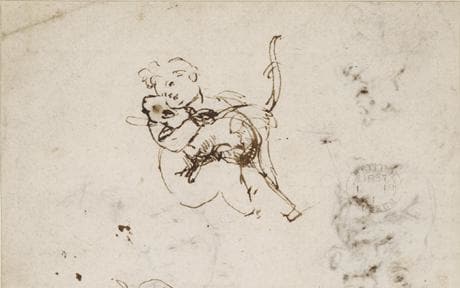
Leonardo da Vinci, Studies of the Infant Christ and a cat, c. 1478-81.  Photo: TRUSTEES OF THE BRITISH MUSEUM

Leonardo da Vinci, Studies of the Infant Christ and a cat, c. 1478-81.  Photo: TRUSTEES OF THE BRITISH MUSEUM

Even browsing the BM website makes me realise that the drawing medium I love so much, silverpoint, is key to such an exhibition. The changing attitude to drawings, the role they began to play in artists' working methods and the intimate links back to classical time in Greece and Rome are apparently demonstrated by Hugo Chapman's choice of works to display. The characteristics of paper, too, are brought out in Dr. Chapman's blog, in that the drawings, when they arrived from Florence, needed to "rest" and acclimatise to their new environment. Since paper is a living organism, it adapts and changes when it is moved. Any artist who works on paper finds this out, almost the hard way, when a finished work suddenly develops undulations, for instance, even under glazing. Given time, the work will adapt to the new conditions and revert to its normal appearance.

Thank you, Marion, for telling me about this exhibition. It is interesting to watch how many more museums are mounting master drawing exhibitions, many of which are featuring silverpoint more prominently. The power exercised by drawings is eloquent. The directness and honesty of this medium - or media, given that there are pen and inks, metalpoints, chalks and later graphites - allow today's museum visitors almost to feel as if the artist is working in front of them, trying out ideas, peering closely at the human body, altering and correcting things. The span of centuries means nothing as one looks at a drawing; its voice is singular and commanding, eloquent of the artist's vision.

If you are lucky enough to be in London, I suspect this exhibition will be well worth a visit. Failing that, the catalogue, Fra Angelico to Leonardo. Italian Renaissance Drawings", would be a lovely possession, I know. Now to order it.

Single-mindedness by Jeannine Cook

I recently alluded to a wonderful book I am reading, The Age of Wonder by Richard Holmes, about the 18th century Romantic generation's discoveries and accomplishments in science, exploration, literature and many other disciplines. The account of astronomer William Herschel's sister, Caroline, interested me deeply. She must have been a pint-sized (about five foot in height) force, highly intelligent and extremely self-disciplined. She was her brother's invaluable astronomical assistant, noting down all his observations as he peered through his wonderful telescopes at outer space, night after night. During the day time, for countless years, she ran his house, kept accounts, received eminent visitors and made the necessary calculations to complete William's observations.

However, in due course, she herself became a fully fledged astronomer, with her own beautiful telescopes which her brother designed and made for her. With single-mindedness, she began to sweep the skies, looking for comets. Like her brother, she became sufficiently familiar with the patterns of the night sky that she could almost "sight read", and thus more easily spot anything different. She became famous as the first lady astronomer, discovering a number of comets and garnering respect and acclaim in the international scientific community. She was also awarded the first professional salary every paid to a woman scientist in Britain when King George III granted her an annual stipend for life. Her single-mindedness, during those long, lonely nights spent looking through her telescope, brought her not only personal satisfaction, but much deserved respect.

Single-mindedness is an ingredient that I believe every creative person needs - whether in science, literature, art, music... Take a much respected and successful author, such as Robert Coram. His non-fiction books range from Boyd to American Patriot or Nobody's Child, while his fiction writing is extensive. His remark, during a lunch we were all sharing, was that for him, ten-hour days were followed by watching a film, by way of relaxation, before bed. That takes single-mindedness - ten-hour days, working on a project that normally takes about three years from start to publication. I mentally compared that with my time spent drawing and painting, and decided I needed to juggle personal and professional life more successfully!

I also had a reminder of another form of creative single-mindedness, as I listened today to NPR's Susan Stamberg talking about the current exhibition at the Smithsonian's Renwick Gallery in Washington, The Art of Gaman. This is apparently an exhibition of the art and crafts created by the Japanese Americans interned in camps here in the United States during World War II. Since they were simply dumped in these camps with no more for each family than four walls, lit by a light bulb, a pot-bellied stove in a corner and cots, they had to fashion anything else they needed out of any scraps they could find. But they went further than just utensils and furniture. Their single-minded courage led many of them to create art, jewellery and other pieces which are now on display. "Gaman" in Japanese means the ability to "bear the seemingly unbearable with dignity and patience".

Bearing the Unbearable: The Art of Gaman , Iseyama teapot

Bearing the Unbearable: The Art of Gaman , Iseyama teapot

Another manifestation of such single-mindedness was the art created by Jewish children and adults sent to Theresienstadt in World War II or, indeed, the drawings and paintings created in Auschwitz or Buchenwald or elsewhere. Think too of the dedication of those who were in Theresienstadt to composing and creating music. Faced with such appalling conditions, it must have required almost superhuman single-mindedness to continue creating beauty and uplifting manifestations of the best of the human spirit.

Patterns that have implications by Jeannine Cook

Well! I blogged about patterns yesterday, but nature is supplying the basis for some patterns that I - and countless other air travellers - could do without. The Icelandic volcano with the unpronounceable name is supplying Spain with its own art form of patterns.

Icelandic volcano eruption, (Image courtesy of Imgur: The magic of the Internet)

Icelandic volcano eruption, (Image courtesy of Imgur: The magic of the Internet)

How about tomorrow's predictions, courtesy of the British Met Office's Volcano Ash Advisory Centres? The airports are juggling flights, and I have already had one flight to Spain cancelled, so the patterns made by volcanic ash drifting who knows where are of considerable interest! El Pais, the Spanish daily newspaper, is full of lovely designs, none of which bring much comfort. Perhaps I had better find another type of subject about which to write in the art world. I seem to have been inviting the fates with the choice of patterns as a topic!