The Siren Calls of Spring by Jeannine Cook

The stirring of spring, with new growth and blossoms, energises most people. We emerge from shorter days, colder weather and general winter constrictions into the bright, clear light of spring. As days lengthen and the weather grows warmer, everyone starts to think further afield, of more outside activities, more travel, and more plein air art if you are an artist. Endless ideas of where to go to paint come back with insistence, of what to paint or draw, of how to celebrate the world around one.

These siren calls of spring return each year as a renewal of energies for me as an artist. By the end of the winter period, I find myself often flagging, somewhat lacking excitement about subject matter for art. Although the same wonderful flowers and scenes return each spring, they inspire me to draw or paint them, leading to debates about how to depict them in a fresh fashion. Flowers, especially, are my delight. Watercolours and silverpoint both lend themselves to such subjects. The big, bold Azalea indica or Southern Azaleas, for instance, are wonderfully sculptural, their flowers dominating the spring landscapes for a brief and glorious period. I find the subtleties in colour endlessly interesting in the different flowers - Nature is masterful in colour-mixing. It is therefore a huge challenge to be faithful - if one wants to go that route - to these blooms.

Azalea indica George L. Tabor

Azalea indica George L. Tabor

I realised, years ago, that I owe my mother a big debt of gratitude for any accuracy I may have in colour assessment. As a very young child, barely able to walk, I used to go with her to the brilliantly radiant fields of annual flowers in bloom that we grew for seed on our farm in East Africa. To keep each strain of flower pure and with correct growth, any plant that was of poor quality or with blooms different from the desired type had to be pulled up before it could set seed. I soon became very accurate in detecting variations in flower colour, and I think I retained that eye in later years. I do remember, too, the countless buckets of beautiful, ebullient flowers that we would take back to the house to enjoy because we hated just to pull up a plant and let it die in the hot tropical sun.

It was thus natural, I suppose, that in my art, I return again and again to the sheer joy of flowers when they start blooming in spring. Not only are they lovely in themselves, but to me, they signify much that is wondrous in nature. They offer solace, serenity, hope and energy. No wonder the Japanese celebrate hanami or " blossom viewing" in festivals, of which the most famous are the Cherry Blossom Festivals all over Japan each spring. There is a palpable sense of delight and awe as the Japanese walk beneath these exquisite blossoms and pay tribute to the beauty of nature in all its brief glory.

Cherry Blossom Time in Japan

Cherry Blossom Time in Japan

The same urgent delight and excitement fills me as spring brings its bounty of flowers to the Georgia coast. It is time to start painting!

Time for what we Value by Jeannine Cook

I spent a wonderful day yesterday drawing plein air with my friend and artist, Marjett Schille. It is gloriously the height of spring, with azaleas bursting forth, wisteria garlanding the trees with soft mauve fragrance, and the birds in courtship songs and displays everywhere one goes. We went to an island in the Altamaha River Delta,  Butler Island. South of Darien on the Georgia coast, it is accessible by road, but the area harks back to the antebellum rice plantation days. There are still the dikes and canals, along with the "trunks" which are the historic tide-driven gates that allow water to flood the rice fields carved out by slaves so long ago. The landscape is very much still man made, but since it is a Georgia State Wildlife Management Area, the ponds and fields are home to many bird species, enormous fish and clearly, many raccoons - to judge from the footprints along the sandy roads. In other words, a perfect place to go and paint or draw in spring.

Osprey Patrol, Butler Island, graphite, Jeanine Cook artist

Osprey Patrol, Butler Island, graphite, Jeanine Cook artist

While we were working there in companionable silence, amid a chorus of bird song from the bushes all around us, I kept thinking back to a passage I had recently read in the May edition of American Artist, where classical oil painter Patricia Watwood is quoted as hoping that, amongst other reactions, viewers would respond to her art by sensing"that there is time enough for the things we value. Time to craft a painting, to study, to learn, to enjoy, and time to sit still and contemplate a picture and the world that it contains."

There is a grace and a privilege for each of us if we can somehow organise our lives as artists - and viewers of art too, of course - to have enough time for matters artistic. To be able to have enough flexibility to put aside a block of time just to go off and paint, single-mindedly, for a day outside in some beautiful place. To have had the time to hone one's skills sufficiently that one can feel comfortable working plein air. To have the inner serenity, without nagging preoccupations, to be able to enjoy the whole experience of being out in nature, where ponds pulse with life and the trees are visibly leafing out hour by hour. And indeed, at the end of our time of painting and drawing, to look at Marjett's lovely watercolours and marvel at her creativity that results in highly original yet evocative paintings.

Ensuring that we all have time for the people, the things and activities we value: that is the true art of living, I suspect. As an artist, I felt that my day on Butler Island yesterday met those criteria wonderfully.

That Problematic Word, "Beauty" by Jeannine Cook

I was preparing an artist's statement for a submission for my art to be considered today, and found myself - again! - referring to the concept of nature's beauty being an inspiration and an aid to people finding serenity. I find it endlessly interesting to see how and why people talk of beauty, in any form.

Roger Scruton, in his 2009 book, "Beauty", writes: "The judgement of beauty is not merely a statement of preference. It demands an act of attention. Less important than the final verdict is the attempt to show what is right, fitting, worthwhile, attractive or expressive in the object; in other words, to identify the aspect of the thing that claims our attention." He inveighs against kitsch and the seemingly prevailing ethos that allows us often to live in denial of any sacrifices, any effort to cater to our higher nature, an attempt "to affirm that other kingdom in which moral and spiritual order prevails."

Sir Roger Scruton

Sir Roger Scruton

I think that most of the artists I personally know are indeed seeking, consciously or not, to show what is "right, fitting, worthwhile, attractive or expressive" in the subject matter they are depicting. The way they depict the material is almost secondary. Certainly I find myself captured by the beauty of nature as I experience it here in coastal Georgia or in parts of Europe that I know. Working plein air, I find that I round a corner and see something that stops me in my tracks, saying insistently, "Pay attention to me, I am important". Often, later, I realise I was drawn by a form of beauty, some elegant shape or intricacy, or an example of something noteworthy, such as the endurance of a tree against all odds. That subtle dialogue is unfathomable to me, but it surely exists. One knows instinctively that the beauty one is seeing is of value for its own sake, taking one into a realm that is almost deliciously childlike, where imagination and serendipity can reign. Once the technical considerations of how to tackle the painting or drawing are finished, I find I can stop thinking consciously and just do.

The other mysterious aspect of this dialogue is that later, other people frequently respond to the image I created. Somehow, if one is fortunate, one has tapped into something greater than oneself, into the realm of the beautiful, the worthwhile.

The Frequent Juxtapositions of Beauty and Terror by Jeannine Cook

The adage about beautiful art being created against a backdrop of terror and upheavals has always fascinated me. I was thinking of its ironies recently as I sat listening to utterly lovely chamber music, of the most civilised and uplifting, and realised that I was facing a huge and dramatic Julian Story 1888 painting of "The Black Prince at the Battle of Crecy" hanging on the wall of the Telfair Museum of Art Rotunda Gallery. I looked further around the walls and there was another savage battle scene, also painted in 1888 by Josef Brandt, simply entitled "A Battle".

The Battle of Crecy, Julian Russell Story, oil on canvas, 1888, (Image courtesy of the Telfair Museums, Savannah, GA)

The Battle of Crecy, Julian Russell Story, oil on canvas, 1888, (Image courtesy of the Telfair Museums, Savannah, GA)

Granted that the chronologies of all these contexts were totally unrelated. The Savannah Music Festival concert featured a wonderful Mozart 1785 Piano Quartet in G minor and Dvorak's 1878 String Sextet in A Major being played by violinist Daniel Hope, pianist Sebastian Knauer, violists Philip Dukes and Carla Maria Rodrigues and friends. The subject of Story's monumental painting was the 1346 Battle of Crecy, a pivotal battle during the Hundred Year War when the Black Prince Edward of Wales killed King John of Bohemia. The 1656 battle depicted in the other painting recorded a skirmish between Swedes and Polish troops. Nonetheless, the juxtaposition for me, during that concert, reminded me that innumerable musical masterpieces, so much visual art, so many other kinds of artistic creation, are produced at periods of huge strife and stress, whether of war, economic distress or personal illness and suffering. To me, the capacity to create beauty and uplifting art at such times is one of mankind's most admirable characteristics.

Daniel Hope has programmed a very special concert on April 1st, in Savannah's Temple Mickve Israel, which perfectly illustrates this capacity to create beauty in the face of unspeakable suffering. Called "Forbidden Music", the programme features music created in the Theresienstadt concentration camp north of Prague by young Jewish musicians before they met their death. Daniel Hope and his wonderful musician friends will be playing a String Trio composed in 1944 by Gideon Klein. Klein was born in the present-day Czech Republic, deported to Theresienstadt (where he organised concerts with his fellow prisoners) and thence to Auschwitz before meeting his death in Furstengrube concentration camp in January, 1945. Another work featured in this programme again underlines this juxtaposition of beauty and terror: Siegmund Schul's Two Chassidic Dances, Opus 15. Schul, a young German composer, was deported to Theresienstadt with his wife in 1941. Whilst there, he composed this and other compositions, testaments to his strength and resiliency. He died in Theresienstadt in 1944, victim of tuberculosis.

The list of works of art of all description that we inherit from men and women of enormous talent and courage is huge. I think it is good to remind ourselves always that whatever our personal travails, we can find inspiration and encouragement from others that - yes, despite everything, we can still be artists and produce work that can be of value to others.

Art and the Mystery of Personal Taste by Jeannine Cook

I am always fascinated by the mysterious forces that impel each of us to make choices, in all sorts of realms, but especially in music and visual arts. For instance, you arrive as a visitor in a new city, and in deciding what to do and what to see, there is frequently the choice first of which museum to visit, and then, within that museum, which type of art to see. It is often an easy series of decisions if you are used to doing it, but even then, the way one chooses is often a subliminal, almost instinctive affair.

Experience helps. The more one visits museums and other places where art, two or three-dimensional, is displayed, the more one refines one's choices. The decisions often boil down to seeking to widen one's knowledge or wanting to see types of art which are already generally known and appreciated. I personally find that I will always head for an exhibition of drawings, if possible, because I am utterly enthralled by the directness of the dialogue with an artist who uses a drawing medium. There is nowhere to hide when you draw - you show yourself as an artist, warts and all, particularly when you are using a medium like silverpoint which precludes any erasures. Most drawing media - graphite, charcoal, ink, silverpoint, etc. - allow a subtlety of expression and depiction that one seldom finds in painting. There is also a wonderful expansion of the definition of drawing today, with many novel uses of paper, media, even attitude. The result is a continuous challenge to any preconceived notions of what one personally likes or even defines in terms of draughtsmanship. These are just a small smaple of drawings that I consider totally sublime and memorable.

Head of a Young Man (?) by Michelangelo, ca. 1516, red chalk, 8 x 6 1/2. Collection Ashmolean Museum, Oxford, England.

Head of a Young Man (?) by Michelangelo, ca. 1516, red chalk, 8 x 6 1/2. Collection Ashmolean Museum, Oxford, England.

Young Woman Looking Down (Study for the Head of St. Apollonia) by Peter Paul Rubens, 1628, black and red chalk heightened with white, retouched with pen and brown ink, 16 5/16 x 11 1/4. Collection Uffizi Gallery, Florence, Italy.

Young Woman Looking Down (Study for the Head of St. Apollonia) by Peter Paul Rubens, 1628, black and red chalk heightened with white, retouched with pen and brown ink, 16 5/16 x 11 1/4. Collection Uffizi Gallery, Florence, Italy.

Woman Carrying a Child Down Stairs by Rembrandt, ca. 1636, pen and brown ink with brown wash, 7 3/8 x 5 3/16. Collection Morgan Library, New York, New York. “

Woman Carrying a Child Down Stairs by Rembrandt, ca. 1636, pen and brown ink with brown wash, 7 3/8 x 5 3/16. Collection Morgan Library, New York, New York. “

Yesterday I was marvelling at the mysterious delights of personal taste in music as well. It was during another of the wonderful Savannah Music Festival concerts, the second in the Sensations series of chamber music recitals held in the acoustic delight of the Telfair Museum of Art's main gallery. The programme was again the result of skilled personal tastes in selecting the concert's music and then my personal choice of that particular performance versus another being offered last night. Violinist Daniel Hope , violist Philip Dukes , pianist Gabriel Montero and friends played Dvorak's Piano Quartet in E-flat Major,Opus 87, in the first half of the concert. Brahms' String Sextet No. 2 in G Major Opus 36 was played after the intermission. Both pieces were ineffably beautiful and wonderfully played. I personally preferred - if one could prefer one or the other in truth - the Dvorak because I loved the lilting melodies that he had incorporated from Bohemian folk songs and the wonderful subtle treatment of strings and piano dialogues. Yet all around me, I heard differing opinions - some loved the first piece, others preferred the Brahms. As in art, every person brought their own experiences to the choice of music.

In the end, it is a miracle that so many of us like the same music, the same art. It underlines that there are universal attributes to works of art that resonate with most people, often subtle, mysterious attributes, but nonetheless very powerful ones.

Eyes of the Artist by Jeannine Cook

Everyone can appreciate how valuable artists' eyes are, but not everyone then goes on to think about the different ways artists use their eyes.

Of course, seeing the canvas, paper, marble or other vehicle for artists' expressions is key. The subject of the art piece, often objects gazed at by the artist, is also looked at by the artist. Yet the different techniques of using one's eyes as an artist dictate many different approaches to art. Plein air art requires careful observation in person, usually of landscapes.

The Guidecca (A Summer  Day on the Giudecca, Venice, watercolour, John Singer Sargent

The Guidecca (A Summer  Day on the Giudecca, Venice, watercolour, John Singer Sargent

Life drawing too implies careful study of the nude model posing, as do still life studies which are usually based on arrangements made and set up for the artwork. Portraiture gets even more decisive, obviously, because a portrait implies a need to reflect some fidelity to the person being depicted. However, the methods of achieving that portrait are varied; one in particular depends very much on the use of the artist's eyes. I am referring to the use of sight-size, when an artist sets up the easel at such a distance that the subject of the portrait (or life drawing and painting too) is the same size as the image being created. Few artists learn this method today, but artists as diverse as Henry Raeburn, Joshua Reynolds and John Singer Sargent all employed this way to convey a unity of impression in their art, rather than copying all the details. A few ateliers do teach artists how to use and trust their eyes in this fashion - Charles H. Cecil's Studio in Florence, Italy, is one, the Bay Area Classical Art Atelier in California is another, the New York-based Grand Central Academy of Art is yet another.

JUlia Chapin Alsop, 1909, John Singer Sargent

JUlia Chapin Alsop, 1909, John Singer Sargent

Working directly from life for drawing and painting is a time-honoured tradition down the centuries for artists - learning to trust one's eyes as you seek to capture the image. Quickly capturing the gesture of a moving person, the characteristic flight of a certain kind of bird, the essence of flowing water, the gait of an animal - all these require careful observation from eyes that become more and more trained as the artist grows more experienced. Practice does indeed make perfect or nearly perfect, as the eyes learn to observe. As an aside, I was fascinated recently to read about a current exhibition, "Michelangelo: Anatomy as Architecture", at the Muscarelle Museum of Art at The College of William and Mary through April 11. Twelve drawings on loan from the Casa Buonarroti in Florence apparently are unusual in that they reveal Michelangelo jotting down visual ideas in a hurry, alongside verses of poetry and various notes. We associate Michelangelo drawings with wonderfully accomplished and often very finished works, but this exhibition includes works that show a much more down-to-earth approach to devising and executing an idea. Apparently it is obvious from some of these drawings that Michelangelo was carefully scrutinising ancient sculptures for his human figures, as well as using his knowledge of direct dissection, after he had peered carefully at muscles and tendons in human bodies - in other words, using his eyes a lot.

There is another aspect to artists' eyes that is vital and fascinating. In the March 2010 edition of Art+Auction, Marisa Bartolucci wrote a long and interesting article on "Zen and the Art of Axel Vervoordt". She recounted that it was apparently the Belgian painter, Jef Verheyen, who taught Vervoordt about the Zero movement and introduced him to a fresh manner of seeing. "The way one looks at things is of the utmost importance. You must feel things with your eyes" (my emphasis). This is a wonderful concept, going to the heart of any art, whether it be the eyes of an artist or those of someone viewing a created artwork. Trained eyes, which imply study, practice and much thought in many cases, allow deepened appreciation and skills. Everyone is enriched by the eyes of artists and art-appreciators.

Artistic Individualism by Jeannine Cook

Last night, the 2010 Savannah Music Festival opened with a wonderful celebration. The Atlanta Symphony Orchestra, directed by Robert Spano, played Tchaikovsky's Symphony No. 5 - lifting hearts and expanding minds. The second half of the programme opened with a flutter of anticipation because Lang Lang, slender and youthful, came out on stage to play Chopin's Piano Concerto No. 2 in F minor.

Portrait of Frédéric Chopin (originally part of a larger painting showing Chopin and Georges Sand), 1838, oil on canvas, Eugene Delacroix (Image courtesy of the Louvre, Paris)

Portrait of Frédéric Chopin (originally part of a larger painting showing Chopin and Georges Sand), 1838, oil on canvas, Eugene Delacroix (Image courtesy of the Louvre, Paris)

As he played, I was fascinated at his butterfly approach to the delicacy and complexity of Chopin's ravishingly beautiful music. His lightness of touch and sensitivity to the nuances in the music made me think back to other pianists whom I have heard interpret this Concerto. Lang Lang has a very different approach, I decided, and his individualistic approach made me feel that Chopin would be very gratified at this interpretation. Essentially music suitable for a younger pianist, I would argue, this Concerto allowed Lang Lang to show his own understanding of Chopin's musical record of his infatuation for a fellow student at the Warsaw Conservatory, Constantia Gladkowska.

As I listened with delight to the music, I could not help thinking about the aspects of any artist's individualism, in any discipline. A musician has to hew to the notes written by the composer, but the interpretation is his or her own in terms of emotion infused into those notes, in conjunction with the other musicians and orchestra director. A visual artist has another task in terms of defining individualism: first the concept and execution of an artwork has to come from within that artist. Only after creation of the piece of art can a viewer appreciate the individuality of that piece and hence the hallmark of the artist. Perhaps, in fact, the visual artist has the easier task, for the musician has to work within much narrower confines to define his or her essential artistry.

Lang Lang's wonderful technical and interpretive skills, complemented by the Atlanta Symphony Orchestra's superb playing, allowed Savannah to glory in great musical beauty last night.

Ways of Protecting Nature by Jeannine Cook

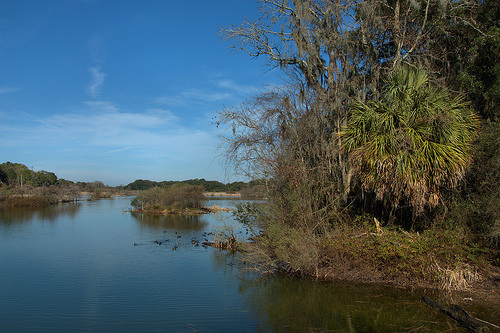
Yesterday, the golden spring light invited us to visit the Harris Neck National Wild Life Refuge in McIntosh County. This small and diverse refuge has been protected since 1962, and it evolved from being a World War II airfield, with long tarred runways. Now it is a fascinating area of ponds which are home to many species of herons, egrets, wood storks, ducks, coots, turtles and alligators large and small. Beyond are areas of maritime forest, and an amazing area of tarred runways now crazed with cracks through which cacti, grasses and trees are inexorably forcing their way as nature reclaims dominance.

Wood Storks ,Mycteria americana, Building Nests Rookery, Harris Neck National Wildlife Refuge NWR, McIntosh County GA (Image courtesy of Brian Brown)

Wood Storks ,Mycteria americana, Building Nests Rookery, Harris Neck National Wildlife Refuge NWR, McIntosh County GA (Image courtesy of Brian Brown)

To me, as an artist who tries frequently to direct my energies to creating art that makes people aware of nature's complex beauties and importance, Harris Neck is the perfect example of undoing man's abuse (justified or not) on nature. Cicero said in his Second Philippic speech in 44 B.C. that "Destroyers of the forest are enemies of the public weal". For the last century and more, we have witnessed at an ever-increasing rate the destruction of forest and the environment in general. This assault on "the forest" makes federal, state and local protected areas all the more important for everyone.

Woody Pond Habitat with Palm Tree Harris Neck NWR McIntosh County, GA (Image courtesy of Brian Brown, photographer)

Woody Pond Habitat with Palm Tree Harris Neck NWR McIntosh County, GA (Image courtesy of Brian Brown, photographer)

The efforts of artists of all stripes to help people understand and appreciate the magical beauty of such areas and their value to society are important. Drawing, painting photography and film, music, sculpture temporary and permanent, poetry and writing : all these disciplines are vital in this never-ending need to alert people that we must all, throughout the world, push back the "destroyers of the forest" and protect nature. The "public weal" demands nothing less, and I for one, as a visual artist, think it is a privilege to depict aspects of coastal Georgia's natural beauty. Harris Neck's magic reinforced my feelings as we visited it yesterday.

Audacity - in Life and in Art by Jeannine Cook

Audacity - it is a wonderful word that makes me instantly imagine someone acting with verve, bravery and decision! What made me think of it was finding a quotation by Winston Churchill: "Beginning with audacity is a very great part of the art of painting."

Just recently, I have been doing a fair amount of reading as I try to recuperate. Two of the most interesting books I have read are Charles Glass' Americans in Paris; Life and Death under the Nazi Occupation and Jimmy Burns' Papa Spy: Love, Faith and Betrayal in Wartime Spain. Of course, a central figure in both books is Winston Churchill, then the Prime Minister in Great Britain during those critical World War II years. His courageous sagacity and pragmatism were remarkable in dealing with the daunting aspects of the conduct of war, the relationships with General de Gaulle and the Vichy regime in France, General Franco in Spain who had just consolidated his power after the Spanish Civil War and the battle, both on and off the actual battlefields, with the Nazis.

Winston Churchill, 1941

Winston Churchill, 1941

His remark about needing audacity to paint is very much in the same spirit as he showed in the multiple other aspects of his remarkable and chequered career. He knew from his own painting sessions that launching oneself into a painting requires a leap of faith, a boldness and a belief that somehow one will succeed in producing a decent work of art. He was pragmatic enough to know that this is not always the case - but like every other artist, he kept trying. In fact, it is remarkable that he managed to produce a large number of very successful paintings, given how little early exposure he had had to art. His audacity paid off. He also remarked of art: "I know of nothing which, without exhausting the body, more entirely occupies the mind." When boldness, decisiveness and concentration are united, art-making usually rewards one with a decent result. Churchill certainly gave us all inspiration - in art-making as well as in many other spheres.

Nurturing the Inner Artist by Jeannine Cook

Hope does spring eternal. I assumed that once I was back at home from my hospital stay, I would soon be able to get back to creating art. Not quite so, I discover! An arm sling and other medical "accoutrements", plus a good dose of rummaged-around nerves and muscles don't yet make it easy to pick up pencil, silver stylus or paint brush.

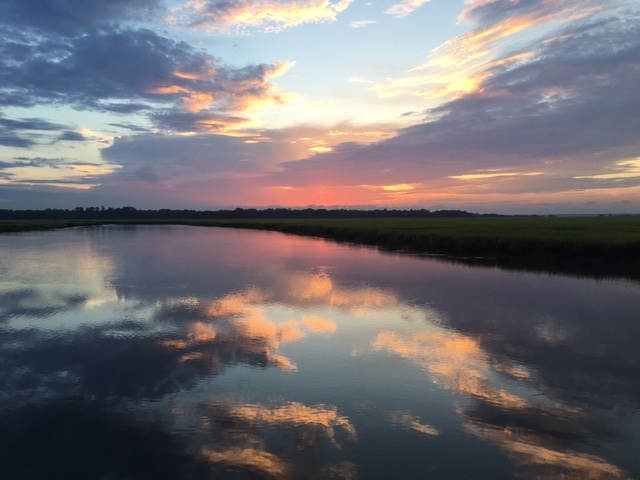
Nonetheless, one does not just turn off the artist's eye. As I first walk into our house, the golden, crystalline late afternoon light floods across the marshes and water in front of us, and I marvel. Still waters reflect a heron's white body catching the rose-orange glow of setting sun as it flies across the creek. At early sunrise, the next morning, the eastern sky's brilliance allowed enough light to sparkle rings of water in the creek below us: the otters were fishing for breakfast. At each of these marvellous moments, I find myself trying to remember, to store up the images so that later, they can, somehow, show up in my art, so that I can share these wonders with others.

Late afternoon view from our home in coastal Georgia

Late afternoon view from our home in coastal Georgia

Another view from our home in coastal Georgia

Another view from our home in coastal Georgia

Within the house, I look afresh at things I have not seen for ten days. Shapes of orchid petals, shadowed into sculpture, tillandsia flowers which have fully opened in my absence into elegant rhythms amid their undulating tendrils of ephiphyte energy, shadows of ornaments lengthened in the morning sun. These are all aspects of life that can be woven into art-making, I hope.

Tillandsia recurvata  Flowers, silverpoint and white gouache highlights, Jeannine Cook artist

Tillandsia recurvata  Flowers, silverpoint and white gouache highlights, Jeannine Cook artist

As I delight in the beautiful natural world in which I am so fortunate to live, I am also reminded of the diversity of optics that artists have on the very concept of making art. Catching up on the March issue of ARTNews, I found a remark which resonated : "Duchamp made it quite clear a long time ago, and so did Warhol, that art isn't an inherent form but a lens and a set of tools to interpret the world around us". (my emphasis). This was a remark made by Nato Thompson, chief curator of the non-profit public arts organisation, Creative Time, in rebuttal against questions and criticisms about whether works about community or social change are art. Carly Berwick was examining "A Different Way to make a Difference" in public art, methods that are poles away from my personal approach to art, but which are meeting the needs for socially engaged art, particularly in urban settings. The article reminded me forcefully that we are all very diverse as artists, with reactions and concepts that vary enormously, not only because of our surroundings but because of the stage in our individual life experience. So it is normal, and indeed vital, that each of us, as an artist, speak in our own voice, because society needs our diversity of inspiration and creation to help interpret and celebrate the world.