As we move into 2010 in the art world by Jeannine Cook

Happy New Year to everyone! May 2010 be a wonderful year for all.

As I watched the New Year come in under a brilliant full moon shining over Palma de Mallorca, I could not help but think that this decade would probably be as full of radical changes in the art world as in all the other domains, be they financial, technological or environmental.

Each of us, as artists, is constantly trying to think of new and better ways to approach the creation of art. However, one of the most interesting - and metaphorically eloquent, perhaps - ways of creating art has been flowering in the United States and and further afield: the framed reproduction of your personal DNA. On sale on the Net, adorned with jewels or other items to your taste, the DNA picture seems to me to be emblematic of our lifestyle tastes of today. Good or bad - who knows? It is certainly a very personal piece of art that you can put on your walls.

I was looking at an example of this art in an illustration I saw in the Diario de Mallorca last week, and could not help thinking of Josef Albers and his use of colour theory.

Formulation Articulation I & II, 1972, Josef Albers (Image courtesy of Phillips)

Formulation Articulation I & II, 1972, Josef Albers (Image courtesy of Phillips)

Perhaps the DNA pictures could be allied to his sense of colour. The history of colour theory is enough to make any artist dizzy, but it does reward by study! Not only the history of the use of colour, but the history of paint pigments themselves make for the most fascinating reading. Having wandered into the world of pigments, artists often then get totally hooked on learning more of the dramatic stories behind the pigments' productions and discoveries. An enthralling book which I read when it came out in 2001 is Bright Earth. Art and the Invention of Color by Philip Ball, published by the University of Chicago Press. Having learned about pigments' histories, I had a far better appreciation not only of the paints I use when I am painting in watercolours, but every painting I view in a museum has an additional layer of interest as I look at the pigments the artist used.

I wonder if that will be said, ten years hence, of the DNA pictures that are increasingly adorning people's walls. Any bets on this aspect of the future art world?

Art as Magic Glue by Jeannine Cook

Christmas Eve is one of those moments in the calendar when each of us stops and thinks of family and friends, an important milepost as each year turns to a new one. As I write holiday messages and receive lovely cards of greeting, I am struck ever more forcibly by the realisation that art has been the magic which has created so many of these friendships.

If one ever doubted the universality of the power of art to communicate and celebrate, then it is at times like this holiday season that that doubt should be dissipated. From the beauty of music, choral or orchestral, to productions of the Nutcracker delighting audiences all over the world at this time, to exhibitions of beautiful art on the walls of museums and - in my personal case - to the sharing of the love of art, the links become a sparkling, complex yet elastic web. Diverse optics and backgrounds, languages and ages can all find common ground in enjoyment of art and - more generally - the arts.

The creation of art takes an interesting trajectory. Most times, the work of art is created as a private, personal expression of one person, a work often created in solitude and thought and often, flat-out hard work. But once created, that work takes wing and is launched into the wider world, where it can find an audience that ranges from totally indifferent to highly receptive and appreciative. Art is defined in Britannica Online as "the use of skill and imagination in the creation of aesthetic objects, environments and experiences that can be shared with others." Man has been creating art in one form or another since time immemorial, with a diversity of goals that range from self-expression to pure creativity. Art can be used to express ideas, be they political, philosophical or spiritual, to evoke a sense of beauty, to explore perceptions, to generate a variety of emotions from pleasure to solemnity, awe or grief - or none of the above. Art for art's sake is a well-known concept in our times. Art, in any form, is nonetheless a form of communication that everyone can understand.

Today we all regard art as a universal language, irrespective of who exactly has ownership of the actual work of art. Copyright ownership is indeed important, for that forms part of the earning capacity of an artist, but nonetheless, there is a wider philosophical consideration that has been around for many centuries. Who truly "owns" a work of art, once it has reached the level of widespread recognition and appreciation? Many people consider art as an essential ingredient for human life, vital for a quality of life that is uplifting and beneficial. Thus, it is reasoned, art cannot just belong to a privileged few.

The first public museum was founded in 1753, in England, when Sir Hans Soane bequeathed a huge art collection to King George II for the benefit of the nation, a bequest which was ratified by an Act of Parliament for the creation of the British Museum.

Hans Sloane, Stephen Slaughter, 1736, (Image courtesy of National Portrait Gallery, London)

Hans Sloane, Stephen Slaughter, 1736, (Image courtesy of National Portrait Gallery, London)

Another early manifestation of this idea of art belonging to everyone was the creation, in 1793, of the first French public art museum, the Louvre. The King of France's magnificent collection of paintings, drawings, sculpture and other objects became the people's collection of art, housed in the Louvre and available to all for enjoyment and inspiration. Throughout the world, this lofty idea of art as a universal form of enriching communication was adopted. Thus, the great museums we know today, from Madrid's El Prado, (created in 1819), Berlin's Altes Museum, built in 1830 as the first of the collection of art and archaeological museums on Berlin's Museum Island , to the Metropolitan Museum of Art (1870) in New York, came into existence. By the 20th century, the idea that art is an essential ingredient of human society was so widely accepted that Diego Rivera could declare categorically, "Art is the universal language. It belongs to all mankind."

Small wonder that on a personal basis, each of us artists find that the art we create proves to be a magical glue that unites us with a wide, diverse and wondrous community of friends, all sharing a love of art. What richness - and what a renewed gift at this time of seasonal celebrations. Happy holidays to you all, my friends and fellow art-lovers!

HP Computer woes for an Artist by Jeannine Cook

When a computer crashes, I am reminded saliently and uncomfortably of how much I depend on my office computer and laptop to conduct my art business. Alas, the beauteous world of salt marshes and surging tidal creeks is not the best place to find competent people to help one out - in fact, quite the contrary, and it seems that many local computer repair people are the heirs to the Devonshire coast wreckers of yore.

So the inevitable conclusion, when I cannot even print out an exhibition proposal correctly to meet a deadline, is that I need to swallow hard and buy a new CPU. One that will "reanimate" printers, scanners and all the other gizmos one seems to need in this hydra-headed image business. So a careful study of the latest Consumer Reports computer rankings heads me and my husband to the HP (Hewlett Packard) website, a serious mad-maker. Finally, we narrow down choices that we try to tailor and order on the website. After several attempts, which get one almost to the end and then cancel out, we decide to talk to a real live person. Finally, we succeed. Hurray!

We explain what equipment we have, all the accessories we need to connect to the CPU, ask advice and guidance, and eventually select a Pavilion Elite e 9250t. The scrabble soup of 8Gbs, 1TBs, 1GBs, LANs and SDRAMs gets sorted out. Credit card numbers, e-mail addresses and street addresses are carefully given and laboriously repeated back to us. Signed and sealed - with assurances of an e-mail confirmation to come swiftly.

No confirmation, even 24 hours later. So, armed with order number, my patient husband phones again, since the website doesn't want to recognise we exist. Surprise, surprise, the order has not been put through, despite confirmation. So we start again – with a promised additional delay in the delivery date. Not an impressive start and an augury we should have heeded! However, in record time, I meet the doughty FedEx man staggering up the front steps with the bulky box.

We then spend another chunk of change to bespeak the services of an HP technical representative to come and install the CPU, connect up all the other bits and pieces and get the wireless links going. The only trouble is that until a security code and password are delivered with much flourish and more delay, HP won't get organised on sending someone. We are now into a week of HP dances by now.

The very nice gentleman appears to install everything, on time, and efficiently. He gets quieter and quieter in the computer room and the hours go by. My husband and I exchange glances and raise eyebrows - I suggest cups of tea. Eventually we hear him phoning the HP tech support people and spending the next half-hour having a conversation with a well-meaning person yet again halfway around the world. Someone who is clearly out of his depth and of no use at all. More time elapses.

Finally as the afternoon dusk encloses us, we learn that despite all our earnest conversations and asking advice of the original salespeople at HP, we have ended up as the proud possessors of a totally useless piece of expensive equipment! The problem? Windows 7 !! Mind you, "Genuine Windows 7 Home Premium 64-bit" - not just some humpty-dumpty Window 7 programme. We learn that this oh so superior programme, the guts of the CPU , doesn't like to have any truck with any of the other programmes we have for printers, scanners, even our brand new notebook and fairly new laptop. We go round in circles, almost contemplating buying new printers, a parallel CPU with another programme - until we get satiated.

I pick up the phone to HP to see if we can put on Windows Vista instead and end up with a very nervous young man who thinks I can get a CPU with all the other aspects we chose, but with Vista instead of this Windows 7 problem. But, he implores me, please, please call back in half an hour, because his superior isn't there. Has anyone noticed that no superior, anywhere, is ever available now when you ask to speak to a supervisor?

In half an hour, dinner guests are about to walk through the floor, when I am going through the same ridiculous mating dance of the duck-billed platypus of name, e-mail address, mailing address, when I have already given a ticket number of the whole sorry business. And, surprise, no supervisor is available. So at 10.30 p.m., we bid farewell to delightful friends, and I pick up the phone again. 76 minutes later, I am cut off, having had my ears assaulted by ugly, over-loud music and had parrot-voices of great formulaic courtesy. I succeed in getting a return authorisation number because there is no redemption for HP Pavilions with their Windows 7 guts. The singsong voice instructs me to print out the return label: I point out that it is
because we can't use our printers through this HP computer that we want to return it. Oh!

At well after midnight, I have been transferred to about seven departments, been put on hold interminably, had conversations which verged from near lunacy to constructive charm, and decided that HP was an company whose ethos reminded me of General Motors 25 years ago. I wondered whether - in our speeded-up world - it will take so long for another such company to unravel. Such a return transaction should have required one phone call, an explanation, exchange of identifying numbers, and the rest of the return and reinbursement arrangements should have been conducted internally, within HP. Not over two hours on the phone... with my having to repeat the same items over and over and over again to different people in different departments in distant lands.

Eventually, I was the proud possessor of two return authorisation numbers, for the CPU and for the installation fee, with FedEx instructed to pick up one from 7 a.m.-1 p.m., and the second from 1 p.m.-7 p.m. - go figure! FedEx sensibly picks up both packages together. But, and a big but, we await more tracking numbers before the three to five days for reimbursement kick in. Not too marvellous for an artist...

Well, after this saga, I am no further along in conducting my art business that ten days ago. But I am older and wiser as a purchaser of HP computers. Has anyone ever heard of that expression: caveat emptor?

Frames - more on their history by Jeannine Cook

I was poking about on the Web to learn more about the history of frames, and for anyone who is interested, there is a wonderful website done by Paul Mitchell, an antique and reproduction frame-maker and conservator of paintings in the UK. Entitled "A short history of the Frame", it makes for concise and fascinating reading for anyone who is interested in how a frame can enhance (as well as protect) a work of art, as well as the evolution of frames.

View of a frame-maker's workshop, oil on canvas, c 1900. (Image courtesy of Dorotheum)

View of a frame-maker's workshop, oil on canvas, c 1900. (Image courtesy of Dorotheum)

By the same token, the changes in taste that dictate a type of frame on a painting at one point and an entirely different one at another period are wonderfully chronicled by a short paragraph about the framing over time of the Mona Lisa, Leonardo da Vinci's masterpiece hanging in the Louvre.

It reminds me of a wonderful story told with great glee by my beloved godfather, the late Reverend Richard H. Randolph, SJ. He was standing in front of a painting in London's National Gallery one day, and turning to his companion, he remarked that he felt the frame was entirely wrong for the work of art. He then described how he would re-frame it, and as he was talking, he noticed a distinguished-looking man was standing behind him, listening intently. He thought no more of the incident until, on his next visit to the same Museum gallery, he saw that the picture in question had been re-framed – exactly as he had described! The gentleman behind him turned out to be the then-Director of the National Gallery, an attentive audience!

More on frames for art by Jeannine Cook

Back on 20th September, I was blogging about framing my art. I mentioned the marvellous riches of historical frames in various museums, especially in the Budapest Fine Arts Museum.

Now I read of a special exhibition of art frames going on display at the Alte Pinakothek in Munich from the Art Daily brief from 19th December. Many years ago, when I spent hours of marvelling at art in the august Alta Pinakothek, I remember being impressed at the diversity and richness of the frames surrounding their very wonderful collection of paintings. I am not surprised that they should have thus curated an exhibition to highlight the art of frame-making.

Apparently they sorted through some 4000 frames and paintings to find the 92 which are on display. They span four centuries and many types, from 16th century case frames to Rococo types, with Classicist and Empire styles in between. Inlaid frames, miniature frames, Dutch cabinet frames and Lutma frames - they are apparently all there to be marvelled at, with additional explanations on frame-making and techniques. For example, Lutma frames were called thus because they were initially made by the leading Dutch silversmith in the 1630s, Johannes Lutma. He would place a cartouche on an elaborate gilded frame at the bottom, with a coat of arms or an inscription in it.

For anyone going to Munich in the near future, this could be a fascinating insight into the complement of art that can so often make or break the initial impact and impression of a piece of art.

Après Copenhagen by Jeannine Cook

Sadly, the results of Copenhagen do not surprise - the interests of too many powerful industries seem to take precedence over the future health of many parts of our world. I wonder what Goethe would say about such situations. He remarked once, "Science and art belong to the whole world and before them vanish the barriers of nationality."

Young Goethe, 1787, Angelica Kauffmann, (Image courtesy of Goethe-Nationalmuseum (Weimar)

Young Goethe, 1787, Angelica Kauffmann, (Image courtesy of Goethe-Nationalmuseum (Weimar)

I am not sure that Copenhagen bore out the first part of his observation for the barriers of nationality seemed to have been stronger than the collective science presented. So I am left wondering about the validity of his thought about art being deemed universal and breaking down barriers. I think that it is becoming more accurate insofar as Chinese, Indian, Indonesian or many other non-Western artists are gaining more and more success in the Western world, while high-profile Western artists are highly esteemed throughout the world. Whether it is because art is a more universal language or whether the highest profile artists are being skilfully promoted - by their representatives or by themselves - time alone tells, decade by decade. It is strange because science would seem to be much more cut and dried as facts, not needing the same dialogue as a viewer and a piece of art. Yet scientific facts seem to become much more politicised when it comes to issues like climate change/global warming.

Clearly Goethe regarded both science and art as valuable tools for banishing national barriers. Perhaps we still need collectively to deepen our respect for both, especially when it comes to a Copenhagen-like forum.

When the weather gods decree otherwise! by Jeannine Cook

There are definitely times when plein air yields to the weather gods - my eagerly anticipated sojourn on Sapelo Island is off, victim of the steady downpours we have all been - or will be - experiencing along the Atlantic coast. Ah well! Maybe in January.

Meanwhile, in between battling with computers to prepare art exhibition proposals (when the main computer gives up the ghost, courtesy of local inept computer "experts"), I am being constantly reminded of the elegant circularity of events in life. The links that come around, even fifty years later, to make a coherent, constructive addition to present life, always surprise and delight me. They are frequent enough that they require exploration in silverpoint drawing(s), I think. And the important theme running through all these is longevity - you have to live long enough to see the links and re-links happening. The Chinese symbol of longevity is the bamboo - how suitable and elegant. The bamboo family is amazingly diverse, but universally beautiful. The Chinese and Japanese brush paintings and prints of bamboos come always to mind as somehow the light and shade, delicacy and strength and the restraint in foliage have been so wonderfully recorded over the centuries by their artists. An image, for instance from the amazing collections from the Ten Bamboo Studio, shows bamboo leaves drawn with a single line with fine, fine branches. It is so remarkable that you can almost hear the wind rustling through the leaves.

The Studio of the Ten Bamboos produced an album of woodcuts, images engraved on wooden plates and then printed, which is regarded as the most successful example of printing in the 17th century in China. The master engraver, Hou Yue-ts'ong, turned to art after serving in government in Nanking. He gathered a group of painter friends and together, they composed an album of the works of famous artists.Working in the Studio of the Ten Bamboos, they started work probably in 1619 to create this album with its eight parts. Printing the images in one, two or three colours, they grouped up to twenty images in each section, under the headings - fruits, birds, bamboos, stones, etc. Poems were paired with the images too. The first complete opus of more than 180 illustrations and the same number of pages of text apparently appeared in 1643. Alas, no complete editions remain but those that do are regarded as marvels. The publisher himself described the books as "a marvel of calligraphy... The paintings are poems, and the poems are paintings. They bear the spirit and the reflection of nature..."

Bamboo in Snow -- Illustration from the Ten Bamboo Studio Manual of Calligraphy and Painting (Shizhuzhai shuhua pu), Hu Zhengyan [Hu Cheng-yen], Chinese (c. 1582 -1672) (after 1732, before 1703), (Image courtesy of the Harvard Art Museum)

Bamboo in Snow -- Illustration from the Ten Bamboo Studio Manual of Calligraphy and Painting (Shizhuzhai shuhua pu), Hu Zhengyan [Hu Cheng-yen], Chinese (c. 1582 -1672) (after 1732, before 1703), (Image courtesy of the Harvard Art Museum)

The Manchu invasion of Nanking saw Hou Yue-ts'ong's workshop burned and many of the album's plates destroyed. Plates were re-engraved and the album was later reprinted in both China and Japan, but never again were the woodcuts of such high quality in the later editions. Thus the early editions, such as the one I alluded to of the bamboo, are held in very high esteem. Some of the prints are held at the British Museum, the Bibliotheque Nationale in Paris and others in the Boston Museum of Fine Arts.

Having planted bamboo myself and watched them grow - slowly and majestically - it seems only appropriate if I can use them in silverpoint drawings exploring longevity and the magical circularity of life. Now, if I can get the time.

"Discovering the World" by Jeannine Cook

Working through the ever-extending list of daily chores that take one away from creating art makes me think often of Sisyphus rolling his boulder up the hill, an exercice in frustration. However, I am due to spend a weekend as Artist in Residence, with my wonderful artist friend, Marjett Schille, on Sapelo Island, courtesy of the Sapelo Island National Estuarine Research Reserve staff. Despite weather forecasts that are making me think of digging out my long johns, I can't wait to be a full-time artist, even for a couple of days.

Marsh grass relics, Sapelo Island beach

Marsh grass relics, Sapelo Island beach

I think that the leitmotif of the weekend is going to be a quote I found by Frederick Franck about drawing: "Drawing is the discipline by which I constantly discover the world." Pencil, pen or silverpoint stylus in hand, the act of drawing is the ideal way to get back into the art world, by exploring and learning about the wonderful complexities of Sapelo's barrier island world.

Franck also talked of the meaning of life being to see, and indeed, there is an absorption, a forgetfulness of everything else, when one starts really looking hard at something. This in turn leads to an understanding and an enrichment of life for the person who has been looking. No wonder that creating art is akin to other forms of meditation. Getting lost in the act of looking, in order to transmute that vision into an image on a piece of paper and gain understanding of the world around one - not a bad way of spending time on Sapelo!

Shipping art for a show by Jeannine Cook

For every artist who is having a show, there comes the moment of having to deal with packing and shipping the artwork. If luck is with one, the museum will pick up the work and arrange all the logistics - a delight. But more often than not, things are not so easy.

Bubble paper - with thinner and thinner bubbles that pop more easily, it seems, these days - is a first priority for me, and then come the choices. If there are just one or two framed pieces of art, my first choice is always for the padded, hard-sided cardboard reusable cartons from Air Float.

An Air Float box for shipping art safely

An Air Float box for shipping art safely

I have owned their cartons, in various sizes, for years and years, and the boxes could have their own frequent mileage accounts. By protecting the art by nesting the pieces in dense foam, and by having non-pierce sides, the art travels safely.

The choices then become more difficult. I used to scurry around to find sturdy cardboard boxes, more bubble paper and lots of strong tape. Now, I find that it is extremely difficult, in coastal Georgia, to find the right-sized boxes, so I opt for UPS and their versions of packing cartons. I know that all art venues absolutely hate styrofoam peanuts - so do I - but when it comes to packing up a large number of pieces of art, it gets complicated to make them padded, safe and tightly packed without those little bits of styrofoam. So – pace, galleries. However, all these exercises in shipping art are not cheap these days, when insurance, drop charges, extra fees and the like get gently added, and added, and added some more.

The total costs of shipping art, over and above fees to enter juried shows, must be having a considerable impact on exhibitions these days. Shipping multiple pieces of art for a solo exhibition, or one with another artist, is indeed costly, but at least there is not the initial jury fee, hanging fee or any of those additional costs. In this economy, most artists must be very carefully considering how many shows they want to enter competitively and how far afield they may want potentially to ship artwork.

In a time when we all are extremely conscious of our global connections, it seems ironic that shipping art is becoming so very expensive and complicated. Ah well!

Jigsaw puzzles and art by Jeannine Cook

I was reading a thought-provoking article in a copy of The Spectator (21st November, 2009) by Matthew Parris today about jigsaw puzzles and religion, a train of thought induced by hearing a talk by Dame Margaret Drabble on her book about her aunt and jigsaw puzzles. This led me in rather a different direction, I suppose because of being an artist.

Dame Margaret advised starting to do a jigsaw puzzle by getting the outline sorted out first, because the one side with a straight line helps. Parris reflected that if one regarded life's experiences as pieces of jigsaw puzzle, there are no helpful edges that can serve as a delineating frame for putting order and coherence to such situations as religion. However, if one thinks about the jigsaw puzzle analogy for matters artistic, it can be of possible help.

First, of course, a delineating frame is always wonderful to use - even by using one's fingers as a frame - to compose a scene if one is trying to decide what to depict. Second, and more intangibly, I suggest that finding the straight-sided pieces first - in art - really is equivalent to sorting out basic technical considerations first before doing any artwork. By that, I mean deciding what medium to use for a work, then what surface - paper, canvas, etc. - what size of image. Composition, the "atmosphere" and, above all, deciding what one wants to convey in the artwork are other aspects of the puzzle frame.

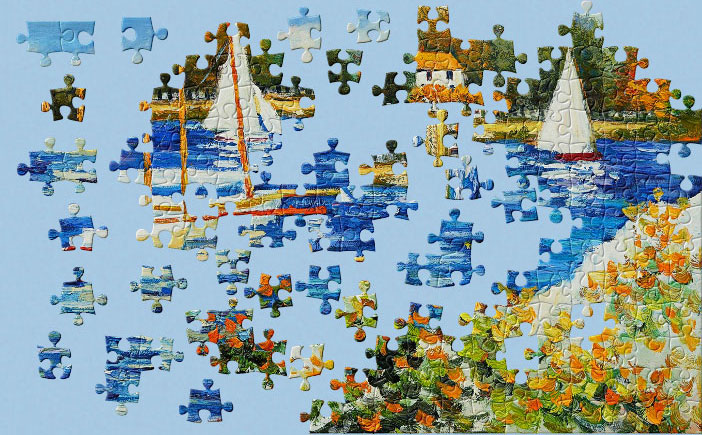
A jigsaw puzzle of a painting by Claude Monet

A jigsaw puzzle of a painting by Claude Monet

The content of a piece of art, as symbolised by the jigsaw puzzle frame, is really the summum of one's experiences in life, one's skills in matters technical, the impact of what moves one to create that image, realistic or abstract. In essence, within that frame, can be contained one's persona as an artist, for good or for bad. Selecting out the "straight-sided" aspects of oneself as an artist can therefore perhaps help in mapping out what one wants to do and achieve. From that frame, the inside, odder-shaped pieces of life and experience can be better organised to make a powerful piece of art. Even the analogy of coloured pieces of jigsaw puzzle can pertain: the artwork can be made more coherent by the choices we make when beginning to work on the frame of the puzzle first. For a realistic artwork, of course, even the source of inspiration - landscape, still life, person, etc. - can help us assemble the jigsaw puzzle pieces within the frame of the conceived artwork.

Ultimately, fitting together all the pieces of the puzzle that we artists deal with on a daily basis is just as much a fascinating challenge as any box of complex jigsaw puzzle pieces.