"Discovering the World" by Jeannine Cook

Working through the ever-extending list of daily chores that take one away from creating art makes me think often of Sisyphus rolling his boulder up the hill, an exercice in frustration. However, I am due to spend a weekend as Artist in Residence, with my wonderful artist friend, Marjett Schille, on Sapelo Island, courtesy of the Sapelo Island National Estuarine Research Reserve staff. Despite weather forecasts that are making me think of digging out my long johns, I can't wait to be a full-time artist, even for a couple of days.
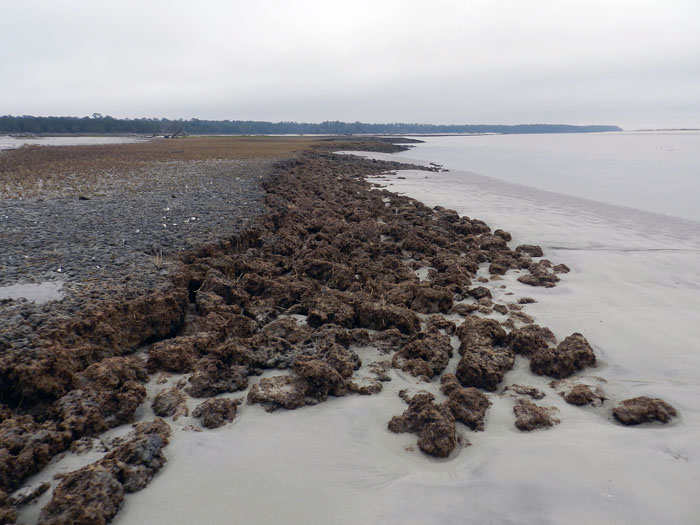
Marsh grass relics, Sapelo Island beach

Marsh grass relics, Sapelo Island beach

I think that the leitmotif of the weekend is going to be a quote I found by Frederick Franck about drawing: "Drawing is the discipline by which I constantly discover the world." Pencil, pen or silverpoint stylus in hand, the act of drawing is the ideal way to get back into the art world, by exploring and learning about the wonderful complexities of Sapelo's barrier island world.

Franck also talked of the meaning of life being to see, and indeed, there is an absorption, a forgetfulness of everything else, when one starts really looking hard at something. This in turn leads to an understanding and an enrichment of life for the person who has been looking. No wonder that creating art is akin to other forms of meditation. Getting lost in the act of looking, in order to transmute that vision into an image on a piece of paper and gain understanding of the world around one - not a bad way of spending time on Sapelo!

Shipping art for a show by Jeannine Cook

For every artist who is having a show, there comes the moment of having to deal with packing and shipping the artwork. If luck is with one, the museum will pick up the work and arrange all the logistics - a delight. But more often than not, things are not so easy.

Bubble paper - with thinner and thinner bubbles that pop more easily, it seems, these days - is a first priority for me, and then come the choices. If there are just one or two framed pieces of art, my first choice is always for the padded, hard-sided cardboard reusable cartons from Air Float.

An Air Float box for shipping art safely

An Air Float box for shipping art safely

I have owned their cartons, in various sizes, for years and years, and the boxes could have their own frequent mileage accounts. By protecting the art by nesting the pieces in dense foam, and by having non-pierce sides, the art travels safely.

The choices then become more difficult. I used to scurry around to find sturdy cardboard boxes, more bubble paper and lots of strong tape. Now, I find that it is extremely difficult, in coastal Georgia, to find the right-sized boxes, so I opt for UPS and their versions of packing cartons. I know that all art venues absolutely hate styrofoam peanuts - so do I - but when it comes to packing up a large number of pieces of art, it gets complicated to make them padded, safe and tightly packed without those little bits of styrofoam. So – pace, galleries. However, all these exercises in shipping art are not cheap these days, when insurance, drop charges, extra fees and the like get gently added, and added, and added some more.

The total costs of shipping art, over and above fees to enter juried shows, must be having a considerable impact on exhibitions these days. Shipping multiple pieces of art for a solo exhibition, or one with another artist, is indeed costly, but at least there is not the initial jury fee, hanging fee or any of those additional costs. In this economy, most artists must be very carefully considering how many shows they want to enter competitively and how far afield they may want potentially to ship artwork.

In a time when we all are extremely conscious of our global connections, it seems ironic that shipping art is becoming so very expensive and complicated. Ah well!

Jigsaw puzzles and art by Jeannine Cook

I was reading a thought-provoking article in a copy of The Spectator (21st November, 2009) by Matthew Parris today about jigsaw puzzles and religion, a train of thought induced by hearing a talk by Dame Margaret Drabble on her book about her aunt and jigsaw puzzles. This led me in rather a different direction, I suppose because of being an artist.

Dame Margaret advised starting to do a jigsaw puzzle by getting the outline sorted out first, because the one side with a straight line helps. Parris reflected that if one regarded life's experiences as pieces of jigsaw puzzle, there are no helpful edges that can serve as a delineating frame for putting order and coherence to such situations as religion. However, if one thinks about the jigsaw puzzle analogy for matters artistic, it can be of possible help.

First, of course, a delineating frame is always wonderful to use - even by using one's fingers as a frame - to compose a scene if one is trying to decide what to depict. Second, and more intangibly, I suggest that finding the straight-sided pieces first - in art - really is equivalent to sorting out basic technical considerations first before doing any artwork. By that, I mean deciding what medium to use for a work, then what surface - paper, canvas, etc. - what size of image. Composition, the "atmosphere" and, above all, deciding what one wants to convey in the artwork are other aspects of the puzzle frame.

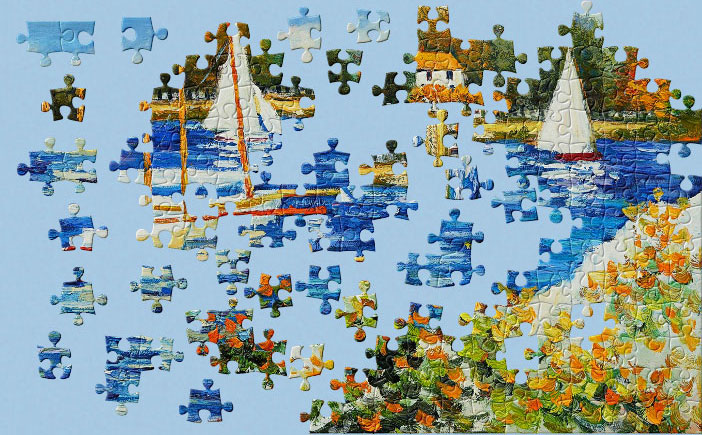
A jigsaw puzzle of a painting by Claude Monet

A jigsaw puzzle of a painting by Claude Monet

The content of a piece of art, as symbolised by the jigsaw puzzle frame, is really the summum of one's experiences in life, one's skills in matters technical, the impact of what moves one to create that image, realistic or abstract. In essence, within that frame, can be contained one's persona as an artist, for good or for bad. Selecting out the "straight-sided" aspects of oneself as an artist can therefore perhaps help in mapping out what one wants to do and achieve. From that frame, the inside, odder-shaped pieces of life and experience can be better organised to make a powerful piece of art. Even the analogy of coloured pieces of jigsaw puzzle can pertain: the artwork can be made more coherent by the choices we make when beginning to work on the frame of the puzzle first. For a realistic artwork, of course, even the source of inspiration - landscape, still life, person, etc. - can help us assemble the jigsaw puzzle pieces within the frame of the conceived artwork.

Ultimately, fitting together all the pieces of the puzzle that we artists deal with on a daily basis is just as much a fascinating challenge as any box of complex jigsaw puzzle pieces.

Artists and Copenhagen by Jeannine Cook

As I listen to the complex issues and concerns that the thousands of climate change delegates are grappling with at the on-going Copenhagen Conference, I keep thinking of all the art that has been done over the past centuries that is, in essence, a record of the world as we have known it.

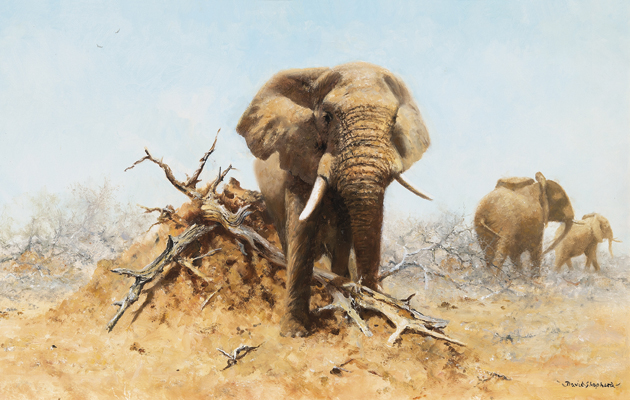
From John James Audubon, with his masterful opus recording America's bird life, to the myriad wonderful botanical artists working today, like Australian Margaret Saul, or wildlife artists like British David Shepherd or American Timothy David Mayhew, there is an important role for art in the discourse on our planet's health.

Elephant and Anthill by David Shepherd CBE, (Image courtesy of The Field)

Elephant and Anthill by David Shepherd CBE, (Image courtesy of The Field)

The Ivory is Theirs, David Shepherd CBE, (Image courtesy of the artist)

The Ivory is Theirs, David Shepherd CBE, (Image courtesy of the artist)

Photography has become the vivid adjunct to this discussion. Each of us artists who dedicates many hours to recording and celebrating aspects of our natural world, on land, under water or in the air, is a witness to the complex, vital web of life that sustains us. In reality, this vast body of artwork about the natural world is an urgent sub-text to the Copenhagen debates. If mankind chooses to continue jeopardising the survival of countless species, then the records of artists will be a beautiful but very sad testimony to what is being lost,

Every time I do a silverpoint drawing of a fragile spring flower, for instance, I find myself wondering how many more springs will be graced so predictably with these flowers. I am sure that Audubon would be appalled to know the status of many of the birds he depicted. I suspect that David Shepherd finds the East African flora and fauna he celebrated so wonderfully in the 1960s, for instance, to be sadly changed and diminished. When artists of all descriptions find themselves recording endangered species and reminding their viewers of vanishing beauty and complexity, it is a situation of sounding the tocsin.

I hope that the politicians gathered in Copenhagen are art lovers.

Back to Basics by Jeannine Cook

Reading an article in this month's Art + Auction about "Artists - Back to the Future" about a recently-noted trend of artists and their collectors returning to simpler, more personally-executed and handcrafted creations, I was struck by the statement: " Just because there is a simplicity in means does not mean the process or results will be simple. It's this question of how do we get back to basics by going a very, very long distance. It's a balance between immediacy and complexity" (Massimiliano Gioni, curator of the New Museum, New York).

I started thinking about how I personally would define basics and the balance between immediacy and complexity. I realised that for me, the answer was very simple - I only have to look at Japanese or Chinese art of past centuries, woodcuts or brush paintings in particular. Perhaps I should initially admit to a predisposition to Japanese art: I grew up with Japanese woodcuts on the walls of my home in East Africa. They were part of one set of a huge series of woodcuts that were commissioned after the 1923 earthquake by foreigners living in Yokohama. They were copied from traditional woodcut images, and the objective of this wide-ranging commission was to help the artists get back on their feet after the devastating earthquake and fire. The set with which I lived was very varied but of great beauty and, of course, of especial meaning for me since my grandfather had been one of the people commissioning the Japanese artists.

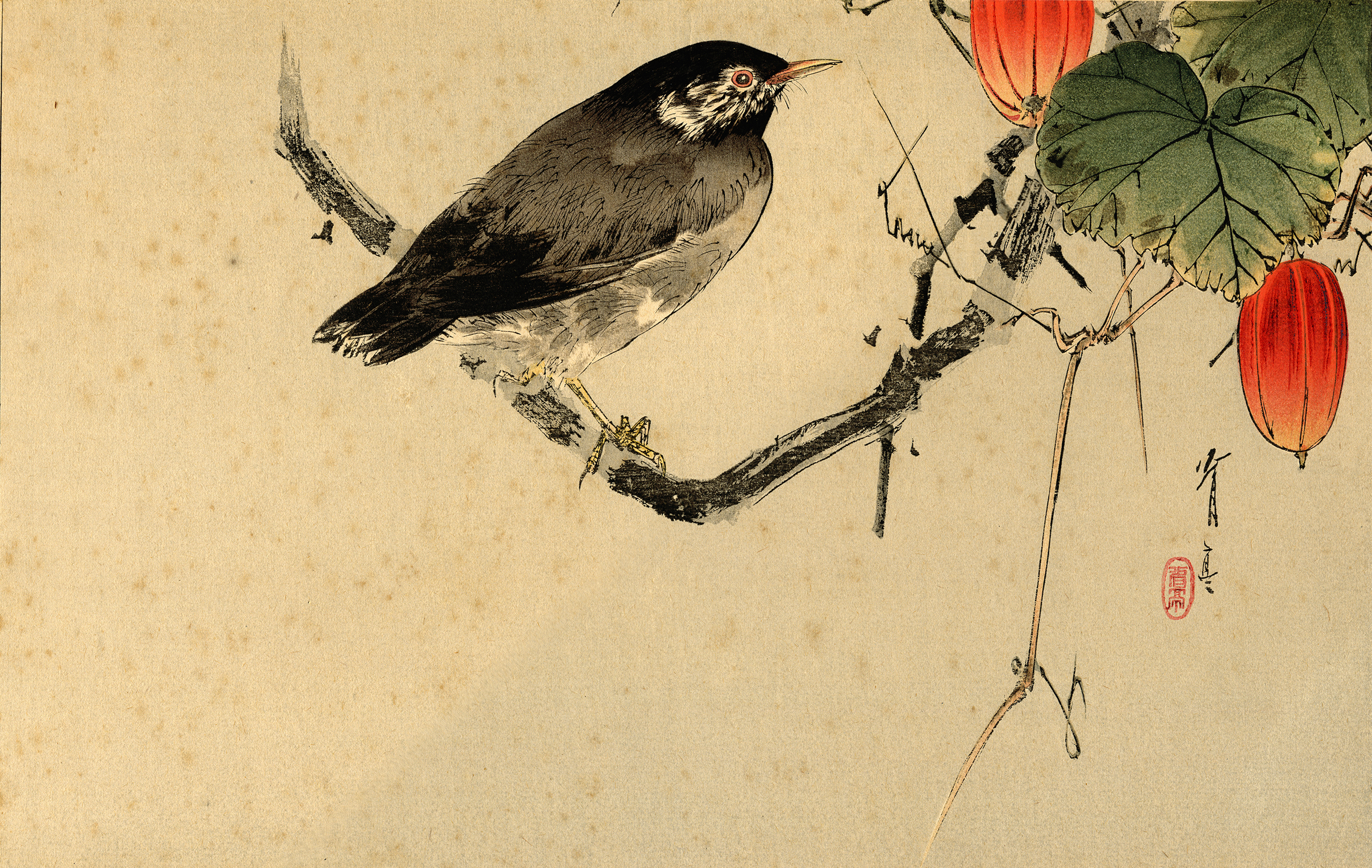
Snake Gourd, woodcut, after Seitei Watanabe

Snake Gourd, woodcut, after Seitei Watanabe

That said, I have later learned that the essence of simplicity in art does indeed require enormous skill and sophistication of mind and hand. I find that some of the hand scrolls, paintings and screens of the Momoyama and Edo periods in Japanese art (1573-1615 and 1615-1868 respectively) are the essence of aesthetic simplicity and oh so utterly beautiful. Many years ago, there was a truly wonderful exhibition and Harry Abrams catalogue publication, "Birds, Beasts, Blossoms and Bugs. The Nature of Japan". I frequently dip back into this publication because I find it of enormous inspiration and nurture, reminding me, particularly for silverpoint drawing, that as long as I really, really know the subject matter I am drawing, less is really, definitely more.

An example of such basic mastery is, for instance (and very a-propos with our autumnal migrating flocks of crows streaming noisily past our windows), a series of three ink paintings with wash on paper of crows, "Snow, Moon and Flower". One, " Crow in flight before the Moon", by Maruyama Okyo (1733-1795), is just a deftly detailed crow silhouetted in flight with the moon half delineated in white behind him - so minimalist it is breath-taking. And one has to remember this is a brush painting in ink - no room for hesitations, erasures, or even running out of ink at the wrong moment. Certainly one definition of "immediacy". Another of these paintings is "Crow on a Plum Branch" by Matsumura Goshun (1752-1811): the bird perches on the branch in simple, believable reality, yet he is pared down to only the essential detail. The plum branch is reduced to a shorthand suggestion which, nonetheless, is entirely complete in its depiction.

Crow on snow-covered Plum Branch, Kawanabe Kyosai, 1870----1880s, Colour woodblock print, (Image courtesy of the RISD Museum)

Crow on snow-covered Plum Branch, Kawanabe Kyosai, 1870----1880s, Colour woodblock print, (Image courtesy of the RISD Museum)

Another wonderful six-fold lacquer screen in the same show was of crows in flocks and gatherings of raucous intensity, just their silhouettes against the gold leaf on paper. It was executed by an unknown artist in the Edo period of the early 17th century, but done by someone who had studied this emblematic bird intensely, in all its attitudes and stances - at a time when there was no photography to freeze flight or movement. It is yet another wonderful example of back to basics – knowing your subject matter thoroughly, having a mastery of your technique and compositional intentions, and just following the age-old tradition of an artist using hand and eye to create images that convey messages of beauty, angst, joy, whatever.

Art and Oxygen by Jeannine Cook

Yesterday, I was listening to a doctor talk about the value of oxygen for someone who is suffering from heart problems and resultant breathing difficulties, even if it is just creating a "bubble" of enriched oxygen around the mouth and nose of the patient. Better breathing, a heart that feels more functional and thus an increased feeling of well-being – a simple, but important path to an improved quality of life. But of course, in order to have the supply of this extra oxygen, you have to set up either a tank or machine, and take the time to get the oxygen treatment.

Today, I was reading the December edition of ARTNews, with a feature article on Marina Abramovic and her upcoming presence at MOMA, New York. She was quoted as saying, "Artists have to serve as oxygen to society." Her objective is to get people to stop and gain a sense of time through her performance art, and thereby alter their perspective and perception of their surroundings, world and life in general. In essence, she becomes the oxygen tank.

Marina Abramovic

Marina Abramovic

I think that just about every form of art - visual, performance, musical, whatever - can have this intrinsic value of causing people to stop, even momentarily, and thus alter their perception of the world around them. Perhaps that is why people have created "cabinets de curiosités" and then museums full of wonders – they provide the oxygen to allow societies to breathe deeply, reflect, learn and enrich life. A beautiful photograph, a wonderful painting, a drawing, a piece of music - I know that my life has been made rich beyond belief by seeing or hearing such art, and that frequently the image or the sound has stayed with me long after.

No wonder Ms. Abramovic used such a metaphor of how to maintain or engender a healthy life or a healthy society.

Another health benefit from art by Jeannine Cook

Not so long ago, I was writing about the different ways art could help heal people. I was therefore fascinated to read in yesterday's ArtDaily.org about a programme at Britain's National Gallery called Ageing Creatively. It is designed to involved people who may be isolated, unable to get out much and generally in need of mental stimulation and companionship, including - at present - people suffering from aphasia, difficulties in communicating in any form, a situation often brought on by suffering a stroke.

By learning ways of painting that, for instance 17th century artists used, the participants are creating art work, and then turning to more modern art to do the same sort of thing. Apparently, all these sorts of activities are hugely helpful and the art is the pathway to a lot of healing.

National Gallery Innovative Art Project For Stroke Suvivors to Restore Creativity

National Gallery Innovative Art Project For Stroke Suvivors to Restore Creativity

Alzheimer's art therapy tours at National Gallery of Australia boost dementia sufferers' wellbeing

Alzheimer's art therapy tours at National Gallery of Australia boost dementia sufferers' wellbeing

The National Gallery Outreach Officer, Emma Rehm, describes the many faceted Ageing Creatively programme thus: “Participatory projects which use art as their starting point bring clear benefits for people with disabilities in terms of physical stimulation, sociability, creativity and enjoyment, and this can have a positive effect on health and general well-being. Participants will be able to share their thoughts and use the National Gallery paintings as inspiration for their own work.” Newham Council’s Executive Member for Health, Councillor Clive Furness, said: “When people suffer a serious or debilitating condition, there is the fear that their useful and creative life is at an end. Projects like this enable people to discover and develop new skills, and to do so in the company of a group of friends."

I can't think of a more constructive endorsement for the role of art in daily life for everyone, no matter what the situation.

Brittany Plein Air for Artist Gourmets - an Art and Gastronomy Workshop, Dinan, France by Jeannine Cook

I have been sending out the first copies of my newly-completed brochure about this Art and Gastronomy Workshop in Brittany, France, planned for May 3rd-12th, 2010. Ten days of plein air work during the day and in the evening, the participants will be welcomed with gourmet meals celebrating the superb local seafood and fresh produce. The text of this brochure is posted on the News Page of my website.

The iconic image of this area of Brittany is, of course, Mont Saint Michel.

Mont St. Michel, Brittany, Rundle Cook photographer

Mont St. Michel, Brittany, Rundle Cook photographer

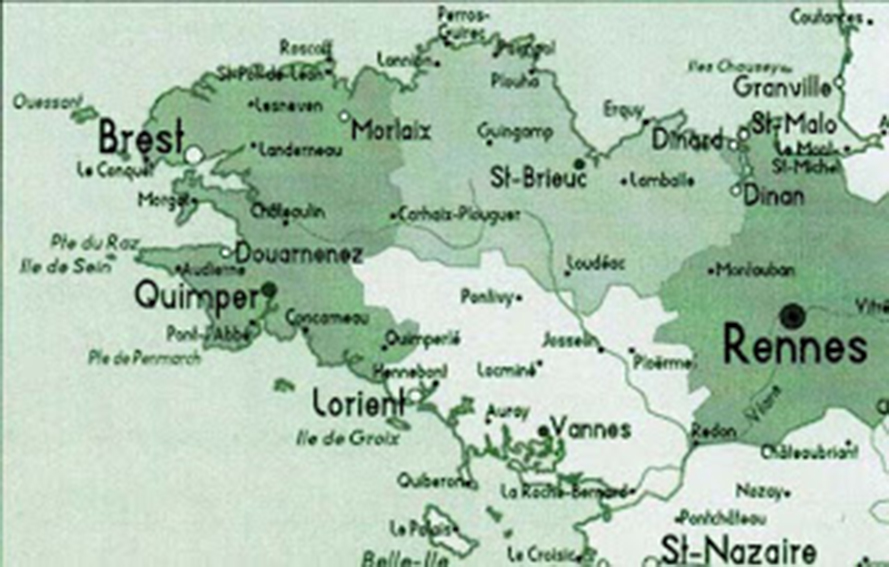
This is a map of Brittany, a wonderful part of France. The area for the workshop is in North Brittany. Rennes is the main rail link with Paris, with a direct train from the Charles deGaulle Airport.

Map of Brittany

Map of Brittany

The Workshop will be based at Le Clos Saint Cadreuc, a 1633 farmhouse with elegant long grey stone buildings, which has been converted to a beautifully appointed bed and breakfast establishment. Its location on the map below is in blue. Highly recommended by many guidebooks, it was listed in Britain's travel "bible" written by Alastair Sawday. It is located amid wonderful farmland, just a few minutes inland from spectacular coastal scenery, ranging from golden sweeps of beach to plunging cliffs and vast oyster and mussel beds in long reaches fingering into the land.

St. Malo area, Brittany, showing the location of Le Clos Saint Cadreuc

St. Malo area, Brittany, showing the location of Le Clos Saint Cadreuc

Brigitte and Patrick Noël are the hosts of Le Clos Saint Cadreuc and they will facilitate this workshop and provide the wonderful meals. Patrick is not only an artist himself but his deep knowledge of the area, from architecture to botanical gardens or coastal gems, will enable the artists to go to wonderful places to create art. Non-painting partners will have plenty to do as well. Meanwhile, Brigitte is the perfect chef and host of this most comfortable establishment. This is a photo of us dining out one night at Eric and Pascale Lemale's wonderful  Restaurant Du Colle on the water, in Saint-Lunaire. (Brigitte is on the right, Patrick centre and I am on the left.)

Du Colle Restaurant, with Jeannine Cook, left, Patrick at centre and Britgitte on the right, Rundle Cook photograpiher

Du Colle Restaurant, with Jeannine Cook, left, Patrick at centre and Britgitte on the right, Rundle Cook photograpiher

I will be the leader for this plein air group, having spent many a fascinated and humbled hour working outside in all weather conditions, in Europe and all around North America. Not only have I loved doing this sort of work but I have been lucky enough to be awarded a number of Artist Residencies to work in this fashion. The month I was awarded as Artist in Residence at Les Amis de la Grande Vigne in Dinan in late 2008 led me to plan this workshop for 2010.

The beauty of the area is unforgettable, and May is the best month of spring in Brittany.

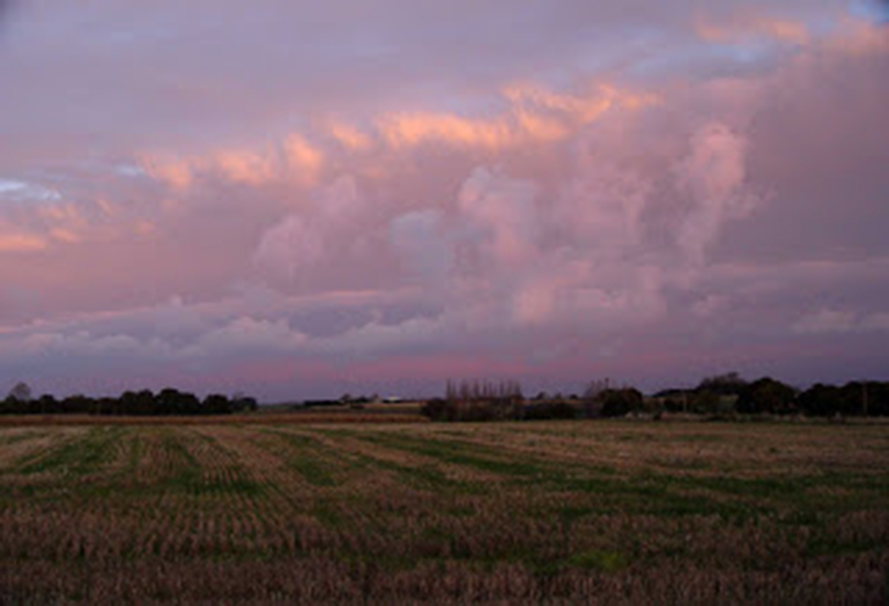
Here are some photographs to give you a flavour of this wonderful area. These photographs were all taken by my husband, Rundle Cook, who was with me in Dinan.

Brittany 6OCT08 (30) a.jpg
Brittany2Nov08 (24) a.jpg
Brittany 6OCT08 (7) a.jpg
Brittany2Nov08 (28) a.jpg
Brittany2Nov08 (40) a.jpg
Brittany2Nov08 (48) a.jpg
Brittany3 (34) a.jpg
Brittany3 (83) a.jpg
Brittany21OctCancale (16) a.jpg

If you are interested in learning more about this workshop, log on to my website, www.jeanninecook.com and check out the details on the News page. Or e-mail me directly at jeanninecook1@cs.com for a complete brochure and application form.

My Art-Tasting open studio - December 5th by Jeannine Cook

Well, the house is turned upside down and has become an airy, spacious studio in which my artwork is out on display. The windows are clean, the floors scrubbed, the flood lights placed outside to turn the oak trees into wondrous night-time cathedrals. The guest list is filling fast and the caterers primed. All these are the rituals of preparing for my Art-Tasting, the fifteenth year I am doing this open studio and wine-tasting, now a tradition for many faithful friends and collectors.

I am sure that every artist experiences the same moments of surprise, sometimes irritation, and general feeling of being able more dispassionately to assess the art hung at an exhibition. I find it an interesting experience every time my art is exhibited, for of course, each piece has a different conversation, depending in part on its neighbours and the general context. Displaying watercolours, silverpoint and graphite drawings together seems to work, thank goodness, and they are definitely the ying and yang of each other. However, a unity in matting and framing help pull everything together. The art of displaying is just as much a skill as the creation of any artwork - and one can constantly learn about placement, context, lighting, labelling.

Now to hope that the weather gods will be kind for tomorrow - Cedar Point is always more beautiful in the soft December afternoon sunlight. Greeting guests and friends is a delight, however, no matter what the weather.

The Marshes at Cedar Point, Georgia

The Marshes at Cedar Point, Georgia

Art to lift the Spirits of the Sick by Jeannine Cook

I have known for many a long year how important it is to have art along the walls of hospitals, clinics and doctors' offices, but just recently, on a personal basis, I have had that theoretical knowledge made vividly real. Walking along the corridors of the local Hospice, it was indeed uplifting and calming to see art on the wall, of all types but all powerful enough to be appreciated.

Art Tour - Mayo Clinic Patient Video Guide - Florida

Art Tour - Mayo Clinic Patient Video Guide - Florida

Many years ago, I was advocating at our local hospital that their building enlargement process should include original artwork on the walls, a message initially received with reticence. However, artwork was soon to be seen throughout the large facilities, and I was lucky enough to have my work purchased as well. I had a vivid affirmation of what art could do because, soon after, a friend phoned me to say that he had had to make a 3 a.m. emergency visit to the ICU, where one of my paintings was hanging on the wall opposite the elevator door on the ICU floor. "I can't tell you," he continued", how calming and helpful it was to see your work on that wall, in the midst of my anxiety." It was one of the best compliments I have ever received.

Now, there are countless studies which clearly demonstrate how valuable art can be in medical environments. Last year, Dr. Lee Eliot Major was writing in the UK Daily Telegraph about work done in Italy and in the wonderful children's hospital at Great Ormond Street, London. This autumn, a long article in the Chicago Tribune by Joanna Broder addressed the help given by getting sick children immersed in creating art through the Snow City Foundation. The Dallas Morning News ran a long article in October this year about all the research done, since the 1960s, on what kinds of art help people heal better in a hospital situation - no surprise that more easily "understandable" art, like reasonably realistic landscapes, for instance, was more accepted than abstract art which required perhaps an effort for a sick person to relate to.

Extrapolating from medical environments to one's daily environment, it would seem that the message for us all is - have art on your walls that lifts your spirits, calms you, interests you and, in general, enhances your daily life. Not such a bad prescription!