Beginning with a drawing by Jeannine Cook

Today I was out painting on the marshes, and the reflections and patterns were unbelievable as the tide flowed serenely in. Working in watercolours, plein air, not from photographs, one can become schizophrenic as things change so quickly. Added to that changeability of light and pattern, you have a lot of humidity, so watercolours seem to take for ever to dry. So I was doing what I seldom do, doing two paintings concurrently.

Pretty soon, I remembered, a little wryly, a remark I found that Hans Holbein the Younger had made: "everything began with a drawing..."

Portrait of Sir Thomas Elyot, 1532–34, chalk, pen and brush on paper (pink-primed paper), Hans Holbein the Younger (Image courtesy of the Royal Collection)

Portrait of Sir Thomas Elyot, 1532–34, chalk, pen and brush on paper (pink-primed paper), Hans Holbein the Younger (Image courtesy of the Royal Collection)

How true! If I had not made a relatively loose but nonetheless careful drawing before I started each painting, I would have been in deep trouble. In one painting, I got fascinated with the reflections of three docks along a creek edge, and the play of light on their pilings, roofs, etc. However, between the drawing and later (sort of!) completion of the watercolour, people had moved boats around, the tide had come in, the sun had gone over and clouds had come up. Without at least a rough "road map" underneath, I would not have known how to continue the painting at some points.

I think I first learned to the value of an initial under-drawing for a watercolour many, many years ago in Alaska. I was doing a landscape of the dramatic mountains and inlets near Homer, and to my delight, there was a little red plane parked at just the right focal point. I had drawn it very roughly, intending to return in more detail as I got more to painting that part... Painting away happily, I suddenly realised that I was hearing the sound of a plane engine starting up. Before I could remedy my omissions of detail, the little red plane had sailed up into the air and disappeared! So much for my focal point!

In other words, draw, draw and draw again - one never regrets it.

Going miniature by Jeannine Cook

This morning, when hunting for a copy of Omar Khayyam's Rubaiyat on our bookshelves, I happened on a forgotten but delightful little book of portrait miniatures published in England some while ago. I promptly sat down to savour of the wondrous skill of the heirs of Jean Clouet who had pioneered such tiny portraits when he was Court Painter to Francois I of France in the early 1500s.

Portrait of Charles IX, 1560s, Italian pencil and red chalk, Francois Clouet, (Image courtesy of the Hermitage Museum)

Portrait of Charles IX, 1560s, Italian pencil and red chalk, Francois Clouet, (Image courtesy of the Hermitage Museum)

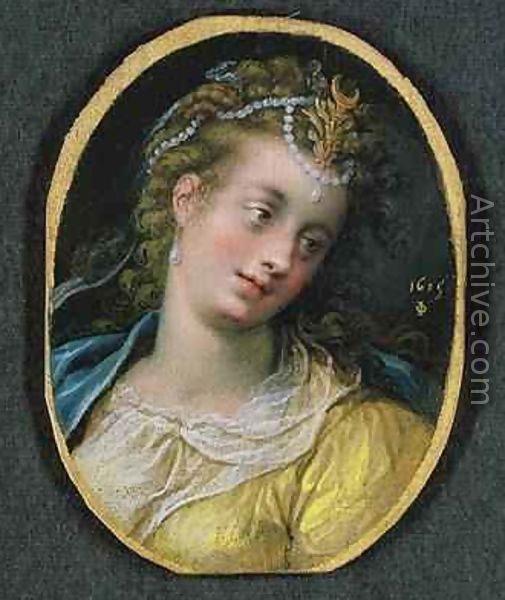
His son, Francois Clouet, and Hans Holbein the Younger followed and developed this genre of limning, as miniature-painting was called. During Elizabeth I's reign, the English Court enthusiastically favoured miniature portraits for political purposes as well as love and desire as they were expressed in that era of courtly love. Luxurious, bejewelled frames surrounded gems painted by Nicholas Hilliard, Hans Ewoth, Hilliard's pupil, Isaac Oliver, and others.

Diana 1615 - Isaac Oliver

Diana 1615 - Isaac Oliver

The next generation was equally gifted in limning, with Isaac's son, Peter Oliver, and Samuel Cooper producing extraordinary works. Cooper's miniature of Oliver Cromwell has an amazingly contemporary feel to it and an almost photographic quality in the likeness, including the warts which apparently Cromwell expressly instructed him to record!

First painted on paper in watercolour and gouache, the miniaturists gradually evolved towards painting on ivory, with later artists such as Rosalba Carriera achieving great luminosity on this surface. Miniatures continued to be greatly esteemed, especially in England, but their second great flowering came when court painting was revived under the influence of Joshua Reynolds and Gainsborough. Miniaturists George Engleheart and Richard Cosway were among the leading artists during the period 1750-1850. In France, too, even after the Revolution, miniatures enjoyed great success, with Jean-Urbain Guerin and Jean-Baptiste Isabey using their great skills to combine simplicity of line and form with exactitude of subject matter. Photography's invention sounded the death knell for miniatures. As I gazed at the exquisite small images in the book I had found, I could not help reflecting on the difference between these works of art which served as portrait-records of all manner of people down the ages and the small thumbnail photos we all post on websites like Facebook today as representative of ourselves for others to see.

One of the most wonderful collections of miniatures is held by the Wallace Collection, Hertford House, in London's Manchester Square. The collection dated mainly from the 17th and 18th century, and the variety and jewel-like quality of these miniatures have always remained fixed vividly in my memory. Well worth a visit. Of course, the other two London museums boasting important collections of miniatures are the V & A and the National Portrait Gallery. Another small and lovely collection I happened on is at the Gibbes Museum in Charleston, SC - again with the British heritage influencing the commission of many of these miniatures by the early South Carolinians.

I always love the many coincidences in life that come along. In the case of finding this book on miniatures, it drove home to me the interesting technical considerations a miniaturist has. Size and thus proportions, the amount of information to include and the technical considerations of surface, paint medium and even the format of a circle, the normal shape for a miniature (although rectangles were used)... these are very specific parameters. The coincidence in this case was that I have been recently using the format of artists' trading cards, 2 1/2 x 3 1/2", to paint and draw as an experiment. This small size presents a whole new set of considerations and requirements, particularly in terms of composition - fun to try out! But it has already left me with a heightened sense of respect for those great limners of earlier times. They were great masters.

Trust by Jeannine Cook

Growing up on a farm in Tanzania, I learned very quickly that trust between humans and between humans and animals made the world go round. Wild animals, wary and watchful, sometimes paid one what I considered the supreme compliment of trust, allowing a human near them, to share their world at close quarters, whether they were mighty elephants or miniature dik dik antelope.

Here in coastal Georgia, the same system operates with birds and wild animals we meet. I was watching a raccoon perched comfortably and serenely on the deck railing this afternoon, watching us as we moved around inside the house, and again reflected on this vast issue of trust. In this instance, the raccoon arrives at the same season every year, during the daytime, to get food. She is feeding her four very small babies and needs help, she thinks! But trust is an ever-increasingly interesting subject. Just this last week, on Krista Tippett's "Speaking of Faith" programme on NPR, she interviewed Paul Zak, the scientist who has almost single-handedly invented the term, neuroeconomics, all based on trust. He has discovered that trust, the social glue that holds together families, communities, societies, is dependent on oxytocin, a molecule produced in the brain. When each of us feels trusted, we produce more oxytocin, and thus we trust more too. This trustworthy behavior is of course much easier to foster in person to person (or animal, I believe!) contacts, and when corporate culture gets too distant and impersonal, we run into the financial and ethical problems we have been experiencing more and more in recent times.

As an artist, I reflected, it is not just the person to person relationships with other artists that is important. Of course, relating to artists whom one admires and respects is totally rewarding. My recent visit to the opening of The Luster of Silver silverpoint exhibition I had helped curate at the Evansville Museum of Arts, Science and History, Evansville, IN, was made far more special by the encounter, finally, face to face, with many wonderful artists with whom I had been corresponding by e-mail. I suspect the oxytocin levels must have been zooming for us all during that weekend!

Victor Koulbak, silverpoint (Image courtesy of the artist)

Victor Koulbak, silverpoint (Image courtesy of the artist)

Nonetheless, there is another level of trust that is, I believe, terribly important for each artist. Trust in oneself and one's abilities. Innumerable times, I have embarked on a painting or drawing, particularly in silverpoint where you cannot erase anything, and suddenly felt something akin to panic: "oh, can I do this as I want? How do I accomplish it?" Experience has finally taught me to listen to a still small voice inside my head, saying, "Trust yourself. It will work out". And somehow, it does seem to. Perhaps not always splendidly, but nonetheless to an acceptable level. That sort of trust only comes with experience and self-awareness, I suspect. But it is invaluable, not only in art, but in every avenue of life. Maybe Paul Zak will find another molecule in the brain, cousin to oxytocin, that engenders trust in oneself and one's abilities!

That Raking Light by Jeannine Cook

I live on the site of an old oyster cannery, which allows an immediacy with the salt water creeks and wide-flung marshes that is unusual. Living with the rhythm of the tides and hours, you become very aware of the play of light across the spartina grasses that make up the marshes. Since the house faces almost due east, we can watch the sun rising further and further north, from behind a long barrier island opposite us, as mid-summer arrives, and then the slow retreat again to winter.

The Sweep of Marsh, watercolour, Jeannine Cook artist

The Sweep of Marsh, watercolour, Jeannine Cook artist

All this play of light has made me tremendously aware of the amazing power of raking light for art. Sunrises, for me as I face east, are dramatic but it is the late afternoon sunshine that creates the marvellous scenes. Slowly, the marshes become more and more luminous, and even without the clouds which are often so majestic, the sense of space is heart-lifting.

Because the coast is so flat, the low horizon almost becomes an integral part of any painting. Inevitably, any landscape painting of the marshes becomes about light and space, whose drama causes one to pause. The scale of man to landscape becomes very much tipped to nature, a balance that is good to remember.

Summer Storms, watercolour.Jeannine Cook artist

Summer Storms, watercolour.Jeannine Cook artist

The key ingredient in so many of the scenes I witness, on a daily basis, is this raking light across the marshes. Its drama is urgent, powerful, but quietly insistent. It makes me return, again and again, to try and capture coastal landscapes of enormous beauty and mystery.

"Treat Life like Art" by Jeannine Cook

Maya Angelou wrote that we should "treat life like art" and to "remember that we are all created creative and can invent new scenarios as frequently as they are needed". I had been going to write about the interconnection of life and the visual arts, but as I was opening up this blog site, I began reading Tyler Green's entries in Modern Art Notes about Considering Torture through Art and Bruce Nauman's Double Steel Cage Piece. It seemed an ironic reversal of what Maya Angelou said. The recent and increasing discussions about the Bush-era issues of torture and abuse remind one that many people do not, in any way, see life as potentially beautiful or noble or even ethical. As Tyler Green said correctly, artists are among the few people who can address such issues as torture since they are "independent contractors", able to "embrace ambiguity rather than reject it" and address it through art.

Not all of us, as artists, feel equipped to tackle such important and weighty subjects, but thank goodness there are many who are the conscience of a society. However, I also feel that each artist is particularly passionate about some important issue and thus will marry life and art as eloquently as possible. In my case, it is the natural world and the need to respect and care for it that move me.

To that end, often, I find that the choice of what I paint or draw is, consciously or subconsciously, guided by environmental concerns and observations. Even when one works plein air, there is a constant "invention of new scenarios" by pruning and editing of the scene in front of one to achieve better the desired effect. Life and art are so closely allied that it is hard to separate them out and the art of living, or living for art, are both full time occupations, requiring practice and thought, a code of conduct and a very necessary sense of humour. As Ms. Angelou reminds us, there is always that gift too - the option of inventing new scenarios, in our own lives, or on canvas or paper - an option to grow as an artist, as a person. She also said, "You can't use up creativity. The more you use, the more you have." A good thought for an artist to remember!

Gifts of the Moment II by Jeannine Cook

I wrote yesterday of my magical day drawing, with the added incentive of Sketchcrawl, truly a worldwide day of drawing. Each of us, in our own environment of choice, records and celebrates different drawing media. I was mainly using graphite. These were some of the small drawings I did.

Aground, graphite on tinted ground, Jeannine Cook artist

Aground, graphite on tinted ground, Jeannine Cook artist

Cedar Point Pines, graphite on tinted ground, Jeannine Cook artist

Cedar Point Pines, graphite on tinted ground, Jeannine Cook artist

Summer Marsh, graphite, Jeannine Cook artist

Summer Marsh, graphite, Jeannine Cook artist

The Old Dockhouse, graphite, Jeannine Cook artist

The Old Dockhouse, graphite, Jeannine Cook artist

The small drawings were all done along a wonderful saltwatercreek near my home. The marshes are wide flung to islands, and the high ground is fringed with majestic old trees that have seen much history.

Gifts of the Moment by Jeannine Cook

Today was one of those gifts that nature bestows on one a few times each summer along the coast, when the humidity drops, the skies are clear and a gentle breeze makes the world joyously sparkling. It was the perfect day to be out drawing along the marshes, a welcome respite from other activities and concerns. The additional incentive was that it was a day designated for drawing by being part of the international Sketchcrawl group.

It was a day to experiment too, with a slightly different format of graphite drawing, with prepared grounds in different subtle colours. I had seen artist George Sorrels' wonderful Arches drawing book in which he had prepared varying sizes of small squares and rectangles in subtle colour, page by pages. Then, according to the subject matter he found, he would select a prepared area and do a graphite drawing of exquisite beauty and sensitivity. So I prepared paper in a number of colours, and sallied forth.

It was enormous fun to be drawing and experimenting, but more than the fun, there were so many gifts of the moment. The salt water marshes, emerald scintillating to golden, were generous with their ever-changing light. The tide flowed full and then softly ebbed, transforming the whole landscape, with the water surface rippled in a million patterns of light from the on-shore breeze. Osprey keened and sailed above. Herons stalked and drowsed, wood storks dangled their long legs just above the spartina grass as they flapped along to the next hunting ground and gulls dipped into the water and swirled back around to dip again. Marsh wrens chattered endlessly from their hidden perches. Schools of fish made their distinctive whoosh of water parting as they leapt in unison to escape a hidden peril. Time lost any meaning.

I don't know if these gifts of beauty, music and peace show up in the art I did in any way, but as artist Phyllis Purvis-Smith remarked in a March 2009 article in American Artist, "experiencing nature for the artist is also important". I know that after the time spent drawing, I felt utterly restored by the generosity of the day.

What flows from outreach by Jeannine Cook

I have been occupied in the other facet of being an artist - reaching out to my collectors by doing my annual art newsletter. It has been an interesting and - in many ways rewarding - exercise as I decided that sending the newsletter by e-mail was far more practical and less costly. The most time-consuming part has been getting all the up-to-date e-mail addresses, an amazingly complicated process in this country. I found that overseas e-mail addresses were far easier to find on the Web.

The rewarding part of this job has been picking up the telephone to many people who own my art, and talking to them. The reactions have been heartwarming and positive, with many mentions of how people like living with my art. When an artist is told such things, it is a wonderful affirmation. Suddenly, the self-doubts that every artist has on occasions are (temporarily, at least!) swept away and the knowledge that somehow, what one has created is enhancing someone else's life – that is pretty wonderful.

The week of work in this change-over for my newsletter confirms again that interaction with one's collectors is so important for an artist. I have more friends whom I met though art that I can count, and many purchased my art before I knew them at all. An enrichment beyond price in life. It is a gift too, in that the give and take between someone who is interested in your art and you, the artist, allows for dimensions and insights that perhaps otherwise would not come about. Usually those moment happen completely unexpectedly. It puts me in mind of a statement I read recently by Pico Iyer in his New York Times blog on "The Joys of Less", a propos of a slightly different context. He wrote that "happiness, like peace or passion, comes most freely when it isn't pursued". It is the same in art. Even when I am busy collecting e-mail addresses, I am given happiness that was unexpected, and thus all the more appreciated.

Playing by Jeannine Cook

I listened with fascination this morning on National Public Radio to a programme, Play, Spirit and Character, on Krista Tippett's show, Speaking of Faith, which talked of playing and its importance in life. Stuart Brown was being interviewed. His wisdom and insights on how animals and humans need to play, in infancy, childhood and adulthood, were fascinating. It is well worth seeking out the interview on the Web.

As Stuart Brown talked about playing, I realised how important playing has always been as I tried to create art. Every time that I want to experiment, to push out boundaries, to improve as an artist, I have always regarded the experience as play. I had not measured, apparently, the vital role play has in daily life, let alone in art. Licence to do something different, unusual, amusing, distracting, lively - these are all versions one can find in the Oxford English Dictionary as definitions, amongst many, of play. Freedom too is a definition. In other words, play is an integral part of one's creativity as an artist: without it, one is liable to be stultified, stuck and dull. Oh!

Think of Manet, Monet, Cezanne, the Fauves, Matisee or Picasso, amongst so many artists - they all show a sense of play in their work, and those works usually herald changes and break-throughs in their development. To say nothing of the spirit of play that one sees among many of the most successful artists of the 20th century, many of whom definitely do not or did not take themselves or the world around them too seriously. It was good to have it reaffirmed in the radio programme today that one needs to play, every day, in all the realms of one's life, but especially in art.

Fishing Boats, Collioure, 1905 , by Andre Derain

Fishing Boats, Collioure, 1905 , by Andre Derain

One up for women artists! by Jeannine Cook

It's another "revision of history"! It has always been assumed that all those wonderful artists that created such astonishing art in the Paleolithic era in caves and on rock faces around Europe were... men. Shamans, hunters, adolescent boys finding out about sexuality - all manner of theories abound about the artists who left us such dazzlingly powerful art at Altamira, Lascaux, Grotte Chauvet, Foz Coa. (http://www.en.wikipedia.org/wiki/Cave_painting and http://www.en.wikipedia.org/wiki/Upper_Paleolithic_art for a start). Remember that this art was created, it is believed, between 35,000 and 11,000 years ago.

In June's edition of National Geographic (http://www.nationalgeographic.com/magazine), I happened to notice a small paragraph which riveted me to attention, because it has lots of ramifications. Apparently archaeologist Dean Snow has been analysing the art on the walls of a Spanish cave, El Castillo, where the art has been dated to 28,000 years ago. As in so many of the caves, El Castillo apparently has many hand stencils, where outlines of outstretched hands are made on the walls, usually with reddish ochre which could have been blown over the hand to create the stencils.

Hand stencils at El Castillo, Spain

Hand stencils at El Castillo, Spain

After analysis of these stencils, Dr. Snow's conclusion is that many of the artists working in the cave could have been women. Well, well. The suggestion thus is that women may have played a far greater role in the culture of those distant prehistoric times than has been recognised heretofore. Hardly surprising, is it.